



Table of Contents
- Understand Your Thyroid and Why Balance Matters
- Foods for Thyroid Health: What to Eat
- What to Drink for Thyroid Health
- Herbs for Thyroid Health and Natural Support
- Thyroid Supplements: When and How to Use Them
- Medication, Food, and Supplement Timing: Critical Spacing
- When to Seek Medical Advice and the Limits of Self-Management
- Thyroid Testing and Interpreting Your Results
- Frequently Asked Questions
Last Updated: October 6, 2026
Understand Your Thyroid and Why Balance Matters
Your thyroid is a small gland in your neck that controls metabolism, energy, and mood. It produces hormones that regulate how fast your body burns calories and uses nutrients.
A sluggish thyroid (hypothyroidism) slows everything down; an overactive thyroid (hyperthyroidism) speeds everything up.
Diet and lifestyle choices support thyroid hormone balance naturally alongside medical treatment.
At Pure Vitamins UK, we focus on clean-label formulations with transparent dosing, so you know exactly what you're getting.
Foods for Thyroid Health: What to Eat
The foods you eat directly affect thyroid hormone production. Three nutrients matter most: iodine, selenium, and B vitamins.
Iodine-rich foods and seafood
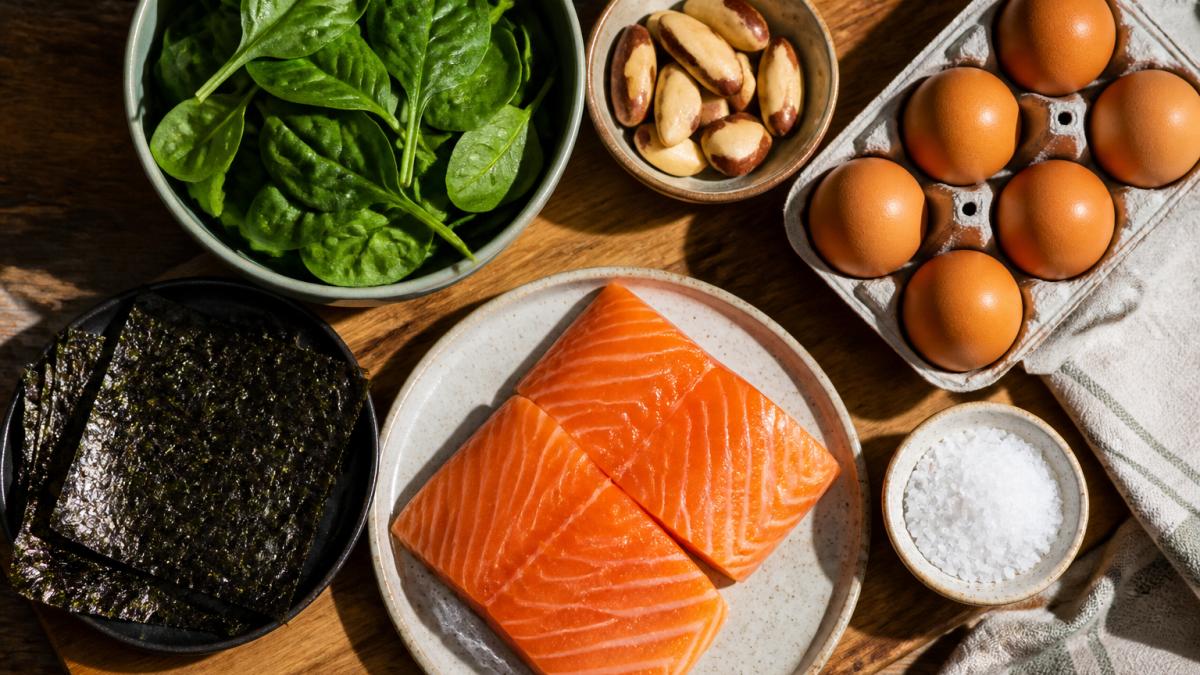
Iodine is essential for thyroid hormone synthesis; without enough, your thyroid cannot produce the hormones it needs. Seafood is the richest natural source:
- Seaweed and nori (sheets used in sushi)
- Cod and other white fish
- Salmon and trout
- Shellfish like prawns and mussels
- Eggs from iodine-fed hens
Sea vegetables like kelp contain iodine, but amounts vary widely by harvest location. Iodised salt also provides iodine, though whole foods are preferable.
Aim for two to three servings of seafood per week. One medium fillet of salmon or a small tin of sardines covers your weekly iodine needs.
Selenium and B vitamins from whole foods
Selenium protects thyroid tissue from oxidative stress. B vitamins support thyroid hormone conversion and energy production.
Best food sources:
For selenium:
- Brazil nuts (just 2-3 per day is enough)
- Chicken and turkey
- Brown rice
- Mushrooms
For B vitamins:
- Leafy greens like spinach and kale
- Eggs and poultry
- Whole grains and legumes
- Nutritional yeast (sprinkle on salads)
Include one selenium-rich food and one B-vitamin source at each main meal.
Most people focus only on iodine and miss selenium entirely. Yet selenium deficiency is just as common in the UK and directly impairs thyroid function. Add a small handful of Brazil nuts to your breakfast, or include mushrooms in your evening meal.
Foods to limit: goitrogens and processed options
Some raw foods contain goitrogens that interfere with iodine absorption, but the risk is real only if you eat them raw in very large quantities daily.
Foods with goitrogens:
- Raw kale, broccoli, and cabbage
- Raw cauliflower
- Soy products
The solution: cook these vegetables. Cooking breaks down goitrogens almost completely, so steamed broccoli poses no risk.
Processed foods damage thyroid health differently: their seed oils, refined carbohydrates, and additives trigger inflammation, worsening thyroid disease.
Focus on whole foods instead, buy ingredients, not packages.
What to Drink for Thyroid Health
Hydration matters more than most guides mention: your thyroid needs adequate water to function and convert hormones efficiently. Aim for 6-8 glasses daily, more if you exercise or live in a warm climate. Some drinks actively support thyroid health:
Green tea contains compounds that enhance iodine absorption. Drink one to two cups daily.
Bone broth provides collagen and minerals that reduce inflammation. Choose quality versions without added sugar.
Herbal infusions like nettle leaf tea are mineral-rich. Nettle contains iodine and selenium naturally.
Limit drinks that interfere with thyroid function:
- Excess caffeine can worsen anxiety in hyperthyroidism
- Alcohol stresses the liver, which processes thyroid hormones
- Sugary drinks trigger inflammation
Plain water remains your best choice, with herbal teas a close second.
Herbs for Thyroid Health and Natural Support
Herbs are where thyroid advice gets murky: some have plausible mechanisms and preliminary evidence, others are traditional remedies with little modern research, and a few are genuinely risky.
How to judge the evidence
- Is there human research, or only laboratory and animal studies? Many herbs have promising test-tube results never confirmed in people.
- Is the evidence for thyroid conditions specifically, or for general stress and inflammation? A herb that lowers stress markers is not the same as one that changes thyroid hormone levels.
- What is the dose and form used in the research? Traditional use and modern standardised extracts are not equivalent.
A useful rule of thumb: if a claim is based only on traditional use or on studies in mice, treat it as preliminary, not established.
Ashwagandha (Withania somnifera)
Ashwagandha is an adaptogen with the strongest preliminary evidence among thyroid herbs. Small human studies suggest it may modestly raise T3 and T4 levels in subclinical hypothyroidism, possibly by reducing cortisol and supporting the hypothalamic-pituitary-thyroid axis.
What to know:
- Typical studied doses are 300-600 mg of a standardised root extract daily
- Effects, if any, take several weeks
- It can interact with thyroid medication, sedatives, and immunosuppressants
- It is not recommended in pregnancy or for people with autoimmune conditions without medical advice
- Rare reports of liver injury exist, so quality and dose matter
If you take levothyroxine, speak to your GP before starting ashwagandha. It may alter your required dose.
Bladderwrack (Fucus vesiculosus)
Bladderwrack is a brown seaweed marketed for thyroid support because it contains iodine, precisely why it is risky. Iodine content varies enormously, from negligible to well above the daily requirement, and labelling is often inaccurate.
Bottom line: avoid bladderwrack unless a clinician has diagnosed iodine deficiency and is supervising your intake. Do not stack it with iodised salt, seaweed, or iodine supplements.
Bugleweed (Lycopus virginicus) and motherwort (Leonurus cardiaca)
These are traditional herbs used for overactive thyroid symptoms such as palpitations and nervousness. The evidence is limited to small studies and traditional use.
Important cautions:
- Bugleweed may interfere with thyroid hormone production and with thyroid medication
- Both can interact with heart medications, blood thinners, and sedatives
- They are not a substitute for antithyroid medication in Graves' disease or toxic nodular goitre
If you have hyperthyroidism, these herbs should only be considered alongside, never instead of, prescribed treatment.
Lemon balm (Melissa officinalis)
Lemon balm is sometimes used to calm overactive thyroid symptoms. Laboratory studies suggest it may block TSH binding to the thyroid, but human evidence is thin. It is generally well tolerated as a tea, though it can interact with thyroid medication and sedatives.
Ginger and turmeric
Ginger and turmeric are anti-inflammatory and generally safe in culinary amounts. They do not directly change thyroid hormone levels, but may reduce inflammation relevant to autoimmune thyroid conditions.
Curcumin, the active compound in turmeric, can interact with blood thinners and may affect iron absorption. High-dose supplements are not the same as using turmeric in cooking.
A practical framework
If you want to try a herb:
- Start with one at a time, so you can tell what is helping or causing side effects
- Choose products with third-party testing and clear standardisation information
- Tell your GP and pharmacist, especially if you take thyroid medication, blood thinners, or heart medication
- Re-test thyroid function after 6-8 weeks to see whether anything has changed
- Stop if you notice palpitations, anxiety, insomnia, or unusual fatigue
A simple way to think about herbs: they may support how you feel, but they rarely change the underlying thyroid picture. If a product promises to 'fix' your thyroid, treat that as a red flag. The herbs with the most plausible role, ashwagandha for stress-related subclinical issues, lemon balm for mild hyperthyroid symptoms, work best as adjuncts, not cures.
Thyroid Supplements: When and How to Use Them
Supplements fill gaps food alone cannot cover, and work best alongside a good diet.
Selenium supplements help if your diet lacks Brazil nuts, fish, and eggs.
B-complex vitamins support thyroid hormone conversion. Look for forms that include B12, folate, and B6.
Iron is essential for thyroid hormone production. Low iron impairs thyroid function.
Zinc supports thyroid hormone receptors. A modest dose is 15-30 milligrams daily.
The key rule: test first, supplement second. A blood test shows which nutrients you actually lack.
Medication, Food, and Supplement Timing: Critical Spacing
This is where most people get it wrong. Timing matters enormously.
If you take thyroid medication (levothyroxine or similar), take it on an empty stomach. Food and supplements interfere with absorption.
Correct timing:
- Take thyroid medication first thing in the morning with water only
- Wait 30-60 minutes before eating or taking other supplements
- Take iron supplements at least 4 hours apart from thyroid medication
- Take calcium and magnesium supplements at least 4 hours apart from thyroid medication
Many people take their medication with breakfast and wonder why they feel no better. The problem isn't the medication, it's the timing.
Write a simple schedule. Stick to it. Consistency makes the difference.
When to Seek Medical Advice and the Limits of Self-Management
Diet and supplements support thyroid health. They do not cure thyroid disease.
If you have symptoms of thyroid dysfunction, see your GP:
- Unexplained fatigue lasting more than two weeks
- Sudden weight gain or loss
- Mood changes, depression, or anxiety
- Hair loss or dry skin
- Irregular heartbeat
- Difficulty concentrating
These symptoms may signal thyroid disease, other conditions, or nutrient deficiencies. A blood test is the only way to know.
Thyroid medication, when needed, is non-negotiable: diagnosed hypothyroidism requires levothyroxine or similar, and food and supplements cannot replace it.
The limits of self-management:
- You cannot diagnose thyroid disease without blood tests
- You cannot determine safe supplement doses without knowing your current nutrient levels
- You cannot stop thyroid medication without medical supervision
- You cannot manage severe hyperthyroidism with diet alone
Work with your GP. Share what supplements you take. Ask about interactions. A good GP welcomes this conversation.
Thyroid Testing and Interpreting Your Results
Understanding your test results helps you make informed choices about diet and supplements.
- Normal range: roughly 0.4-4.0 mIU/L (ranges vary slightly by lab)
- High TSH suggests underactive thyroid (hypothyroidism)
- Low TSH suggests overactive thyroid (hyperthyroidism)
Free T4 and Free T3 measure the actual thyroid hormones in your blood.
- High levels suggest hyperthyroidism
- Low levels suggest hypothyroidism
Thyroid antibodies (TPO and thyroglobulin) indicate autoimmune thyroid disease.
What your results mean:
If TSH is high and you feel tired, your thyroid is struggling. Medication plus nutritional support helps.
If you have antibodies, your immune system is attacking your thyroid, autoimmune thyroid disease.
Ask your GP for a copy of your results. Write down the numbers. Track them over time.
Frequently Asked Questions
How can you support thyroid hormone balance naturally?
Support thyroid hormone balance through three key actions: eat iodine-rich foods like seafood and eggs, consume selenium and B vitamins from whole foods, and space any supplements or medication at least 4 hours apart from iron or calcium. Limit processed foods and raw goitrogen-containing vegetables when eaten in large quantities. If symptoms persist despite dietary changes, consult your GP for thyroid testing, as some conditions require medical treatment that diet alone cannot address.
What foods support thyroid health best?
Seafood (particularly cod and seaweed), eggs, Brazil nuts, and whole grains provide iodine, selenium, and B vitamins essential for thyroid function. Lean meat and poultry supply iron and zinc. Include plenty of vegetables, but cook cruciferous varieties like broccoli and kale rather than eating them raw in large quantities, as raw forms contain compounds that may interfere with iodine absorption. Whole foods are always preferable to processed alternatives for maintaining nutrient density.
Can lifestyle changes replace thyroid medication?
No. If you have been diagnosed with hypothyroidism or hyperthyroidism, medication prescribed by your GP is essential and cannot be replaced by diet, supplements, or herbs alone. Dietary support and supplements may help optimise overall health alongside medication, but stopping or reducing prescribed treatment without medical guidance is unsafe. Always discuss any changes to your thyroid management with your GP before making adjustments.
When should you speak to a GP about possible thyroid symptoms?
Contact your GP if you experience persistent fatigue, unexplained weight changes, temperature sensitivity, mood changes, or hair loss. These may indicate thyroid dysfunction. Your GP can order thyroid function tests (TSH, free T4) to establish whether a thyroid condition is present. Do not delay seeking medical advice if symptoms are severe or if you are pregnant, as thyroid health is particularly important during pregnancy and affects fetal development.

