



Table of Contents
- What Transparent Sourcing in Supplements Actually Means
- How to Read Supplement Labels Without Getting Fooled
- Third-Party Supplement Testing Standards Explained
- Why Bioavailable Ingredient Forms Matter More Than Dose Alone
- Clean Label Supplements UK: What the Label Should Tell You
- How to Verify Transparency Claims as a Consumer
- The Cost of Transparent Sourcing: Is It Worth Paying More?
- Frequently Asked Questions
Last Updated: September 29, 2026
What Transparent Sourcing in Supplements Actually Means
What is transparent sourcing in supplements? It is the practice of disclosing where every ingredient comes from, what form it takes, and at what dose, so a buyer can verify a finished product back to its raw material origin without guesswork. It covers the full chain: supplier identity, extraction and standardisation methods, batch testing results, and manufacturing standards. (Source: retained EU law on food hygiene)
From Raw Material Origin to Finished Batch
Traceability runs in one direction: seed to shelf. A transparent supply chain records which supplier grew or extracted the raw material, how it was standardised, and which finished batch it landed in. That record is what lets a brand answer a simple question honestly: can you prove this capsule contains what the label says?
How to Read Supplement Labels Without Getting Fooled
Start with the back panel, not the front. The front sells a feeling; the back either declares its doses or hides them.
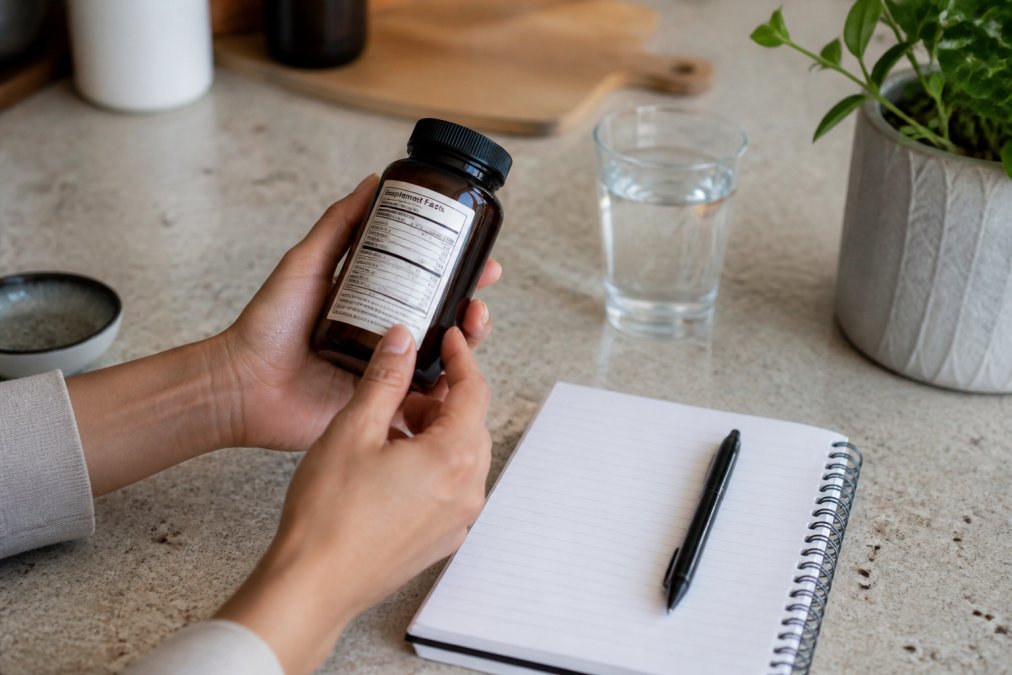
Four things to check, in order:
- Ingredient form, not just name. "Magnesium" tells you nothing. "Magnesium glycinate" tells you the chelated form and roughly how well it absorbs.
- Dose per serving. If the number is missing, the ingredient is probably there for label decoration.
- Standardisation. For botanicals, look for a stated extract ratio or a marker compound, such as silymarin in milk thistle.
- Batch and testing references. A batch code plus a testing statement is a traceability claim you can follow up.
Third-Party Supplement Testing Standards Explained
Third-party testing means an independent laboratory, with no commercial stake in the result, analyses the product. It exists to catch what in-house quality assurance can miss: incorrect doses, misidentified botanicals, and contaminants introduced somewhere in the supply chain.

- Facility certification. The manufacturing site is audited against a recognised standard for hygiene, process control and record-keeping. This tells you the factory is competent, not that a specific product was tested.
- Product certification. A finished product or batch is tested and certified against a defined specification. This is closer to what a consumer actually cares about.
- Ingredient or raw-material certification. A single input, a botanical extract, a mineral salt, is verified for identity, purity or a stated standardisation.
- Testing-only services. A lab analyses a sample and issues a certificate of analysis (CoA). There is no ongoing audit; you are trusting the sample was representative.
What Batch Testing and Contaminant Screening Actually Prove
Batch testing proves that a specific production run, not a generic sample, met its specification. Contaminant screening covers the things you cannot see: heavy metals, residual solvents, and microbial growth. Identity testing confirms the material is the species named on the label.
How to Tell a Meaningful Certification from a Paid Logo
A certification earns its place when it is specific, auditable and traceable to your batch. Ask three questions:
- What is certified? The site, the product, or one ingredient. A site certificate says nothing about the capsule in your hand.
- Who audits, and how often? An independent body with published criteria and a re-audit cycle is worth more than a self-declared badge.
- Can it be tied to a batch? If the certificate cannot be matched to the lot number on your tub, it is decoration.
Why Bioavailable Ingredient Forms Matter More Than Dose Alone
A high number on a label is worthless if the body cannot absorb it. Bioavailability describes how much of a nutrient actually reaches circulation in a usable form, and it varies enormously between chemical forms of the same mineral.
Clean Label Supplements UK: What the Label Should Tell You
A clean label means no unnecessary fillers, no synthetic additives, and no undisclosed blends. It is a short, checkable list rather than a philosophy.
- Every active ingredient, with its form and dose
- The extract ratio or standardisation for any botanical
- Whether the ingredient is non-GMO where that claim is made
- The batch code, so testing can be traced
- Any allergen or animal-derived content, stated plainly
How to Verify Transparency Claims as a Consumer
Treat every claim as a question with a checkable answer. Verification is a five-minute habit, not an investigation.
- Does the brand publish batch test certificates, or only say it tests?
- Is the extract ratio or standardisation stated for each botanical?
- Can you find a named supplier or origin for the raw material?
- Does the label declare doses, or use a proprietary blend?
- Is there a batch code you could quote if you asked for documentation?
Transparency vs Proprietary Blends: Spotting the Difference
A proprietary blend lists ingredients under one combined weight, hiding each individual dose. It is legal, and it is the single most effective way to appear transparent while disclosing nothing.
NAD+ Supplement | Nicotinamide →
The Cost of Transparent Sourcing: Is It Worth Paying More?
Most guides stop at why transparency matters. The harder question is what it costs, who absorbs that cost, and whether the premium is justified. Transparent sourcing is genuinely more expensive, and the honest answer is that not every buyer needs it.
Where the Extra Cost Actually Comes From
Four line items drive the difference between a budget formula and a transparent one:
- Raw material grade. A standardised botanical extract with a declared marker compound costs more than an unstandardised powder of the same plant. Chelated minerals cost more than oxides.
- Supplier auditing. Verifying a supplier's identity, origin and quality systems takes time and, often, travel. That overhead is real even before a single capsule is filled.
- Per-batch laboratory testing. Identity, potency and contaminant screening on every run, not once a year, multiplies the testing bill.
- Documentation and traceability systems. Keeping a batch-level record from raw material to finished tub requires software, staff time and process discipline.
How the Cost Reaches the Shelf
Each of those costs is spread across the units in a production run. A small batch carries more overhead per capsule than a large one, which is one reason transparent brands often have narrower ranges and fewer SKUs, they cannot hide inefficiency behind volume. The premium you pay at retail is the sum of those four line items, divided by the number of tubs sold, plus a normal margin.
| What you're buying | Typical budget approach | Transparent approach |
|---|---|---|
| Ingredient form | Often oxide or basic powder | Chelated or standardised forms |
| Dose disclosure | Blends or vague totals | Every dose declared |
| Testing | In-house only, if any | Batch certificates available |
| Traceability | Supplier unnamed | Origin and batch traceable |
| Cost | Lower | Higher |
What You Are Actually Paying For
What you are buying with the premium is risk reduction. You are lowering the chance of an underdosed formula, a misidentified botanical, or a contaminant that slipped through. For a general-purpose top-up, that risk may be small enough to accept a budget option. For a targeted botanical, a high-dose mineral, or anything you take daily for months, the calculation shifts.
Frequently Asked Questions
What does transparent sourcing mean for supplement quality?
Transparent sourcing means the brand tells you where raw materials come from, how they are tested, and exactly what dose each ingredient delivers. That matters because it lets you check ingredient integrity and batch testing records before buying. Without it, you cannot tell whether a formula uses well-absorbed forms or cheap fillers. Transparent sourcing in supplements is the difference between a label you can verify and one you simply have to trust.
How can I verify the origin of ingredients in my vitamins?
Start with the label: look for named raw material origin, standardised extracts, and a declared dose per serving. Then check whether the brand publishes batch testing or certificates of analysis. Under GB rules, supplement labels must list ingredients and amounts, but they do not have to state where each raw material was grown. If a brand will not share that detail on request, treat the traceability claim as unproven.
Why is third-party supplement testing important for transparency?
In-house testing is useful, but third-party supplement testing standards add an independent check on contaminant screening, label accuracy and ingredient potency. A brand that publishes third-party results is showing you evidence, not just a promise. This matters for product safety because heavy metals, mould or incorrect doses are exactly what batch testing is designed to catch. Ask for the certificate, not just the claim.
What are clean label supplements and how do they differ from standard ones?
Clean label supplements UK buyers look for avoid unnecessary fillers, synthetic additives and vague blends. Instead, they declare every active dose and use recognisable ingredients. Standard products may hide doses behind a proprietary blend or use poorly absorbed forms like magnesium oxide. Clean label is not a legal category, so use it as a shorthand for full disclosure, not as proof of quality on its own.
Are UK supplement manufacturers required to disclose ingredient sources?
No. UK manufacturers must comply with food supplement labelling rules covering ingredients, allergens and nutrition claims, but there is no blanket legal duty to publish raw material origin or full supply chain visibility. That is why transparency is a brand choice, not a legal guarantee. When a company volunteers sourcing detail and batch test results, it is going beyond the minimum required.
How does transparent dosing improve supplement efficacy?
Transparent dosing means every active ingredient is listed at its exact amount per serving, so you can compare formulas on equal terms. It also lets you check whether the dose matches what studies use. Combined with bioavailable ingredient forms such as magnesium glycinate or collagen peptides, a declared dose tells you whether the formula can actually deliver what the label promises.
The supplement aisle rewards confident labelling over verifiable content, which is why so few buyers ever check the back panel. Pure Vitamins UK builds every formula the other way round: transparent dosing, well-absorbed forms such as magnesium glycinate and vitamin D3 with K2, documented in-house batch testing, and clear labelling across a 23-product range. If you want to see what full disclosure looks like on a label, browse the range and read the ingredient panel before you buy.


