



Table of Contents
- What Are Adaptogens and Stimulants?
- How They Work: Mechanism of Action
- Energy and Performance: Immediate vs Long-Term
- Benefits of Adaptogenic Herbs
- Caffeine vs Adaptogens for Focus
- Safety of Herbal Supplements in the UK
- Tolerance, Dependency and Crash Risk
- Choosing the Right Approach for Your Needs
- Frequently Asked Questions
Last Updated: October 1, 2026
What Are Adaptogens and Stimulants?
Understanding adaptogens vs stimulants is essential because both boost energy and performance, but they work through fundamentally different biological mechanisms. Understanding this difference between adaptogens and stimulants is essential for anyone considering either category.
Adaptogens are plant-derived substances that help your body maintain homeostasis when under stress. They don't force energy production; instead, they help your system adapt to stressors and recover more effectively. Common examples include ashwagandha, rhodiola, and ginseng.

Stimulants directly activate your central nervous system to increase alertness and energy. Caffeine is the most familiar example, but this category also includes pharmaceutical stimulants like amphetamines. They increase heart rate, blood pressure, and neurotransmitter release.
Stimulants deliver a rapid boost that peaks and crashes. Adaptogens work gradually, building resilience over weeks of consistent use.
How They Work: Mechanism of Action
The science behind adaptogens vs stimulants reveals why these two categories produce such different results. Adaptogens and stimulants engage entirely separate biological pathways, which explains why they suit different needs.
Adaptogens and the HPA axis
Adaptogens primarily influence the hypothalamic-pituitary-adrenal axis (HPA axis), your body's central stress-response system. When chronically overactive, it floods your system with cortisol, leading to fatigue, poor focus, and weakened immunity.
Adaptogens help recalibrate this system. Ashwagandha contains withanolides that modulate cortisol levels, restoring normal regulation rather than forcing cortisol down.
Most people notice meaningful changes after 4-6 weeks of consistent use, and benefits persist because you're supporting biological balance, not forcing a chemical reaction.
Stimulants and the central nervous system
Stimulants target your central nervous system directly, increasing sympathomimetic activity, compounds that mimic your sympathetic "fight or flight" branch.
Caffeine blocks adenosine receptors, preventing tiredness signals from reaching your consciousness, while increasing dopamine and noradrenaline release.
You feel the effect within 15-30 minutes, but as your body metabolises the stimulant, adenosine signals build up again, creating the characteristic afternoon crash.
Energy and Performance: Immediate vs Long-Term
This is where the practical difference becomes undeniable. If you need energy right now, these two categories deliver entirely different outcomes.
Immediate boost and crash risk
Stimulants produce noticeable effects within minutes, sharpening focus and increasing alertness.
As the stimulant wears off (typically 4-6 hours for caffeine), adenosine levels spike and you hit the afternoon slump, often prompting another dose and creating a cycle of peaks and crashes.
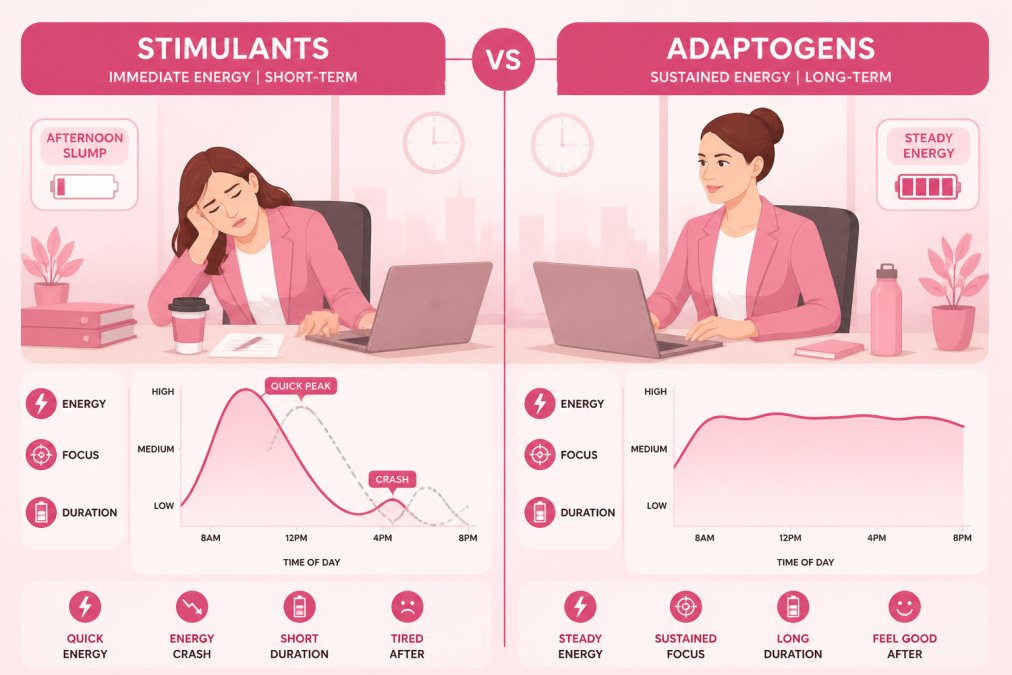
Adaptogens produce no immediate rush because they work through homeostatic mechanisms rather than direct neurotransmitter manipulation. You may notice subtle improvements in mood or mental clarity after a few weeks, with no crash because there was no artificial peak.
For people sensitive to caffeine or prone to anxiety, this absence of overstimulation is a significant advantage.
Sustained resilience over time
Over weeks and months, stimulant users develop tolerance, needing increasing doses to achieve the same effect. This is why regular coffee drinkers report their first cup felt more powerful.
Adaptogens work oppositely: your HPA axis becomes more efficient at regulating itself, making stressful situations feel less overwhelming and improving baseline energy without increasing doses.
Stimulants suit acute performance demands; adaptogens support sustained resilience by maintaining biological balance.
Benefits of Adaptogenic Herbs
Adaptogenic herbs offer stress resilience without overstimulation. Users often report feeling calmer during stressful situations, recovering faster from disruption, and experiencing fewer physical symptoms of chronic stress.
Adaptogens enhance how your body processes energy at the cellular level, supporting actual energy production rather than borrowing it through forced neurotransmitter release.
By restoring normal HPA axis function, adaptogens indirectly support hormonal balance and immune function, reducing the stress burden on these systems.
Adaptogens carry minimal abuse potential and don't create dependency cycles, making them suitable for long-term daily use without the risks of chronic stimulant consumption.
Caffeine vs Adaptogens for Focus
Many assume focus requires stimulation, but evidence suggests adaptogens may support sustained focus more effectively than caffeine.
Energy & Focus Bundle | Lion's Mane, Ashwagandha, NAD+ & B12 | Pure Vitamins UK →
Caffeine sharpens focus temporarily by increasing dopamine and noradrenaline, producing improved concentration for 2-4 hours.
Sustained focus requires a calm yet alert nervous system, a state stimulants undermine. Overactive sympathetic nervous system reduces prefrontal cortex effectiveness, making thinking more scattered and reactive.
Adaptogens support focus by moderating stress response and reducing mental noise that interferes with concentration. (Source: the UK's Medicines and Healthcare products Regulatory Agency (MHRA))
Many professionals report adaptogens like Lion's Mane or ashwagandha improve sustained attention on complex work by reducing internal stress rather than providing chemical stimulation.
Safety of Herbal Supplements in the UK
Herbal supplements sit in a regulatory grey zone that confuses many consumers. Understanding the UK framework is essential before deciding whether to use adaptogens.
In the UK, herbal supplements are regulated as food supplements, not medicines, facing less rigorous pre-market testing than pharmaceutical drugs. The MHRA oversees safety, requiring products to avoid harmful contaminants and disease claims (Herbal products: safety update).
Herbal supplements don't require efficacy proof like medicines, which is why adaptogens are described as "supports normal stress response" rather than "treats anxiety", compliance with UK nutrition and health claims rules.
Well-sourced adaptogenic herbs have strong safety profiles, with centuries of traditional use and decades of modern research supporting their safety at standard doses.
Quality varies dramatically, with some supplements containing underdosed extracts or contaminants. Reputable brands like Pure Vitamins UK manufacture to ISO 22000, HACCP, and GMP standards with documented batch testing.
Always consult a healthcare professional before starting any supplement, especially if you're pregnant, breastfeeding, or taking medications. Some adaptogens can interact with certain drugs, and individual responses vary.
Tolerance, Dependency and Crash Risk
This is where the long-term comparison becomes stark. Stimulants and adaptogens have fundamentally different safety profiles when used regularly.
Addiction potential and abuse risk
Stimulants carry genuine addiction risk. Caffeine creates physical dependence; regular users experience withdrawal symptoms, typically headaches and fatigue, if they stop abruptly. Pharmaceutical stimulants carry far greater abuse potential, particularly amphetamines, which are highly addictive and carry significant health risks with chronic use.
The addiction mechanism is straightforward: stimulants trigger dopamine release, and your brain adapts by reducing dopamine sensitivity. You need more stimulant to achieve the same effect. Over time, your baseline dopamine becomes lower than it was before you started, leaving you feeling depleted without the drug.
Adaptogens don't work this way.
Homeostatic balance and resilience
The fundamental difference comes down to how each category affects your nervous system's set point. Stimulants push your system into a heightened state, and your body adapts by raising the threshold for activation. You feel less stimulated over time, so you need more stimulant.
Choosing the Right Approach for Your Needs
The choice between adaptogens and stimulants isn't binary. Context determines which is appropriate, and some people benefit from both, used strategically and separately.
When to use adaptogens
Adaptogens suit situations where you need sustained resilience rather than immediate performance. Use them if you're managing chronic stress, dealing with irregular sleep, or trying to prevent burnout. They're ideal for anyone whose energy crashes predictably in the afternoon or who feels constantly depleted despite adequate sleep.
When to use stimulants
Stimulants suit acute performance demands. Use them when you need immediate alertness, during a critical presentation, a night shift, or a long drive. They're tools for specific situations, not daily foundations.
Synergistic usage and timing protocols
Some people find value in combining both, but timing and intention matter.
Frequently Asked Questions
What is the key difference between adaptogens and stimulants?
Adaptogens work to restore your body's natural balance by moderating the stress response and supporting the hypothalamic-pituitary-adrenal axis, offering sustained resilience over weeks. Stimulants like caffeine directly activate your central nervous system for immediate alertness but can lead to energy crashes and tolerance. Adaptogens build adaptive capacity; stimulants provide acute activation.
Can adaptogens provide an immediate energy boost like stimulants?
Adaptogens typically require consistent use over 4-6 weeks to show their full effect on stress resilience and sustained energy. They do not produce the immediate 'jolt' of caffeine or other sympathomimetics. If you need energy right now, a stimulant works faster; if you want to build long-term stress resilience and avoid crashes, adaptogens like ashwagandha are the better choice.
Do adaptogens cause a crash like caffeine does?
No. Adaptogens support homeostasis and do not trigger the sharp energy depletion that follows stimulant use. Caffeine and similar stimulants exhaust neurotransmitter reserves, leading to the characteristic afternoon crash and jittery rebound. Adaptogens work with your body's natural messenger signaling systems to sustain alertness and reduce fatigue without the boom-and-bust cycle.
Are herbal supplements and adaptogens regulated in the UK?
Yes. Herbal supplements sold in the UK are regulated as food supplements and must comply with the Nutrition and Health Claims Regulation (EC 1924/2006). Manufacturers must ensure safety and purity, and health claims must be authorised. Always check that products comply with GB standards for purity.
Can I use adaptogens and stimulants together?
Yes, but timing and dosage matter. Many people use adaptogens in the evening or morning for baseline resilience, and caffeine or stimulants strategically during the day when acute focus is needed. This synergistic approach avoids over-reliance on stimulants alone. However, if you take medications or have a medical condition, consult a healthcare professional before combining supplements, as some adaptogens may interact with common drugs.

