


Table of Contents
- What heavy metals are and how they enter dietary supplements
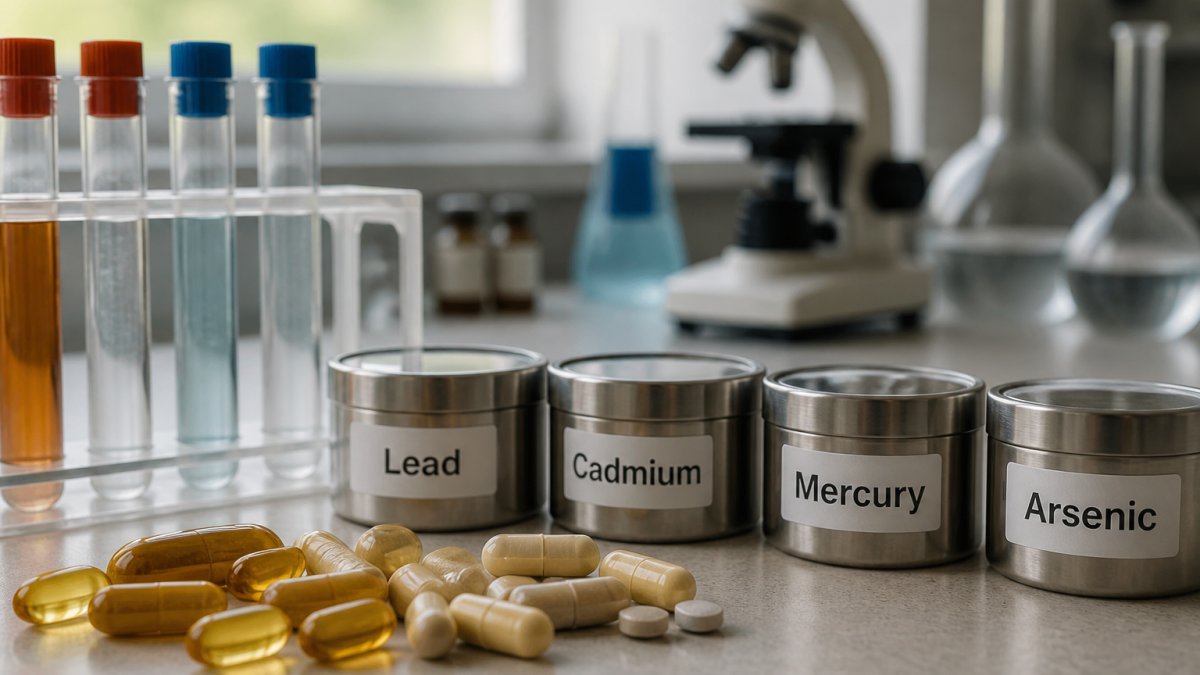
- The main contaminants: lead, cadmium, arsenic, and mercury
- Health effects and cumulative exposure risks
- Symptoms of heavy metal exposure you should recognise
- Heavy metal testing for supplements: what the claims mean
- Choosing a safe multivitamin: practical steps
- What to do if you find concerning test results
- Frequently Asked Questions
Last Updated: October 13, 2026
What heavy metals are and how they enter dietary supplements
The risk isn't intentional inclusion but that heavy metals are difficult to eliminate. Soil contamination varies by geography, mineral-based supplements may contain trace elements missed during extraction, and manufacturing can introduce contamination if equipment isn't properly cleaned between batches.
At Pure Vitamins UK, we focus on ingredient sourcing and batch testing to minimise this risk. We work with suppliers who maintain detailed soil and water testing records, and every finished product undergoes laboratory analysis before release, though no supplement can guarantee zero traces.
The key distinction is between detectable levels (which may pose no health risk) and unsafe accumulation (which occurs through chronic exposure). That's why regulators set upper limits rather than banning supplements.
The main contaminants: lead, cadmium, arsenic, and mercury
These four metals appear most often in contamination studies because they're widespread in soil and water and the most toxic to human health.
Lead is the most common concern. It accumulates in bone tissue and interferes with calcium metabolism, affecting bone density and neurological function.
Cadmium concentrates in the kidneys and liver. Chronic exposure damages kidney function, weakens bones, and is classified as a human carcinogen.
Arsenic damages blood vessels, increases cardiovascular disease risk, and impairs neurological development in children.
Mercury damages the nervous system. It crosses the blood-brain barrier and accumulates in brain tissue, affecting memory, concentration, and motor control.
All four metals are cumulative, the body doesn't eliminate them efficiently, so chronic low-level exposure is more dangerous than a single high dose.
Health effects and cumulative exposure risks
Cumulative exposure is the real concern with heavy metals in vitamins.

Short-term symptoms are rare at low levels, which makes the risk insidious.
Long-term effects depend on the metal and dose.
Cadmium causes kidney damage that may not be reversible; by the time function declines noticeably, significant harm has occurred.
Arsenic increases cardiovascular disease risk, raises blood pressure, and impairs glucose metabolism. In children it reduces IQ and attention.
Mercury's neurological effects are most pronounced in developing brains: prenatal and early childhood exposure causes lasting cognitive and motor impairment.
The dose-response relationship matters: there's a threshold below which effects are minimal, but it varies by age, health status, and diet.
Symptoms of heavy metal exposure you should recognise
Most people with low-level exposure from supplements won't experience obvious symptoms, which is precisely why testing matters, since damage occurs before you feel unwell.
That said, chronic heavy metal exposure can produce these signs:
- Persistent fatigue or low energy not explained by sleep or diet
- Difficulty concentrating, memory problems, or brain fog
- Headaches that don't respond to typical treatments
- Joint or muscle pain without clear cause
- Digestive issues like constipation or nausea
- Hair loss or changes in hair texture
- Skin problems that don't respond to standard treatments
- Elevated blood pressure without other risk factors
- Anaemia or low iron levels despite adequate dietary intake
- Tremor or involuntary muscle twitching
These symptoms are non-specific and could indicate dozens of other conditions. If you experience several alongside long-term use of a supplement with unknown metal content, it's worth investigating.
Some groups develop symptoms at lower exposures: pregnant women, children, people with kidney disease, and those with genetic variations affecting metal metabolism. If you fall into one of these groups, verify supplement safety before use.
Heavy metal testing for supplements: what the claims mean
Understanding testing terminology helps you evaluate whether a brand is actually monitoring for contamination, but label claims are only as useful as the detail behind them.
Third-party testing means an independent laboratory (not the manufacturer) tested the product. It's more credible than in-house testing, though a single test on a single batch tells you about that batch only.
Certificate of analysis (CoA) is a document from the testing laboratory listing detected levels of specific metals. A reputable brand makes these publicly available. When reviewing a CoA, work through this checklist rather than accepting the headline result:
- Which metals were tested? Lead, cadmium, arsenic, and mercury are the minimum. A CoA covering only lead leaves three of the four most common contaminants unaddressed.
- Who performed the test? Look for a named laboratory, not just "an accredited lab." You can check whether a laboratory holds accreditation under a recognised scheme such as UKAS (the national accreditation body). Accreditation is not a guarantee of a specific result, but it indicates the lab is assessed against international standards.
- What method was used? Techniques such as ICP-MS (inductively coupled plasma mass spectrometry) can measure very low concentrations. A method with a high detection limit may report "not detected" simply because it cannot see low levels.
- What is the detection limit? This is the lowest concentration the test can reliably measure. A CoA showing "not detected" for lead does not mean zero lead, it means the level is below the test's detection limit. A test with a detection limit of 0.5 micrograms per serving will not find 0.1 micrograms, even if it is present.
- Are results given per serving or per gram? This matters enormously, and it is where many CoAs become misleading. A result expressed per gram of powder tells you nothing until you multiply by the actual serving size. Always convert to a per-serving figure before comparing with any limit.
- Was the finished product tested, or only the raw ingredients? Ingredients can pass testing while the finished product fails, because contamination can be introduced during manufacturing, blending, or packaging. A CoA for the finished, sealed product is more meaningful than one for incoming materials.
- Which batch does it cover? Look for a batch or lot number that matches the packaging. A CoA for a different batch is not evidence about your bottle.
- What is the test date? Contamination varies between production runs. An old CoA may not reflect current stock.
Regulatory limits vary by jurisdiction and product type. In the UK, the Food Standards Agency (FSA) sets maximum levels for certain contaminants in food, enforced by local authorities. But limits differ between countries, and not every metal has an official UK limit for every supplement category, a supplement legal in one country might exceed limits in another, and a figure quoted without its source is impossible to interpret.
Many brands cite California Proposition 65 limits (a US standard), which do not apply in the UK. This is misleading, it suggests compliance with UK standards when it actually reflects US requirements.
"Heavy metal free" is marketing language with no legal definition. Every supplement contains some trace metals.
Batch testing versus ongoing monitoring, some brands test every batch; others test representative samples. Batch testing is more rigorous but costs more.
Finally, understand the limits of testing itself. Laboratories test a small sample from a batch; contamination can be unevenly distributed, so a clean sample does not prove every capsule is clean. Detection limits mean very low levels may be present but unmeasured. And no test can tell you your total exposure, that depends on how much you take, for how long, and what else you consume.
Choosing a safe multivitamin: practical steps
Start by identifying which supplements you actually need. If your diet is reasonably balanced, you may need only specific nutrients, and fewer supplements mean lower cumulative exposure to contaminants.
Request certificates of analysis from the manufacturer before buying. Reputable brands provide these freely; if a company won't share testing results, choose a competitor.
Compare the metals tested across brands. Some test only lead; others test lead, cadmium, arsenic, and mercury. Broader testing indicates more rigorous quality control.
Check the ingredient form and source.
Consider your individual risk factors. Pregnant women should prioritise prenatal vitamins from brands with rigorous testing.
At Pure Vitamins UK, every product is tested for lead, cadmium, arsenic, and mercury before release. Our manufacturing follows ISO 22000, HACCP, and GMP standards, protocols designed to prevent contamination.
What to do if you find concerning test results
If you discover a supplement you've been taking contains elevated heavy metal levels, put the number in context rather than reacting to the headline.
**1.
2. Pause the product while you investigate. You do not need to panic, but there is little benefit in continuing to take a supplement whose contamination status is unclear.
3. Consider your total exposure, not just this product. Heavy metals also come from food, water, and other supplements.
**4.
5. Report the product. In the UK, you can report a suspected food or supplement safety issue to the Food Standards Agency through their food and feed safety reporting system. The FSA tracks reports and can act, including issuing recalls, if a product is found to be unsafe. Your report helps protect other consumers, and it is a normal, expected part of the system rather than an overreaction.
6. Ask the manufacturer for a refund or replacement. Most reputable brands will refund or replace a product found to contain unsafe contaminant levels.
7. Do not assume every product from that brand is unsafe, but do look for a pattern. One batch might be contaminated while others aren't.
**8.
Frequently Asked Questions
Can daily vitamins actually contain heavy metals?
Yes. Heavy metals like lead, cadmium, arsenic, and mercury can be present in dietary supplements in trace amounts due to contamination during sourcing, processing, or manufacturing. The presence of these toxic elements depends on ingredient quality, sourcing practices, and manufacturing controls. Not all supplements contain detectable levels, but cumulative exposure from daily intake over months or years can pose health risks, particularly for pregnant women, children, and people with kidney or liver conditions. Third-party testing and certificates of analysis help identify whether a specific product batch contains these contaminants at unsafe levels.
How do I know if a supplement has been tested for heavy metals?
Look for a certificate of analysis (CoA) from an independent laboratory, not just the manufacturer's own testing claim. A genuine CoA lists specific contaminants tested (lead, cadmium, arsenic, mercury), the detection limits, and the actual results for that batch. Be sceptical of vague claims like 'tested for purity' without naming the contaminants or the lab. Reputable brands publish batch-specific results or provide them on request. Ask the manufacturer which third-party lab conducted testing and whether results are available for the batch you're purchasing. Testing claims without verifiable documentation are difficult to trust.
What are the signs of heavy metal exposure from supplements?
Chronic heavy metal exposure can cause a range of symptoms over time. Acute symptoms may include nausea, headaches, fatigue, and joint pain, though these are non-specific and can overlap with other conditions. Because symptoms develop gradually and can mimic other illnesses, exposure is often undiagnosed. If you suspect contamination from a product, stop taking it, consult your GP, and request blood or urine testing for specific metals. Your GP can advise on whether medical monitoring is appropriate.
Should I stop taking vitamins if I'm worried about contamination?
Not necessarily. The risk depends on the specific product, your daily intake, your age, and your overall health. Rather than abandon supplementation, choose brands that publish transparent testing results and demonstrate rigorous quality control. Request certificates of analysis for the batch you're considering. If you're pregnant, nursing, or have kidney disease, consult your GP before starting or continuing any supplement regimen. For most healthy adults taking a well-tested daily multivitamin at recommended doses, the nutritional benefit often outweighs the contamination risk, provided the product has been independently tested and results are available.
Choosing a safe multivitamin means looking beyond marketing claims to actual testing and transparency. At Pure Vitamins UK, we believe consumers deserve to know exactly what's in their supplements and at what dose, including documented evidence that heavy metals are controlled. Shop now and see the difference transparent, batch-tested formulations make to your daily health routine.

