


Reviewed and updated: 9 August 2026
Yes, for most UK adults taking 1000 IU of vitamin D3 daily is a good, sensible choice, especially through the darker autumn and winter months when our skin makes very little of its own. It sits comfortably above the UK baseline recommendation and well below the safe upper limit, which is exactly where a daily top-up wants to be. I am Dr. Miron, founder of Pure Vitamins UK, and in this guide I will walk you through what that dose actually means, who might want a little more or less, and how to take it well.

Is 1000 IU of vitamin D3 daily good? The short answer
Taking 1000 IU of vitamin D3 daily is a reasonable and popular maintenance dose for healthy UK adults who want to keep their levels topped up. The UK government recommends everyone consider a supplement providing 10 micrograms (400 IU) a day during autumn and winter, so 1000 IU is a generous, comfortable margin above that floor while staying far under the upper limit. Vitamin D is one of the few nutrients where most of us genuinely fall short in a British winter, so a steady daily habit tends to be more useful than an occasional large dose.
Quick answer: the essentials at a glance
- What it is: vitamin D3 (cholecalciferol) is the same form your skin makes from sunlight, and it is well recognised by the body.
- Who it is for: UK adults topping up from October to April, anyone who spends most of the day indoors, and people with darker skin or who keep their skin covered.
- The dose in context: 1000 IU equals 25 micrograms. The UK baseline is 10 micrograms (400 IU) a day, and the safe upper limit for adults is 100 micrograms (4000 IU) a day.
- Key thing to know: vitamin D is fat-soluble, so take it with a meal that contains some fat, and keep it consistent rather than sporadic.
What vitamin D actually does in the body
Vitamin D earns its place because it supports several everyday functions that we tend to take for granted. Under GB rules, the authorised way to describe it is precise, and it happens to be accurate: vitamin D contributes to the maintenance of normal bones and teeth, it contributes to normal muscle function, it contributes to the normal function of the immune system, it contributes to normal blood calcium levels and normal absorption and use of calcium, and it has a role in the process of cell division.
Those are not marketing flourishes, they are the recognised functions of the nutrient. The reason so many people in Britain choose to supplement is simply that it is hard to get enough from a northern-latitude lifestyle for half the year.

1000 IU, 25 micrograms, 400 IU: making sense of the numbers
Vitamin D labels can be confusing because two units are in common use. International units (IU) and micrograms (mcg) measure the same thing in different scales. Here is the simple conversion: 1000 IU is the same as 25 micrograms, and the UK baseline of 10 micrograms is the same as 400 IU. So a 1000 IU tablet gives you two and a half times the UK reference intake, which is why it is such a practical everyday choice for topping up rather than just scraping the minimum.
What the UK actually recommends
The NHS and the UK Scientific Advisory Committee on Nutrition advise that adults and children over the age of one should consider a daily supplement containing 10 micrograms (400 IU) of vitamin D, particularly during autumn and winter. That figure is a floor designed to protect the general population from deficiency, not a target for optimal levels. Many people quite reasonably choose a higher maintenance dose such as 1000 IU to keep their stores comfortable through the darker months, and that still leaves a wide safety margin.
Why autumn and winter matter so much in Britain
From roughly October to March, the sunlight across the UK is too weak for our skin to make meaningful amounts of vitamin D, no matter how much time we spend outdoors. That is the heart of the British vitamin D story. In summer, short daily sun exposure on bare skin can top us up, but from mid-autumn onward the angle of the sun simply does not deliver. This is exactly the window where a daily 1000 IU tablet does its quiet, useful work. If I had to pick one habit to keep through a grey British winter, this would be near the top of the list.

Who might need more than the baseline
Some people are more likely to run low and may benefit from a steady higher intake such as 1000 IU, or from a chat with their GP about their own levels. This includes people with darker skin, whose skin makes vitamin D less efficiently at UK latitudes; people who are housebound or spend very little time outdoors; those who keep most of their skin covered for cultural or personal reasons; and older adults, whose skin becomes less efficient at producing it. The UK guidance specifically flags several of these groups as being at greater risk of falling short year-round, not only in winter.
How much is too much? The UK safe upper limit
Vitamin D is fat-soluble, which means the body stores it, so more is not automatically better. The UK safe upper limit for adults is 100 micrograms, which is 4000 IU, a day from supplements. A daily 1000 IU tablet sits at a quarter of that ceiling, which is one of the reasons it is such a comfortable everyday dose. Problems from vitamin D are almost always the result of taking very high doses for a long time, not of a sensible daily top-up.
If someone did take far too much for a prolonged period, the concern is a build-up of calcium in the blood, known as hypercalcaemia. Signs can include feeling sick, poor appetite, excessive thirst, needing to pass urine often, constipation and general weakness. These are reasons to stop and speak to a healthcare professional, and they are not something a standard 1000 IU daily habit should cause.
Food and sunlight: where else vitamin D comes from
Food alone rarely gets most of us to a comfortable level in winter, but it helps. The richest natural sources are oily fish such as salmon, mackerel, sardines and trout, along with egg yolks and liver. In the UK you will also find it added to some foods such as certain breakfast cereals and fat spreads. Sunlight remains the biggest natural contributor for most of the year, which is exactly why the shortfall shows up when the sun weakens. A daily supplement is simply the reliable way to bridge the gap.
D3 versus D2, and why some people pair it with K2
There are two forms of supplemental vitamin D. D2 (ergocalciferol) comes from plant and fungal sources, while D3 (cholecalciferol) is the form your own skin produces. Research has generally found D3 to be more effective than D2 at raising and maintaining blood levels of vitamin D, which is why D3 is the form I recommend for most people. Our own D3 is a 100% vegan formula with no lanolin, so you get the more effective form without animal derivatives.
You will also see D3 sold alongside vitamin K2. The thinking is that the two fat-soluble vitamins play complementary roles in how the body handles calcium, so many people who take higher doses of D3 like to pair it with K2. If that interests you, our Vitamin D3 + K2 tablets combine both in one daily tablet, and you can read more in our guide to D3 and K2 for bone health.

What the research shows (kept honest)
The science on vitamin D is genuinely interesting, and it is worth framing it as science rather than a promise. A meta-analysis in Nutrients looking across supplementation trials found that a daily dose of around 1000 IU was effective at influencing markers of vitamin D status and parathyroid hormone, which supports the idea that 1000 IU is a meaningful maintenance dose rather than a token one (Lotito et al., 2017). A large individual-participant meta-analysis in the BMJ explored vitamin D and the immune system, and reported that regular daily or weekly supplementation was associated with a modest protective effect against acute respiratory infections, with the clearest benefit in people who started off most deficient (Martineau et al., 2017). And a 2023 review in Advances in Nutrition confirmed that D3 raises blood levels of vitamin D more effectively than D2 (van den Heuvel et al., 2023). This is science about the nutrient rather than a promise about a product, but it does explain why a steady daily D3 habit is a reasonable thing to do, especially if you are starting from a low base.
How to take 1000 IU vitamin D3 well
My best practical tips are simple. Take your tablet with a meal that contains some fat, because vitamin D3 is fat-soluble and absorbs better that way. Keep it consistent, ideally daily, rather than remembering it now and then, since it is the steady habit that keeps your levels comfortable. Autumn to spring is the most important window in the UK, though people who are indoors most of the year may choose to continue through summer too. For choosing a supplement more broadly, our UK buyer's guide to vitamin D3 and K2 supplements walks through what to look for, and our guide to vitamin D in winter explains the seasonal picture in more detail.
A few cautions worth knowing
- If you are pregnant or breastfeeding, have a medical condition, or take medication, check with your GP or pharmacist before starting a supplement.
- People with certain conditions such as sarcoidosis, kidney disease or a history of high blood calcium should take vitamin D only under medical guidance.
- If you are unsure of your own levels, or you have symptoms you are worried about, a GP can arrange a simple blood test rather than guessing.
- Stick to sensible doses. There is no benefit in exceeding the 4000 IU daily upper limit, and doing so over time carries risk.
The Pure Vitamins standard
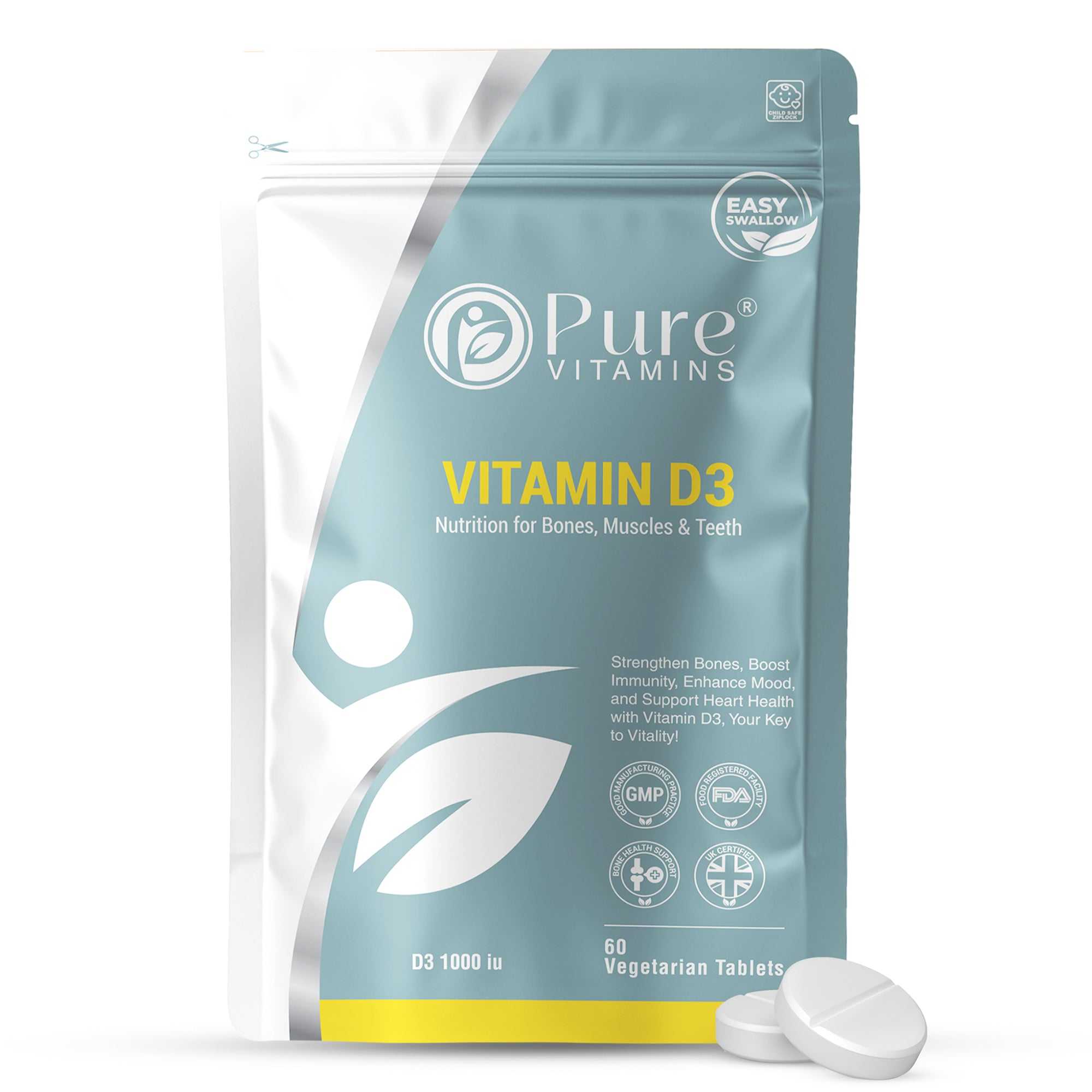
Our Vitamin D3 1000 IU tablets are formulated in the UK, made in GMP-certified facilities and tested for purity and heavy metals. They are 100% vegan with no lanolin, gluten-free, and free from unnecessary fillers, so you get a clean, straightforward daily dose. You can also browse our full library of plain-English guides on the supplement guides hub, or start from our homepage.
Frequently asked questions
Is 1000 IU of vitamin D3 a day enough?
For most healthy UK adults, 1000 IU daily is a good maintenance dose. It is comfortably above the UK baseline of 400 IU and well below the 4000 IU upper limit. Some people who start off very low may need a higher, GP-guided dose for a while, but 1000 IU is a sensible everyday choice for keeping levels topped up.
How many micrograms is 1000 IU of vitamin D3?
1000 IU of vitamin D3 is 25 micrograms. For comparison, the UK baseline recommendation of 400 IU is 10 micrograms, and the safe upper limit of 4000 IU is 100 micrograms.
Can I take 1000 IU of vitamin D3 every day, all year round?
Many people do, particularly if they spend most of their time indoors. The most important window in the UK is autumn to spring, when sunlight is too weak for the skin to make its own. Taking 1000 IU daily stays well within the safe upper limit.
What are the signs of taking too much vitamin D?
Taking far too much for a long time can raise blood calcium, which may cause nausea, poor appetite, excessive thirst, frequent urination, constipation and weakness. A standard 1000 IU daily dose should not cause this. If you have these symptoms, stop and speak to a healthcare professional.
Should I take vitamin D3 with K2?
Some people who take higher doses of D3 like to pair it with K2, since the two fat-soluble vitamins have complementary roles in how the body handles calcium. It is a personal choice. If you prefer both in one tablet, a combined D3 and K2 product is a convenient option.
If you want a simple, clean daily top-up for the darker months, our 1000 IU tablets are an easy place to start.
Shop Vitamin D3 1000 IU Tablets
Warmly,
Dr. Miron, Founder of Pure Vitamins UK
Food supplements are not a substitute for a varied, balanced diet and a healthy lifestyle. This article is for general information and is not medical advice. If you are pregnant, breastfeeding, have a medical condition or take medication, speak to your GP or pharmacist before starting a supplement.

