


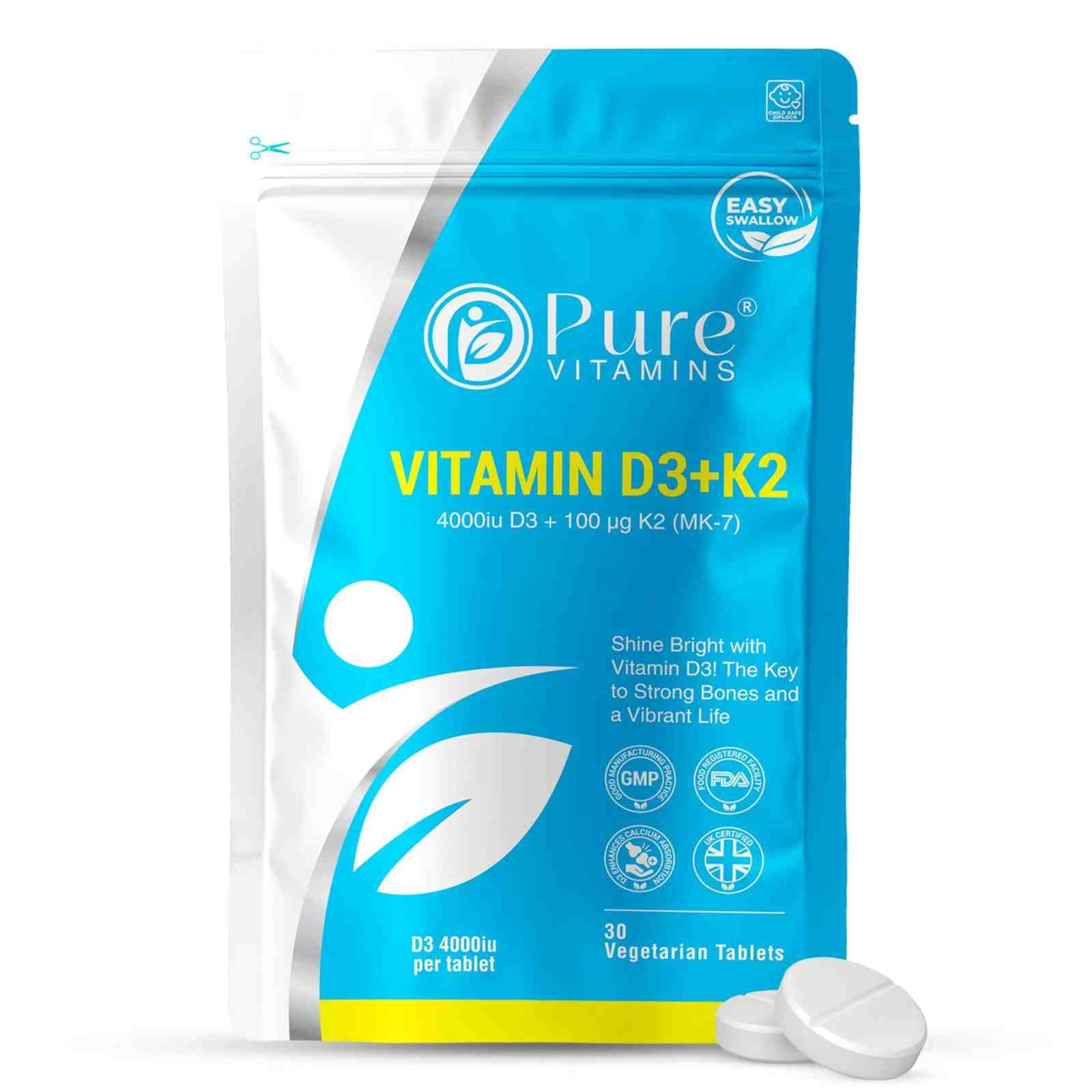
Vitamin D3 and K2 for bone health are paired because the two fat-soluble vitamins work through complementary pathways: D3 helps the body absorb and manage calcium, while K2 helps activate the proteins that bind that calcium into bone. This guide explains why they are combined, why the MK-7 form matters, the role magnesium plays behind the scenes, the sensible dose ratio, what the research honestly shows, the common myths, and how to choose, with the science kept firmly in its proper place. For a buyer's guide, see how to choose a vitamin D3 and K2 supplement. For more, see D3 vs D3 plus K2 and whether 4000 IU is safe.
Reviewed and updated: 24 July 2026
Vitamin D3 and K2 for bone health: the quick answer (TL;DR)
- What it is: a pairing of two fat-soluble vitamins, vitamin D3 (cholecalciferol) and vitamin K2 (as MK-7).
- Why paired: D3 supports calcium absorption and handling; K2 helps activate proteins like osteocalcin that direct calcium into bone.
- Who it is for: anyone focused on bone maintenance, especially through a UK winter when vitamin D from sunlight is scarce.
- Key risk: vitamin K interacts with warfarin and similar blood thinners, and vitamin D has a 100 microgram (4000 IU) daily upper limit for adults.

Why Vitamin D3 and K2 are paired
The case for combining them is mechanistic. Vitamin D drives the production of several vitamin K-dependent proteins, and those proteins only become active once vitamin K carboxylates them, so the two nutrients depend on each other in calcium metabolism. A narrative review of the evidence describes this as a synergistic interplay, concluding that adequate levels of both vitamin D and vitamin K appear beneficial for bone, and that taking them together may be more effective than either alone (van Ballegooijen and colleagues, 2017, DOI). In plain terms: D3 helps you absorb and hold the right amount of calcium, and K2 helps activate the proteins that put it where it belongs. Neither vitamin works in isolation, which is the whole logic of a combined tablet.
What each vitamin contributes
- Vitamin D3 contributes to normal blood calcium levels, the normal absorption and utilisation of calcium and phosphorus, and the maintenance of normal bones and teeth.
- Vitamin K2 contributes to the maintenance of normal bones, through a different pathway: it helps carboxylate (switch on) bone proteins such as osteocalcin.
Both help maintain normal bones, and because they act through different routes, a combined supplement covers bone maintenance from two complementary directions. A review of calcium, vitamin D and vitamin K describes them as contributing to bone health both independently and collectively (Karpinski and colleagues, 2017, DOI).
The calcium-delivery rationale: what osteocalcin actually does
It helps to picture the journey of a calcium atom. Vitamin D opens the door at the gut so calcium is absorbed from food, and it supports normal blood calcium levels. But absorbed calcium then needs to be steered into the bone matrix. That final step relies on vitamin K-dependent proteins, the best known of which is osteocalcin, produced by the bone-building cells. Osteocalcin is made in an inactive form and only becomes able to bind calcium into bone once vitamin K carboxylates it. If vitamin K status is low, more of that osteocalcin stays uncarboxylated and inactive. This is why researchers describe the ratio of uncarboxylated to carboxylated osteocalcin as a practical marker of vitamin K status, and why adequate vitamin K is part of the bone-maintenance picture rather than an optional extra.

Why MK-7 specifically
Vitamin K2 comes in different chain lengths; the one used in quality supplements is MK-7 (menaquinone-7). It is valued because it is better absorbed and stays in the circulation much longer than shorter-chain forms or dietary vitamin K1. Laboratory work comparing the isomers notes that MK-7 reaches markedly higher and longer-lasting blood concentrations than vitamin K1, with a circulating half-life of around 72 hours compared with roughly 3 hours for K1 (Cirilli and colleagues, 2022, DOI). That long action is what makes a once-daily MK-7 tablet practical: a single dose keeps vitamin K activity topped up around the clock, whereas short-acting forms peak and clear quickly. Our D3 + K2 uses MK-7 for exactly this reason, and we explain the form in more depth in what vitamin K2 MK-7 is.
Natural food sources of D and K2
It is worth knowing where these vitamins come from in the diet, because it explains why supplementing is common. Vitamin D is found in oily fish, egg yolks and fortified foods, but UK diets typically provide little, and winter sunlight makes none. Vitamin K1 is plentiful in leafy greens such as kale, spinach and broccoli, but long-chain K2 (MK-7) is a different story: the richest source by far is natto, a fermented soybean dish that is a staple in parts of Japan but almost unknown in British kitchens. Smaller amounts of K2 appear in some hard and soft cheeses, egg yolk and organ meats. For most people in the UK, dietary MK-7 intake is modest, which is part of the appeal of a declared amount in a supplement.
What the research honestly shows
It is worth being straight about the evidence, because this is where marketing often overreaches. Most clinical trials of vitamin K and the D-and-K combination have studied older or postmenopausal women, and the results across different bone sites have been mixed rather than uniform (van Ballegooijen and colleagues, 2017, DOI). On the more encouraging side, a three-year randomised trial in healthy postmenopausal women found that a low daily dose of MK-7 (180 micrograms) improved vitamin K status and reduced the age-related decline in bone mineral density and bone strength at the spine and femoral neck, though not at the total hip (Knapen and colleagues, 2013, DOI). That study was in healthy women, which is the relevant population for a food supplement, and the authors were careful to note the findings may not transfer directly to men or younger people. The honest summary: the mechanism for pairing D and K is sound, the bone roles are real, and there is supportive human data, but no supplement builds strong bones on its own. Bone maintenance reflects calcium intake, vitamin D and K status, protein and weight-bearing activity together. We set out the wider picture in supplements for bones and joints UK and vitamin D and bone health.
Who benefits most from a combined supplement
The pairing is most logical for a few groups. Postmenopausal women are the population most studied for vitamin K and bone, because bone density naturally declines faster after menopause, and that is where the MK-7 evidence above sits. UK adults heading into winter are another: vitamin D from sunlight all but disappears from October to March, so a daily D3 dose is sensible regardless, and adding K2 covers the second half of the calcium story. Older adults more generally tend to have lower vitamin D status and less efficient skin synthesis. None of this is a promise of a specific outcome; it is simply where the bone-maintenance rationale is strongest. People who already get plenty of sun year-round and eat a varied diet rich in leafy greens and fermented foods may have less to gain.
The role of magnesium behind the scenes
One nutrient that rarely gets a mention in D3 + K2 discussions is magnesium, yet it sits quietly upstream of the whole process. Vitamin D is biologically inert until the liver and kidneys convert it into its active form, and the enzymes that carry out those conversions depend on magnesium. A review of the science notes that all of the enzymes which metabolise vitamin D appear to require magnesium, which acts as a cofactor in those reactions, so magnesium status influences how well the body can use the vitamin D it has (Uwitonze and Razzaque, 2018, DOI). This is one reason a genuinely balanced diet matters alongside any supplement, and why some people choose to keep their magnesium intake adequate as well. If that interests you, our guide to the magnesium glycinate formulation explains the well-absorbed form, though it is a separate product from our D3 + K2.

How much, the dose ratio, and the safe upper limits
For vitamin D, the reference intake (NRV) is 10 micrograms (400 IU) a day, and the adult tolerable upper intake level is 100 micrograms (4000 IU) a day from supplements, which should not be exceeded long-term because vitamin D is stored in the body. For vitamin K, the NRV is 75 micrograms a day; there is no set tolerable upper limit, and it is well tolerated from food and supplements, with the warfarin interaction below being the important caveat. On the question of a D-to-K ratio: there is no official ratio, and the body does not require a fixed proportion. Most combined products simply pair a sensible daily vitamin D dose with a meaningful amount of MK-7, commonly in the region of 75 to 100 micrograms or more, which is in line with the amounts used in research. The practical rule is to keep vitamin D comfortably under its 4000 IU ceiling and choose a product that declares a genuine, named amount of MK-7 rather than a token sprinkle. For full dosing detail, see how much vitamin D3 and K2 to take daily.
Is it risky to take vitamin D3 without K2?
This is one of the most common worries, and it deserves a calm, honest answer. Taking vitamin D3 on its own is entirely mainstream: UK public health guidance recommends a daily vitamin D supplement through the winter without specifying that it must be combined with K2, and millions of people take D3 alone safely. The case for adding K2 is about the bone-maintenance synergy described above, not about fixing a danger. Claims that taking D3 without K2 will somehow harm you are stronger than the evidence supports. The sensible reading is that K2 is a worthwhile complementary partner for bone health if you want both halves of the calcium story in one tablet, while D3 alone remains a perfectly reasonable choice, especially as a winter top-up. If in doubt, a combined D3 + K2 simply removes the question.
Common myths about Vitamin D3 and K2
- Myth: K2 keeps calcium out of your arteries. The human evidence for a cardiovascular or arterial effect in healthy people is limited and not settled, so we do not go there. The clear, well-established role here is helping to maintain normal bones.
- Myth: more K2 is always better. Research has used modest amounts such as 90 to 180 micrograms of MK-7 a day; very high doses are not shown to do more for bone, and dose is not a contest.
- Myth: D3 without K2 is dangerous. As above, D3 alone is mainstream and widely recommended; adding K2 is about bone synergy, not damage control.
- Myth: you easily get enough K2 from diet. Vitamin K1 is common in leafy greens, but long-chain K2 (MK-7) is found mainly in fermented foods like natto, which few people in the UK eat regularly, so intakes are often modest.
Vitamin D3 and K2 beyond bones
The pairing is not only about bones. Vitamin D3 also contributes to the normal function of the immune system and to normal muscle function, which is why it is the single most useful supplement for UK adults through winter, when skin makes little or none from sunlight. We cover that in vitamin D in a UK winter. So a D3 + K2 tablet does double duty: bone maintenance from both vitamins, plus vitamin D3's broader roles in immunity and muscle.
What to realistically expect
Let me be honest about timescales, because bone is slow-moving tissue. You will not feel a D3 + K2 tablet working the way you might feel a coffee. The value here is quiet and long-term: keeping your vitamin D and K status topped up so the everyday machinery of bone maintenance has what it needs, year after year. The clinical trials that show benefit ran for two to three years, not two to three weeks. So the right mindset is consistency as part of a broader routine, alongside enough calcium, protein, movement and, in the UK, a winter vitamin D habit, rather than expecting a noticeable change. If you have a specific concern about your bone density, that is a conversation for your GP, who can arrange the right assessment.
How to choose and take it
- Look for D3, not D2: D3 (cholecalciferol) is the form the body makes from sunlight and is generally more effective at raising levels.
- Look for K2 as MK-7: the well-absorbed, long-acting form, in a declared amount rather than a trace.
- Take with food containing some fat: both are fat-soluble, so a meal aids absorption, and there is more on the timing question in our guide to the best time of day to take vitamin D3 and K2.
- Check the declared doses: a sensible vitamin D level well under the 100 microgram limit, and a meaningful amount of MK-7.
- Mind your wider diet: adequate calcium, magnesium and protein, plus weight-bearing activity, all matter for bones.
A few cautions worth knowing
The most important caution is for anyone taking a vitamin K antagonist blood thinner such as warfarin: vitamin K can affect how that medication works, so speak to your GP or pharmacist before taking any K2 product. People with high blood calcium, kidney stones, sarcoidosis or kidney disease should get medical advice before supplementing vitamin D. If you are pregnant or breastfeeding, take regular medication, or manage a health condition, check with a healthcare professional first.
How our Vitamin D3 + K2 is formulated
Our Vitamin D3 + K2 pairs vitamin D3 with vitamin K2 as MK-7, the well-absorbed long-acting form, in a once-daily vegetarian tablet. It is formulated in the UK and tested for purity and heavy metals at our GMP-certified facility. If you want vitamin D alone, our Vitamin D3 is a focused option, and you can browse the range on our home page.

Frequently asked questions
Why take vitamin D3 and K2 together?
They have complementary roles in calcium metabolism: vitamin D3 supports calcium absorption and normal blood calcium levels, while vitamin K2 helps activate bone proteins such as osteocalcin. Both help maintain normal bones.
What is MK-7 and why is it preferred?
MK-7 is a long-chain form of vitamin K2 that is well absorbed and stays in the circulation far longer than vitamin K1, which makes a once-daily dose practical. Quality D3 + K2 supplements use it for that reason.
Is it bad to take vitamin D3 without K2?
No. Vitamin D3 on its own is mainstream and widely recommended, especially through winter. Adding K2 is about the bone-maintenance synergy between the two vitamins, not about fixing a danger from D3 alone.
Does magnesium matter for vitamin D?
Yes, in the background. The enzymes that activate vitamin D rely on magnesium as a cofactor, so keeping magnesium intake adequate through a varied diet helps the body use the vitamin D it has.
Can I take D3 + K2 if I am on warfarin?
Not without medical advice. Vitamin K can interfere with vitamin K antagonist blood thinners such as warfarin, so speak to your GP or pharmacist before starting any K2 product.
How should I take D3 + K2?
Take it with a meal that contains some fat, since both vitamins are fat-soluble and absorb better with food.
Signed, Dr. Miron, Founder of Pure Vitamins UK.
Sources retrieved from PubMed and journal pages; see the linked DOIs above. This article is for general information, not medical advice. Food supplements should not be used as a substitute for a varied, balanced diet and a healthy lifestyle. If you are pregnant, breastfeeding, taking medication (especially anticoagulants) or managing a medical condition, speak to your GP or pharmacist before starting a new supplement.
