

Reviewed and updated: 3 September 2026
If you are asking which is better, B12 or biotin, the honest answer is that neither one wins, because they are not really competing for the same job. Vitamin B12 and biotin are both B vitamins, but they look after different parts of your body, so the right question is not which is stronger, it is which one fits what you are trying to support, and whether you might actually benefit from both.
B12 or biotin: the short version
I am Dr. Miron, Founder of Pure Vitamins UK, and this is the comparison I get asked about more than almost any other. People see biotin marketed for hair and B12 marketed for energy, assume they overlap, and try to pick a winner. They do not overlap much at all. Biotin is best known for its role in maintaining normal hair and skin, while B12 is the one your body leans on for normal red blood cell formation, a normal nervous system, and reducing tiredness and fatigue. Choose based on your goal, not on which sounds more powerful.

The quick answer, at a glance
- What they are: both are water-soluble B vitamins your body cannot store in large amounts, so a steady daily intake matters.
- Reach for biotin if: your focus is hair and skin, or you want support for normal energy-yielding metabolism and macronutrient metabolism.
- Reach for B12 if: your focus is everyday energy, the nervous system and red blood cells, especially if you eat little or no animal food.
- Can you take both? Yes. They are complementary B vitamins with no reason to compete, and many people sensibly take both.
- The one catch: very high-strength biotin can interfere with some blood tests, so mention it to whoever takes your bloods.
B12 versus biotin, side by side
Most comparisons online are written for a US audience and skim the practical detail, so here is the straight side-by-side using UK figures. I have laid it out point by point rather than as a chart, because these are the six things that actually decide which one belongs in your cupboard.
What each one is
- Biotin is vitamin B7, sometimes still called vitamin H in older writing. It is a small sulphur-containing molecule that acts as a coenzyme.
- Vitamin B12 is cobalamin, the largest and most structurally complex of all the vitamins, built around a cobalt atom.
What each one does in normal metabolism
- Biotin contributes to normal macronutrient metabolism, normal energy-yielding metabolism, the normal functioning of the nervous system, normal psychological function, and the maintenance of normal hair and normal skin.
- Vitamin B12 contributes to normal energy-yielding metabolism, the normal functioning of the nervous system, normal red blood cell formation, normal homocysteine metabolism, normal psychological function, the normal function of the immune system, and the reduction of tiredness and fatigue.
UK nutrient reference value (NRV)
- Biotin: 50 micrograms a day. EFSA sets an adequate intake of around 40 micrograms a day for adults.
- Vitamin B12: 2.5 micrograms a day. The UK reference nutrient intake for adults sits around 1.5 micrograms a day.
Typical supplement strengths you will see on a UK shelf
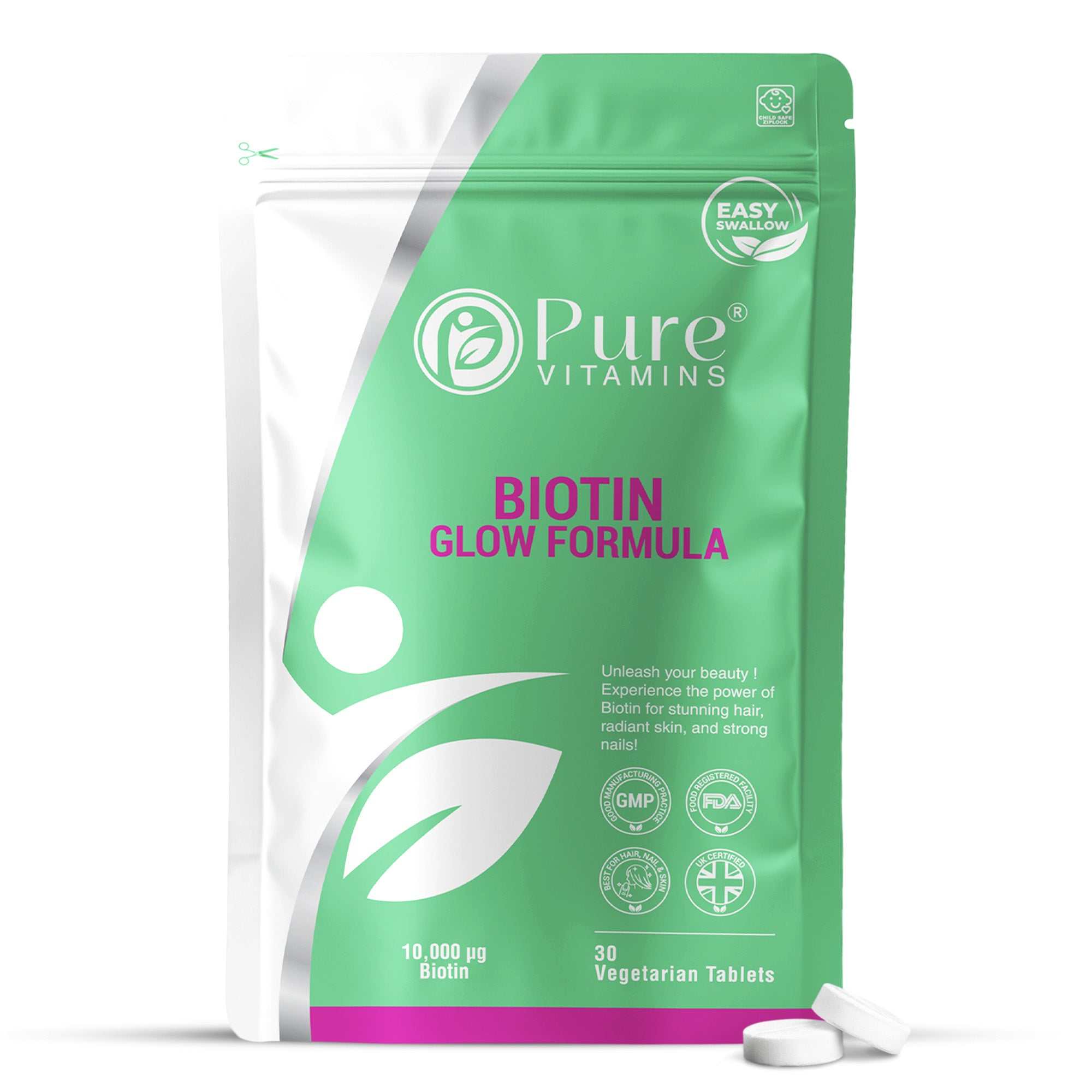
- Biotin: anywhere from about 100 micrograms in a multivitamin up to 10,000 micrograms in a dedicated high-strength tablet.
- Vitamin B12: commonly 100 to 1,000 micrograms, and sometimes higher, because only a small fraction of a large single dose is actually taken up.
Best food sources
- Biotin: egg yolk, liver, nuts, seeds, oily fish, sweet potato and wholegrains. Widely spread across both plant and animal foods.
- Vitamin B12: meat, fish, shellfish, eggs and dairy, plus fortified foods such as some plant milks, yeast extracts and breakfast cereals. Almost absent from unfortified plant foods.
Who each one tends to suit
- Biotin suits people focused on a hair and skin routine, and anyone whose diet is low in eggs, nuts and wholegrains.
- Vitamin B12 suits vegans and largely plant-based eaters, older adults, people taking long-term acid-reducing medicines or metformin, and anyone who has had gastric or bowel surgery.
Is biotin even a B vitamin, and how does it relate to B12?
Yes, biotin is a genuine member of the B-vitamin family, which is where a lot of the confusion starts. The B vitamins are not one substance, they are a group of eight unrelated compounds that happened to be discovered together in the same fraction of food and were numbered as they were isolated. Biotin ended up as B7 and cobalamin as B12, but chemically they have almost nothing in common. Biotin is a compact coenzyme that clips onto enzymes. B12 is a large cobalt-centred molecule that needs a small chain of transport proteins just to get into your bloodstream.
What they do share is a role in the background chemistry that keeps cells running, which is why they turn up together in every B-complex on the shelf. If you would like the wider picture of how the family members sit alongside one another, our guide on whether you can take vitamin B and B12 together covers the overlap in more detail.
What biotin actually does
Biotin's day job is beautifully specific. In humans it is the essential partner for five biotin-dependent carboxylase enzymes, and an enzyme called holocarboxylase synthetase is what attaches biotin to each of them. Those five carboxylases sit at key junctions in metabolism: building and breaking down fatty acids, breaking down the amino acid leucine, and making new glucose in the liver (Zempleni and colleagues, 2014, https://doi.org/10.1111/nure.12103). That is the mechanism behind the plain-language claim that biotin contributes to normal macronutrient and energy-yielding metabolism. It is not a stimulant, it is a piece of enzymatic machinery.
Biotin also appears to have roles beyond the carboxylases, including in gene expression, and research has looked at how biotin status is best measured, since blood biotin itself is a poor marker and markers such as acylcarnitine excretion are more informative (Mock, 2017, https://doi.org/10.3945/jn.116.238956). The same review notes that marginal biotin shortfall appears more often in pregnancy than most people assume, which is a useful reminder that "rare deficiency" and "always plentiful" are not the same statement.
Here is the part the marketing tends to skip. The research on biotin for hair is genuinely useful, but it is honest about its limits. A systematic review of biotin for hair loss found that improvement was seen in people who had an underlying biotin deficiency or a specific condition, and concluded there is a lack of good evidence that supplementing helps people who are not deficient (Patel, Swink and Castelo-Soccio, 2017, https://doi.org/10.1159/000462981). A broader review of vitamins and minerals in hair loss reached a similar view, that micronutrients matter most when a deficiency is present (Almohanna and colleagues, 2019, https://doi.org/10.1007/s13555-018-0278-6). So biotin is a sensible daily nutrient for hair and skin maintenance, not a guaranteed hair-growth switch, and our guide on how many days you should take biotin for hair growth sets realistic timescales.
One small point of accuracy worth knowing: the authorised UK wording links biotin to normal hair and skin, while it is actually zinc that carries the wording for the maintenance of normal nails, which is why our hair, skin and nails thinking usually pairs the two. You can read more in our guide to what actually supports normal nails, and in our look at whether you can take selenium and biotin together.

What vitamin B12 actually does
Vitamin B12, or cobalamin, does heavier lifting across the body. It contributes to normal energy-yielding metabolism, the normal functioning of the nervous system, normal red blood cell formation, normal homocysteine metabolism, normal psychological function, and the reduction of tiredness and fatigue. In plain terms, it is central to making healthy red blood cells, keeping nerves working properly, and supporting steady everyday energy.
B12 also has a well-documented deficiency story, which is really a story about biology rather than any product. B12 has an important role in DNA synthesis, methylation and cellular metabolism, and shortfall can produce both blood and neurological effects if it is missed for a long time (Green and colleagues, 2017, https://doi.org/10.1038/nrdp.2017.40). Because the body mostly gets B12 from animal foods, people following vegan or vegetarian diets, older adults, and anyone with absorption problems are more likely to run low, and clinical guidance stresses paying attention to symptoms alongside blood markers (Obeid and colleagues, 2024, https://doi.org/10.3390/jcm13082176). If you eat little or no animal food, this is the one I would look at first, and our full vitamin B12 UK guide goes deeper on who is most at risk.
How each one is absorbed, and why B12 is the fussier of the two
This is the difference almost nobody explains, and it is the single best reason the two vitamins behave so differently in real life.
Biotin is straightforward. Most dietary biotin is bound to protein, an enzyme called biotinidase releases it in the gut, and a carrier in the small intestine takes it up. At the very high strengths sold as beauty supplements, a good deal simply crosses passively, which is why a 10,000 microgram tablet raises circulating biotin so sharply. Whatever you do not use is water-soluble and mostly leaves in urine.
B12 is the opposite of straightforward. It needs a relay of three transport proteins to reach your cells. Stomach acid and pepsin release B12 from food, haptocorrin in saliva carries it through the stomach, pancreatic enzymes then hand it over to intrinsic factor made by the stomach lining, and only that intrinsic factor complex is recognised by a receptor made of cubilin and amnionless in the last part of the small intestine. Transcobalamin then carries it around the body (Gueant and colleagues, 2022, https://doi.org/10.1016/bs.vh.2022.01.016).
Every link in that chain is a place things can go wrong, which is why B12 absorption falls with low stomach acid, autoimmune conditions affecting intrinsic factor, coeliac disease, inflammatory bowel disease, bariatric surgery or bowel resection. It also explains the odd-looking doses on B12 labels. Because the intrinsic factor route saturates at a small amount per dose, a high-strength tablet relies partly on a slower passive route, and only a small percentage of that big number is actually absorbed. High numbers on a B12 label are not marketing bravado, they are arithmetic.
The old biotin, B12 and folate connection
There is a genuinely interesting piece of history behind this comparison. Back in 1965, researchers publishing in the Biochemical Journal fed rats a biotin-free diet and looked at what happened to the folate compounds in their livers. Both biotin and B12 raised total folate-active substances compared with deficient animals, and both changed how the different folate forms were distributed. The authors read this as both vitamins feeding into the same one-carbon chemistry (Marchetti, Pasquali and Landi, 1965, https://doi.org/10.1042/bj0940763).
I include it because that paper still ranks near the top when people search this exact question, and it deserves honest framing. It is a sixty-year-old animal study using microbiological assays, not a human trial, and nothing in it says taking biotin does anything to your folate or B12 status. What it does illustrate nicely is the underlying point of this whole article: the B vitamins are colleagues working in adjacent parts of the same factory, not rivals.

Which forms should you look for?
Forms matter far more for B12 than for biotin, and knowing the difference saves money.
- Cyanocobalamin is the cheapest and most stable B12 form, and the one used in most fortified foods. Your body converts it, releasing a tiny cyanide group in the process, which is harmless at these amounts but is why some people prefer an alternative.
- Methylcobalamin is one of the two forms your body actually uses, active in the enzyme that recycles homocysteine.
- Adenosylcobalamin is the other active form, the one used inside mitochondria. A supplement carrying both covers each side of B12's job without relying on conversion, which is why we use methylcobalamin and adenosylcobalamin in our vitamin B12 supplement. Our explainer on B12 forms goes through the trade-offs properly.
- Biotin is simpler. The form used in food and supplements is d-biotin, and that is the only one with real activity, so the decision is about strength and honesty of labelling rather than chemistry.
So which is better, B12 or biotin?
The most useful way to answer which is better, B12 or biotin, is to stop ranking them and match each to a goal. If your interest is hair and skin, biotin is the more relevant nutrient. If your interest is energy that comes from healthy blood and nerves, or you are worried about a dietary gap, B12 is the more relevant one. Neither is a stronger version of the other, and picking the wrong one for your goal is the only real mistake here.
A few honest scenarios help:
- You want to support your hair and skin routine: biotin is the natural fit, ideally alongside a varied diet. See our honest take on biotin versus collagen for beauty if you are weighing those two as well.
- You feel persistently tired and eat little animal food: B12 is the more logical starting point, and worth a conversation with your GP.
- You are over 60, or take long-term acid-reducing medication: B12 again, because the absorption chain described above becomes less reliable with age and with less stomach acid.
- You are covering general nutrition: both appear together in most B-complex and multivitamin formulas for good reason, and you can read how we think about that in our best vitamins for hair, skin and nails guide and the wider supplement guides hub.
Can you take B12 and biotin together?
Yes, and there is no clash. They are both B vitamins, they act on different pathways, and neither blocks the other. Plenty of people take a dedicated biotin for hair and skin and a separate B12 for energy and dietary cover, or simply take a B-complex that includes both. If you prefer to keep things targeted, you can pair our high-strength biotin tablets with a vitamin B12 supplement and take them at whatever time suits your routine, since consistency matters far more than timing.
The products that already combine them, and what to check
You may not need to choose at all, because four common product types already carry both. Knowing which one you are holding is the quickest way to avoid buying the same nutrient twice.
- A vitamin B-complex. This is the classic combination product. A standard B-complex carries all eight B vitamins, usually including biotin somewhere between 50 and 150 micrograms and B12 anywhere from 2.5 to 500 micrograms. Good cover, modest biotin, and the sensible default if you simply want the whole family.
- A daily multivitamin. Almost every UK multivitamin includes both at or a little above the NRV. If you already take one, you are very likely covered for both at baseline level, and a separate product only earns its place if you have a specific goal.
- A hair, skin and nails formula. These usually pair a much higher biotin dose with zinc, selenium and vitamin C, and often a small amount of B12. The biotin figure here is the one to note, because it is frequently in the thousands of micrograms.
- A dedicated high-strength biotin. These are usually biotin alone, often 5,000 or 10,000 micrograms, with no B12 at all. If you are relying on one of these for your B vitamins generally, you are not covered for B12.
My own rule of thumb is simple. If the goal is broad nutritional cover, a B-complex or multivitamin is the tidier answer. If the goal is a targeted hair and skin routine, a dedicated biotin alongside whatever B12 your diet or multivitamin already provides makes more sense than buying a second broad formula.
How to read the label and avoid doubling up
This is where most people quietly waste money, so it is worth ninety seconds with your bottles.
- Add up the same nutrient across everything you take. A multivitamin, a hair gummy and a dedicated biotin tablet can easily stack three lots of biotin without you noticing.
- Read the "per serving" line, not the front of the pack. If a serving is two tablets, the headline figure is not what one tablet gives you.
- Check the %NRV column. It is the fastest way to see whether something is a modest top-up or a very high multiple of the daily reference amount.
- Watch the units. Biotin and B12 are both listed in micrograms (mcg), and a stray decimal point changes the meaning entirely.
- Decide what each product is for. If your multivitamin already covers B12 comfortably and your goal is hair and skin, a targeted biotin makes more sense than a second multivitamin.
- Keep an eye on total biotin specifically, because of the blood-test point below. Knowing your real daily total is the useful thing here.
How much of each do you need?
For labelling in the UK, the nutrient reference value, or NRV, is 50 micrograms for biotin and 2.5 micrograms for B12. Those NRVs are the baseline a normal diet aims to cover, not a ceiling. Everyday adequate intakes are modest: EFSA sets an adequate intake for biotin around 40 micrograms a day, and the UK reference nutrient intake for B12 is roughly 1.5 micrograms a day for adults.
Supplements often sit well above those figures, which is normal for water-soluble B vitamins. A 10,000 microgram biotin tablet, for example, provides a very high multiple of the NRV, and a B12 supplement is frequently dosed high to account for the fact that only a fraction is absorbed at once. Neither biotin nor B12 has a formal tolerable upper intake level set, largely because they are water-soluble and surplus amounts are mostly excreted rather than stored. That is different from fat-soluble nutrients such as vitamin D or vitamin A, where a genuine upper limit exists and matters. It does not mean more is automatically better, and for biotin in particular there is a specific reason to be thoughtful about very high doses, which I will come to next. If you want the detail on strengths, our guide to how much biotin you actually need lays it out.
Tolerability: how well each one is usually handled
Both of these are, in everyday use, among the easiest nutrients to take. Here is the honest picture rather than the marketing one.
- No formal upper limit for either. Because neither biotin nor B12 has an established tolerable upper intake level, you will not find a legal ceiling printed on a UK label. The absence of a set limit reflects the fact that surplus is largely excreted, not a licence to take unlimited amounts.
- Biotin is generally well tolerated. Even at the very high strengths sold for hair and skin, side effects are uncommon. Some people notice mild digestive upset if they take a tablet on a completely empty stomach, which usually settles by taking it with food.
- The real biotin caveat is analytical, not toxicological. The genuine reason to be careful with a 10,000 microgram dose is the blood-test interference covered in the next section, not a risk to your body.
- B12 is similarly well tolerated. High oral doses are routinely used precisely because absorption is inefficient, and the surplus simply leaves in urine. A pinkish tint to your urine after a B-complex is riboflavin, not a problem.
- Watch the extras, not the vitamin. Where a product does cause a reaction, the culprit is more often a flavouring, a sweetener, a gelatine capsule or a bulking agent than the vitamin itself. This is one of several reasons I would rather see a short, clean ingredients list than a long one.
- Skin reactions are worth taking seriously. Rarely, people report acne-type breakouts on very high biotin doses. The evidence for a direct link is thin, but if it happens to you, dropping to a lower strength is a perfectly reasonable response.
The one thing to know before a blood test
This is the part most hair-and-energy articles leave out, and it genuinely matters. High-strength biotin can interfere with some laboratory blood tests. Many common tests use biotin-based streptavidin technology, and when there is a lot of biotin in your bloodstream it can push certain results falsely high or falsely low. A review of this problem lists thyroid tests, troponin (a heart marker), and hormone and vitamin tests among those that can be affected, and notes the interference tends to appear at higher intakes (Moerman and Delanghe, 2020, https://doi.org/10.1080/17843286.2020.1780770). The nutrition literature flags the same issue, describing potentially misleading hormone results in people taking large amounts of biotin (Mock, 2017, https://doi.org/10.3945/jn.116.238956).
The practical takeaway is simple and reassuring. If you take a high-strength biotin, tell whoever is arranging your blood tests, and it is commonly suggested to pause biotin for a couple of days beforehand so your results are read accurately. This is also a neat reason the two vitamins connect: biotin can distort some of the very markers used around B12 and thyroid testing, so honesty with your clinician keeps the picture clean.

Signs your levels might be low
Frank biotin shortfall is uncommon in people eating a normal varied diet, because biotin is widespread in food and also made by gut bacteria. When it does occur it can show up as thinning hair, skin changes and brittleness. B12 shortfall is more common, especially with a plant-based diet or with age, and can show as unusual tiredness, a pale or washed-out look, pins and needles, or low mood. None of this is something to self-assess from a blog, so if symptoms are persistent, a GP and a blood test are the sensible route. Our guide to who is most at risk of B12 deficiency goes through the groups in detail.
When a blood test is the better next step than a supplement
This is the question I would most like people to ask before they buy anything, and almost nobody does. Supplementing is the right move when you are covering a known dietary gap. Testing is the right move when something is actually wrong and you do not yet know why.
Reach for a GP appointment rather than a bottle if any of these apply:
- Tiredness that is persistent, unexplained and out of character rather than the ordinary busy-week kind.
- Pins and needles, numbness, unsteadiness or any change in sensation, which are nerve signals and should never be self-treated with a supplement.
- Noticeable, sudden or patchy hair loss, which has many possible causes and is rarely a simple biotin story.
- Breathlessness, palpitations or an unusually pale appearance, which point towards a blood picture rather than a vitamin top-up.
- You are on long-term metformin or an acid-reducing medicine, or have had gastric or bowel surgery, where the absorption chain itself is the issue.
- You have been supplementing for months with no change at all, which is a good sign the original assumption was wrong.
It is also worth knowing that a B12 blood result is less clear-cut than most people expect. Serum B12 on its own is a limited stand-alone marker, and the modern approach usually combines it with a second, functional marker such as methylmalonic acid, homocysteine or active B12 (holotranscobalamin), because a low serum figure does not always mean true deficiency and a normal one does not always rule it out (Sobczynska-Malefora and colleagues, 2021, https://doi.org/10.1080/10408363.2021.1885339). A more recent review reaches the same practical conclusion, that pairing a B12 measure with a metabolic marker such as methylmalonic acid is the most useful combination in everyday practice, and that total B12 is of limited value once someone is already taking large doses (Nexo and Parkner, 2024, https://doi.org/10.1177/03795721241227114).
That last point has a very practical consequence. If you start a high-strength B12 and then get tested, the result becomes difficult to interpret, because the supplement is what the test is now measuring. If you suspect a genuine shortfall, get tested first and supplement afterwards, rather than the other way around. Biotin has no equivalent everyday blood test in routine UK practice, since blood biotin is a poor marker of status, which is another reason the hair conversation is best had with a GP rather than a lab result.
Vegans, vegetarians and older adults: the two groups this question matters most to
For most people, choosing between B12 and biotin is a preference. For these two groups it is closer to a decision worth getting right.
If you eat little or no animal food, B12 is not really optional. It is the one nutrient a well-planned plant-based diet cannot supply reliably without fortified foods or a supplement, because unfortified plant foods contain essentially none. Biotin, by contrast, is comfortably available from nuts, seeds, wholegrains and sweet potato, so a vegan diet is far more likely to leave a B12 gap than a biotin one. Fortified plant milks, nutritional yeast and some breakfast cereals help, but they need to be eaten consistently to count. Our guide on whether vegans need a B12 supplement covers the practicalities.
If you are over about 60, the issue is not what you eat but what you absorb. Stomach acid production tends to fall with age, and since the first step in the B12 relay is acid releasing B12 from food protein, food-bound B12 becomes harder to extract even when intake looks fine on paper. Interestingly, the B12 in fortified foods and supplements is not protein-bound, so it sidesteps that first step entirely, which is why a supplement can be more useful with age rather than less. Long-term proton pump inhibitors, H2 blockers and metformin push in the same direction. Biotin absorption is not affected in anything like the same way.
So if you belong to either group and are trying to pick one, pick B12. If your hair and skin are also on your mind, add biotin alongside it rather than instead of it.
Where to get them from food
Food first is always my starting point. Biotin is found in eggs (especially the yolk), nuts, seeds, oily fish, sweet potatoes and wholegrains. B12 is almost entirely found in animal foods such as meat, fish, eggs and dairy, plus fortified foods like some plant milks and breakfast cereals. That single difference explains a lot: it is much easier to fall short on B12 on a vegan diet than on biotin, which is one of the clearest cases where a supplement earns its place.
How to choose and take them well
When you are comparing products, look past the front of the label. For B12, the form matters to some people, which is why we use methylcobalamin and adenosylcobalamin, the body-ready forms. For biotin, the useful details are the actual microgram strength and the NRV percentage, so you know exactly what you are getting. Both of ours are formulated in the UK and tested for purity and heavy metals at our GMP-certified facility, which is the standard I would want as a buyer.
On timing, do not overthink it. Both are water-soluble, so take them with a little food if that helps you remember, keep it daily, and let consistency do the work. If you like a tidy routine, the whole point of our Pure Vitamins range is that you can build exactly the stack your goals call for.
What to realistically expect
Set expectations kindly. If you are genuinely low in a nutrient, correcting that gap can make a real difference over weeks to months. Hair in particular grows about a centimetre a month, so any change in a hair routine is a matter of seasons rather than days. If your levels are already fine, topping up further is unlikely to transform anything, and that is true for both biotin and B12. Supplements support a good diet and lifestyle, they do not replace them, and the most honest promise any brand can make is a clean, well-labelled product that helps you cover your bases.
A few cautions worth knowing
- If you are pregnant, breastfeeding, or managing a health condition, check with a healthcare professional before starting a new high-strength supplement.
- Tell whoever arranges your blood tests that you take biotin, as high-strength biotin can affect some results.
- If you take long-term acid-reducing medication, metformin, or have had gastric or bowel surgery, mention B12 to your GP, as absorption can be affected.
- If you think you may be low in B12, ask about testing before you start a high-strength supplement, because supplementing first makes the result harder to read.
- Persistent tiredness, tingling or hair changes deserve a proper look from your GP rather than guesswork.
- Stick to the stated dose on the label unless a professional advises otherwise.
Frequently asked questions
Is B12 or biotin better for energy?
For energy specifically, B12 is the more relevant of the two, because it contributes to normal energy-yielding metabolism and the reduction of tiredness and fatigue, and it is central to red blood cell formation. Biotin also contributes to normal energy-yielding metabolism, but it is better known for hair and skin.
Is B12 or biotin better for hair?
Biotin is the one associated with the maintenance of normal hair. That said, the research shows the clearest benefit in people who are actually low in biotin, so it supports a hair routine rather than guaranteeing regrowth.
Can I take B12 and biotin at the same time?
Yes. They are complementary B vitamins with no interaction to worry about, and many people take both, either as separate supplements or within a B-complex or multivitamin.
Is biotin the same as vitamin B12?
No. Biotin is vitamin B7 and vitamin B12 is cobalamin. They belong to the same B-vitamin family but are chemically unrelated, have different jobs, different reference values and very different absorption routes.
Does biotin really affect blood tests?
High-strength biotin can interfere with some laboratory immunoassays and shift certain results, including thyroid, troponin and hormone tests, so it is best to tell your clinician you take it and, where advised, pause it for a day or two before testing.
Do I still need a separate biotin or B12 if I take a multivitamin?
Often not. Most multivitamins and B-complex products already include both at or above the NRV, so check the per-serving figures first and only add a dedicated product if you have a specific goal, such as a targeted high-strength biotin for a hair and skin routine.
Which should I choose if I am vegan?
B12 is usually the priority for anyone on a vegan or largely plant-based diet, because it is found almost entirely in animal foods. Biotin is more widely available from plant foods, so shortfalls are less common.
Should I get tested before taking B12 or biotin?
If you simply want to cover a known dietary gap, testing is not usually necessary. If you have persistent unexplained tiredness, nerve symptoms such as pins and needles, or sudden hair loss, see your GP first. Testing before you start matters most for B12, because taking a high-strength supplement makes a later blood result much harder to interpret.
Is there a safe upper limit for biotin or B12?
No formal tolerable upper intake level has been set for either, because both are water-soluble and surplus amounts are largely excreted rather than stored. That is not a reason to take unlimited amounts, and with biotin in particular the practical limit on very high doses is the interference with laboratory blood tests rather than any risk to your body.
Sources
- Zempleni and colleagues, 2014, biotin and biotinidase deficiency, https://doi.org/10.1111/nure.12103
- Mock, 2017, biotin status and assessment, https://doi.org/10.3945/jn.116.238956
- Patel, Swink and Castelo-Soccio, 2017, review of biotin in hair loss, https://doi.org/10.1159/000462981
- Almohanna and colleagues, 2019, vitamins and minerals in hair loss, https://doi.org/10.1007/s13555-018-0278-6
- Green and colleagues, 2017, vitamin B12 deficiency primer, https://doi.org/10.1038/nrdp.2017.40
- Obeid and colleagues, 2024, clinical perspectives on B12 status, https://doi.org/10.3390/jcm13082176
- Gueant and colleagues, 2022, cobalamin absorption and transport, https://doi.org/10.1016/bs.vh.2022.01.016
- Sobczynska-Malefora and colleagues, 2021, B12 diagnosis and laboratory pitfalls, https://doi.org/10.1080/10408363.2021.1885339
- Nexo and Parkner, 2024, B12-related biomarkers, https://doi.org/10.1177/03795721241227114
- Moerman and Delanghe, 2020, biotin interference in immunoassays, https://doi.org/10.1080/17843286.2020.1780770
- Marchetti, Pasquali and Landi, 1965, biotin, B12 and liver folate in rats, https://doi.org/10.1042/bj0940763
Shop High-Strength Biotin Tablets
Warmly,
Dr. Miron, Founder of Pure Vitamins UK
This article is for general information and education. Food supplements are not a substitute for a varied, balanced diet and a healthy lifestyle, and this is not medical advice. If you have symptoms or a health condition, speak to your GP or a qualified healthcare professional.
