


Reviewed and updated: 24 August 2026
Can you take vitamin B and B12 together?
Yes, you can take vitamin B and B12 together, and for a lot of people it is a perfectly sensible thing to do. B12 is itself one of the eight B vitamins, so a B complex and a standalone B12 tablet are not two different nutrients competing with each other. They overlap. The real question is not whether the combination is safe, because the B vitamins are water soluble and your body is good at letting go of what it does not need. The real question is whether you are quietly paying twice for the same microgram, and whether the amount you are getting is the amount you actually intended.
That is the part almost nobody shows you, so let us do the arithmetic properly.

The short version
- A B complex already contains B12, so taking a separate B12 on top is doubling up, not adding a missing nutrient.
- Doubling up on B12 is not dangerous for most healthy adults. There is no upper safe level set for B12 in the UK, and what your body cannot use is largely passed out in urine.
- The nutrient in a B complex worth watching is not B12, it is vitamin B6. The NHS advises not taking more than 10mg of B6 a day from supplements unless a doctor has told you otherwise.
- Most UK B complexes carry a modest amount of B12, often somewhere between 2.5 and 100 micrograms. Standalone B12 products are typically far higher.
- Vitamin B12 contributes to normal energy-yielding metabolism, to the reduction of tiredness and fatigue, and to normal functioning of the nervous system.
- If you are vegan, over 50, on metformin or on long-term stomach acid medication, a standalone B12 alongside a complex is the version of this question worth taking seriously.
What a B complex actually contains
When someone says "vitamin B" they almost always mean a B complex, which is a single tablet holding all eight B vitamins. Those eight are:
- B1, thiamine. Contributes to normal energy-yielding metabolism, normal functioning of the nervous system, normal psychological function and the normal function of the heart.
- B2, riboflavin. Contributes to normal energy-yielding metabolism, the maintenance of normal red blood cells, the maintenance of normal vision and the reduction of tiredness and fatigue.
- B3, niacin. Contributes to normal energy-yielding metabolism, the reduction of tiredness and fatigue and the maintenance of normal skin.
- B5, pantothenic acid. Contributes to normal energy-yielding metabolism and to normal mental performance.
- B6, pyridoxine. Contributes to normal red blood cell formation, normal homocysteine metabolism, the regulation of hormonal activity, normal psychological function and the reduction of tiredness and fatigue.
- B7, biotin. Contributes to normal energy-yielding metabolism, normal functioning of the nervous system and the maintenance of normal hair and skin.
- B9, folate or folic acid. Contributes to normal blood formation, normal amino acid synthesis, normal homocysteine metabolism and the reduction of tiredness and fatigue.
- B12, cobalamin. Contributes to normal red blood cell formation, normal energy-yielding metabolism, normal functioning of the nervous system, normal psychological function, normal homocysteine metabolism and the reduction of tiredness and fatigue.
Read that last line again. B12 is inside the complex. So the honest framing of this question is not "can I combine two nutrients" but "do I want more of one nutrient than the complex already gives me".
How a standalone B12 differs from a complex
Three things usually separate the two products on the shelf.
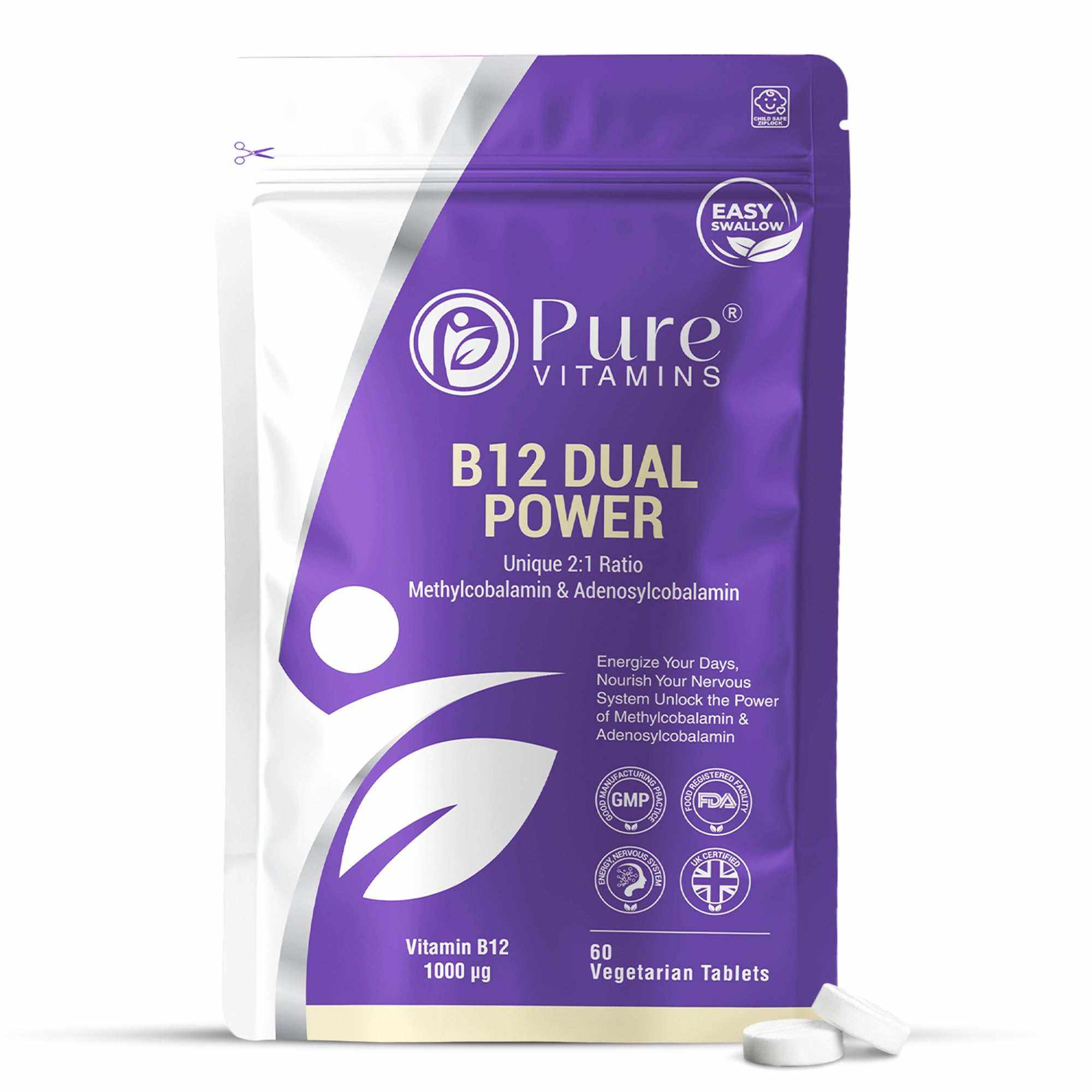
The amount. A complex spreads its budget across eight nutrients and usually keeps B12 conservative. A standalone B12 does one job, so it tends to be far stronger. Ours delivers 1000 micrograms per two-tablet serving, which is a different order of magnitude to what most complexes carry.
The form. Complexes commonly use cyanocobalamin, which is stable and inexpensive but has to be converted by the body before it can be used. Standalone products more often use the active forms. Ours uses methylcobalamin and adenosylcobalamin, the two forms your cells work with directly. If you want the full comparison, we have written it up in our guide to the different B12 forms and what separates them.
The purpose. A complex is a broad insurance policy across the whole B family. A standalone B12 is a targeted top-up for a nutrient a lot of people in the UK genuinely run short on, particularly if animal foods are off the menu.

How much B12 is already in your B complex
This is the arithmetic. The UK Nutrient Reference Value for vitamin B12 is 2.5 micrograms a day, and every label has to show what percentage of that NRV a serving provides. Once you know the NRV, the percentages stop being marketing noise and start being useful.
- 2.5 micrograms is 100 percent of the NRV. This is the low end of a budget B complex.
- 10 micrograms is 400 percent of the NRV. Common in mid-range complexes.
- 50 micrograms is 2,000 percent of the NRV. Common in the stronger complexes marketed for energy.
- 100 micrograms is 4,000 percent of the NRV. Toward the top of what a complex usually carries.
- 1000 micrograms is 40,000 percent of the NRV. This is standalone B12 territory, and it is what our own tablets deliver.
So if you take a complex carrying 50 micrograms and add a 1000 microgram B12 on top, you are at 1050 micrograms. The complex is contributing under five percent of your daily B12. That is worth knowing before you decide which of the two you actually need. Some people conclude they want both. Others realise the complex is doing very little for B12 and they would rather buy a good standalone and a separate cheap multivitamin.
Does doubling up matter? Why water solubility is the key
The B vitamins are water soluble, which is the single most useful fact in this whole discussion. Unlike vitamin A or vitamin D, they are not stored in fat tissue in any meaningful quantity, and surplus is filtered out by the kidneys rather than accumulating. That is why bright yellow urine after a B complex is riboflavin doing exactly what it should, not a sign that something has gone wrong.
B12 is the partial exception, because the liver does hold a reserve that can last a good while. Even so, no upper safe level has been set for B12 in the UK, and the reason is simple: the absorption route puts a natural ceiling on how much can get in from any single dose. Which brings us to the mechanism.
How B12 is actually absorbed
The intrinsic factor route
B12 is the most structurally complicated vitamin we have, and it cannot simply drift across the gut wall the way vitamin C does. It has to be escorted. Stomach acid and enzymes free it from food proteins, it is handed to a protein called intrinsic factor made by the stomach lining, and the pair travel to the last stretch of the small intestine where a receptor called cubam recognises the complex and pulls it into the cell. Said and Nexo set the whole pathway out in their review of how the body handles water-soluble vitamins (DOI: 10.1002/j.2040-4603.2018.tb00052.x).
That escort system is efficient but it is also finite. It saturates. There is only so much intrinsic factor and only so many receptors, which is why a single very large dose does not translate into a proportionally large amount absorbed.
The passive diffusion route
There is a second, much less efficient route, and it is the reason high-strength B12 tablets exist at all. When a large oral dose is taken, a small fraction crosses the gut wall by simple passive diffusion with no escort involved. The classic figure, described by Seetharam and Alpers, is roughly one percent of an oral dose in the 100 to 5,000 microgram range (DOI: 10.1002/j.2040-4603.1991.tb01418.x).
One percent sounds terrible until you do the sum. One percent of 1000 micrograms is around 10 micrograms, which comfortably clears a daily requirement of 2.5. That is the whole logic of a high-strength tablet: it is not trying to be efficient, it is deliberately overshooting so that the inefficient route alone delivers enough. It also explains why oral B12 holds up so well against injections. An Ontario health technology assessment reviewing the randomised trials concluded that oral B12 is as effective as the parenteral route in people with confirmed deficiency (PMC3874776).
With food or without
Intrinsic factor is released alongside stomach acid when you eat, so taking B12 with a meal gives the active route the best chance of working. That is why the instruction on our own pack is two tablets daily with water, preferably with a meal. If you are taking a complex as well, the same meal is fine for both.

Who tends to be advised a standalone B12 alongside a complex
For a lot of people a complex on its own is plenty. There are a few groups where the extra B12 genuinely earns its place.
- Vegans and long-term vegetarians. B12 is essentially absent from plant foods, so a reliable supplement is the practical answer rather than an optional extra. We look at the intakes and the evidence in our guide to whether vegans need a B12 supplement.
- Anyone over about 50. Stomach acid output and intrinsic factor production both tend to decline with age, and Said and Nexo note that up to 20 percent of people over 60 are considered to have impaired B12 status even where dietary supply is adequate.
- People on metformin. A meta-analysis of 29 studies covering just over 8,000 people found metformin treatment was associated with a significantly higher rate of low B12 and lower serum concentrations (DOI: 10.1007/s11739-014-1157-5).
- People on long-term proton pump inhibitors or other acid-suppressing medicines. Less acid means less intrinsic factor and a weaker active absorption route.
- Anyone with a condition affecting the stomach or the last part of the small intestine, including pernicious anaemia, coeliac disease, Crohn's disease or a previous bowel resection.
If you recognise yourself in that list, our piece on who is most at risk of low B12 and what the early signs look like is worth ten minutes. And if the tiredness that brought you here has been going on for months, a blood test through your GP tells you more than any supplement label can.
Timing: same time or split across the day
My honest answer is that this matters far less than people hope. Take them at the same time with breakfast and you have covered it. The reasons to split are practical rather than biochemical: some people find a strong B complex a little rough on an empty stomach, and a few find B vitamins taken late in the evening leave them feeling too switched on to settle. If either applies to you, take the complex with breakfast and the B12 with lunch. There is no interaction to engineer around, only your own comfort.
Consistency beats timing every time. A tablet taken most days at a convenient moment does more than a perfectly timed one you keep forgetting.
How to read the label and check for overlap
Two minutes with both packs tells you everything.
- Find the per-serving column, not the per-tablet column. If a serving is two tablets, the headline figure is for two. Ours is 1000 micrograms per two tablets, not per tablet.
- Add the B12 figures together from both products and compare against the 2.5 microgram NRV. Now you know your real intake.
- Check the B6 figure on the complex and keep the total across everything you take at or under 10mg unless a doctor has advised otherwise.
- Check the B12 form. Cyanocobalamin, methylcobalamin, adenosylcobalamin or hydroxocobalamin. It should be named. If it just says "vitamin B12" with no form, that tells you something about the brand.
- Check whether the complex includes folic acid, and at what level, for the reason set out below.
- Check who made it. Ours is formulated in the UK and manufactured in GMP-certified facilities, and every batch is tested for purity and heavy metals at that facility.

A few cautions worth knowing
Vitamin B6 is the one to watch, not B12. High intakes of the pyridoxine form have been linked with sensory nerve symptoms, and laboratory work by Vrolijk and colleagues suggests pyridoxine can competitively inhibit the active form of the vitamin, so the symptoms of taking too much end up resembling the symptoms of having too little (DOI: 10.1016/j.tiv.2017.07.009). The NHS position is to keep supplemental B6 to 10mg a day or less unless a doctor advises otherwise. If you are stacking a complex with anything else containing B6, add the numbers up.
Folic acid and B12 need thinking about together. The long-standing concern is that a generous folic acid intake can correct the anaemia of B12 deficiency while the nerve problems carry on unnoticed. Miller and colleagues reviewed the evidence and concluded it is compelling enough to warrant extra vigilance in older adults and anyone with absorption problems, while being clear that much of it is correlational and the mechanism has not been directly tested (DOI: 10.1177/03795721241229503). It is only fair to say the picture is contested: a review by van Gool and colleagues argued the masking concept does not hold up well and supported the existing 1mg upper level for folic acid (DOI: 10.1080/10408444.2020.1727842). The practical takeaway sits in the middle. If you are supplementing folic acid and you have reason to think your B12 might be low, get the B12 checked rather than assuming a good blood count settles it.
High-dose biotin can interfere with blood tests. Many complexes carry biotin well above the NRV, and at high intakes it can distort certain laboratory immunoassays, including some thyroid and cardiac tests. It does not change your health, it changes the reading. Tell whoever takes your blood what you are taking. We go into it further in our piece on how much biotin you actually need.
Medicines and conditions. Metformin, proton pump inhibitors and H2 blockers all affect B12 status over time. Regular heavy drinking works against B vitamin status generally. If you are pregnant, breastfeeding, taking prescribed medication or living with a diagnosed condition, run the combination past your GP or pharmacist first.
What to realistically expect
If you were genuinely running low on B12, correcting it can make a real difference and that difference is usually gradual rather than sudden, measured over weeks. If your B12 was already fine, adding more will not push you above normal into something better. There is no bonus tier. That is not a fashionable thing for a supplement company to say, but it is the truth, and knowing it saves you both money and disappointment.
What a sensible combination does give you is coverage. Vitamin B12 contributes to normal energy-yielding metabolism and to the reduction of tiredness and fatigue, and if your diet or your age or your medication makes that intake unreliable, closing the gap is a reasonable thing to do.
Frequently asked questions
Can you take a B complex and B12 on the same day?
Yes. They can be taken on the same day and at the same time. B12 is already one of the eight vitamins in the complex, so you are increasing the amount of one nutrient rather than combining two that might clash.
Is it bad to take too much B12?
No upper safe level has been set for vitamin B12 in the UK. It is water soluble, absorption from any single dose is limited by the intrinsic factor pathway, and surplus is largely excreted. The nutrient in a B complex that has a meaningful ceiling is vitamin B6, which the NHS advises keeping to 10mg a day from supplements unless a doctor says otherwise.
Do I need a B complex if I already take B12?
Not necessarily. If your diet is varied and your reason for supplementing is specifically B12, a standalone B12 covers it. A complex makes more sense if you want broader cover across the whole B family or your overall diet is patchy.
Which form of B12 should I look for?
Methylcobalamin and adenosylcobalamin are the two forms the body uses directly. Cyanocobalamin is stable, well studied and has to be converted first. Whichever you choose, the label should name the form.
Should I take B vitamins with food?
With food is the better default. Intrinsic factor is released alongside stomach acid when you eat, which helps the active B12 absorption route, and a meal also makes a strong complex easier on the stomach.
Where to go from here
If you want the full picture on this nutrient, start with our complete UK guide to vitamin B12, which covers what it does, the forms and who needs it. If tiredness is the thread that brought you here, our honest look at which vitamins are involved in tiredness is the sensible next read, and our piece on iron with vitamin C and folic acid covers the folate side of the picture. Everything we have written sits together on our supplement guides hub, and you can browse the full range on the Pure Vitamins UK home page.
Shop our Vitamin B12 tablets with methylcobalamin and adenosylcobalamin
Dr. Miron, Founder of Pure Vitamins UK
Food supplements should not be used as a substitute for a varied, balanced diet and a healthy lifestyle. This article is for general information and is not medical advice. Always consult a healthcare professional before use if you are pregnant, breastfeeding, have a medical condition or are taking medication.


