


Vitamin B12 is one of the most important nutrients to get right, and one of the most over-hyped, thanks to a lot of "instant energy" marketing. Here is the honest, complete picture: what B12 really does for you, the signs people notice first when it runs low, the different forms you will see on a label, who is most likely to be short, and how to choose well in the UK.
Reviewed and updated: 21 September 2026

Vitamin B12: the quick answer (TL;DR)
- What it does: B12 contributes to normal energy-yielding metabolism, the reduction of tiredness and fatigue, and normal functioning of the nervous system, among other roles.
- How much: the UK reference nutrient intake for adults is 1.5 micrograms a day, which is small but comes almost entirely from animal foods.
- The forms: cyanocobalamin is the cheap, stable synthetic form; methylcobalamin and adenosylcobalamin are the active forms the body uses directly.
- Who is at risk: vegans and vegetarians, older adults, and people on certain medicines or with absorption conditions.
- No stimulant buzz: B12 supports how your body releases energy from food; it is not a caffeine-style pick-me-up.
- The honest caution: if you think you may be short, the answer is a blood test from your GP, not a guess and a bigger bottle.
What does vitamin B12 actually do?
B12 does a lot of quiet, essential work in the body. Vitamin B12 contributes to:
- normal energy-yielding metabolism, helping your body release energy from food;
- the reduction of tiredness and fatigue;
- normal functioning of the nervous system and normal psychological function;
- normal red blood cell formation;
- normal homocysteine metabolism and the normal function of the immune system, and it has a role in the process of cell division.
Mechanistically, B12 acts as a cofactor in one-carbon transfers, the methylation reactions that sit at the heart of amino acid and nucleic acid metabolism. That is the reason a shortfall tends to show up first in two places: the blood, where red cells cannot be built properly, and the nervous system, where the protective myelin sheath around nerves depends on the same chemistry. Based on a review retrieved from PubMed of B12 in vegetarian diets, plant foods are not a reliable source of the vitamin, which is what makes dietary supply the central issue for anyone eating plant-based (Rizzo et al., 2016, Nutrients; DOI 10.3390/nu8120767, full text on PMC).
How much do you need, and where does it come from?
The UK reference nutrient intake for adults is 1.5 micrograms a day. That is a genuinely tiny amount, and in a mixed diet it is met without any effort at all. The catch is where it comes from.
B12 is made by bacteria, not by plants or animals, and it accumulates up the food chain. In practice that means the dependable sources in a British diet are:
- Liver, which is in a league of its own, with a single small portion supplying many times a day's intake.
- Oily fish and shellfish: mackerel, salmon, sardines, mussels and cockles are all strong sources.
- Red meat, poultry and eggs, in more ordinary amounts.
- Milk, cheese and yoghurt, which are the steady background supply for most people who eat dairy. A pint of milk alone comfortably covers the daily reference intake.
- Fortified foods, which is where plant-based eaters get theirs: many breakfast cereals, most fortified plant milks, some yeast extracts and some nutritional yeast products. The word to look for is fortified, because unfortified versions of all of these contain essentially none.
Two myths worth putting to bed. Mushrooms, seaweed, spirulina and unfortified nutritional yeast are not reliable sources; some contain B12 analogues that show up in an analysis but are not usable by the body, and can in principle interfere with the real thing. And organic vegetables carry no meaningful B12 from soil residue, whatever you may read.
The early signs people notice first
This is the question I am asked most, and it deserves a careful answer, because B12 is unusual in how it announces itself.
A shortfall develops slowly. The liver holds a reserve that, in an adult who previously ate a mixed diet, can last a long time, so the change creeps up over months or years rather than arriving one week. The symptoms are also non-specific, which is precisely why they get attributed to being busy, getting older, or not sleeping well. The ones commonly reported early are:
- Tiredness and weakness that rest does not really shift.
- Breathlessness on mild exertion, such as stairs you used to manage easily.
- Pale skin, sometimes with a faintly yellow tinge.
- A sore, red or unusually smooth tongue, and mouth ulcers. This one is worth knowing because it is relatively distinctive and often ignored.
- Pins and needles or numbness, typically in the hands and feet.
- Changes in memory, concentration or mental clarity.
- Low mood or irritability that feels out of character.
- Reduced appetite and, sometimes, weight loss alongside it.
- Disturbed vision or problems with balance and coordination, which are less common and more significant.
I want to be straightforward about what that list is and is not. Every single one of those symptoms has many possible causes, most of them nothing to do with B12. Tiredness in particular is far more often about sleep, stress, thyroid function or low iron. So the list is useful for recognising a pattern worth investigating, and useless as a self-diagnosis. Nobody can tell from symptoms alone whether their B12 is low, and neither can I.
Low B12 and B12-deficiency anaemia are not the same thing
These two get used interchangeably and they are different stages of the same story.
Low B12 means your intake or absorption has not kept up and your levels have fallen. At this stage you may have no symptoms at all, or only vague ones.
B12-deficiency anaemia is what can follow if it continues. Without enough B12, the bone marrow cannot divide cells properly, so it produces red blood cells that are abnormally large and fewer in number. That is called megaloblastic anaemia, and it is what causes the tiredness, breathlessness and pallor.
The part that matters most is this: the nerve-related effects can develop independently of the anaemia. Someone can have neurological symptoms such as numbness or unsteadiness with a blood count that looks normal, which is one reason B12 problems are sometimes missed. It is also why nerve symptoms should never be brushed off as "probably nothing" while waiting to see if tiredness gets worse.
How a GP actually confirms it
Since the honest answer to "am I low?" is a blood test, it helps to know roughly what that involves so it feels less like an imposition to ask for.
- A serum B12 test is the usual starting point, measuring the total B12 circulating in your blood.
- Folate is normally checked at the same time, because the two deficiencies look alike on a blood count and are often tangled together.
- A full blood count shows whether red cells are enlarged, which points towards a deficiency of one or the other.
- Second-line tests exist where the first result is borderline or the picture does not fit, including methylmalonic acid and active B12, also called holotranscobalamin. These get closer to whether the vitamin is actually available to your cells rather than simply present in the blood.
- Where an absorption problem is suspected, such as pernicious anaemia, an antibody test may follow, and the treatment that results is a clinical decision rather than a shelf one.
One practical note before you go: high-dose biotin, which is common in hair and nail supplements, can interfere with some laboratory assays. Tell whoever takes your blood everything you are taking.
The energy nuance worth understanding
"B12 for energy" is the most widely misread claim in this whole category, so let me be precise about it.
The authorised role is in energy-yielding metabolism, which is the biochemical process of converting food into usable energy inside your cells. It is a genuine and important role. What it is not is an acute lift. B12 is not a stimulant, it has no caffeine-like action, and it does not make an adequately nourished person feel energised.
So who actually notices a difference? People who were genuinely running low. If a shortfall was contributing to your tiredness, correcting it can make a real and sometimes marked difference, though usually over weeks rather than overnight. If your B12 was already fine, taking more will not do anything you can feel, and no amount of marketing changes that. That is the honest dividing line, and it is worth knowing before you spend money.
The same logic answers the common question of whether a B complex would be better. A B complex spreads a moderate amount across all eight B vitamins, which suits someone covering general dietary bases. A dedicated B12 supplies a much larger amount of one vitamin, which suits someone with a specific reason to think that one is short, such as a plant-based diet or an absorption issue. Neither is better in the abstract; they answer different questions. If you are weighing up taking both together, I have set out the label arithmetic in can you take vitamin B and B12 together, and the wider fatigue picture sits in what vitamins help with tiredness.

The different forms of B12
Not all B12 is the same form. The cheapest and most common is cyanocobalamin, a stable synthetic form the body has to convert before use. The active, body-ready coenzyme forms are methylcobalamin and adenosylcobalamin, the two forms B12 actually works as inside the body, one in the cytoplasm and one in the mitochondria. Hydroxocobalamin is a third form, the one typically used for injections.
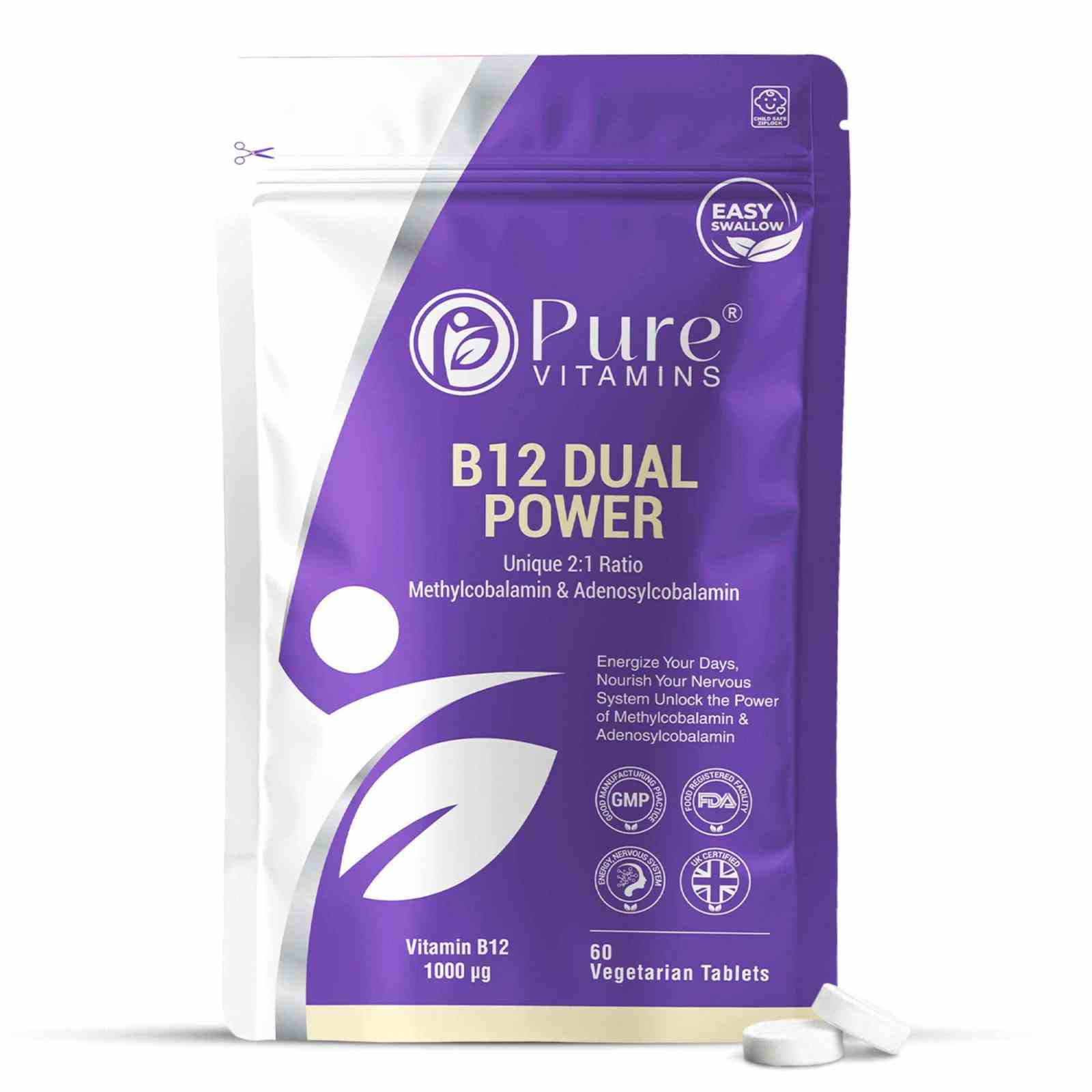
Our Vitamin B12 uses both active forms together at 1,000 micrograms per serving. To be honest with you, all forms can raise your B12 status, and for most people the practical difference is modest; the appeal of the active forms is simply that they are the versions the body uses directly. I compare them properly, including the injectable form, in B12 forms explained.
Absorption, and why the label number is so large
This is the bit that explains an otherwise baffling label. B12 absorption depends on intrinsic factor, a protein made by the stomach lining, which escorts the vitamin to be absorbed further down the small intestine. That pathway is efficient but easily saturated, so it can only handle a small amount at a time, in the region of one to two micrograms per dose.
Above that, a second route takes over: passive diffusion, which absorbs roughly one per cent of whatever is present, without needing intrinsic factor at all. That is why a supplement carries 1,000 micrograms rather than the 1.5 micrograms of the reference intake. It is not mega-dosing for its own sake; it is arithmetic, designed so that the one per cent that gets through passively is still a useful amount. It is also why supplements can work for people whose intrinsic factor pathway is impaired, though anyone in that position should be guided by their GP rather than self-managing.
Who is most at risk of low B12?
Because B12 is found almost exclusively in animal foods, some groups are much more likely to run low:
- Vegans and vegetarians, since plant foods are not a dependable source;
- older adults, because stomach acid production and absorption both tend to decline with age;
- people on certain long-term medicines, particularly metformin and acid-suppressing drugs such as proton pump inhibitors, which reduce absorption;
- people with absorption conditions, such as pernicious anaemia, coeliac disease or Crohn's disease;
- people who have had gastric or bowel surgery, where the absorbing surface itself has changed;
- anyone whose overall intake has dropped sharply, for any reason, since animal foods are often among the first things to go.
There is more on the signs and at-risk groups in B12 deficiency: symptoms and who is at risk, and if your intake has fallen generally, our guide to supplements while on a calorie deficit puts B12 alongside the other nutrients that slide.
Do vegans need a B12 supplement?
This is the one nutrient nearly every credible source agrees plant-based eaters should supplement. Because dependable B12 comes from animal foods, a supplement or genuinely fortified foods is the sensible, widely recommended route for anyone eating vegan or largely vegetarian. It is the single most important supplement for a vegan diet, which is why our B12 is a vegetarian and vegan-friendly formula. More in do vegans need a B12 supplement.
A lesser-known interaction: folic acid can mask B12 deficiency
Here is a genuinely useful, under-discussed point. High intakes of folic acid, from high-dose supplements or heavy fortification, can mask the blood signs of a B12 deficiency while the underlying shortfall, and its potential effects on the nervous system, continue unchecked. Based on a review retrieved from PubMed, excess folic acid may exacerbate B12 deficiency in at-risk people, and the authors urged extra vigilance in older adults and those with low B12 intake or malabsorption (Miller et al., 2024, Food and Nutrition Bulletin; DOI 10.1177/03795721241229503, full text on PMC).
The practical message: if you take high-dose folic acid and you are in an at-risk group, make sure your B12 status is actually checked rather than assumed. This is also the mechanism behind the standard clinical practice of testing folate and B12 together rather than one alone.
How much is too much: the upper limit question
B12 is water-soluble and considered to have low toxicity, and no Tolerable Upper Intake Level has been set for it, because excess is generally excreted rather than stored to harmful levels. That is also why supplement doses look very large compared with the nutrient reference value, as explained in the absorption section above.
One caveat worth stating plainly. "No upper limit set" means no level of harm has been established, not that more is better. Beyond covering your needs, additional B12 is simply excreted, so there is nothing to be gained from stacking products. Follow the label and prioritise consistency over size.

When to see your GP, and when not to wait
This is where I would rather be useful than salesy, so here is the line as I would give it to a friend.
Make a routine appointment if: you have had unexplained tiredness for more than a few weeks; you have been eating vegan or largely plant-based without a reliable B12 source; you take metformin or a long-term acid-suppressing medicine; you are over 60 and feeling persistently below par; or you have a sore, smooth tongue or recurrent mouth ulcers alongside fatigue.
Do not wait if: you have pins and needles, numbness or any change in sensation; you are unsteady on your feet or your balance has changed; you have noticed changes in vision; you feel confused or your memory has changed noticeably; or you are markedly breathless or very pale. Nerve symptoms in particular deserve prompt attention, because the longer they go unaddressed the less reliably they resolve.
And the honest framing on supplements in all of this: a supplement is a way of covering dietary intake. It is not a diagnosis, it is not a treatment for a confirmed deficiency, and starting one before a blood test can muddy the result. If you genuinely suspect a deficiency, get tested first, and let the test guide what happens next.
A few cautions worth knowing
- Medication: metformin and long-term acid-suppressing medicines can lower B12 absorption, so mention them to your GP or pharmacist.
- Folic acid: as above, high folic acid intake can mask a B12 deficiency, so the two are worth considering together.
- Before testing: starting a supplement shortly before a blood test can obscure the picture. Speak to your GP about timing.
- High-dose biotin from hair and nail products can interfere with some laboratory assays, so declare everything you take.
- Suspected deficiency: persistent tiredness, tingling or neurological symptoms should be assessed by your GP, who can arrange a blood test rather than you self-diagnosing.
- Pregnancy, breastfeeding or a medical condition: check before starting any new supplement.
How to choose and take a B12 supplement
- Form: the active forms, methylcobalamin and adenosylcobalamin, are the body-ready coenzyme forms; many people prefer them over cyanocobalamin.
- Diet suitability: check it is vegan-friendly if you need that; ours is.
- Sensible dose: large label numbers reflect low absorption efficiency, not a need to mega-dose.
- Consistency beats size: a daily habit at a moderate dose does more than an occasional very large one, because the passive absorption route works on what is present each day.
- Quality: tested for purity and heavy metals at our GMP-certified facility and formulated in the UK.
- How to take: our B12 is two tablets daily with water, preferably with a meal, taken consistently.

The takeaway
Vitamin B12 genuinely contributes to normal energy-yielding metabolism, the reduction of tiredness and fatigue, and normal nervous-system function: real roles, not an instant-buzz myth. The UK reference intake is only 1.5 micrograms a day, but it comes almost entirely from animal foods, so vegans, older adults and people on certain medicines are most likely to run short. The early signs are real but non-specific, high folic acid intake can mask them, and nerve symptoms deserve prompt attention, which is why testing matters more than guessing. For a body-ready option, our Vitamin B12 (methylcobalamin and adenosylcobalamin) uses the two active forms. Everything we have written by nutrient sits together on the supplement guides hub, and you can browse the full range at the Pure Vitamins UK home page.
Signed, Dr. Miron, Founder of Pure Vitamins UK.
Frequently asked questions
What are the early signs of low B12?
The ones commonly reported early are tiredness and weakness that rest does not shift, breathlessness on mild exertion, pale or faintly yellow-tinged skin, a sore or unusually smooth tongue and mouth ulcers, pins and needles in the hands and feet, changes in memory or concentration, low mood, and reduced appetite. All of them have many other possible causes, so they are a reason to ask for a blood test rather than a basis for self-diagnosis.
What is the difference between low B12 and B12-deficiency anaemia?
Low B12 means your levels have fallen, and you may have few or no symptoms. B12-deficiency anaemia is what can follow, where the bone marrow cannot divide cells properly and produces red blood cells that are abnormally large and fewer in number, causing tiredness, breathlessness and pallor. Importantly, nerve-related symptoms can develop independently of the anaemia, so a normal blood count does not rule a problem out.
How does a GP test for B12 deficiency?
Usually with a serum B12 blood test, with folate checked at the same time because the two deficiencies look alike, plus a full blood count to see whether red cells are enlarged. Where the result is borderline, second-line tests such as methylmalonic acid or active B12 may follow, and an antibody test if an absorption problem like pernicious anaemia is suspected.
What does vitamin B12 do?
Vitamin B12 contributes to normal energy-yielding metabolism, the reduction of tiredness and fatigue, normal functioning of the nervous system, normal psychological function, normal red blood cell formation, normal homocysteine metabolism and the normal function of the immune system, and it has a role in cell division.
Which foods contain vitamin B12 in the UK?
Liver is by far the richest source, followed by oily fish and shellfish such as mackerel, salmon, sardines and mussels, then red meat, poultry, eggs and dairy. A pint of milk alone covers the 1.5 microgram daily reference intake. For plant-based eaters the reliable route is fortified foods, meaning fortified breakfast cereals, fortified plant milks and some yeast extracts. Mushrooms, seaweed, spirulina and unfortified nutritional yeast are not dependable sources.
What is the difference between B12 forms?
Cyanocobalamin is a cheap, stable synthetic form the body must convert. Methylcobalamin and adenosylcobalamin are the active coenzyme forms the body uses directly, and hydroxocobalamin is the form typically used for injections. All forms can raise B12 status; the appeal of the active forms is that they are used directly.
Why do B12 supplements contain 1,000 micrograms when I only need 1.5?
Because of how absorption works. The efficient route depends on intrinsic factor from the stomach and saturates at roughly one to two micrograms per dose. Above that, only passive diffusion is available, which absorbs about one per cent of whatever is present. A large label figure is designed so that one per cent is still a useful amount, rather than being mega-dosing for its own sake.
Can folic acid hide a B12 deficiency?
Yes. High intakes of folic acid can mask the blood signs of B12 deficiency while the underlying shortfall continues, so people in at-risk groups who take high-dose folic acid should have their B12 status checked rather than assumed. It is also why folate and B12 are normally tested together.
Is there an upper limit for B12?
No Tolerable Upper Intake Level has been set for B12. It is water-soluble with low toxicity, and excess is generally excreted. That means no level of harm has been established, not that more is better; beyond covering your needs, extra B12 is simply excreted.
Research findings are paraphrased from the published literature as science and are not product claims; sources are linked to their PubMed Central records above. This article is for general information, not medical advice. Food supplements should not be used as a substitute for a varied, balanced diet and a healthy lifestyle. If you are pregnant, breastfeeding, taking medication or managing a medical condition, speak to your GP or pharmacist before starting a new supplement. Persistent tiredness or suspected deficiency should be assessed by your GP, who can arrange a blood test.
