


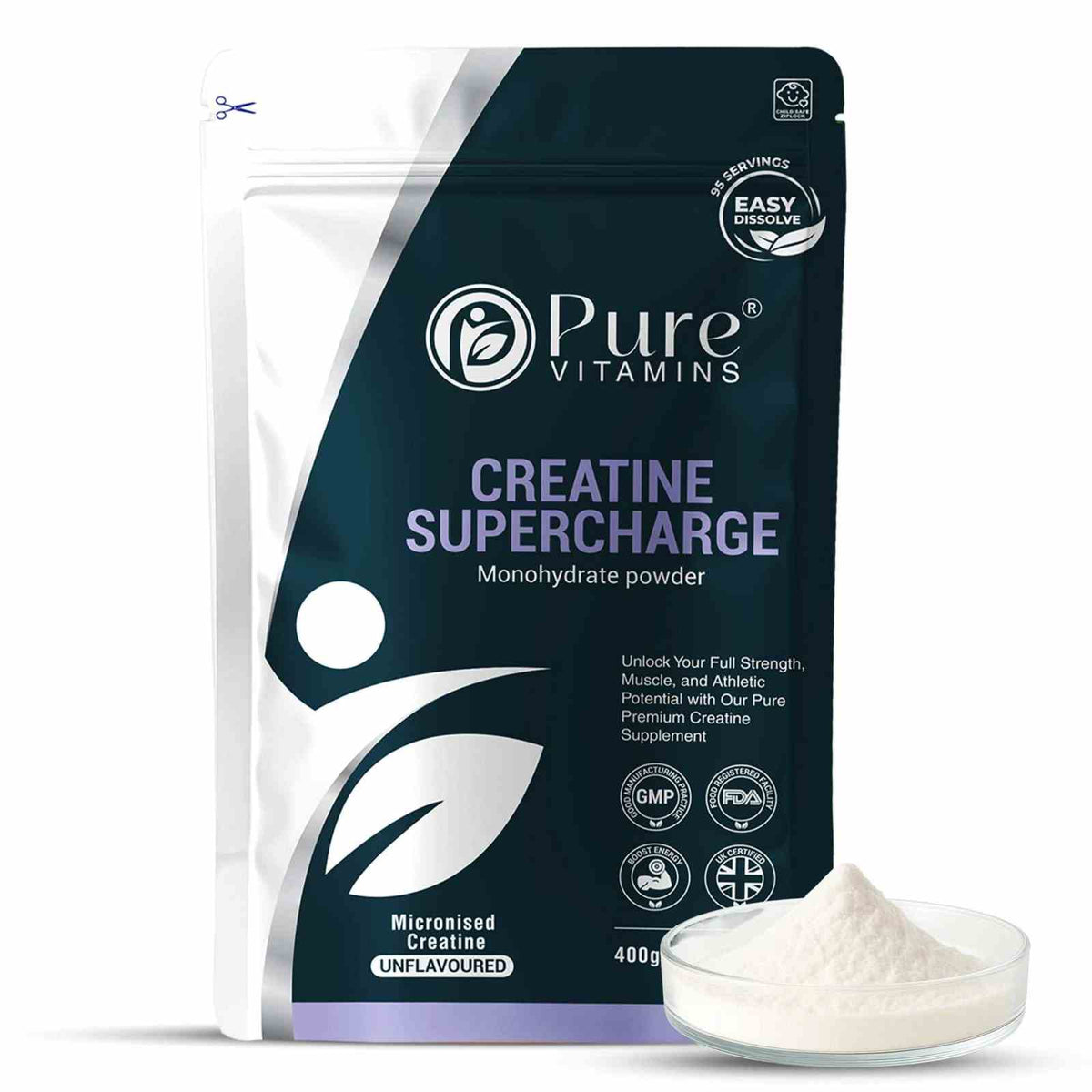
If you gained weight after taking creatine, the most likely explanation is water, not fat. Seeing the scales jump by a few pounds in your first week or two on creatine monohydrate is one of the most common things people notice, and it almost always reflects a shift in body water rather than new body fat. This UK guide explains what is happening inside your muscles, what the research actually measured, why ten pounds sits at the unusual end of the range, and what you can do if you would rather avoid the early bump.
Why you gained weight after taking creatine: the short answer
When you gain weight after taking creatine, your muscle cells are holding on to more water. Creatine is stored inside skeletal muscle as phosphocreatine, part of the body's fast energy system. Creatine is also osmotically active, which simply means it pulls water in alongside it. As your muscles take up and store more creatine, they draw extra water into the muscle cell to keep it company. The number on the scales rises, but the change is fluid being stored inside the muscle, not fat being added to your body.

This is why the increase tends to appear quickly, often within the first seven days, and why it is most noticeable in people who begin with a high-dose loading approach. It is a storage effect, not a calorie effect. Creatine carries no meaningful calories that could be turned into fat, so the early weight is water finding a home inside your muscle tissue.
Is it really 10 pounds? What the numbers usually look like
Ten pounds, which is about 4.5 kg, sits at the high end and is more than most people actually experience. Across the published research, the typical early increase in body mass with creatine loading is closer to 1 to 2 kg, which is roughly 2 to 4 pounds. If your scales have moved by a full ten pounds, some of that is very likely layered on top of the creatine water shift: the carbohydrates and salt you take it with, normal day-to-day swings in hydration, food sitting in your gut, and any genuine changes from your training and diet over the same few weeks. Creatine on its own rarely accounts for a ten-pound jump.
It also helps to know that not everyone responds the same way. People who already eat plenty of red meat and fish, the main dietary sources of creatine, often start with fuller muscle stores and notice very little change. Vegetarians and vegans, who take in almost no creatine from food, sometimes notice a larger initial shift simply because their muscles had more room to fill.
What the research shows: creatine and total body water
The clearest study on this exact question comes from Powers and colleagues, published in the Journal of Athletic Training in 2003. Across 28 days, men and women following a loading protocol (25 g a day for a week, then 5 g a day) had their body mass and total body water measured directly using deuterium oxide dilution. The creatine group showed a significant rise in muscle creatine, body mass, and total body water, while fluid distribution between compartments did not change. In plain terms, the added weight was water, and it was stored in a normal, balanced way rather than pooling abnormally. According to this research indexed on PubMed, the weight gain and the water gain moved together (Powers ME et al., 2003: PubMed 12937471; full text at PMC155510).

More recent work points the same way. A 2023 controlled trial by Buck and colleagues found that one week of creatine produced about a 2% rise in total body water, which body-composition devices then registered as an increase in so-called fat-free mass (Buck EA et al., 2023: DOI). A separate trial by Ribeiro and colleagues reported that intracellular water rose alongside resistance training in the creatine group (Ribeiro AS et al., 2020: DOI). The consistent thread across these studies, all indexed on PubMed, is that early weight change on creatine tracks body water, and specifically water held inside the muscle cell.
Where the water actually goes
This detail matters for how the change looks and feels. Because the water is drawn into the muscle cell itself rather than sitting under the skin, many people find their muscles look a little fuller rather than soft or puffy. Powers and colleagues found the balance between intracellular and extracellular fluid stayed the same, and Ribeiro's group specifically measured the intracellular compartment rising. A minority of people do report a softer look in the first couple of weeks, which is individual and usually settles as stores stabilise.
Water weight is not fat: why the distinction matters
Gaining fat requires taking in more energy than you burn over time. Creatine provides essentially no calories, so it cannot add fat on its own. The scale simply cannot tell the difference between a kilogram of water and a kilogram of fat, which is what makes the first week misleading. If your goal is body composition, the early scale jump is one of the least useful things to judge yourself by.
A more honest way to track progress is to look across several weeks: how your clothes fit, simple tape measurements, and how you look in the mirror, rather than the number that appeared on day five. Treat the initial creatine weight as a one-off water adjustment and read the trend, not the spike. And if your real aim is a flatter stomach rather than the number on the scale, it is worth knowing that creatine does not burn belly fat either, so that work is done by your overall diet, activity and consistency.

How to reduce or avoid the initial water weight
Skip the loading phase
The fast scale jump is mostly driven by loading, which means taking around 20 to 25 g a day for a week to fill muscle stores quickly. You do not have to load. Taking a steady 3 to 5 g a day reaches the same muscle saturation over roughly three to four weeks, with the water arriving gradually instead of all at once, so the scale change is smaller and slower. Our micronised creatine monohydrate is built for exactly this approach: one level 5 g serving a day, no loading required. If you want the detail on saturation, see our guide to creatine loading, dosing and saturation.
Give it a few weeks
The initial water shift is a single adjustment as your muscles top up their stores. Once they are saturated, body weight tends to settle at the new level and stops climbing. In other words, the early gain is not an ongoing trend, it is your muscles reaching a new baseline and then holding steady.
What happens if you stop taking creatine?
If you stop, the extra water your muscles were holding gradually leaves over a few weeks as muscle creatine returns to its natural baseline, and the scale typically drifts back down by a similar amount to what it went up. There is nothing harmful in this, it is simply the same storage effect running in reverse. For more on the everyday practicalities, our notes on creatine timing and usage may help.
An honest note on the evidence
The water-weight explanation is well supported, but a few caveats are fair. Most body-water studies are short and involve small groups of participants. Some rely on bioelectrical impedance, which estimates body water rather than measuring it with perfect precision. Responses also vary from person to person, so your experience may sit above or below the averages. And because water counts as fat-free mass, a rise in fat-free mass on a body-composition scan can be misread as new muscle when part of it is simply stored fluid. We think it is more useful to understand the mechanism than to chase the number on the scale. If you have come across alarming claims online, our honest look at common creatine myths puts them in context.
Safety and who should take care
Creatine monohydrate is one of the most widely studied supplement ingredients, and it is generally well tolerated by healthy adults. Some people notice mild stomach discomfort, which is usually linked to large loading doses taken in one go, another reason a single daily 5 g serving suits most people better. Drink fluids as you normally would. As with any supplement, if you are pregnant or breastfeeding, have a health condition, or take any medication, speak to your GP or pharmacist before starting. A food supplement is not a substitute for a varied, balanced diet.
How we make our creatine
Our creatine is 100% micronised creatine monohydrate: a single ingredient, milled ultra-fine so it mixes cleanly without grit, with a full and transparent 5 g per serving and no fillers, flavourings, sweeteners or anti-caking agents. It is vegan-friendly, formulated in the UK, and tested for purity and heavy metals at our GMP-certified facility. If you are weighing up forms, our explainer on creatine monohydrate versus HCl and the primer on what creatine is and how it works are good next reads.

Shop Micronised Creatine Monohydrate
If you would rather avoid the early water spike, skipping the loading phase and taking a steady daily serving is the simplest route. Our micronised creatine monohydrate provides 3.5g per level teaspoon, enough to reach full muscle saturation gradually.
Dr. Miron, Founder of Pure Vitamins UK
This article is for general information and is not medical advice. Food supplements should not be used as a substitute for a varied, balanced diet and a healthy lifestyle. If you are pregnant, breastfeeding, have a medical condition or are taking medication, consult a healthcare professional before use.
