


Reviewed and updated: 23 July 2026
Ginkgo biloba is the ingredient in Man's Prime Blue with the longest CV, and the one whose whole reputation is built on one thing: circulation. In this piece I will walk you through it properly, the tree it comes from, the two families of compounds that do the work, how those compounds are absorbed, and the blood-flow mechanisms, including the nitric oxide side, that explain why ginkgo has been a circulation herb for centuries. As always, no promises, just the chemistry and the heritage, so the reasoning behind the formula is transparent.
A living fossil
Ginkgo is one of the oldest tree species still on earth, effectively unchanged for something like two hundred million years, which is why it is often called a living fossil. Its fan-shaped leaves have been used in traditional Chinese herbalism for centuries, and in modern Europe a standardised leaf extract became one of the most studied and most widely used plant preparations there is. Its traditional and best-evidenced association is with blood flow and circulation, and because so much of male vitality, sexual wellbeing very much included, runs on healthy blood flow, that circulation heritage is exactly why men have taken an interest in ginkgo and why it belongs in a men's botanical complex.

The two families of compounds
Ginkgo's activity comes from two distinct groups of molecules working together. First, the flavonol glycosides, roughly 24% of a proper standardised extract, built mostly on quercetin, kaempferol and isorhamnetin. These are the antioxidant, free-radical-scavenging side of ginkgo. Second, and unique to this plant, the terpene lactones, around 6%, which split into the ginkgolides (A, B and C, about 3.1% of the extract) and bilobalide (about 2.9%). According to PubMed, a food-science review of ginkgo describes exactly this composition of the standardised extract, 24% flavonoid glycosides and 6% terpene lactones with under 5 parts per million of the allergenic ginkgolic acid, and notes that the flavonoid and terpenoid constituents appear to act in a complementary way (Mahadevan and Park, 2007, DOI).
This is what "50:1, standardised, 85 to 100% purity" on our label is really about. A 50:1 concentrate means fifty parts of leaf reduced to one part of extract, standardised so the flavonoid and terpene-lactone percentages are consistent, and purified so the ginkgolic acid is kept right down. A regulatory safety assessment of ginkgo extract from EFSA describes the same benchmark composition, at least 24% total flavonoids and at least 6% terpene lactones with ginkgolic acids held to trace levels (EFSA, 2024, DOI).
How ginkgo is absorbed
The two compound families behave differently once you swallow them, which is part of ginkgo's charm. The terpene lactones, the ginkgolides and bilobalide, are relatively well absorbed and appear in the bloodstream with fairly short, predictable half-lives of a couple of hours (EFSA, 2024, DOI). The flavonoid glycosides are the opposite story: in their sugar-bound glycoside form they are poorly absorbed, and your gut bacteria have to cleave them into their aglycone forms before much gets through, after which the liver conjugates them further (Mahadevan and Park, 2007, DOI). That gut-conversion step is a recurring theme with botanicals, and it is another reason a clean, well-standardised extract taken consistently makes more sense than a random dose of powdered leaf.

The blood-flow mechanisms
Ginkgo works on circulation through more than one route, which is what makes it interesting rather than a one-trick herb. The headline mechanism is platelet-activating factor, or PAF: the ginkgolides, especially ginkgolide B, are natural PAF antagonists, meaning they dial down the signal that makes platelets clump together, which supports smoother blood flow (Noor-E-Tabassum et al., 2022, DOI). On top of that, the food-science review describes ginkgo stimulating endothelium-derived relaxing factor, which is nitric oxide, the same vessel-widening signal we talked about with ginseng, alongside its antioxidant and microcirculatory actions, with the flavonoids and terpenoids complementing each other (Mahadevan and Park, 2007, DOI). So you have an antioxidant fraction protecting the vessel lining, a terpene fraction easing platelet stickiness, and a nudge to the nitric oxide pathway that relaxes the vessels themselves.
Why that matters for male vitality
Healthy circulation quietly underpins a great deal of how a man feels day to day, from clear-headedness to physical vitality to sexual wellbeing, all of which lean on good blood flow and nitric-oxide signalling. Ginkgo has been the circulation herb for centuries, and in modern use that reputation has extended quite naturally to the blood-flow side of male sexual wellbeing, which is precisely why it sits in the Blue formula. I will still leave the conclusion to you, my job here is to show you the mechanism honestly rather than make a promise, but you can see where it points.
Why it sits in Man's Prime Blue, at 50:1
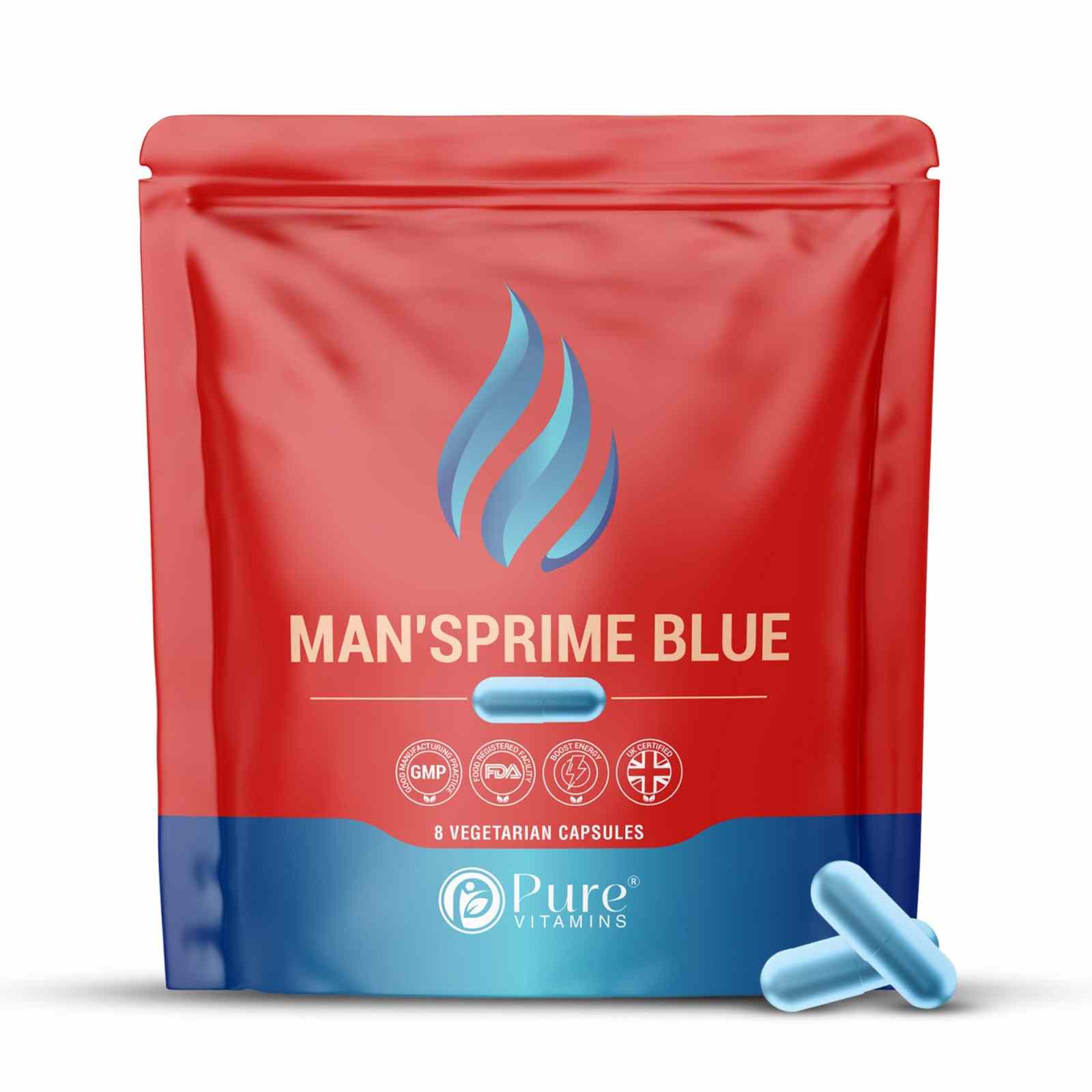
Blue is our fast-absorbing formula, and ginkgo is its circulation anchor. Using a high-grade 50:1 standardised leaf extract means the flavonoid and terpene-lactone content is concentrated and consistent, and the low ginkgolic-acid purity spec is a genuine quality and tolerability marker, not just a number. Alongside ginseng and maca it rounds out a complex aimed at circulation and everyday vitality, in a plant-based capsule designed to be taken as and when it suits you rather than as a daily foundation, which is the job Gold does.

A few cautions worth knowing
Ginkgo is the ingredient here that needs the most respect, precisely because it works on platelets and blood flow. Please check with your GP or pharmacist first if any of these apply:
- Blood thinners and antiplatelet medicines: this is the big one. Because ginkgolides reduce platelet aggregation, ginkgo can add to the effect of warfarin, aspirin or similar, so do not combine them without medical advice.
- Surgery or dental procedures: stop ginkgo at least two weeks beforehand and tell your surgical team, again because of the effect on platelets.
- A seizure history: caution is generally advised with ginkgo, so speak to your doctor first.
- Other regular medication: ginkgo can interact with several medicines, so if you take anything regularly, check before adding it.
- Pregnancy and breastfeeding: not suitable. This is a men's formula, but worth stating.
You can see the full seven-botanical formulation on the Man's Prime Blue page, and the daily-foundation formula on the Man's Prime Gold page.
Dr. Miron, Founder of Pure Vitamins UK
This article is for general information and education and is not medical advice. Food supplements are not a substitute for a varied, balanced diet and a healthy lifestyle, and are not intended to diagnose, treat, cure or prevent any condition. Suitable for men aged 18 and above. If you take medication, especially blood thinners, or have a health condition, speak to your GP or pharmacist before use.
Sources
- Mahadevan S, Park Y. Multifaceted therapeutic benefits of Ginkgo biloba L.: chemistry, efficacy, safety, and uses. Journal of Food Science, 2007. https://doi.org/10.1111/j.1750-3841.2007.00597.x
- Noor-E-Tabassum, et al. Ginkgo biloba: a treasure of functional phytochemicals with multimedicinal applications. Evidence-Based Complementary and Alternative Medicine, 2022. https://doi.org/10.1155/2022/8288818
- EFSA FEEDAP Panel. Safety and efficacy of a dry extract from the leaves of Ginkgo biloba L. EFSA Journal, 2024. https://doi.org/10.2903/j.efsa.2024.8733
