


Reviewed and updated: 23 July 2026
Panax ginseng is one of the most storied roots in the whole of herbal tradition, and it is also one of the more genuinely interesting once you look at what is happening inside it. In this piece I want to take you through it the way I would explain it to a friend: where it comes from, the actual compounds it carries, how your body absorbs them, and the nitric oxide mechanism that sits at the heart of why it has been valued for men for so long. No promises, just the biochemistry and the heritage, so you can see for yourself why it earns its place in Man's Prime.
What Panax ginseng actually is
Panax ginseng, sometimes called Korean or Asian ginseng, is the "true" ginseng, and it has been a cornerstone of traditional East Asian herbalism for around two thousand years. The name Panax shares a root with "panacea," which tells you how highly the old herbalists rated it. Traditionally it was taken to build stamina and to help the body cope with fatigue and physical stress, the classic profile of a tonic root you take steadily over time rather than a quick hit. It has also long been prized by men in particular, as a tonic for vigour, drive and vitality, which is a big part of why it anchors a men's formula. The part used is the root, and quality varies enormously depending on how it is grown, harvested and extracted, which is exactly why standardisation matters.

The compounds inside: ginsenosides
The active chemistry of ginseng comes down mostly to a family of molecules called ginsenosides, which are triterpene saponins built on a dammarane skeleton. There are more than thirty of them, and the ones researchers talk about most are Rb1, Rg1 and Rg3, split broadly into two families (the protopanaxadiols and protopanaxatriols) that behave slightly differently in the body. According to PubMed, a review of ginseng pharmacology describes these ginsenosides as the main active components behind its effects on the cardiovascular system, the nervous system and metabolism, while being honest that the literature is mixed partly because ginsenoside content varies so much between products (Gillis, 1997, DOI). This is why a serious formula uses a standardised extract, ours is a concentrated 4:1 standardised for ginsenoside content, rather than a scoop of cheap root powder where you have no idea what you are getting.
How ginseng is actually absorbed
Here is the part most articles skip, and it is genuinely fascinating. Ginsenosides in their natural form are large, sugar-decorated molecules that your small intestine absorbs poorly on their own. What happens instead is that your gut bacteria go to work on them, snipping off the sugar groups and converting them into smaller metabolites, the best known being compound K, which is far more readily absorbed and is thought to carry a lot of the real activity. According to PubMed, a review of herb and gut-microbiota interactions highlights ginseng as a prime example of this "microbiota availability," where the bugs in your gut effectively finish the job of turning the herb into something your body can use (Chen et al., 2015, DOI). Two practical takeaways fall out of this: your own gut flora influences how well ginseng works for you, and consistent daily use tends to matter more than any single dose.

The nitric oxide mechanism
Nitric oxide is one of the body's master signals for blood flow. It is made in the thin endothelial lining of your blood vessels, and when it is released the vessel wall relaxes and widens, letting more blood through. This is the pathway that a lot of ginseng's most interesting research circles back to. According to PubMed, an acute randomised, double-blind, placebo-controlled crossover trial in healthy adults found that Korean red ginseng improved flow-mediated dilation, a standard non-invasive measure of how well the endothelium relaxes a blood vessel, and that the effect tracked specifically to the ginsenoside fraction rather than the polysaccharides (Jovanovski et al., 2014, DOI). That sits on top of a long-standing line of work first drawn together in the Gillis review, which proposed that many of ginseng's organ-protective and vasodilatory effects are linked to enhanced nitric oxide synthesis in the endothelium (Gillis, 1997, DOI).
Circulation and male vitality
Now for the part men actually want to know about. Nitric oxide is not a local trick; it is the same signal that governs blood flow throughout the body, and that includes the specialised vascular tissue involved in sexual function, which leans heavily on healthy nitric-oxide signalling and good circulation. This is not a modern marketing angle bolted on afterwards: supporting male vitality and sexual wellbeing is genuinely one of the things ginseng has been best known for across its long history, and the very review that first framed the root as a "nitric oxide link" pointed to exactly this connection, in the same breath as its centuries-old reputation as a male tonic (Gillis, 1997, DOI). I will still not make you a promise, because a food supplement does not get to and every man is different. But the biochemistry and the centuries of tradition happen to point the same way, and that is rather the point.
Why it sits in Man's Prime, and at 4:1
In our men's formulas, ginseng plays two roles at once: it is an adaptogen with that traditional stamina-and-resilience heritage, and it is a circulation-and-nitric-oxide botanical. We use a concentrated 4:1 standardised extract rather than raw powder so the ginsenoside content is meaningful and consistent batch to batch, and we pair it with the other botanicals, maca, ginkgo in the Blue formula, and the rest, so the complex covers vitality, circulation and everyday resilience together rather than leaning on any single herb. It is built to be taken steadily. Given how much of ginseng's effect depends on that gut-metabolism step, daily consistency is the whole game.

A few cautions worth knowing
Ginseng is well tolerated by most healthy men, but it is genuinely active, so a few sensible checks apply. Have a word with your GP or pharmacist first if any of these fit you:
- Blood-sugar or diabetes medication: ginseng can influence blood glucose, so it is worth flagging if you take anything for it.
- Blood thinners: if you take warfarin or antiplatelet medicines, check first, as interactions have been reported.
- Blood pressure medication: given the vascular activity, mention it to your prescriber if you are treated for blood pressure.
- Sleep: some people find ginseng a touch energising, so if you are sensitive, a morning dose suits better than late in the day.
- Pregnancy and breastfeeding: not suitable. These are men's formulas in any case, but worth stating plainly.
- Surgery: it is usually advised to stop herbal supplements a couple of weeks beforehand; tell your surgical team what you take.
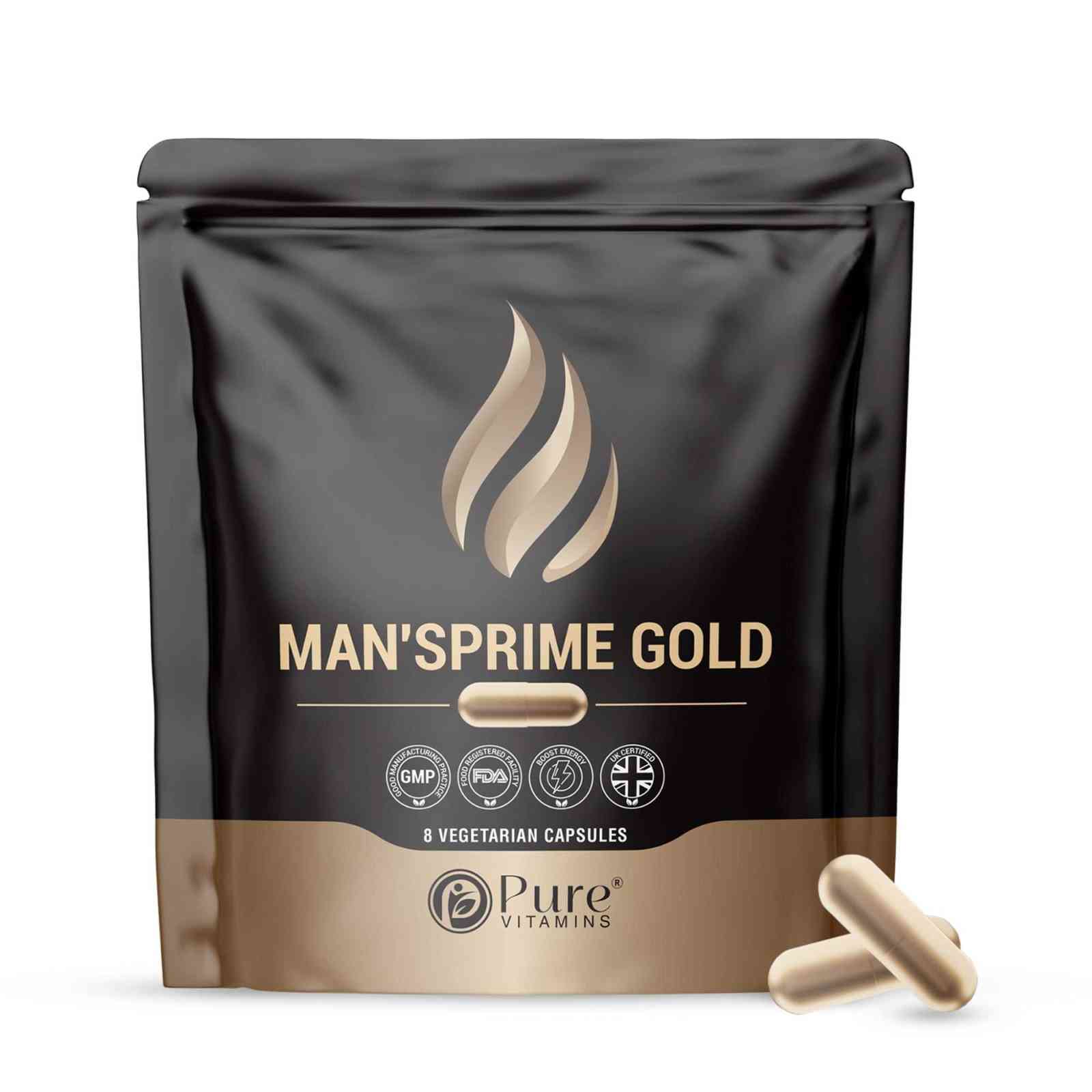
You can see the full formulation, the other six botanicals and how we make it on the Man's Prime Gold page, and the fast-absorbing version that adds ginkgo on the Man's Prime Blue page.
Dr. Miron, Founder of Pure Vitamins UK
This article is for general information and education and is not medical advice. Food supplements are not a substitute for a varied, balanced diet and a healthy lifestyle, and are not intended to diagnose, treat, cure or prevent any condition. Suitable for men aged 18 and above. If you take medication or have a health condition, speak to your GP or pharmacist before use.
Sources
- Gillis CN. Panax ginseng pharmacology: a nitric oxide link? Biochemical Pharmacology, 1997. https://doi.org/10.1016/s0006-2952(97)00193-7
- Jovanovski E, et al. Modulation of endothelial function by Korean red ginseng in healthy individuals: a randomized controlled trial. Cardiovascular Therapeutics, 2014. https://doi.org/10.1111/1755-5922.12077
- Chen F, et al. Could the gut microbiota reconcile the oral bioavailability conundrum of traditional herbs? Journal of Ethnopharmacology, 2015. https://doi.org/10.1016/j.jep.2015.12.031
