


Reviewed and updated: 22 July 2026
If you have started taking ashwagandha and want to get a little more from it, the best combo with ashwagandha is really the one that fits how you want to feel. Most people settle on one of three simple pairings: ashwagandha with magnesium to help wind down in the evening, ashwagandha with L-theanine for calm, steady focus through the day, and ashwagandha with a B vitamin to support everyday energy. Below I will walk you through each one, why it works, and how to put it together sensibly.
What is the best combo with ashwagandha? The short answer
Ashwagandha has been used in Ayurveda for well over two thousand years as a grounding, calming root, the kind of thing people reach for when life feels busy and they want to feel a bit more steady. It works quietly and over time, which is exactly why it pairs so nicely with other ingredients that do something a little different. Match it to your goal and keep the routine simple, and you will get far more from it than piling on capsules.

TL;DR
- What it is: a friendly guide to the ingredients people most often pair with ashwagandha, and why each combination makes sense.
- Who it is for: anyone building a simple daily routine around a good, standardised ashwagandha such as KSM-66.
- The three pairings people love: ashwagandha and magnesium for the evening, ashwagandha and L-theanine for calm daytime focus, and ashwagandha and B vitamins for everyday energy.
- One thing to remember: ashwagandha, L-theanine and magnesium are all calming, so go gently if you take sleep or sedative medicines, and give it a miss during pregnancy and breastfeeding. If in doubt, have a quick word with your GP or pharmacist.
Why people pair ashwagandha with other ingredients
Ashwagandha (Withania somnifera) is an adaptogen, one of a handful of traditional plants people have long turned to for a sense of calm and resilience when they are under pressure. Because it works in its own gentle, cumulative way, it leaves plenty of room for a partner ingredient that brings something else to the table, whether that is a mineral your body genuinely runs on, or a green-tea amino acid that people find helps them feel settled the same afternoon. Stacking is really just about covering more than one need without overcomplicating things. If you are new to the category, our piece on what an adaptogen is is a nice place to start, and what KSM-66 ashwagandha is explains the extract we use.
Ashwagandha and magnesium: the classic evening wind-down
This is the pairing most people have in mind when they think about calming down at the end of the day. Ashwagandha brings its traditional grounding quality, and magnesium is the mineral your nervous system genuinely depends on. Magnesium contributes to normal psychological function, to the normal functioning of the nervous system, to normal muscle function and to a reduction of tiredness and fatigue, so it earns its place in an evening routine rather than just riding along.
There is some lovely research here too. According to PubMed, a randomised, placebo-controlled trial in healthy adults who slept poorly found that magnesium bisglycinate helped modestly with their sleep over four weeks, though the researchers were honest that the effect was small (Schuster et al., 2025, DOI). And a 60-day study of a standardised ashwagandha extract in stressed but otherwise healthy adults saw lower anxiety-scale scores and lower morning cortisol than placebo, while the authors sensibly called for larger trials to build on it (Lopresti et al., 2019, DOI). Think of these as what the science is exploring about the ingredients, not a promise about any one bottle.

If this is your combo, our guide on magnesium and ashwagandha together goes deeper, and a gentle, well-absorbed form like our magnesium glycinate 3-in-1 is an easy one to reach for at night.
Ashwagandha and L-theanine: calm focus while you get on with your day
L-theanine is the amino acid in green tea that many people associate with feeling relaxed but clear-headed, that mellow focus a good cup of tea can give you without the jitters. What makes it such a natural partner for ashwagandha is timing. Ashwagandha works slowly in the background over weeks, while L-theanine is something people notice the same day. According to PubMed, a randomised, placebo-controlled crossover study in healthy adults found an L-theanine drink softened the stress response to a demanding multitasking task about an hour after it was taken, with matching changes in calm, resting alpha brain activity (White et al., 2016, DOI).
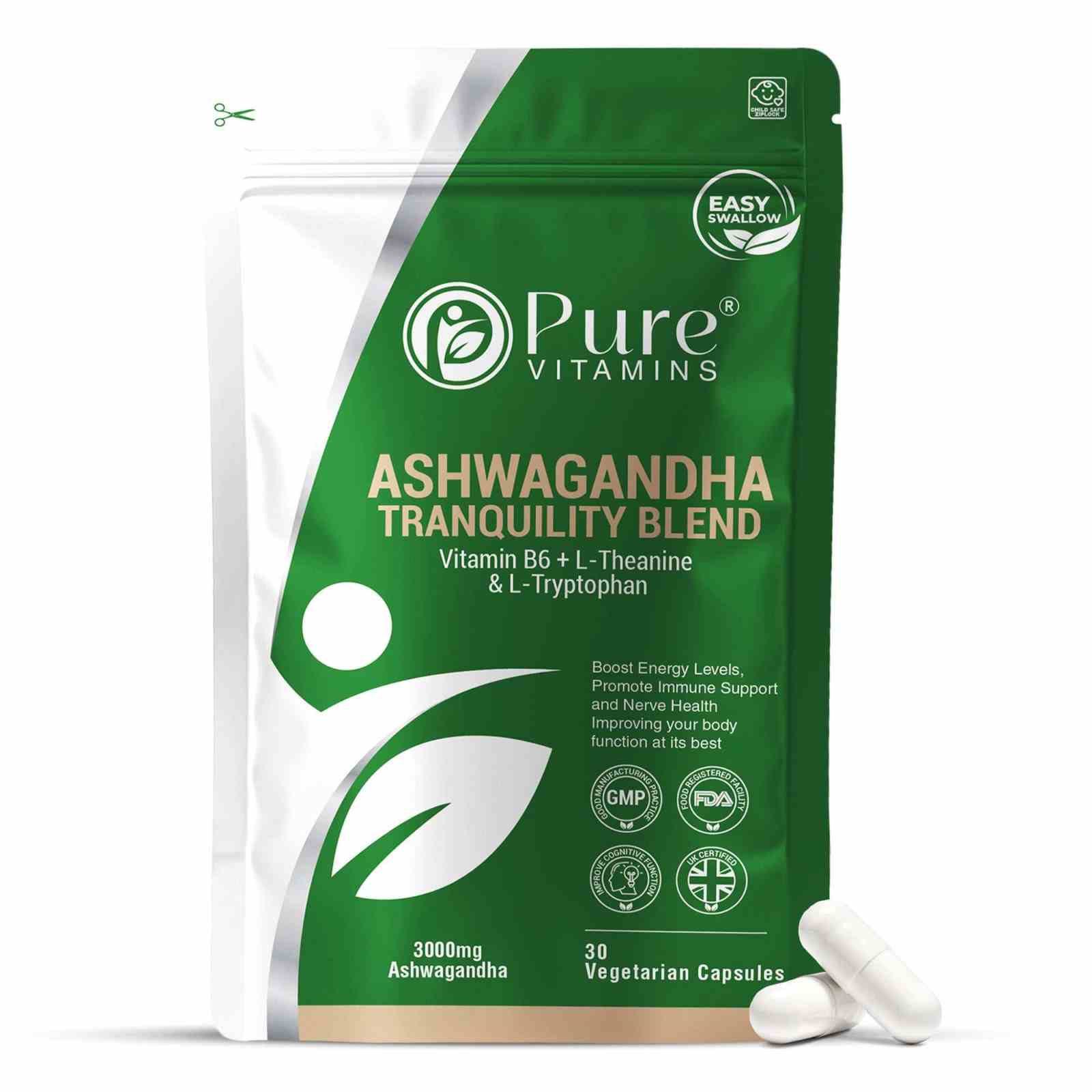
That pairing is exactly why we built our KSM-66 ashwagandha with L-theanine and vitamin B6 the way we did, bringing the two together in a single capsule so you do not have to buy them separately or fuss over timing. There is more on the thinking behind it in why L-theanine is added to ashwagandha.
Ashwagandha and B vitamins: a lift for everyday energy
If your days feel flat rather than frazzled, adding a B vitamin is a smart companion to ashwagandha. Vitamin B6 is built into our ashwagandha formula for good reason: it contributes to normal energy-yielding metabolism, to the normal functioning of the nervous system, to normal psychological function, to the reduction of tiredness and fatigue and to the regulation of hormonal activity. So while ashwagandha brings its calming heritage, the B6 quietly supports the energy side of the picture. A broader B-complex is a popular partner for the same reason. If tiredness is the thing you most want to tackle, our guide to vitamins that help with tiredness is worth a read.

Ashwagandha and rhodiola: for the busy, full-on stretches
Rhodiola rosea is another adaptogen with a long tradition of use, and people pair it with ashwagandha because the two have slightly different characters, one more calming and one more associated with pushing through tiring, demanding periods. The research is interesting: a double-blind crossover study in healthy night-duty doctors found a standardised rhodiola extract improved a measured fatigue score in the first couple of weeks compared with placebo (Darbinyan et al., 2000, DOI). If you do run two adaptogens together, keep everything else simple so you can feel what each one is doing.
Ashwagandha and maca: two roots, one daily ritual
Maca (Lepidium meyenii) is a Peruvian root that has been eaten as a food and used in traditional practice for generations. People sometimes pair it with ashwagandha simply as a two-root daily habit they enjoy. Human research on the specific combination is still thin, so I would think of this one as a traditional pairing you like the idea of, rather than something with a stack of trials behind it. For the head-to-head, see our dedicated guide on ashwagandha vs maca.
How to build your ashwagandha combo without overdoing it
Simple and steady beats big and complicated. As a rough guide to the amounts you will see in good products and in research, not a personal prescription:
- Ashwagandha: a standardised root extract such as KSM-66, usually around 300 to 600 mg a day, standardised to its withanolides. Taking it consistently for a few weeks matters far more than any single big dose.
- Magnesium: in the UK it is wise to keep supplemental magnesium to about 250 mg of elemental magnesium a day, as more than that can loosen the stools. Glycinate is a gentle, well-absorbed form.
- L-theanine: studies have tended to use somewhere around 100 to 200 mg.
- Vitamin B6: a little goes a long way, so stick to sensible everyday amounts rather than very high doses, which over a long time have been linked to nerve symptoms.
- Rhodiola and maca: follow the label on a standardised product and start on the low side.
My best tip is to add one thing at a time. Introduce a single new ingredient, give it a fair few weeks, and only then think about another, so you can actually tell what is helping.

When to take your combo
Timing comes down to your goal rather than a strict rule. Plenty of people take ashwagandha with a meal, lean on an evening or split dose when they want to wind down, and choose a morning dose when they want it working through the day. L-theanine tends to suit whenever you want that calm focus, and magnesium is a natural fit for the evening. Honestly, the biggest thing is simply taking it every day. For a fuller walk-through, see when to take ashwagandha and our look at what is actually in a natural sleep supplement.
A few cautions worth knowing
Because you are combining calming ingredients, the sensible checks matter a bit more. Please have a word with your GP or pharmacist first if any of these apply to you:
- Sleep or sedative medicines: ashwagandha, L-theanine and magnesium are all calming, so together with sedatives they can add up.
- Blood pressure medicines: magnesium and L-theanine may nudge blood pressure down a little, worth noting if you already take something for it.
- Thyroid medication: ashwagandha can affect thyroid hormone levels, and minerals can get in the way of levothyroxine, so space them out by a few hours and mention it to your prescriber.
- Pregnancy and breastfeeding: it is best to skip ashwagandha, rhodiola and maca, simply because we do not have enough safety data.
- Autoimmune conditions or immunosuppressants: take extra care with ashwagandha and get medical advice first.
- Your liver: there have been rare reports of liver reactions with ashwagandha, so stop and seek advice if you notice things like yellowing skin, dark urine or unusual tiredness.
Our fuller ashwagandha safety guide covers who should take particular care.
What stacking can feel like
Most healthy adults get on well with these ingredients at sensible amounts, but stacking can make the gentle stuff more noticeable. Ashwagandha can occasionally leave you a little drowsy or unsettle your stomach, too much magnesium can loosen the stools, and layering several calming ingredients can leave some people feeling more relaxed than they bargained for in the evening. If you ever feel groggy or over-mellow, just simplify the stack, ease off the amounts, or take a break and reassess.
Choosing a good ashwagandha to build around
Whatever you pair it with, the ashwagandha itself is the foundation, so it is worth getting right. Look for a standardised root extract, ideally a named one like KSM-66, with the withanolide standardisation printed on the label so you know each batch is consistent. Ours is formulated in the UK and tested for purity and heavy metals at our GMP-certified facility, and it already brings KSM-66 together with L-theanine and vitamin B6, so a calm-focus combo is built in from the start. You can see the full formulation on the product page, or browse the wider range on our home page.
Shop KSM-66 Ashwagandha with L-Theanine and B6
Frequently asked questions
Which is better, ashwagandha or maca?
For most people, ashwagandha is the more practical choice of the two adaptogens: it is far better studied in humans and comes as a standardised root extract (measured by withanolide content), so you can actually compare quality between brands. Maca is a nutrient-dense Andean food with a long heritage, but its modern claims still rest on thinner, less conclusive research. Both are food supplements, and as botanicals neither carries an authorised UK health claim. If you enjoy maca, it pairs perfectly well alongside ashwagandha as part of a daily ritual — but if you are choosing just one to build a routine around, ashwagandha is the stronger starting point.
What is the best combo with ashwagandha for sleep?
For winding down, ashwagandha and magnesium is the classic pairing. Magnesium contributes to normal psychological function and to the normal functioning of the nervous system, and ashwagandha brings its traditional calming character, so the two sit nicely together in an evening routine. Keep it consistent and keep the evening simple.
Can you take ashwagandha and L-theanine together?
Plenty of healthy adults do, and the two are often combined in one product, ours included, because L-theanine is something people notice the same day while ashwagandha builds up gently over weeks. If you take sedative medication, check with your pharmacist first, as both are calming.
Is it safe to stack ashwagandha with magnesium and B vitamins?
For most healthy adults, a simple stack of a standardised ashwagandha, a sensible amount of magnesium and a modest B vitamin is generally well tolerated. Keep magnesium to about 250 mg of elemental magnesium a day, add one ingredient at a time, and speak to your GP if you take medication or are pregnant or breastfeeding. For one popular three-way version, see whether you can take magnesium glycinate, L-theanine and ashwagandha together.
What should you not combine with ashwagandha?
Take extra care combining ashwagandha with sedatives or sleep medicines, thyroid medication, blood pressure medicines and immunosuppressants, and avoid it in pregnancy and breastfeeding. When in doubt, ask your GP or pharmacist before adding it to other supplements or medicines.
Do you need to buy each ingredient separately?
Not always. Some combinations are already formulated into one product; our ashwagandha includes L-theanine and vitamin B6, which covers a popular calm-focus pairing without extra capsules or extra timing.
The honest bottom line
The best combo with ashwagandha is simply the one that matches how you want to feel: magnesium or a B vitamin when you want a mineral or vitamin genuinely pulling its weight, or L-theanine when you want that same-day calm to sit alongside ashwagandha's slower, traditional grounding. Keep your stack simple, take it consistently, respect the cautions, and check with a professional if you are on any medication. Do that, and a good ashwagandha becomes the quiet centre of a routine you will actually stick with. If you are deciding between ashwagandha and another traditional men's botanical rather than combining them, see our comparison of ashwagandha and tribulus terrestris.
Dr. Miron, Founder of Pure Vitamins UK
This article is for general information and is not medical advice. Food supplements are not a substitute for a varied, balanced diet and a healthy lifestyle. If you are pregnant, breastfeeding, taking medication or have a health condition, speak to your GP or pharmacist before taking supplements.
