


Reviewed and updated: 30 October 2026
The best ashwagandha supplement is the one whose label you can read from top to bottom and understand: a named root extract, a stated withanolide percentage, milligrams you can actually compare, every added ingredient declared, and purity testing that is described plainly. I have a lot of respect for ashwagandha, a root with a long Ayurvedic history, but I would rather you choose on the numbers than on a promise, so here is how I would do it.
Best ashwagandha supplement UK: the quick answer
- What it is: ashwagandha (Withania somnifera) is a root used for centuries in Ayurveda. Supplements usually contain a concentrated extract of the root, not the raw powder.
- Who this guide is for: anyone comparing UK ashwagandha products who wants to read a label with confidence.
- The five checks: plant part (root), extract type and ratio, withanolide percentage, milligrams per serving, and how purity is tested and shown.
- The price check: work out the cost per day and per 100 mg of extract, not the price of the tub or pouch.
- The one caution: ashwagandha is not recommended in pregnancy or breastfeeding, and people with thyroid, autoimmune or liver conditions, or who take medication, should speak to a GP or pharmacist first.

A little heritage: where ashwagandha comes from
Ashwagandha is a small woody shrub that grows in the drier parts of India, the Middle East and parts of Africa. Its name comes from Sanskrit and is usually explained as a reference to the earthy, horse-like smell of the fresh root. In Ayurveda, the traditional medicine system of India, it is classed as a Rasayana herb and is traditionally known for being taken as part of a daily routine, usually as the dried root made into a powder. You will also see it called Indian ginseng or winter cherry, after the orange-red berries that grow inside a papery husk.

That heritage is genuine, and it is worth respecting. It is also the reason ashwagandha products vary so much: a tradition built around a whole dried root has been turned into capsules, tablets, gummies and powders made in very different ways. Understanding what is inside the capsule is the first step in choosing well, and our explainer on what an adaptogen actually means gives the wider context for how the herb is usually described.
Root, leaf or whole plant: which part is in the capsule?
The first thing I check on any ashwagandha label is which part of the plant it uses. The traditional medicine uses the root, and most of the human research on branded extracts has used root extracts. Some products use the leaf, or a mixture of root and leaf, and some simply list "ashwagandha" with no part named at all. None of these are the same thing, so a label that does not say "root" is a label that has not told you something I would want to know.
Withanolides, the family of naturally occurring steroidal compounds most associated with the plant, are found throughout it, but the mix differs between the root and the leaf. That is one of the reasons a root-only extract and a leaf-containing extract should not be treated as interchangeable when you compare them. Our own capsule uses a root extract, not the leaves, and you can read the detail of how that extract is made and described in our guide to KSM-66 ashwagandha and withanolides.
Extract types: KSM-66, Sensoril and plain root powder
There are three broad kinds of ashwagandha product on the UK market, and the labels look more alike than they are.
- Plain root powder: the dried root, ground. This is the closest to the traditional preparation. It is not concentrated, so a capsule needs a lot of powder to carry a meaningful amount, and the withanolide content is usually unstated or variable.
- Root extract (for example KSM-66): a concentrated, full-spectrum extract made from the root only and standardised to a stated withanolide percentage, so each capsule carries a consistent amount. KSM-66 is a branded root extract that appears in much of the published research on branded extracts, and it is the one in our own capsule, standardised to 5% withanolides.
- Leaf and root extracts (for example Sensoril): extracts made from both parts of the plant and standardised differently, usually to a different set of markers. They are made and specified differently from a root-only extract, so a milligram of one is not a milligram of the other.
None of this is a ranking. It is a reminder that "ashwagandha 500 mg" can mean three quite different things, which is why the plant part, the extract type and the standardisation need to be on the label before the milligrams mean anything. For a deeper look at how the root-only and full-spectrum descriptions are used, our pillar guide on what KSM-66 ashwagandha is walks through it step by step.
What a 10:1 or 12:1 extract ratio does and does not tell you
Many labels show a ratio such as 10:1 or 12:1. It describes how much raw root went into making the extract. A 12:1 extract means roughly 12 kg of root was used to make 1 kg of extract, so 250 mg of 12:1 extract is the equivalent of about 3,000 mg of root powder. That is exactly how the figure "3,000 mg ashwagandha" you sometimes see on a pack is reached, and it is a fair way to describe the starting material as long as the label also shows the extract amount.
What the ratio does not tell you is how much of the active compound family you are getting. Two 10:1 extracts can contain quite different amounts of withanolides depending on how and where the root was grown and how it was processed. That is the job of the standardisation percentage, and it is why I regard a ratio on its own as half an answer.
A worked example (hypothetical numbers)
Capsule X says "600 mg ashwagandha root powder" and nothing else: raw powder, withanolides unstated. Capsule Y says "300 mg root extract standardised to 5% withanolides": 15 mg of withanolides per capsule. Capsule Z says "500 mg ashwagandha 10:1 extract" with no percentage: a concentrated extract, but you cannot tell what is in it. Only Y lets you compare like with like. Your labels will differ, so use your own numbers; it takes two minutes.
Withanolides and the standardisation percentage
A standardised extract is made so that every batch contains a consistent amount of a chosen marker, which in ashwagandha is usually the withanolides, expressed as a percentage. Our capsule, for example, uses an extract standardised to 5% withanolides. With 250 mg of extract in each capsule, that works out to about 12.5 mg of withanolides per capsule (250 mg multiplied by 5%).
It is worth knowing that the percentage can be measured and described in more than one way, which is why you will see 1.5%, 2.5%, 5% and 10% on different products. Those numbers are only comparable if the label says what was measured and how. A higher percentage is not automatically better, it simply tells you the concentration of the marker, and the sensible comparison is the withanolide milligrams per serving. If you want more on how that figure is read, the KSM-66 guide covers what the percentage does and does not mean.

Our pick for this guide
Want to see what a clearly labelled ashwagandha looks like?
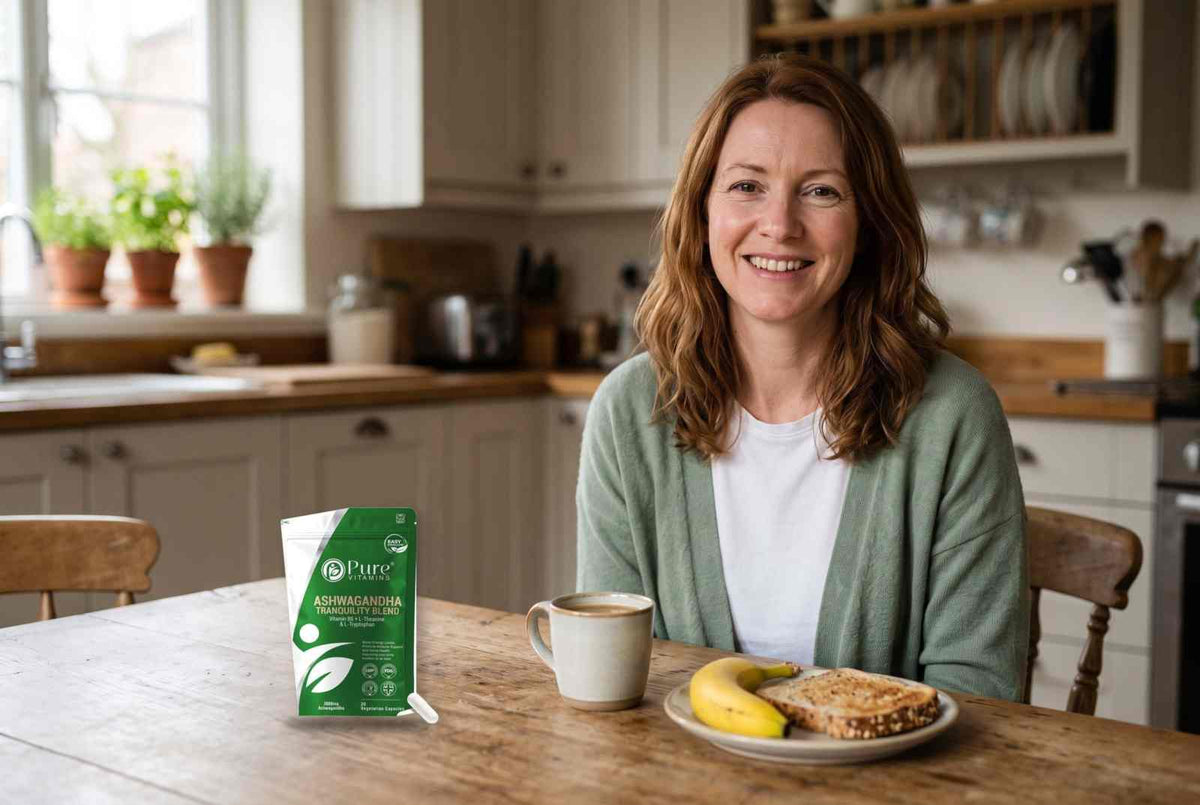
Ashwagandha KSM-66 root extract 250 mg (12:1, 5% withanolides) with L-Theanine 100 mg, L-Tryptophan 100 mg, Vitamin B6 1.7 mg and Black Pepper Extract 20 mg in every capsule. A food supplement, not a replacement for medical advice.
From £11.99 · 60 vegan capsules (2 months)
Shop Ashwagandha KSM-66 →How many milligrams of ashwagandha should the label show?
The question I hear most is "how much should I look for?" The honest answer is that it depends on the extract, and that the figures from research are a guide to the evidence, not a recommendation for you. In the human trials, standardised root extracts were mostly used at around 300 to 600 mg a day. A systematic review and meta-analysis of twelve randomised trials found that the dose-response analysis for stress scores pointed to 300 to 600 mg a day (Akhgarjand et al., 2022, doi:10.1002/ptr.7598). One of the better-known trials gave a full-spectrum root extract as 300 mg twice a day for 60 days (Chandrasekhar et al., 2012, doi:10.4103/0253-7176.106022).
Here is the part I would rather say plainly than leave you to discover. Our capsule contains 250 mg of a 12:1 root extract, taken as one capsule a day, which is a little below the lowest figure in those trial ranges. Trials used different extracts, so the numbers are not a like-for-like target, and our label gives the serving to follow. But if your goal is to match a particular trial dose, read the label of whatever you are considering, work out the extract milligrams per day, and speak to your GP or pharmacist. I would much rather you understood the arithmetic than assumed it.
You can also see how the amounts break down by age and sex in our guide on how much ashwagandha per day for females.
What the research shows, and its limits
Here I am paraphrasing published science, not making product claims. The most useful single source is the 2022 systematic review and meta-analysis in Phytotherapy Research. It pooled twelve randomised controlled trials with 1,002 participants and found that ashwagandha extract was associated with lower perceived stress scores than placebo, with the authors rating the certainty of the evidence as low for both outcomes and calling for further high-quality studies (doi:10.1002/ptr.7598). The results also varied a great deal between trials, with high heterogeneity, which is one more reason to read the headline numbers with caution.
The trial by Chandrasekhar and colleagues enrolled 64 adults with a history of chronic stress and reported that, after 60 days, those taking a full-spectrum root extract had lower scores on stress questionnaires and lower serum cortisol than those on placebo, with mild adverse effects comparable in both groups (doi:10.4103/0253-7176.106022). It was a single-centre study of modest size, and that is typical of the field.
The honest summary is this: the direction of the research is encouraging, the trials are mostly small and short, many used a specific branded extract, and the certainty is officially rated low. A study on one extract does not automatically carry across to every product that has the word ashwagandha on it. That is why I am careful to describe the science as science and not to turn it into a promise about any capsule, ours included.

Capsule, tablet, gummy, powder or liquid?
Format changes what you get for your money more than most people realise.
- Capsules: usually the most extract per serving, a fixed dose and little or no added sugar. Vegan capsule shells are widely available. This is the format I prefer for a concentrated extract.
- Tablets: similar to capsules, but they often include binders and bulking agents, so check the "other ingredients" line.
- Gummies: pleasant to take, but each gummy typically holds less active ingredient and adds sugar or sweeteners, so you may need several to reach the same milligrams as one capsule.
- Powders: closest to the traditional root powder, flexible and economical, but the taste is earthy and you have to measure carefully.
- Liquids and tinctures: can be convenient, but amounts per dropper vary and the alcohol content is worth checking if you avoid it.
None is better in the abstract. The best format is the one that states its amounts clearly and that you will take consistently. If you take other supplements at the same time, our guide on the best combinations with ashwagandha covers what people commonly pair it with.
Traditional preparations compared with a modern capsule
In Ayurveda the dried root is traditionally ground to a fine powder, called churna, and taken stirred into warm milk, water or honey, often as part of a daily routine. It is a lovely tradition and it is still how many people take it. The difference with a modern capsule is not that one is right and the other wrong, it is what you can know about the dose.
A spoonful of root powder varies with how finely it is ground, how old the root is, how it was dried and how heaped the spoon is. A standardised extract capsule is measured, repeatable and labelled with an extract amount and a withanolide percentage. If you like the ritual, a traditional powder has its place. If you want to know what you are taking from one day to the next, a clearly labelled extract is easier to compare, and that is the reason most of the published research uses extracts rather than raw powder.
Single ingredient or a combination formula?
A single-ingredient ashwagandha tells you exactly what you are taking and is simplest to compare. A combination formula adds other ingredients, and whether that is useful depends on what they are and whether the amounts are declared. Our capsule is a five-part formula, and every amount is on the label: ashwagandha KSM-66 root extract 250 mg (12:1, 5% withanolides), vitamin B6 1.7 mg (121% of the daily reference intake), L-theanine 100 mg, L-tryptophan 100 mg and black pepper extract 20 mg (10:1).
Of those, the vitamin B6 is the one with a defined role in the regulatory wording for food supplements. Vitamin B6 contributes to normal psychological function, to the normal functioning of the nervous system, to normal energy-yielding metabolism, to the reduction of tiredness and fatigue, to the regulation of hormonal activity and to the normal function of the immune system. Those statements apply to the vitamin B6 in the capsule, not to the ashwagandha. The other ingredients are described by what they are: L-theanine is an amino acid found in tea, L-tryptophan is an essential amino acid, and black pepper extract is included as a companion ingredient. You can read why the amino acid is paired with the herb in can you take ashwagandha and L-theanine together.

The vitamin B6 limit worth knowing
If you take a combination capsule, add up your total vitamin B6 from everything you take, including any multivitamin or B-complex. The NHS says that taking 10 mg or less of vitamin B6 supplements a day is unlikely to cause harm, whereas very high intakes over a long time have been linked to nerve symptoms such as tingling in the hands and feet. A modest amount like 1.7 mg sits well inside that guidance, but stacking several high-B6 products is where problems begin. Our fuller discussion is in the ashwagandha combinations guide.
Purity, heavy metals and testing: what to look for
Because ashwagandha is a root, it takes up whatever is in the soil, so purity testing is not a nice extra. It is part of choosing well. The best-known paper on this topic looked at 193 Ayurvedic medicines bought over the internet and found that about one in five (20.7%) contained detectable lead, mercury or arsenic, with similar rates in US-made and Indian-made products and a higher prevalence in products made by rasa shastra, the traditional practice of combining herbs with metals and minerals (Saper et al., JAMA 2008, doi:10.1001/jama.300.8.915). It was a snapshot of one market at one time, and it concerned a broad range of Ayurvedic products rather than modern standardised extracts, but it is a fair reminder of why a plain statement about testing matters.
So what should the label, or the product page, tell you? Look for four things:
- Where it was made: a named, GMP-certified manufacturing facility is a good sign, because GMP means documented, controlled processes.
- What was tested: heavy metals, microbes and the active content, not just a general statement that the product is "tested".
- Whether you can see the result: a batch certificate of analysis you can open is worth more than a badge.
- Whether the wording is specific: "tested for purity and heavy metals" says something, whereas a logo with no explanation says very little.
Our own ashwagandha is made in a GMP-certified facility and tested for purity and heavy metals there, and every batch is tested for active content, microbes and heavy metals with the results published. You can view the certificate of analysis for our ashwagandha and judge the numbers yourself.
Organic, vegan and other badges: what they do and do not cover
Badges are a shortcut, and shortcuts are useful only if you know what they stand for. "Organic" describes how the plant was grown and certified, not how pure or how concentrated the extract is. "Vegan" describes the ingredients and the capsule shell, not the quality of the herb. "Non-GMO" and "gluten-free" describe specific attributes. A logo for a factory standard describes the factory, not a particular batch. All of these can be genuinely useful, but none of them replaces the plant part, the standardisation and the testing information we have already covered.
If an organic certificate matters to you, choose a product that shows it. If it does not, do not pay a premium for the badge alone. What I would never skip is the testing and the declared amounts.
Price per daily serving: the arithmetic roundups skip
The price on the front of the pack tells you very little. The number that matters is what a day costs, and how much extract that day contains. Here is the simple method:
- Divide the price by the number of capsules to get the cost per capsule, then multiply by the capsules in a day's serving.
- Look at the extract milligrams per serving, then divide the cost per serving by that figure and multiply by 100 to get the cost per 100 mg of extract.
- Check what else is in the capsule, because a combination formula is paying for more than the herb.
Our own numbers, shown in full
Our Ashwagandha KSM-66 capsules cost £11.99 for 60 capsules, which is about 20p per daily capsule. With 250 mg of 12:1 extract in each, that is roughly 8p per 100 mg of extract. A plain single-ingredient extract will often come out cheaper per 100 mg of extract, because it is not paying for anything else. Ours also contains L-theanine, L-tryptophan, vitamin B6 and black pepper extract in every capsule, so the sensible question is whether you want those too. A hypothetical comparison: a £16.99 pack of 120 capsules at 300 mg of extract each is about 14p per capsule and about 5p per 100 mg of extract. Your labels will differ, so use your own numbers.
Reading reviews and star ratings sensibly
Reviews are useful, and they are also easy to over-read. A few habits make them more reliable. Look for reviews that describe the product itself, such as how easy the capsules are to take or whether the label matched what arrived, rather than reviews that make big promises about what a herb did for someone. Be wary of a page where every review is five stars and written in the same short style, and remember that a rating on a retailer's own page tells you about that shop's customers, not about how well a product has been tested.
Most of all, do not let a star rating replace the label. A product can be well liked and still leave out the plant part, the extract ratio or the testing information, and a product with fewer reviews can be perfectly well made. Read the label first, then use reviews as a second opinion.
Common mistakes when buying ashwagandha
- Buying on the biggest number: "10,000 mg" on the front of a pack usually means a ratio-based equivalent, not 10,000 mg in the capsule.
- Not checking the plant part: a label that says only "ashwagandha" has not told you whether it is root, leaf or both.
- Ignoring the serving size: some products need two or three capsules to reach the stated amount, which changes the price per day.
- Stacking supplements without adding them up: especially vitamin B6 across a multivitamin and a combination capsule.
- Starting without a plan: if you take medication or have a health condition, speak to a GP or pharmacist before the first capsule, not after.
- Judging it too soon: a food supplement is a steady daily habit, so give it a sensible, consistent run before deciding.
How to spot overstated label claims
This is the part of choosing that pays for itself. In Great Britain a food supplement label can only make a health statement that has been authorised for a specific vitamin or mineral, and ashwagandha is a herb, not a vitamin or a mineral. So a pack that says the herb itself will do something is going further than the rules allow, and I would take that as a reason to look harder at the rest of the label.
Here are the signs I would watch for:
- Outcome promises about the herb: anything that tells you ashwagandha will change how you feel, rather than describing what it is.
- Miracle language: "guaranteed results", "works in days", "doctor approved", or before-and-after style stories.
- Mystery blends: a "proprietary blend" that hides the amount of each ingredient.
- Big numbers with no context: "3,000 mg" or "10,000 mg" with no extract ratio, no part named and no withanolide percentage.
- Borrowed credibility: logos and certificates that do not say what was certified or by whom.
- Vitamin claims on the herb: where a label mixes a vitamin with a herb, the wording for the vitamin should sit with the vitamin, not the botanical.
How long to take it, and when
There is no single correct time of day, and the research has not established one. Consistency matters more than the hour. Many people take a daily capsule with a meal, which can be gentler on the stomach, and our label says to take one capsule a day with a glass of water, with or without food. The trials ran for around 8 weeks or 60 days, which is why our label suggests taking it consistently for several weeks rather than judging it after a few days. For the timing discussion in full, see when to take ashwagandha, morning or night and, if you pair it with the amino acid, ashwagandha and L-theanine: morning or night.
Storage and shelf life
Keep ashwagandha capsules somewhere cool and dry, out of reach of children, with the pouch or lid closed after each use, and check the best-before date printed on the pack. Moisture and heat are the usual enemies of any botanical extract, so the kitchen shelf above the kettle is not an ideal home. If you buy a larger pack, only keep what you will finish within a sensible time, and never take capsules that look damp, discoloured or smell unusual.

Who should speak to a GP or pharmacist first
Ashwagandha is generally well tolerated in short-term trials, and mild digestive upset or drowsiness is among the reports in the literature. But it is a plant extract with real activity, and some people should take advice before starting:
- Pregnancy and breastfeeding: not recommended.
- Thyroid conditions or thyroid medication: a small trial in adults with subclinical hypothyroidism reported changes in thyroid hormone measurements on ashwagandha extract (Sharma et al., 2017, doi:10.1089/acm.2017.0183), so anyone with a thyroid condition or on thyroid medicine should speak to their GP first.
- Autoimmune conditions: because ashwagandha may affect immune activity, check with a clinician.
- Liver conditions: a case series describes liver injury in five people taking ashwagandha-containing supplements, with symptoms such as jaundice and itching that settled over one to five months after stopping (Björnsson et al., 2020, doi:10.1111/liv.14393). Such cases appear to be uncommon, but if you have a liver condition, check first, and stop and seek medical advice if you notice yellowing of the skin or eyes, dark urine or persistent itching.
- Sedatives, diabetes or blood-pressure medicines: ashwagandha may add to drowsiness and may interact with some medicines, so check with a pharmacist.
- Surgery: if you have an operation planned, tell your surgeon or anaesthetist what supplements you take.
- Nightshade sensitivity: ashwagandha belongs to the nightshade family, so if you avoid nightshades, ask for advice.
Our complete write-up of these points is in ashwagandha safety: side effects and who should take care.
What other people say
The One I researched before buying
“I didn't purchase this on impulse. I spent time reading about the ingredients and comparing labels. This formula was the one that suited my preferences best, and I've enjoyed keeping it as part of my regular supplement selection.”
YYorrick Dalrymple · 5-star review on our store (Judge.me)
Ten questions to ask any ashwagandha label
- Does it name the plant part, and is it the root?
- Is the extract type named, and is it root-only or root and leaf?
- Is the extract ratio shown, for example 10:1 or 12:1?
- Is a withanolide percentage stated, and does the label say how it was measured?
- How many milligrams of extract are in one serving, not just one capsule?
- Is every other ingredient declared with its amount, with no proprietary blend?
- Is the manufacturing site named, and is it GMP-certified?
- Is there a statement about testing for heavy metals and microbes, and can you see the certificate?
- Does the pack avoid outcome promises about the herb?
- Can you work out the price per day and per 100 mg of extract?
Where our own ashwagandha fits
I have tried to write this guide so that it helps you whichever product you choose. If you would like to see how our own capsule answers the ten questions above, here it is: the Ashwagandha KSM-66 Capsules with L-Theanine and Vitamin B6 uses a root extract (not the leaves) standardised to 5% withanolides at a 12:1 ratio, 250 mg per capsule, with every ingredient amount declared. It is vegan, gluten-free and free from unnecessary fillers, binders and bulking agents, formulated in the UK and made in a GMP-certified facility, and tested for purity and heavy metals there. Each pack holds 60 capsules, a two-month supply at one a day.
It is not the only sensible choice, and it may not be the right one for you, especially if you want a single-ingredient extract, a higher extract amount or a different format. The wider supplement guides hub brings together our other label-reading guides, and if you are weighing ashwagandha against other adaptogens, ashwagandha vs maca is a good place to start.
What to realistically expect
A good ashwagandha supplement is a steady daily habit, not something you will feel overnight, and the research does not suggest otherwise. The value is in choosing a product whose label tells you the truth, taking it sensibly alongside a varied diet and a good routine, and being honest with yourself about what a food supplement is. If you want one simple rule: choose the product you can fully read, work out the cost per day, check it suits your circumstances and keep it consistent.
Frequently asked questions
What is the best ashwagandha supplement?
There is no single best product for everyone, so choose by the label. Look for a root-only extract with a named standardisation (such as 5% withanolides), the extract ratio and milligrams per capsule stated clearly, every added ingredient declared with its amount, purity and heavy-metal testing, and a price you can work out per day. Then check it suits you, including any medication you take.
Is KSM-66 the best ashwagandha extract?
KSM-66 is a well-known full-spectrum root extract, and it is the one used in much of the published research on branded extracts, but 'best' depends on what you want from a label. The useful questions are whether it is root-only, how it is standardised and how many milligrams you get per capsule. Other extracts, such as leaf-and-root extracts, are made differently and are not directly comparable.
What does 10:1 or 12:1 mean on an ashwagandha label?
The ratio shows how much raw root was used to make the extract. A 12:1 extract means roughly 12 kg of root per 1 kg of extract, so 250 mg of 12:1 extract is equivalent to about 3,000 mg of root powder. The ratio tells you how concentrated the extract is, but not how much withanolide it contains, which is why the standardisation percentage matters as well.
How many milligrams of ashwagandha should I look for?
Trials in the published research mostly used 300 to 600 mg a day of a standardised root extract, but extracts differ, so those figures are not a recommendation. Read the label for the extract amount and the withanolide percentage, follow the serving on the pack and speak to your GP or pharmacist if you are unsure. Do not exceed the stated serving.
Is a capsule better than a gummy or powder?
Capsules usually carry the most extract per serving and the least added sugar, and they keep the extract in a measured dose. Gummies tend to hold less active ingredient per piece and add sugar or sweeteners. Powders are flexible but taste earthy and need measuring. The best format is the one you will take consistently and that states its amounts clearly.
Can I take ashwagandha with vitamin B6?
Many people do, and several formulas combine them. Vitamin B6 contributes to normal psychological function, to the normal functioning of the nervous system and to the reduction of tiredness and fatigue, and those wordings apply to the vitamin, not the herb. Keep an eye on your total B6 from all supplements, as the NHS says 10 mg or less a day is unlikely to cause harm.
Who should not take ashwagandha?
It is not recommended during pregnancy or breastfeeding. Speak to your GP or pharmacist first if you have a thyroid condition, an autoimmune condition, a liver condition, are due to have surgery or take prescription medication, particularly sedatives, thyroid, diabetes or blood-pressure medicines. Stop and seek advice if you notice yellowing of the skin or eyes, dark urine or persistent itching.
How long should I take ashwagandha before judging it?
Trials typically ran for around 8 weeks or 60 days, and our own label suggests taking it consistently for several weeks. Pick a time you can keep to daily, with or without food, and keep realistic expectations: a food supplement is a steady daily habit alongside a varied diet, not an overnight change.
Our pick for this guide
Ready to try a clearly labelled ashwagandha?
Ashwagandha KSM-66 root extract 250 mg (12:1, 5% withanolides) with L-Theanine, L-Tryptophan, Vitamin B6 and Black Pepper Extract. Vitamin B6 contributes to normal psychological function and to the normal functioning of the nervous system. A food supplement, not a replacement for medical advice.
From £11.99 · 60 vegan capsules (2 months)
Shop Ashwagandha KSM-66 →If you would like to read more, our supplement guides hub brings every guide together, and you can browse the full range from the Pure Vitamins UK home page.
Dr. Miron, Founder of Pure Vitamins UK.
Food supplements should not be used as a substitute for a varied, balanced diet and a healthy lifestyle. This guide is for general information and is not medical advice. Do not exceed the stated serving. If you are pregnant, breastfeeding, taking medication or managing a medical condition, speak to your GP or pharmacist before starting a new supplement.
