


Reviewed and updated: 22 September 2026
When to take ashwagandha, morning or night, has no single correct answer, and the honest version is this: both are common, neither is objectively better, and the thing that actually changes your experience is which standardised extract you are taking and how consistently you take it. Ashwagandha (Withania somnifera) has been used in Ayurveda for well over two thousand years, traditionally reached for during demanding, tiring stretches to help people feel calm and grounded, and traditionally taken as a steady daily practice over weeks rather than as a fast-acting remedy. This guide gives you the morning case, the evening case, sample schedules for real routines, and the part almost nobody covers: how to let the extract on your own label decide the timing.
TL;DR: when to take ashwagandha
- Morning or night: both are common and widely used. Pick the time you will genuinely remember.
- Let the extract decide: a once-daily 600 mg standardised root extract suits one fixed slot; a lower-strength or sustained-release capsule and split-dose labels suit different routines. Read your own label first.
- With food: a sensible default. Many people find it gentler on the stomach taken with a meal.
- Consistency beats timing: trials dosed it once daily, or split, across roughly 8 to 12 weeks, so a steady daily habit is the model to copy.
- Give it weeks, not days: this is not a same-evening supplement, and anyone selling it as one is overselling it.
- One honest caution: it is best avoided in pregnancy and breastfeeding, and there are rare reports of liver-related effects, so speak to your GP or pharmacist if you take regular medication.

Where ashwagandha comes from and what it is traditionally taken for
Ashwagandha is a small shrub that grows across India, the Middle East and parts of Africa, and its root has been part of Ayurvedic practice for more than two millennia. In that tradition it sits in the Rasayana category, the tonics taken steadily over long periods rather than reached for in a crisis. The Sanskrit name translates roughly as "smell of the horse", a nod both to the aroma of the fresh root and to the strength and steadiness people traditionally associated with it.
What has it traditionally been used for? Helping people feel calm and grounded through demanding stretches, supporting everyday stamina, and helping the body settle at the end of a long day. That is the story customers are actually buying into, and it is worth saying plainly that it is a story about tradition and about how people use the herb, not a promise about what a capsule will do for you personally. Modern research has looked at standardised root extract in healthy adults, and I will cover what it shows further down, honestly, including where the evidence is still thin.
The case for taking ashwagandha in the morning
Morning dosing is the more popular choice in the UK, and for good practical reasons rather than pharmacological ones.
- Habit anchoring. Breakfast is the most reliably repeated meal of the day for most people. If you already take a multivitamin or a vitamin D with breakfast, adding ashwagandha to that slot is the single easiest way to make it stick.
- It pairs with a meal by default. Ashwagandha is commonly taken with food, and breakfast gives you that without any planning.
- You are awake to notice tolerability. If a new supplement does not sit well with you, it is far easier to identify at 8am than at 11pm.
- Split-dose routines usually start here. If your label suggests twice daily, morning is almost always the first of the two.
The one thing morning dosing does not do is make ashwagandha into a stimulant. It is not a caffeine substitute and it does not work on that timescale.
The case for taking ashwagandha in the evening
Evening dosing is the choice for people who want the herb to sit inside a wind-down routine rather than a wake-up one.
- It fits an existing evening ritual. If you already take magnesium after dinner, ashwagandha slots alongside it without adding a new reminder to your day.
- It matches how people traditionally think about it. The traditional association is with settling and steadiness, and plenty of people simply prefer to take it as the day closes.
- Evening meals are often larger. If you find supplements sit better with a more substantial meal, dinner may suit you better than toast.
- Trials that used a single daily dose did not standardise the hour. Studies have generally specified a dose and a duration, not a clock time, which tells you something useful: the research base does not establish that one hour beats another.
A practical note. Some people settle on evenings after trying mornings, and plenty go the other way. Switching once, deliberately, after a few weeks is reasonable. Switching every few days is how you end up unable to tell whether it suits you at all.
The part nobody covers: let your extract decide the timing
Here is the gap in almost every article on this question. They answer "morning or night" as though every ashwagandha product were the same thing, when the label in your hand is what should actually drive the answer. Three numbers on that label matter:
- The extract ratio (for example 10:1), which tells you how much raw root was concentrated into the extract. A higher ratio means a smaller capsule carries more plant material.
- The standardised withanolide percentage (commonly 2.5% or 5%), which is the marker-compound level the manufacturer guarantees. Withanolides are the compounds used to gauge an extract's strength, and Withania somnifera root contains a whole family of them.
- The named extract, such as KSM-66, a well-known branded root-only extract. A named, standardised extract tells you the batch was made to a specification rather than to whatever the harvest gave.
Now apply that to timing. If your product is a single 600 mg standardised root extract capsule, the dosing question is genuinely just "which one slot", and the research base supports once-daily use, so pick the slot you will keep. If your product is a lower-strength capsule where the serving is two capsules, you have a real choice: both together at one time, or one morning and one evening. And if you are holding a sustained-release capsule, it has been formulated to release across the day, so splitting it defeats the point and a single fixed daily slot is the sensible read. Two products at the same milligram strength can therefore call for different routines, which is precisely why "morning or night" cannot be answered generically. For more on standardisation and what those percentages actually buy you, see what KSM-66 ashwagandha is and what withanolides are.
Typical daily amounts and how long people take it for
According to research indexed on PubMed, trials in healthy adults have generally used standardised root extract at around 300 to 600 mg per day. A systematic review and meta-analysis of five randomised controlled trials covering 400 participants reported a small but statistically significant effect on sleep measures, with more prominent effects in the subgroups taking 600 mg per day or more and continuing for eight weeks or more (Cheah and colleagues, 2021, DOI 10.1371/journal.pone.0257843, read it on PMC). Note the two conditions there, because they are the practical takeaway: a meaningful daily amount, and a sustained run of weeks.
A separate randomised, double-blind, placebo-controlled study in 130 stressed but healthy adults used a single 300 mg sustained-release root extract capsule daily for 90 days and measured outcomes including perceived stress scores, morning serum cortisol and sleep quality (Gopukumar and colleagues, 2021, DOI 10.1155/2021/8254344, read it on PMC). Again, once daily, over months.
So the sensible framing is not "how fast does it work" but "have I taken it properly for long enough to judge". Eight to twelve weeks of consistent daily use is the window the research uses, and it is a fair window for you to use too. If you want the female-specific numbers, I have gone through them in how much ashwagandha per day for women.

Splitting the dose, and how to structure it
Splitting means taking part of your daily amount in the morning and part in the evening. It is a common pattern and there is nothing wrong with it, but do it deliberately rather than by accident.
- Follow the serving on your own product first. If the label says one capsule daily, splitting is not an option; if it says two capsules daily, splitting is a genuine choice.
- Split evenly and keep the total the same. Splitting is about spreading the same daily amount, not about taking more of it.
- Anchor both halves to meals. Breakfast and dinner are easier to remember than arbitrary clock times.
- Do not split a sustained-release capsule, and never open or crush a capsule designed to release gradually.
- Pick one pattern and hold it for the full eight to twelve weeks. Comparing split against single dosing is only meaningful if each gets a proper run.
Should you take it with food?
With food is the sensible default. Ashwagandha is commonly taken with a meal, and the most frequently reported niggles with it are digestive, so a meal tends to make it easier on the stomach. It is not a strict requirement, and it can be taken without food, but if you have ever found supplements sit heavily with you then a meal is the obvious first adjustment to try before concluding the herb does not suit you.
One practical point on tolerability: mild digestive upset and drowsiness are the effects most commonly reported, and both are worth paying attention to in the first week or two. If drowsiness is what you notice, that alone is a reasonable argument for moving your dose to the evening.
How long before you notice anything?
Honestly, longer than most people expect, and I would rather tell you that up front than have you give up at day five. This is not a supplement with an acute, same-day effect you can feel on the clock. The trials above ran for 8, 12 and even 90 days before measuring their outcomes, and the meta-analysis found the more prominent effects in the trials that ran eight weeks or longer. So the realistic expectation is a gradual thing assessed over weeks, judged by looking back at a stretch of time rather than by how you feel an hour after a capsule.
Set a date in your calendar roughly eight weeks from starting, and use it as your honest checkpoint: has this earned a place in your routine, or not?
Sample timing schedules for real routines
Four patterns that work, depending on how your day is actually shaped.
- The simple morning routine. One capsule with breakfast, every day, alongside whatever else you already take in the morning. Best for anyone who has ever forgotten an evening supplement, which is most of us.
- The wind-down routine. One capsule with your evening meal, a couple of hours before bed, ideally alongside your existing evening habits. Best if you already take magnesium in the evening and want one consolidated slot.
- The split routine. One capsule with breakfast and one with dinner, where the label serving is two capsules daily. Best for spreading a larger daily amount and for anyone who finds a full serving in one go a little heavy.
- The shift-work routine. Anchor to your first substantial meal after waking, whenever that falls, rather than to a clock time. Consistency relative to your own day matters more than matching someone else's morning.
In every one of these, the anchor is a meal and a habit you already have. That is the whole trick.

What the research actually shows, kept as science
Ashwagandha is traditionally classed in Ayurveda as a Rasayana, a category modern writing often translates as adaptogen. Based on articles retrieved from PubMed, standardised root extract has been investigated in healthy adults at 300 to 600 mg daily, with trials measuring outcomes such as perceived stress scores, sleep quality and morning cortisol. The sleep meta-analysis cited above found a small but significant pooled effect with notable heterogeneity between the trials, and its authors concluded that safety data for long-term use remain limited. A separate systematic review with Bayesian meta-analysis looked at physical performance outcomes across thirteen trials and reported results favouring supplementation on strength, cardiorespiratory and recovery measures, while noting a low to moderate risk of bias and calling for more comparable studies (Bonilla and colleagues, 2021, DOI 10.3390/jfmk6010020, read it on PMC).
That is a fair summary of the state of play: a genuine and growing evidence base, mostly small trials, promising signals, real limitations, and reviewers who are consistently careful about how much weight to put on it. It is research about the plant. It is not a promise about what a capsule will do for you, and you should be sceptical of anyone who presents it as one. If the category itself is new to you, start with what an adaptogen actually is.
What is in our formula, and why
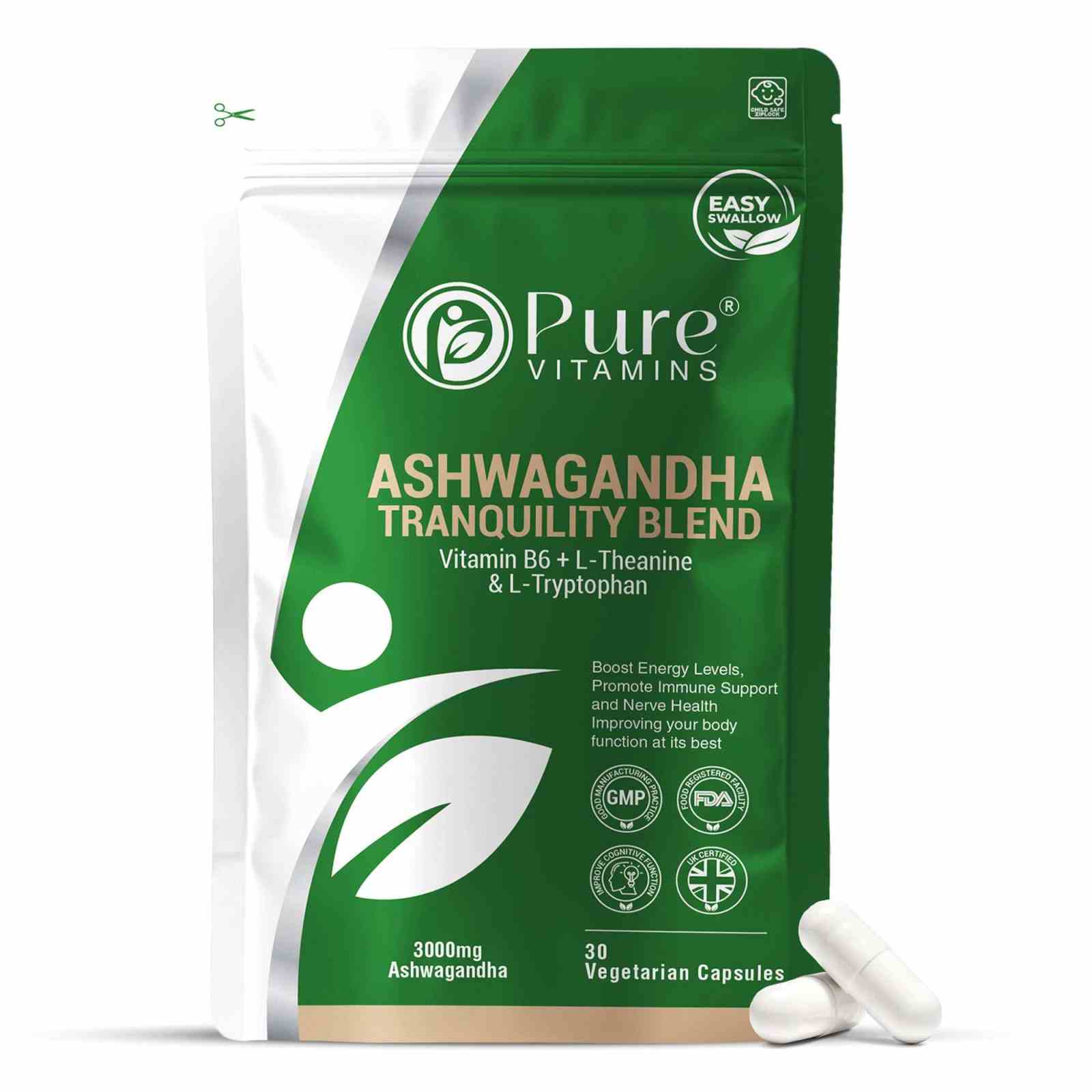
Our blend brings together KSM-66 ashwagandha root extract, L-theanine and vitamin B6, and each is there for a reason worth stating plainly.
L-theanine is an amino acid found naturally in tea leaves and a long-standing companion in calm-focused blends. It is a classic pairing: the herb people have reached for over centuries, alongside the amino acid many of us associate with an unhurried cup of tea. I have written about the combination and the timing question in taking ashwagandha and L-theanine together.
Vitamin B6 is the component that pulls genuine, formal weight. Vitamin B6 contributes to normal psychological function, to the normal functioning of the nervous system, and to the reduction of tiredness and fatigue. Those are recognised nutrient functions, and they are one honest reason this particular blend is put together the way it is. If you like to stack sensibly, see what pairs well with ashwagandha.
Everything is formulated in the UK and tested for purity and heavy metals at our GMP-certified facility, which is the part of quality that never appears on the front of the pack but decides whether the number on the label is the number in the capsule.

Can you take ashwagandha with magnesium?
Yes, and it is one of the most common pairings people ask me about. There is no inherent problem taking them together. In practice many people take magnesium in the evening as part of a wind-down routine, which makes an evening ashwagandha dose a tidy way to consolidate both into one moment you will remember. I have gone through the pairing in more detail in magnesium and ashwagandha. As always, if you take prescribed medication or manage a health condition, check with your GP or pharmacist before combining supplements.
A few cautions worth knowing
Ashwagandha was generally well tolerated in the trials above, and the most commonly reported effects are mild and digestive, but sensible caution applies and I would rather be straight with you.
- Pregnancy and breastfeeding: best avoided, because the safety data are limited.
- Medication: speak to your GP or pharmacist first if you take sedatives or sleep medication, thyroid medication, blood-sugar or blood-pressure treatments, or immunosuppressants, since interactions are at least theoretically possible.
- Liver signal: there have been rare published reports of liver-related effects associated with ashwagandha products, and a 2024 review of herbs used in traditional Indian systems of medicine discusses Withania somnifera among them (Philips and Theruvath, 2024, DOI 10.1097/MD.0000000000037903, read it on PMC). Most reported cases resolved after stopping. Stop and seek medical advice if you notice unusual tiredness, yellowing of the skin or eyes, or dark urine.
- Autoimmune conditions: take medical advice before use.
- Do not stack duplicates: if you take a multi-ingredient blend as well as a standalone ashwagandha, add up the total across both before you decide your routine.
For the fuller picture, see ashwagandha safety and who should take care.
Frequently asked questions
Is ashwagandha better in the morning or at night?
Neither is objectively better, and the trials that established the typical daily amounts specified a dose and a duration rather than a clock time. Both are common. The right time is the one you will take consistently, ideally anchored to a meal you already eat every day.
Should ashwagandha be taken with food?
With food is the sensible default. The most commonly reported niggles with ashwagandha are digestive, and a meal tends to make it easier on the stomach. It can be taken without food, but if it has ever sat heavily with you, taking it with a meal is the first adjustment to try.
Can you split an ashwagandha dose between morning and evening?
Yes, if your product's serving is more than one capsule a day. Split it evenly, keep the daily total the same, and anchor each half to a meal. Do not split a sustained-release capsule, since it is formulated to release gradually from a single dose.
How long does ashwagandha take to work?
Longer than most people expect. It is not an acute, same-day supplement. Clinical studies in healthy adults have typically run for 8 to 12 weeks, with one using a single daily capsule for 90 days, and the pooled sleep analysis found more prominent effects in trials lasting eight weeks or more. Give it a full eight weeks before you judge it.
How much ashwagandha do people usually take per day?
Trials in healthy adults have generally used standardised root extract at around 300 to 600 mg daily. Your own product's label is what you should follow, because the extract ratio, the standardised withanolide percentage and the capsule format all change what a sensible serving looks like.
Does it matter which ashwagandha extract I take for timing?
It matters more than the hour does. A once-daily 600 mg standardised root extract points to a single fixed slot, a two-capsule serving gives you the option to split, and a sustained-release capsule is designed to be taken once and not divided. Read the extract ratio, the withanolide percentage and the serving size before you decide your routine.
What does the vitamin B6 in the formula do?
Vitamin B6 contributes to normal psychological function, to the normal functioning of the nervous system, and to the reduction of tiredness and fatigue. It gives the blend a recognised everyday nutrient role alongside the herb.
You can browse every guide in one place on our supplement guides hub, or see the wider range at Pure Vitamins UK.
Food supplements should not be used as a substitute for a varied, balanced diet and a healthy lifestyle. If you are pregnant, breastfeeding, taking medication or managing a medical condition, speak to your GP or pharmacist before starting a new supplement. Signed, Dr. Miron, Founder of Pure Vitamins UK.
Related articles
- What is KSM-66 ashwagandha? Withanolides explained
- How much ashwagandha per day for women?
- Can you take ashwagandha and L-theanine together?
- Ashwagandha safety: side effects and who should take care
- What is the best combination with ashwagandha?
- Magnesium and ashwagandha: can you take them together?
Sources
- Cheah KL and colleagues (2021). Effect of Ashwagandha (Withania somnifera) extract on sleep: a systematic review and meta-analysis. PLoS One. DOI 10.1371/journal.pone.0257843. PMC8462692
- Gopukumar K and colleagues (2021). Efficacy and safety of ashwagandha root extract on cognitive functions in healthy, stressed adults. Evidence-Based Complementary and Alternative Medicine. DOI 10.1155/2021/8254344. PMC8632422
- Bonilla DA and colleagues (2021). Effects of ashwagandha on physical performance: systematic review and Bayesian meta-analysis. Journal of Functional Morphology and Kinesiology. DOI 10.3390/jfmk6010020. PMC8006238
- Philips CA and Theruvath AH (2024). A comprehensive review on the hepatotoxicity of herbs used in the Indian (Ayush) systems of alternative medicine. Medicine (Baltimore). DOI 10.1097/MD.0000000000037903. PMC11029936
