


Reviewed and updated: 24 July 2026
KSM-66 ashwagandha is a branded, root-only extract of Withania somnifera, the root that Ayurvedic practitioners in India have valued for well over two thousand years, traditionally reached for to help the body feel calm, steady and grounded during demanding times. What makes KSM-66 stand out is that it is standardised to a high withanolide content, and withanolides are the natural compounds an ashwagandha extract's strength is measured by. In this guide I will explain what KSM-66 is, what withanolides are, how to read a label, and why quality varies so much between products.

TL;DR: KSM-66 ashwagandha in brief
- What it is: a branded, root-only Withania somnifera extract standardised to a minimum 5% withanolides.
- Withanolides: the steroidal-lactone marker compounds used to express an extract's strength.
- Why branded matters: independent testing shows generic products often stray widely from their stated withanolide content.
- Heritage: ashwagandha is a root long used in Ayurveda, traditionally valued as a calming, grounding adaptogen.
- Our formula: pairs KSM-66 with L-theanine and vitamin B6, which supports normal psychological function and the nervous system.
What KSM-66 ashwagandha is
KSM-66 is one of the most extensively produced branded ashwagandha extracts in the world. It is made from the root only, by a defined standardised process, and standardised to a high withanolide content. When a label says KSM-66, you are getting a consistent, well-characterised extract rather than generic root powder of unknown strength. The root itself has a long and genuine heritage: in traditional Ayurvedic practice it is classed as an adaptogen, a plant people have reached for over centuries to help them feel more settled and resilient during tiring, stressful stretches. I explain that idea in what an adaptogen is. Because ashwagandha is such an old and popular root, the questions worth asking today are really about quality, which is exactly where KSM-66 and withanolides come in.
What are withanolides?
Withanolides are a group of naturally occurring steroidal lactones that are the characteristic active constituents of Withania somnifera, and extracts are standardised to them as marker compounds (Zellner and colleagues, 2025, DOI). A stated withanolide percentage, for example "standardised to 5% withanolides", tells you the concentration of these characteristic compounds, much as silymarin does for milk thistle or curcuminoids for turmeric. It is the single most useful quality signal on an ashwagandha label. I go deeper in what standardised to 5% withanolides means.

Full-spectrum versus root-only: clearing up the confusion
These two terms sound contradictory but are not. "Root-only" describes which part of the plant is used, the root rather than the leaves. "Full-spectrum" describes how the extract is made, aiming to preserve the natural balance of constituents found in that root rather than isolating a single compound. KSM-66 is both: a root-only extract that keeps the full constituent profile of the root. I compare the approaches in root-only versus full-spectrum ashwagandha.
Why a stated withanolide percentage matters so much
Here is the honest, practical reason to care about standardisation: generic ashwagandha products vary enormously. An analysis of more than twenty commercial ashwagandha products found that measured withanolide and withanoside content deviated from the values stated on the label by anywhere from roughly two-fold to thirty-five-fold (Zellner and colleagues, 2025, DOI). A separate comparison against British and US Pharmacopoeia standards found that a large share of commercial products failed to meet quality thresholds, and that many "root" products actually contained undeclared leaf material (Avula and colleagues, 2025, DOI). That is real quality-control science, and it is precisely why a defined branded extract with a stated withanolide percentage is worth looking for.
Is KSM-66 better than regular ashwagandha?
"Better" depends on what you mean, but there are real, factual reasons KSM-66 is regarded as premium: it is a root-only extract (some cheaper products use leaves or a root-and-leaf mix), it is standardised to a consistent withanolide content, and it is a defined branded extract rather than variable raw powder. The case for it is simply consistency and quality: when you buy KSM-66, you know what you are getting from one bottle to the next.
What to look for when buying ashwagandha
- A standardised, branded extract such as KSM-66, so the strength is defined and consistent.
- Root-only, the traditionally valued part of the plant.
- A stated withanolide percentage, your concentration signal.
- Quality assurance, made in a GMP-certified facility and tested for purity and heavy metals.

How and when to take it
A typical serving is one to two capsules daily, taken consistently over several weeks, with or without food. Many people choose the evening, since ashwagandha and L-theanine are often folded into a wind-down routine before bed. There is no need to "load" it, and my honest advice is to give it a steady run of a few weeks rather than judging it after a day or two. For the specific milligram range used in adult studies, including in women, see my guide to how much ashwagandha per day for females. For more on timing see when to take ashwagandha.
A few cautions worth knowing
- Pregnancy and breastfeeding: ashwagandha is not recommended during pregnancy or breastfeeding.
- Thyroid and sedative medicines: if you take thyroid medication, sedatives or other prescription medicines, check with your GP or pharmacist first, as botanicals can interact.
- Autoimmune conditions: speak to a healthcare professional before use.
- Surgery: as with many supplements, it is sensible to pause before planned surgery and tell your clinical team what you take.
Why we add L-theanine and vitamin B6
Our formula pairs KSM-66 ashwagandha with L-theanine, an amino acid found in tea leaves and a natural companion in a calm-evening routine, and with vitamin B6. That B6 is a genuinely useful addition, because vitamin B6 contributes to normal psychological function, to the normal functioning of the nervous system, to the reduction of tiredness and fatigue, and to the regulation of hormonal activity. I explain the pairing in why L-theanine is added to ashwagandha.
How our ashwagandha is formulated
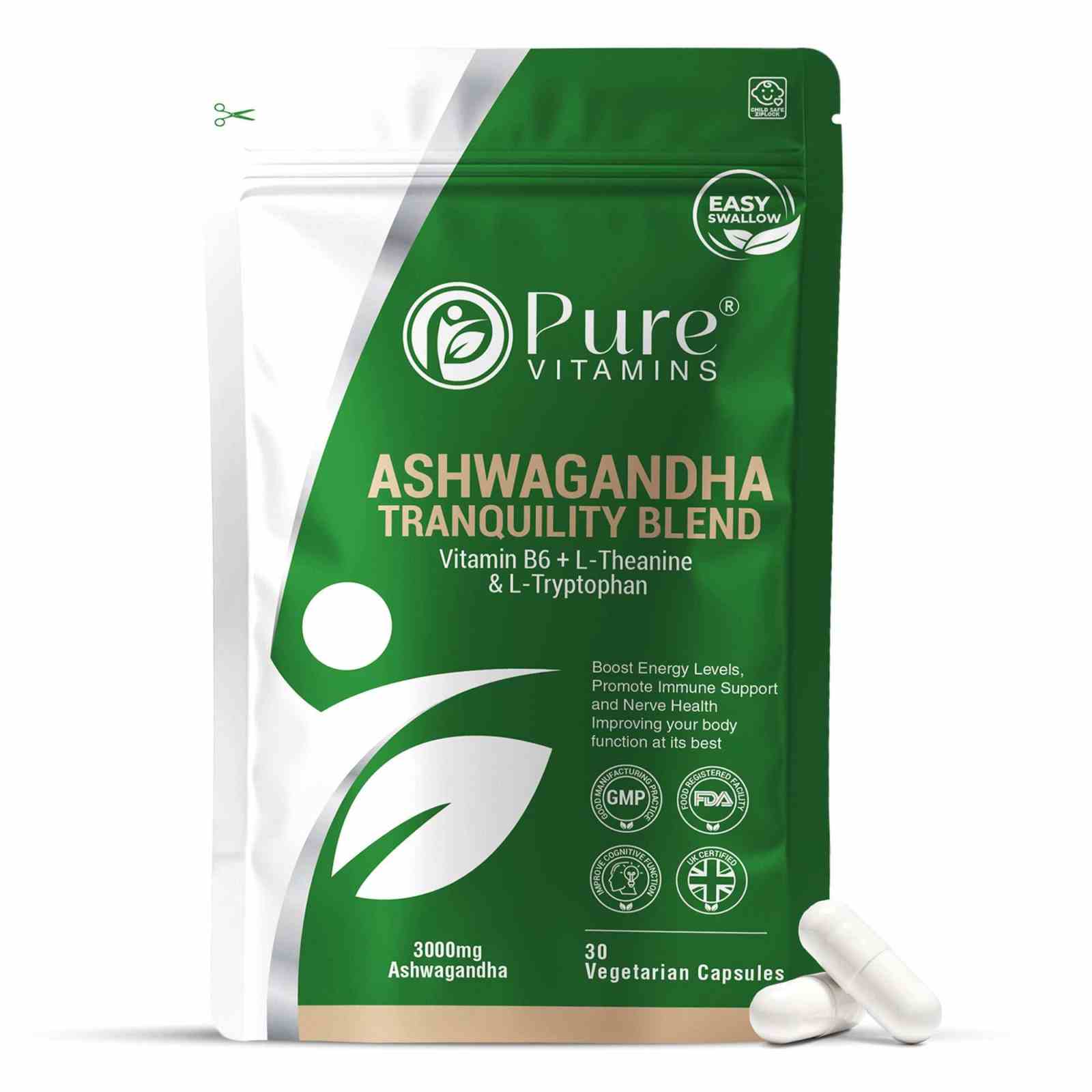
Our Ashwagandha uses KSM-66, standardised to a minimum 5% withanolides and extracted from the root, paired with L-theanine and vitamin B6. It is formulated in the UK, vegan and gluten-free, and tested for purity and heavy metals at our GMP-certified facility. If you are weighing it up against another traditional men's botanical, see our comparison of ashwagandha and tribulus terrestris. Browse the full range on the Pure Vitamins UK home page.
Frequently asked questions
What is the difference between KSM-66 and regular ashwagandha?
KSM-66 is a defined, branded, root-only extract standardised to a consistent withanolide content. Generic ashwagandha is often raw root powder, or a root-and-leaf mix, of unknown and variable strength. The difference is consistency and quality.
What does standardised to 5% withanolides mean?
It means the extract is made to contain at least 5% withanolides, the characteristic marker compounds of ashwagandha. The percentage is a concentration signal, letting you compare strength between products.
Is KSM-66 full-spectrum or root-only?
Both. Root-only refers to the plant part used, and full-spectrum refers to preserving the natural balance of the root's constituents rather than isolating one compound.
Who should not take ashwagandha?
It is not recommended in pregnancy or breastfeeding. People on thyroid medication, sedatives or other prescription medicines, or with autoimmune conditions, should check with their GP or pharmacist first.
This article is for general information and composition education, not medical advice. Food supplements should not be used as a substitute for a varied, balanced diet and a healthy lifestyle. If you are pregnant, breastfeeding, taking medication or managing a medical condition, speak to your GP or pharmacist before starting a new supplement. Signed, Dr. Miron, Founder of Pure Vitamins UK.
