
Reviewed and updated: 24 July 2026
Silymarin is not a single molecule but a group of related plant compounds, called flavonolignans, extracted from the seeds of milk thistle, a spiky purple-flowered plant that healers around the Mediterranean have valued for well over two thousand years. It is also the figure that milk thistle standardisation percentages refer to. In this guide I will explain what silymarin actually is, what sits inside the complex, how it is measured and standardised, and the interactions worth knowing, kept as composition throughout.

TL;DR: silymarin in brief
- What it is: a complex of flavonolignan compounds extracted from milk thistle seeds, not one molecule.
- Main components: silybin A and B (together called silibinin), isosilybin, silychristin and silydianin, with the precursor taxifolin.
- On a label: "silymarin" is the whole family, and standardisation (often 80%) refers to it.
- Why it matters: raw plant silymarin content varies a lot, so standardisation gives consistency.
- Worth knowing: silymarin can affect how some medicines are processed; check interactions.
What silymarin is
Silymarin is not a single substance but a complex, a group of related plant compounds extracted together from milk thistle (Silybum marianum) seeds. Chemically these belong to a class called flavonolignans. So when a label says "silymarin", it is referring to this whole family of related compounds rather than one isolated molecule. A milk thistle extract is a mixture composed mainly of these structurally similar flavonolignans (Riasova and colleagues, 2021, DOI). Milk thistle is often formulated alongside dandelion, a fellow daisy-family plant, a heritage pairing I cover in milk thistle and dandelion.
What is in the silymarin complex
The silymarin complex includes several named flavonolignans, the main ones being:
- Silybin A and silybin B (a 1:1 mixture of these two is known as silibinin), usually the most abundant and most studied components.
- Isosilybin A and B
- Silychristin
- Silydianin
Alongside these sits the precursor flavonoid taxifolin. In total, more than twenty flavonolignans have been identified in milk thistle, though a handful dominate (Riasova and colleagues, 2021, DOI). It is genuinely a rich little chemical family for a single seed.

How silymarin is measured and standardised
Because silymarin is the characteristic compound complex, quality milk thistle extracts are standardised to contain a stated percentage of it, commonly 80%. Pharmacopoeia methods define silymarin by the proportions of its main flavonolignans; for example, the European Pharmacopoeia expects defined ranges for the silychristin-and-silydianin group, the silybin group and the isosilybin group, and sets the silymarin content of a dried extract within a specified band (Riasova and colleagues, 2021, DOI). I explain the headline 80% figure in milk thistle extract and the 80% figure. Once you know the percentage, working out your actual intake becomes straightforward, and our guide to how much milk thistle a woman should take sets out the silymarin amounts used in research.
Why standardisation matters: natural variation
The reason standardisation is worth caring about is that the silymarin content of raw milk thistle varies considerably by variety, region and growing conditions. A review of the plant's composition describes silymarin as the flavonolignan extract from the seeds and details the seed's wider make-up (Chambers and colleagues, 2017, DOI). Standardising the seed extract to a stated silymarin percentage is what turns variable raw material into a consistent product, batch to batch, so you know what you are getting each time.
Silymarin versus silibinin: the terminology
These terms are often muddled. The silymarin complex is the whole extract, the full flavonolignan family. Silibinin is specifically the 1:1 mixture of silybin A and silybin B, the most studied single fraction within silymarin. So silibinin is part of silymarin, not a synonym for it. I break the components down further in the silymarin complex components.
Where silymarin comes from
Silymarin is concentrated in the seed (botanically the fruit) of the milk thistle plant, which is why supplements use a standardised seed extract rather than whole-plant powder. I cover the botany in what part of milk thistle is used, and the heritage in milk thistle composition and traditional use.

A few cautions worth knowing
- Prescription medication: silymarin can influence some drug-metabolising enzymes, so if you take regular medicines, check with your GP or pharmacist before use.
- Asteraceae (daisy family) allergy: milk thistle is in the same family as ragweed, daisies and marigolds, so allergy sufferers should be cautious.
- Pregnancy and breastfeeding: best avoided unless advised by a healthcare professional.
- Tolerance: milk thistle is generally well tolerated, with occasional mild digestive effects.

How our milk thistle is formulated
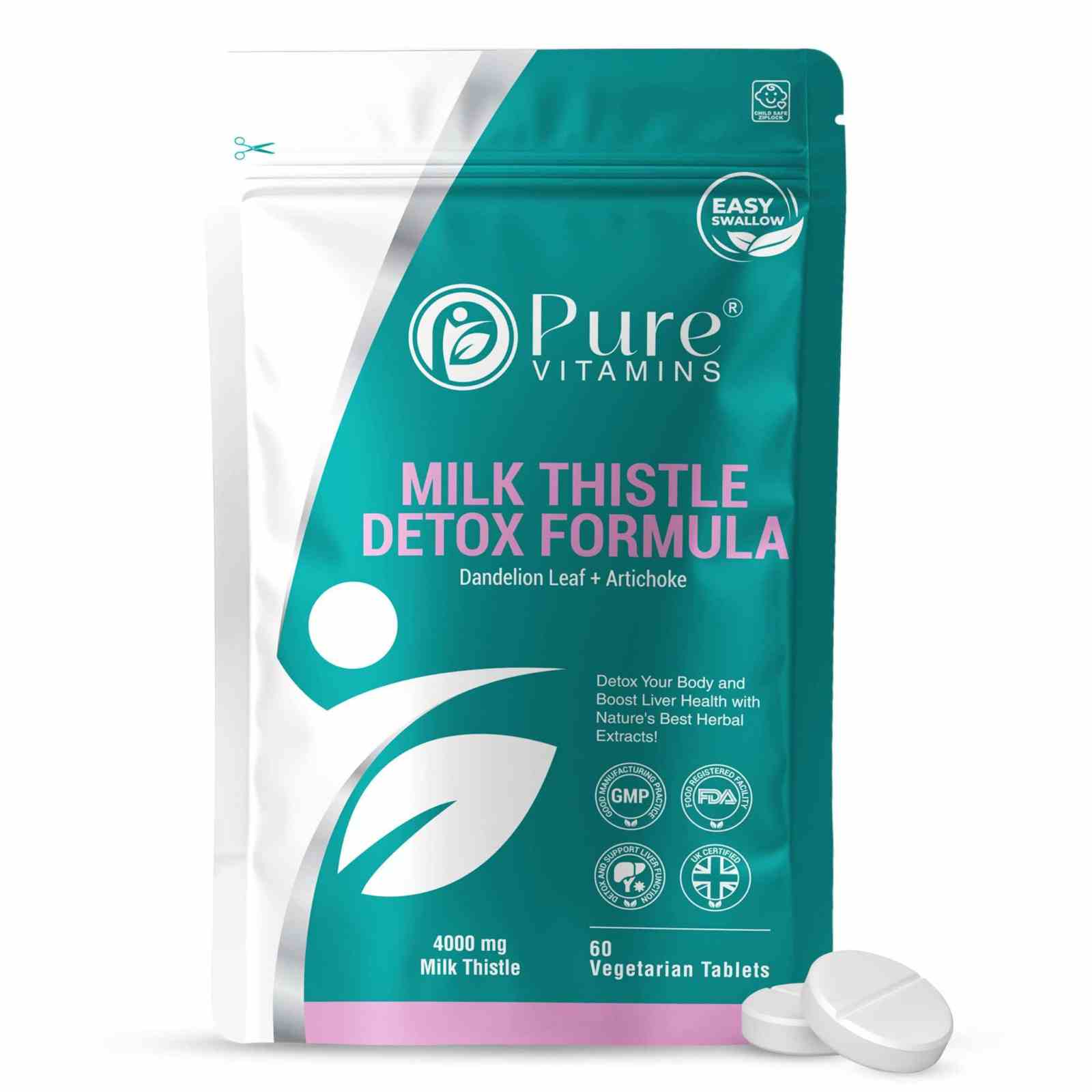
Our Milk Thistle uses a standardised seed extract, described openly by its silymarin standardisation so you can see exactly what is in it. It is combined with dandelion and artichoke on a traditional-pairing basis, formulated in the UK and tested for purity and heavy metals at our GMP-certified facility. Browse the full range on the Pure Vitamins UK home page.
Frequently asked questions
Is silymarin the same as milk thistle?
Not exactly. Milk thistle is the plant; silymarin is the characteristic complex of flavonolignan compounds extracted from its seeds. A standardised extract is described by its silymarin percentage.
What is silymarin made of?
It is a complex of flavonolignans, mainly silybin A and B (together called silibinin), isosilybin, silychristin and silydianin, alongside the precursor taxifolin.
What does standardised to 80% silymarin mean?
It means the extract is made to contain about 80% silymarin flavonolignans, giving a consistent strength batch to batch rather than variable raw powder.
Is silymarin the same as silibinin?
No. Silymarin is the whole flavonolignan complex, while silibinin is specifically the 1:1 mixture of silybin A and silybin B within it.
This article is for general information and composition education, not medical advice. Food supplements should not be used as a substitute for a varied, balanced diet and a healthy lifestyle. If you are pregnant, breastfeeding, taking medication or managing a medical condition, speak to your GP or pharmacist before starting a new supplement. Signed, Dr. Miron, Founder of Pure Vitamins UK.
