


Reviewed and updated: 31 October 2026
Pure Vitamins UK is an independent British brand. We are not connected to, endorsed by or affiliated with BioCare, Nutrition Geeks, Puresport, Kollo Health, Purition, AlzChem (the maker of Creapure), Pure Encapsulations, Pure Nutrition Supplements or their owners. These names are trademarks of their respective owners and are named here only to identify the products compared.
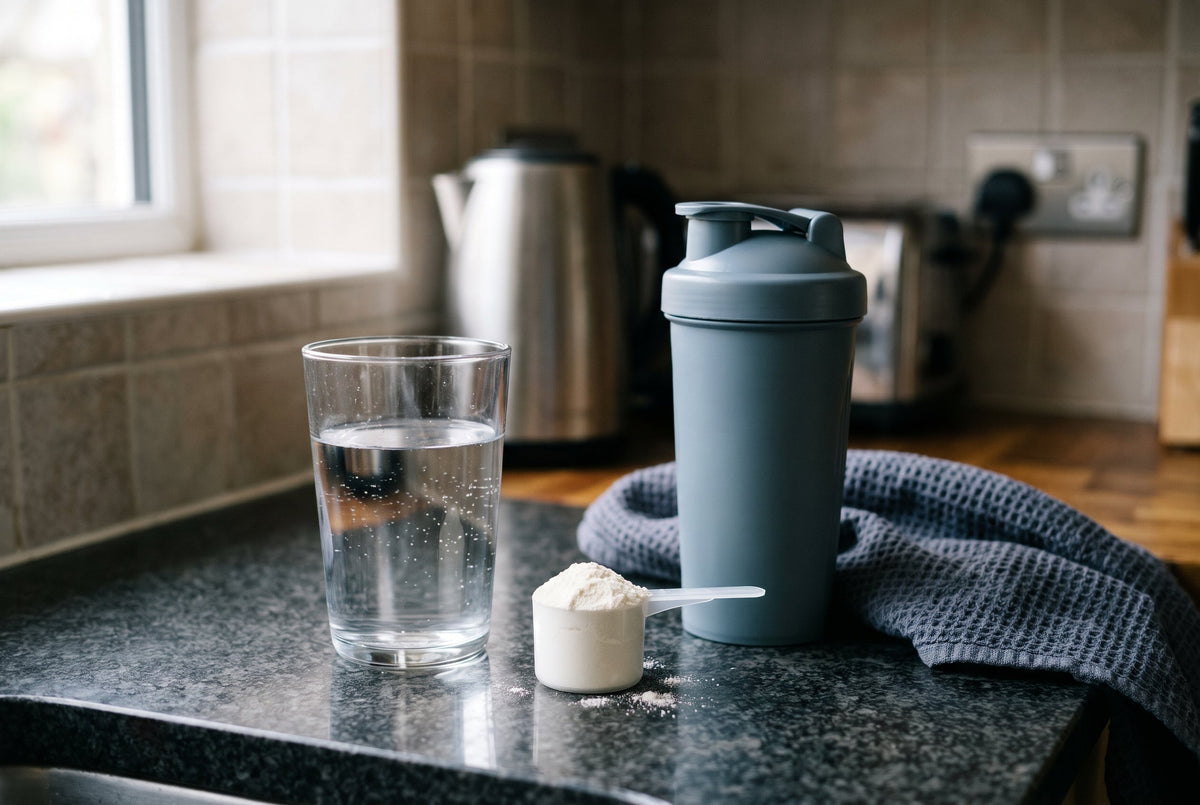
Pure creatine monohydrate, in the way most UK shoppers mean it, is a powder whose only ingredient is creatine monohydrate: no flavourings, no sweeteners, no fillers. Several well-known UK brands sell exactly that, and so do we, so the useful questions are how much creatine you get per serving, how many servings are in the pack, what each one costs per day, and what format suits your routine. I checked each product page on 31 October 2026 and laid it all out below.
Pure creatine monohydrate in the UK: the quick answer
- What “pure” usually means: a single-ingredient creatine monohydrate powder. Every product in this guide lists creatine monohydrate as its only ingredient.
- Serving sizes differ: BioCare, Puresport and Kollo use a 5 g serving; Nutrition Geeks, Purition and our own Micronised Creatine Monohydrate use 3.5 g.
- The research dose: creatine increases physical performance in successive bursts of short-term, high intensity exercise. The beneficial effect is obtained with a daily intake of 3 g of creatine. All six products clear that 3 g mark in one serving.
- Price per day on 31 Oct 2026 ranged from about 9p to about 83p, depending mostly on pack size and format (tub-style powder versus single sachets).
- One honest caution: if you have kidney problems or take regular medication, talk to your GP or pharmacist before starting creatine.

Our pick for this guide
Looking for a plain, unflavoured creatine monohydrate powder?
Our Micronised Creatine Monohydrate gives 3.5 g of micronised creatine monohydrate per level teaspoon, with no fillers, flavourings or sweeteners, and around 114 servings in a 400 g pouch. A food supplement, not a replacement for medical advice.
From £10.07 · 400g pouch
What shoppers mean by “pure creatine”
When someone types “pure creatine” into Google, they are rarely asking a chemistry question. In my experience, they want one of three things: a single-ingredient powder with nothing else added, a named raw material such as Creapure, or simply an unflavoured product they can stir into whatever they already drink. Those are three different things, and it helps to keep them apart.
Creatine itself is a small compound your body makes from three amino acids (arginine, glycine and methionine), mostly in the liver and kidneys, and also gets from meat and fish. Most of it is stored in skeletal muscle as phosphocreatine, which helps regenerate ATP, the molecule your muscles use for short, hard efforts. The International Society of Sports Nutrition's position stand describes creatine monohydrate as the most extensively studied and most effective form for this purpose (Kreider et al., 2017).
A quick word on our own name, because it causes confusion: we are called Pure Vitamins, and that is a brand name, not a description. Our creatine is a single-ingredient powder, so it does fit the “one ingredient, nothing added” meaning, but I would rather show you the label facts than lean on a word.

What Creapure is (and what it is not)
Creapure is a trademarked creatine monohydrate raw material made by AlzChem in Trostberg, Germany. Its technical data sheet describes it as a fine, colourless, odourless powder made by chemical synthesis, specified at 99.9% or more creatine monohydrate, with set upper limits for by-products such as creatinine, dicyandiamide and dihydrotriazine. Brands that buy it can print the Creapure name on their label.
What it is not: a separate form of creatine. It is creatine monohydrate, and the name identifies the manufacturer and its specification. Choosing a named raw material is a sourcing preference, and some people like the traceability that comes with it. None of the five brand pages I checked on 31 October 2026 named Creapure as their raw material, so I have not assumed it either way.
Side by side: six single-ingredient creatine powders
Every figure below was read from the brand's own product page on 31 October 2026, using the standard one-off price (subscription prices are mentioned where shown). Price per day assumes one serving a day, as each brand directs.
Pure Vitamins Micronised Creatine Monohydrate Powder 400g
- Form: micronised creatine monohydrate powder, unflavoured
- Serving: 3.5 g (one level teaspoon)
- Servings: around 114 per 400 g pouch
- Price: £10.07
- Per day: £10.07 ÷ 114 = about 9p
- Vegan-friendly, gluten-free; formulated in the UK
Nutrition Geeks Pure Creatine Monohydrate Powder
- Form: micronised creatine monohydrate powder, unflavoured
- Serving: 3.5 g (one flat teaspoon)
- Servings: 90 per 315 g pack
- Price: £9.99 one-off (£8.99 on subscription)
- Per day: £9.99 ÷ 90 = about 11p
- Delivery: free tracked UK delivery stated
Purition Pure Creatine Monohydrate
- Form: creatine monohydrate powder, unflavoured
- Serving: 3.5 g (one teaspoon)
- Servings: 140+ per 500 g bag
- Price: £20.00
- Per day: 500 g ÷ 3.5 g = about 142 servings; £20.00 ÷ 142 = about 14p
- Delivery: free over £25
BioCare Pure Creatine Monohydrate
- Form: micronised creatine monohydrate powder
- Serving: 5 g (one heaped teaspoon)
- Supply: 30 days, one serving daily
- Price: £14.95
- Per day: £14.95 ÷ 30 = about 50p
- Suitable for vegans; delivery £3.95, free over £40
Kollo Pure Creatine Monohydrate Powder
- Form: creatine monohydrate powder, unflavoured
- Serving: 5 g (one scoop)
- Servings: 30 per month's supply
- Price: £22.00 one-off (£18.70 on subscription)
- Per day: £22.00 ÷ 30 = about 73p
- Suitable for vegans; free UK delivery on subscriptions
Puresport Creatine Monohydrate (30 pack)
- Form: single-serve 5 g sachets
- Serving: 5 g (one sachet)
- Servings: 30 sachets
- Price: £25.00 one-off
- Per day: £25.00 ÷ 30 = about 83p
- Vegan and gluten-free badges; free UK shipping over £50 or on subscription
At a glance, on 31 October 2026:
- Lowest price per day: Pure Vitamins (about 9p), then Nutrition Geeks (about 11p) and Purition (about 14p).
- Largest single pack: Purition's 500 g bag.
- Only sachet format: Puresport, handy for a gym bag.
- Biggest serving: BioCare, Kollo and Puresport at 5 g each.
3.5 g or 5 g: does the serving size matter?
This is the comparison that trips people up most, because a 5 g serving looks like “more” and a cheaper 3.5 g pack looks like “less”. The authorised daily amount for creatine's performance effect is 3 g, so both serving sizes clear it. Research protocols tend to use either a short loading phase (around 20 g a day split into four doses for five to seven days) or simply 3 to 5 g a day, which reaches full muscle saturation over roughly three to four weeks instead of one (Kreider et al., 2017).

The fair way to compare price is per gram of creatine as well as per serving. Using the one-off prices above: ours works out at about 2.5p per gram (£10.07 ÷ 400 g), Nutrition Geeks about 3.2p (£9.99 ÷ 315 g) and Purition 4p (£20.00 ÷ 500 g). For the 5 g products, dividing the price per day by 5 g gives about 10p per gram for BioCare (50p ÷ 5), about 14.7p for Kollo (73p ÷ 5) and about 16.7p for Puresport (83p ÷ 5). If you prefer a 5 g daily serving, you can of course take a heaped extra half-teaspoon of any of the 3.5 g powders and redo the sums.
For a deeper look at loading versus steady daily dosing, our guide to creatine loading, dosing and saturation walks through both approaches.
“I wanted a creatine powder that I could take daily without changing the taste of my drinks. This has been ideal because it's unflavoured and mixes easily.”
Noah H. · 5-star review on our store (Judge.me)
Micronised or standard: what is the difference?
Micronised creatine monohydrate is the same compound milled into finer particles. The point of micronising is practical: finer powder disperses faster and leaves less grit at the bottom of the glass. Our product, BioCare's and Nutrition Geeks' all state that they are micronised; Purition, Kollo and Puresport did not say either way on the pages I checked. If texture matters to you, that is worth checking, but it is a mixing preference rather than a different type of creatine. Our article on micronised creatine versus standard monohydrate goes into this in more detail, and which type of creatine is best covers the other forms you will see on shelves.
Testing, certification and what the labels tell you
Brands describe quality checks in different ways, and it is worth reading what each one actually says. Nutrition Geeks publishes a test result showing its creatine meets the label claim of 3.5 g per serving. Kollo's page states that the product is Informed Choice certified, a sport-focused testing scheme that some athletes look for. BioCare states a 99.9% purity figure. Ours is formulated in the UK and manufactured in facilities certified to GMP standards.
If you compete in a drug-tested sport, a sport-specific certification is the thing to look for on the exact product and batch you buy, and you should follow your governing body's advice.

Which one suits you
For some readers another product will be the better fit, so here is how I would choose:
- Choose single sachets (Puresport) if you train away from home and want a pre-measured dose you can throw in a bag, and the convenience is worth the higher cost per day.
- Choose a sport-certified product (such as Kollo, per its page) if you are a tested athlete and certification matters more to you than price.
- Choose a 5 g serving (BioCare, Kollo or Puresport) if you prefer the larger dose used in many studies and like a single measured scoop.
- Choose the biggest bag (Purition) if you want 500 g in one go.
- Choose our Micronised Creatine Monohydrate if you want a plain, single-ingredient micronised powder at the lowest price per day in this comparison, with a 3.5 g serving that clears the 3 g daily amount.
If a doctor, dietitian or coach recommended a specific product, have a word with them before switching. That is the simplest way to make sure the change fits whatever they had in mind.
How to take creatine monohydrate day to day
The good news is that creatine is about the least fussy supplement there is. Consistency matters far more than timing, so pick a moment you will not forget: a morning glass of water, your post-training shake, or a coffee. It dissolves most readily in warm liquid. Expect the scales to nudge up a little in the first week or two, which is water drawn into muscle rather than fat, and is covered in our piece on why the scales can jump after starting creatine. If you are completely new to it, our guide to what creatine is and how it works is the best place to start.

Creatine has a long safety record in healthy adults at these doses. A 2021 review of common questions concluded that the evidence does not support claims that creatine harms the kidneys of healthy people or causes hair loss, while noting that research in people with existing kidney disease is limited (Antonio et al., 2021).
A few cautions worth knowing
- Speak to your GP before starting if you have kidney disease or reduced kidney function, or take medication that affects the kidneys.
- Creatine can raise blood creatinine readings, which are used to estimate kidney function. Tell your doctor you take it before a blood test.
- If you are pregnant or breastfeeding, check with your GP or midwife first. Our product is not suitable for under-18s.
- Drink normally through the day; there is no need to over-hydrate.
Frequently asked questions
What does “pure creatine” mean on a label?
There is no legal definition. In practice it is used for powders whose only ingredient is creatine monohydrate, with no flavourings, sweeteners or fillers. Check the ingredients list: it should say creatine monohydrate and nothing else.
Is Creapure different from other creatine monohydrate?
Creapure is a branded creatine monohydrate raw material made by AlzChem in Germany, specified at 99.9% or more creatine monohydrate. The name identifies the manufacturer and its specification rather than a separate form of creatine; choosing it is a sourcing preference.
How much creatine should I take a day?
Creatine increases physical performance in successive bursts of short-term, high intensity exercise, and the beneficial effect is obtained with a daily intake of 3 g. Many people take 3 to 5 g a day. Our serving is 3.5 g.
Do I need a loading phase?
No. Loading fills muscle stores faster, but a steady daily serving reaches the same saturation over roughly three to four weeks.
Is Pure Vitamins the same company as Puresport, Pure Encapsulations or Pure Nutrition?
No. Pure Vitamins UK is an independent British brand and is not connected to, endorsed by or affiliated with any other company that uses the word “pure” in its name or product titles.
If you only remember one thing from this guide, make it this: compare the ingredients list, the serving size and the price per day, and then choose the format you will actually take every day. That is where the real difference lies.
Dr. Miron, Founder of Pure Vitamins UK
Our pick for this guide
Want one ingredient and a 3.5 g daily serving?
Micronised Creatine Monohydrate: 3.5 g of micronised creatine monohydrate per level teaspoon, unflavoured and vegan-friendly, around 114 servings per 400 g pouch. A food supplement, not a replacement for medical advice.
From £10.07 · 400g pouch
Where these facts come from
- BioCare Pure Creatine Monohydrate, product page, checked 31 October 2026: biocare.co.uk
- Nutrition Geeks Pure Creatine Monohydrate Powder, product page, checked 31 October 2026: nutritiongeeks.co
- Puresport Creatine Monohydrate, product page, checked 31 October 2026 (showing “notify me when available” at the time): puresport.co
- Kollo Pure Creatine Monohydrate Powder, product page, checked 31 October 2026: kollohealth.com
- Purition Pure Creatine Monohydrate, product page, checked 31 October 2026: purition.co.uk
- Creapure technical data sheet (AlzChem Trostberg GmbH), checked 31 October 2026: Creapure TDS (PDF)
- Pure Vitamins Micronised Creatine Monohydrate, product page, checked 31 October 2026: puremultivitamins.com
Prices and pack details change. Always check the brand's own page before you buy.
Sources
- Kreider RB, et al. International Society of Sports Nutrition position stand: safety and efficacy of creatine supplementation in exercise, sport, and medicine. J Int Soc Sports Nutr. 2017;14:18. PMC5469049
- Antonio J, et al. Common questions and misconceptions about creatine supplementation: what does the scientific evidence really show? J Int Soc Sports Nutr. 2021;18:13. PMC7871530
- Great Britain nutrition and health claims (NHC) register, GOV.UK. gov.uk
More guides: all supplement guides · creatine timing · Pure Vitamins UK home
Food supplements should not be used as a substitute for a varied, balanced diet and a healthy lifestyle. This article is for general information and is not medical advice.


