


Table of Contents
- What Are Supplement Fillers and Excipients?
- Why Manufacturers Use Fillers in Vitamins
- Common Supplement Additives to Avoid
- How to Read Supplement Labels
- Step-by-Step: How to Spot Fillers on Your Supplement
- Are Expensive Vitamins Actually Better?
- Quality Markers That Go Beyond Price
- Conclusion
Last Updated: August 23, 2026
What Are Supplement Fillers and Excipients?
Supplement fillers, also called excipients, are inactive ingredients added to vitamins and minerals to make them stable, mixable, and easy to consume. Active ingredients are what you want: vitamin C, magnesium, zinc, collagen peptides. Excipients are everything else: binders that hold tablets together, flow agents that help powders mix smoothly, preservatives that prevent spoilage, and anti-caking agents that stop clumping.

Many manufacturers use fillers because they're cheap and functional. A tablet without binders would crumble. A powder without flow agents would clump. The problem isn't that fillers exist, it's that some manufacturers pile them in at levels far higher than necessary, or choose fillers that offer no real benefit while potentially irritating sensitive digestive systems. A well-formulated supplement uses the minimum effective amount of fillers needed for stability and function. At Pure Vitamins UK, we disclose every ingredient at its precise dose, so you can see exactly what you're getting and at what concentration.
Why Manufacturers Use Fillers in Vitamins
Fillers serve legitimate functional purposes. Tablets need binders to hold their shape during manufacturing and storage. Powders need flow agents so they pour smoothly and mix evenly. Preservatives prevent bacterial growth and oxidation. Anti-caking agents keep moisture out of powders. Capsule shells themselves, usually made from gelatin or plant-based alternatives, are technically excipients.
The real issue emerges when manufacturers use more filler than necessary. A tablet that's 40% binder when 15% would work fine is overloaded. Cost is the primary driver: fillers are cheaper than active ingredients. For budget brands competing on price alone, this creates an incentive to minimize active ingredients and maximize cheap fillers. Comparing price per serving without checking the actual dose of active ingredients is a false economy, you might be buying mostly filler at a discount.
Common Supplement Additives to Avoid
Not all fillers are created equal. Some are inert and harmless. Others can trigger digestive upset, allergic reactions, or simply provide no functional benefit.
Binders and Flow Agents
Magnesium stearate is the most common binder and flow agent. It's cheap and effective, though some practitioners argue that high doses above 2% of a supplement's weight can coat the digestive tract and reduce nutrient absorption. Use the minimum amount needed.
Titanium dioxide is a white pigment used to make tablets look clean and bright. It offers no functional benefit, it's purely cosmetic. If a manufacturer is using it, they're prioritizing appearance over simplicity.
Silicon dioxide is a flow agent that absorbs moisture and prevents caking. At typical doses under 2%, it's considered safe, though excessive use can interfere with nutrient absorption.
Microcrystalline cellulose is a plant-derived binder made from wood pulp. It's one of the cleanest filler options. It doesn't trigger allergies, doesn't coat the digestive tract, and adds minimal bulk. If you see this as a binder, the manufacturer is choosing function and safety over rock-bottom cost.
Artificial Colours and Preservatives
FD&C dyes (like FD&C Red No. 40, Yellow No. 5) are synthetic colorants that serve no nutritional purpose. Some people are sensitive to them, and they're banned in several countries. Natural alternatives like beta-carotene or spirulina exist. If the manufacturer chose synthetic dyes, they prioritized cost and shelf appeal.
Artificial preservatives like butylated hydroxytoluene (BHT) and butylated hydroxyanisole (BHA) prevent oxidation and extend shelf life. Natural alternatives like vitamin E (mixed tocopherols) or rosemary extract work similarly without the synthetic baggage.
Sodium benzoate is a preservative that prevents mold and bacterial growth. It's generally recognized as safe, but it's unnecessary in most supplements because proper manufacturing and packaging prevent contamination without it.
If a filler offers no functional benefit beyond cost reduction or appearance, it's worth avoiding. A supplement containing only functional fillers at minimal doses signals that the manufacturer cares about efficacy, not just profit margins.
How to Read Supplement Labels
Understanding supplement labels is the foundation of spotting fillers. Every label contains a "Supplement Facts" panel listing active ingredients and their doses. Below that is the "Other Ingredients" list, where fillers live.
Decoding the 'Other Ingredients' List
The "Other Ingredients" section lists everything that isn't an active nutrient. Ingredients are listed by weight, from highest to lowest. If magnesium stearate appears first, it's present in higher concentration than if it appears near the end.
A clean "Other Ingredients" list typically contains 3-5 items: a binder, a flow agent, the capsule material, and possibly a preservative. Anything longer suggests unnecessary complexity.
Compare two hypothetical labels:
Supplement A: Other Ingredients: Microcrystalline cellulose, magnesium stearate, hypromellose capsule
Supplement B: Other Ingredients: Maltodextrin, magnesium stearate, silicon dioxide, titanium dioxide, FD&C Red No. 40, carrageenan, gum arabic, sodium benzoate, magnesium oxide
Supplement A has three functional fillers. Supplement B has eight, many serving cosmetic or cost-reduction purposes. The cost difference comes out of either the active ingredient dose or your wallet.
Spotting Active Ingredients vs Fillers
The "Supplement Facts" panel lists active ingredients with their doses in milligrams (mg) or micrograms (mcg). A 1,000 mg dose of vitamin C is a 1,000 mg dose regardless of brand, though the form matters: vitamin C as ascorbic acid absorbs differently than vitamin C as calcium ascorbate.
Below the Supplement Facts panel, the "Other Ingredients" list shows fillers without doses listed. If an ingredient appears in the Supplement Facts panel with a dose, it's active. If it appears in the Other Ingredients list without a dose, it's a filler.
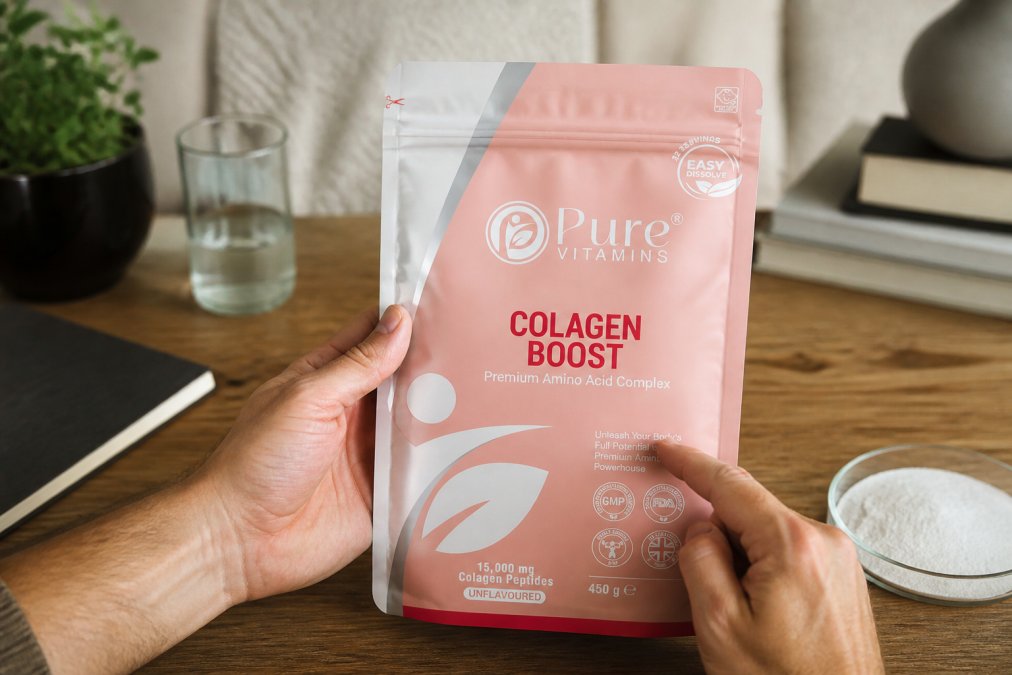
Step-by-Step: How to Spot Fillers on Your Supplement
Step 1: Check the Supplement Facts panel for dose transparency.
Are active ingredients listed at specific amounts (e.g., 500 mg vitamin C, 25 mcg vitamin D3), or are they vague (e.g., "proprietary blend")? Vague dosing hides weak formulas. At Pure Vitamins UK, every active ingredient is listed at its precise dose.
Step 2: Flip to the Other Ingredients list and count the items.
Three to five is normal and functional. Eight or more suggests unnecessary complexity.
Step 3: Identify each filler's function.
- Binders: microcrystalline cellulose, maltodextrin, gum arabic
- Flow agents: magnesium stearate, silicon dioxide, calcium silicate
- Capsule materials: hypromellose, gelatin, cellulose
- Colorants: titanium dioxide, FD&C dyes, beta-carotene
- Preservatives: sodium benzoate, potassium sorbate, mixed tocopherols
If multiple items serve the same function, the formula is overengineered.
Step 4: Check for fillers that offer no functional benefit.
Titanium dioxide? Pure cosmetics. FD&C dyes? Cosmetics and cost savings. If present, the manufacturer chose appearance over simplicity.
Step 5: Look for ingredient forms that suggest poor bioavailability.
Magnesium oxide is cheap with poor absorption, often used as a laxative. Magnesium glycinate absorbs far better. Ferrous sulfate (iron) causes digestive upset; ferrous bisglycinate is better tolerated. The ingredient form reveals whether the manufacturer cares about results or just hitting a price point.

Step 6: Cross-reference against third-party testing.
Many reputable brands publish third-party testing certificates showing that the supplement contains what the label claims and is free from contaminants. If a manufacturer won't provide them, they're either not testing or hiding results. Pure Vitamins UK products undergo documented in-house batch testing, with results available on request.
Are Expensive Vitamins Actually Better?
Price and quality don't always correlate in the supplement industry. Budget supplements (under £5 per month) typically cut corners on active ingredient doses, use cheap filler forms, and skip third-party testing. Mid-range supplements (£8-£20 per month) often strike a balance with adequate doses, functional fillers at minimal levels, and may include third-party testing. Premium supplements (£25+ per month) sometimes justify their cost with superior ingredient forms, but many are expensive simply because they've built a brand story without delivering proportionally better results.
The key metric is cost per active ingredient dose, not cost per bottle. A £15 supplement with 500 mg of a well-absorbed magnesium form might deliver better value than a £10 supplement with 200 mg of a poorly absorbed form.
Quality Markers That Go Beyond Price
Transparent dosing is non-negotiable. Every active ingredient should be listed with a specific dose. Proprietary blends hide weak formulas.
Minimal, functional fillers signal efficacy. Fewer than six items in the Other Ingredients list is a good baseline. Each filler should serve a clear function.
Superior ingredient forms reveal whether the manufacturer cares about absorption. Magnesium glycinate absorbs better than magnesium oxide. Vitamin D3 with K2 works synergistically. Hydrolysed collagen peptides dissolve cleanly and absorb efficiently.

Third-party testing certificates prove the supplement contains what the label claims and is free from heavy metals and microbial contaminants. Reputable brands publish these openly.
Clear sourcing and manufacturing standards matter. ISO 22000, HACCP, and GMP certification indicate rigorous quality control ([EXTERNAL_LINK: International Organization for Standardization | iso.org]). These aren't marketing badges, they're verifiable standards.
The brands worth buying are transparent about their process. They publish testing results. They explain why they chose specific ingredient forms. They disclose manufacturing standards. They cost more than the absolute cheapest options, but less than luxury brands charging for packaging and hype.
Spotting supplement fillers comes down to reading labels carefully, understanding what each ingredient does, and recognizing when a manufacturer has chosen function over cost savings. The supplement industry thrives on confusion, vague dosing, unnecessary fillers, and proprietary blends that hide weak formulas. Cutting through that noise requires asking simple questions: What's the actual dose? What are these fillers doing? Can the manufacturer prove what's in the bottle?
At Pure Vitamins UK, we answer those questions directly. Every product is formulated in the UK to ISO 22000, HACCP, and GMP standards. Every active ingredient is listed at its precise dose. Every formula uses only functional fillers at minimal levels. We publish batch testing results on request. If you're tired of guessing whether your supplement is actually working, shop our clean-label range now and see the difference transparent formulation makes. Start with our Magnesium Glycinate Capsules at £11.99 or our Hydrolysed Collagen Peptides at £16.00, both formulated with superior ingredient forms and zero unnecessary additives.
Frequently Asked Questions
Q: What are the most common supplement fillers to avoid?
A: Magnesium stearate, silicon dioxide, microcrystalline cellulose, titanium dioxide, and artificial colours are among the most common fillers. While many are generally recognised as safe, they add no nutritional value and can affect bioavailability. Magnesium stearate, used as a flow agent, may reduce nutrient absorption in some cases. Check the 'Other Ingredients' list on your label, if it's longer than the active ingredients, fillers likely dominate the formula.
Q: How do I know if a supplement is high quality?
A: Look for third-party testing certification, transparent dosing on the label, and minimal 'Other Ingredients' listed. Check whether the brand discloses manufacturing standards (ISO 22000, HACCP, GMP). Bioavailable ingredient forms matter too, magnesium glycinate absorbs better than oxide, for example. Quality brands also publish batch test results. Price alone doesn't guarantee quality; a well-formulated supplement can outperform a poorly designed one.
Q: Are all supplement additives harmful?
A: No. Some excipients serve essential functions: binders hold tablets together, flow agents prevent clumping during manufacturing, and preservatives extend shelf stability. The issue arises when filler volume exceeds active ingredient volume, or when synthetic additives like artificial colours are used unnecessarily. Natural alternatives exist for most fillers, plant-based capsules instead of gelatin, gum arabic instead of silicon dioxide. Read the label; if fillers outnumber actives, that's a red flag.
Q: Why do manufacturers use fillers in vitamins?
A: Fillers serve practical manufacturing purposes: binders compress powders into tablets, flow agents prevent ingredient separation, and preservatives extend shelf stability. Some fillers reduce production costs significantly. However, transparent brands minimise fillers and disclose exactly why each ingredient is present. At Pure Vitamins UK, we use only necessary excipients and list them clearly on every label so you know precisely what you're taking and at what dose.

