


Reviewed and updated: 25 July 2026
What vitamins help with tiredness? A UK guide
If you are constantly tired and wondering which vitamins help with tiredness, several vitamins and minerals are officially recognised in the UK for their role in energy and reducing fatigue: iron, vitamin B12, folate, vitamin C, magnesium and the wider B vitamins. The important caveat is that these only help when your tiredness is genuinely caused by a shortfall in that nutrient. This guide explains which nutrients carry authorised roles, why iron and B12 matter most, and how to choose a supplement worth taking.

TL;DR
- What helps: iron, vitamin B12, folate, vitamin C and magnesium all carry authorised claims for the reduction of tiredness and fatigue or for energy-yielding metabolism.
- Who it is for: people whose tiredness is linked to a genuine nutrient shortfall, which is more common in menstruating women, vegans and those with restricted diets.
- Most common culprits: low iron and low B12 are the two nutritional causes most often behind persistent tiredness.
- Important: persistent tiredness has many causes, so see your GP for a blood test rather than guessing. Supplements are not a fix for everything.
First, tiredness has many causes
Before reaching for a supplement, it is worth saying plainly that persistent tiredness can come from sleep, stress, diet, and sometimes underlying medical issues. If you are exhausted all the time, the single most useful step is to see your GP, who can run a simple blood test to check things like iron and B12. Supplements help when you are genuinely short of a particular nutrient; they are not a cure-all. With that in mind, here are the nutrients that hold authorised roles in energy and fatigue. There is more detail in how to compare multivitamin formulas, and if your tiredness started when your food intake dropped, our guide to what supplements to take on a calorie deficit covers which nutrients thin out first, while what vitamin to take if you don't eat enough is the read for a small appetite rather than a chosen deficit.
The vitamins and minerals recognised for energy and tiredness
These nutrients hold authorised health claims on the GB register for their role in energy metabolism and reducing tiredness and fatigue, when present at qualifying amounts:
- Iron contributes to normal energy-yielding metabolism, to the reduction of tiredness and fatigue, and to normal oxygen transport in the body.
- Vitamin B12 contributes to normal energy-yielding metabolism and to the reduction of tiredness and fatigue, as well as to normal psychological function and the nervous system.
- Folate (folic acid) contributes to the reduction of tiredness and fatigue and to normal blood formation, and works alongside B12.
- Vitamin C contributes to the reduction of tiredness and fatigue, and increases iron absorption, which is why it is often paired with iron.
- Magnesium contributes to normal energy-yielding metabolism and to the reduction of tiredness and fatigue.
- The B vitamins (B1, B2, B3, B6) each contribute to normal energy-yielding metabolism, and B6 also to the reduction of tiredness and fatigue.
Notice the theme: iron, B12, folate and vitamin C keep appearing together. That is because they work as a group in the processes behind energy and healthy blood, which is why combination formulas built around them make sense for everyday tiredness. According to PubMed, a detailed review of the biochemistry sets out exactly how the B vitamins, vitamin C, iron and magnesium feed into energy-yielding metabolism, oxygen transport and nerve function, and why a shortfall in any of them can show up as physical and mental fatigue (Tardy and colleagues, Nutrients, https://doi.org/10.3390/nu12010228).

Iron: the one most often behind fatigue
Of all the nutrients above, iron is the one most commonly linked to feeling persistently drained, particularly in menstruating women, because low iron stores reduce oxygen transport and energy metabolism. The evidence supports correcting a genuine shortfall. According to PubMed, a randomised controlled trial in 198 non-anaemic women with unexplained fatigue and low ferritin found that 12 weeks of iron reduced fatigue scores significantly more than placebo, although it did not change quality of life, mood or anxiety (Vaucher and colleagues, CMAJ, https://doi.org/10.1503/cmaj.110950). The honest takeaway is that iron helps fatigue when your iron stores are actually low, not as a general energy booster for everyone. If you suspect this, our guide on how to increase ferritin explains the practical steps, ideally after a blood test.
Vitamin B12: energy and the nervous system
Vitamin B12 contributes to normal energy-yielding metabolism and to the reduction of tiredness and fatigue. Because B12 comes almost entirely from animal foods, vegans and many vegetarians are more likely to run low, and absorption also declines with age. Again, supplementing helps most when you are genuinely short. Our honest look at B12 and energy explains who actually benefits, and our Vitamin B12 uses two active forms, methylcobalamin and adenosylcobalamin.
How much, and the safe limits
More is not better. Iron is best taken only when you need it, because high supplemental doses commonly cause constipation and stomach upset, and long-term iron without knowing your levels is not advisable. Water-soluble vitamins like B12, folate and vitamin C are generally well tolerated, but very high vitamin C (above roughly 1,000 mg a day) can cause stomach upset and loose stools. The sensible approach is meaningful doses around the Nutrient Reference Value, not megadoses.

Interactions and who should be cautious
- Iron timing: tea, coffee and calcium reduce iron absorption, while vitamin C improves it, so take iron with water or a vitamin C source rather than with a brew.
- Medication spacing: iron can reduce absorption of some thyroid medicines and antibiotics, so separate them by a few hours.
- Pregnancy: iron and folate needs change in pregnancy, so follow your midwife's or GP's advice rather than self-prescribing.
- Persistent fatigue: if tiredness continues despite a good diet, see your GP, as it can signal conditions that need proper assessment rather than a supplement.
How to choose an energy supplement worth taking
- The right nutrients, properly dosed: iron, B12, folate and vitamin C are the core energy-and-blood group. Check they are present at meaningful amounts, at or near the Nutrient Reference Value.
- A well-tolerated form of iron: ferrous fumarate is a well-absorbed, widely used form, and a lower-dose gentle iron suits sensitive stomachs.
- Vitamin C included: because it increases iron absorption, having it in the same formula is genuinely useful.
- Transparency and quality: every nutrient and dose declared, formulated in the UK and tested for purity and heavy metals at a GMP-certified facility.
Where Pure Vitamins fits
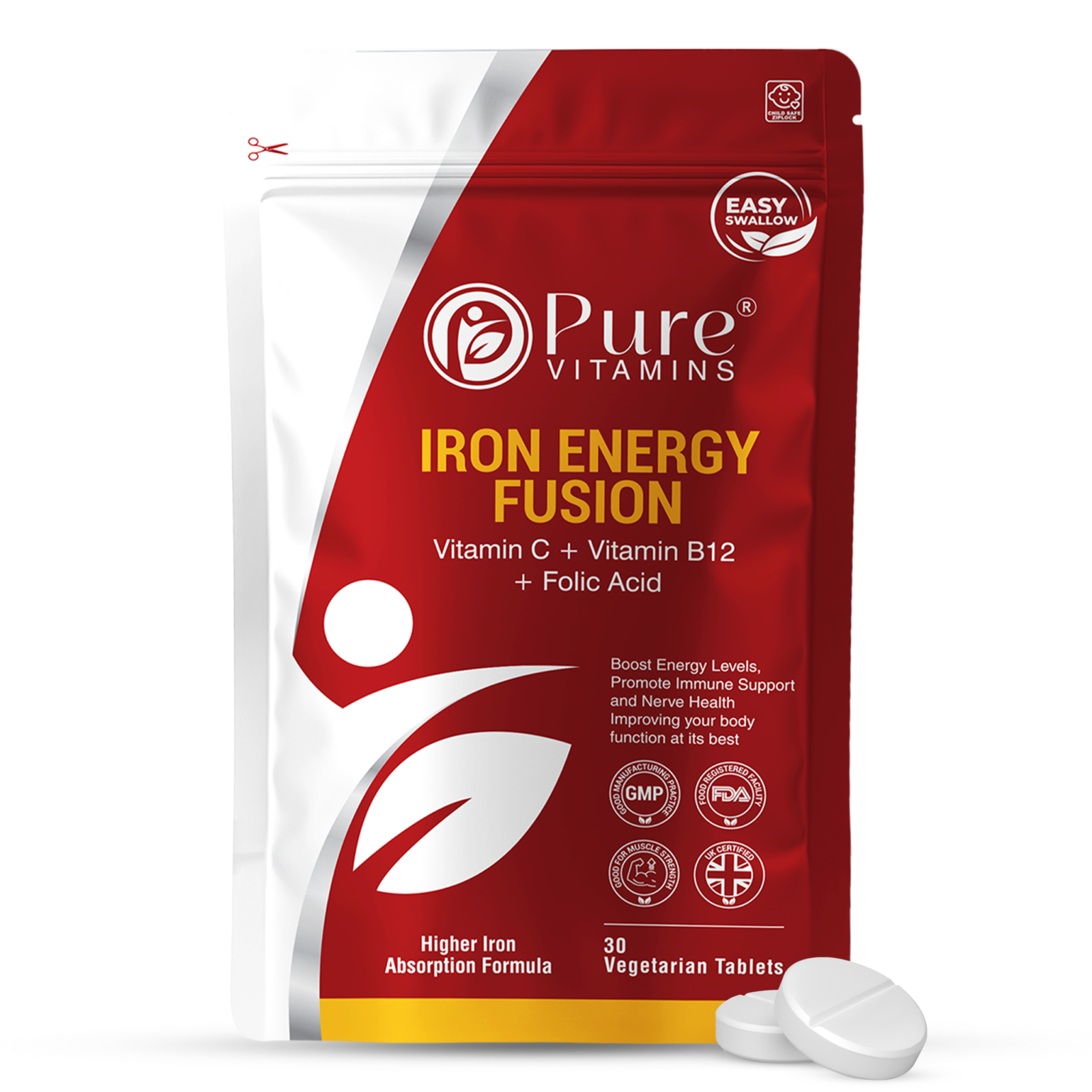
Our Iron tablets bring together exactly that energy-and-blood group: ferrous fumarate iron with vitamin C, B12 and folic acid in one tablet, nutrients that between them contribute to normal energy-yielding metabolism and the reduction of tiredness and fatigue. If you want a gentle, lower-dose single iron, see our 14mg high-absorption iron; if it is B12 you are after, our Vitamin B12 uses two active forms. For the calm-and-energy overlap, our magnesium guide is a useful read, and you can browse everything on our home page.

Frequently asked questions
Which vitamin is best for tiredness?
There is no single best one. Iron, vitamin B12, folate, vitamin C and magnesium all carry authorised roles in energy and reducing fatigue. Iron and B12 are the two most commonly linked to persistent tiredness, but they only help if you are genuinely low.
Why am I so tired all the time?
Tiredness has many causes, from sleep and stress to low iron or B12. If it is persistent, see your GP for a blood test rather than guessing, because fatigue can also signal conditions that need proper assessment.
Does vitamin C help with energy?
Vitamin C contributes to the reduction of tiredness and fatigue, and it also increases iron absorption, which is why the two are often combined in one formula.
Can I take iron and B12 together?
Yes. They work alongside each other in energy production and blood formation, which is why combination formulas include both, often with vitamin C and folate.
Dr. Miron, Founder of Pure Vitamins UK.
This article is for general information and education only and is not medical advice. Food supplements are not a substitute for a varied, balanced diet and a healthy lifestyle. If you are persistently tired, or are pregnant, breastfeeding, taking medication or living with a health condition, speak to your GP or pharmacist before starting a supplement.
