


Reviewed and updated: 3 August 2026
If you have just started taking biotin for your hair, you are almost certainly wondering when you will actually see something in the mirror. The honest, useful answer is that biotin is not measured in days at all. Hair grows slowly and on a fixed cycle, so a daily biotin habit is something you give weeks and months, not days, before you judge it, and it tends to matter most for people who were genuinely low in it to begin with.

How many days should I take biotin for hair growth?
The short version of how many days you should take biotin for hair growth is this: take it every day, consistently, and give it at least two to three months before you decide whether it is doing anything for you. There is no magic number of days after which a biotin tablet "kicks in" the way a painkiller does. Because a hair on your head grows only around a centimetre a month, any nutritional support shows up gradually, over full weeks and months, as new hair works its way out. If your interest is really about visible thinning or a shedding pattern rather than general upkeep, the honest window is longer still, closer to six to twelve months, because that is how long a hair takes to grow out to a length you would notice. I would rather tell you that plainly than promise a two-week transformation that biology simply will not deliver.
The quick answer
- What to do: take biotin daily, ideally with a meal, and stay consistent. Skipping days is the main thing that undoes it.
- How long before you judge it: around two to three months to notice anything, and six to twelve months for a fuller change, because that is how slowly hair grows.
- Who it helps most: people who were actually low in biotin. If your levels are already fine, extra biotin is unlikely to speed things up.
- One thing to know: high-dose biotin can skew certain blood tests, so mention it to your doctor before you have bloods taken.
Why the timeline is set by your hair, not by the tablet
To understand the "how long" question, it helps to know how hair actually grows. Every follicle on your scalp runs through a repeating cycle. There is a long growing phase, called anagen, that lasts anywhere from about two to six years and is when the hair is actively lengthening. Then a brief transition, catagen, lasting a couple of weeks. Then a resting phase, telogen, of roughly three months, after which the old hair sheds and a new one begins. At any moment most of your hair is in the growing phase, and it advances at a fairly steady pace of about a centimetre, or half an inch, each month.
That single fact reframes the whole "how many days" question. Ninety days, the length people often have in mind, is roughly one resting-phase turnover, barely a first checkpoint rather than a finish line. Micronutrients like biotin, iron, zinc and vitamin D are woven into that cycle because the cells in the hair bulb divide rapidly and need a steady nutritional supply. According to PubMed, a review of vitamins and minerals in hair loss describes these micronutrients as major elements in the normal hair follicle cycle, while being honest that the evidence for supplementing them in people who are not deficient is still limited and calls for larger trials (Almohanna et al., 2019, DOI). The practical upshot is simple: because the cycle turns over slowly, you are giving your hair the raw materials now and seeing the result later.

Does biotin actually speed up hair growth?
Here is where I want to be straight with you, because a lot of marketing is not. Biotin, also called vitamin B7, contributes to the maintenance of normal hair and normal skin, and that is a genuine, authorised role. What it is not is a guaranteed accelerator that makes anyone's hair grow faster on demand.
According to PubMed, a systematic review of biotin for hair loss found that in every reported case where biotin visibly helped, the person had an underlying reason for poor hair or nail growth, such as a genuine biotin deficiency or a specific condition like brittle nail syndrome or uncombable hair. The authors concluded there is a lack of sufficient evidence to expect a benefit in otherwise healthy people who are not deficient (Patel et al., 2017, DOI). In plain terms, biotin tends to help most when it is filling a real gap. If you already get plenty from your diet, topping up further is unlikely to be the thing that changes your hair.
That is not a reason to feel deflated. Biotin deficiency is more common than people assume in certain situations, and where it exists, correcting it genuinely matters. It just means the sensible expectation is "supporting normal, healthy hair over time," not "regrowing a full head in a fortnight."
How much biotin, in numbers, and how long to keep taking it
Your body actually needs only a tiny amount of biotin each day. To put real figures on it, the European Food Safety Authority sets an adequate intake of around 40 micrograms a day for adults, and the reference value used on UK supplement labels, the NRV, is 50 micrograms. Most people reach that comfortably from a normal diet. Supplements often go far higher, up to 10,000 micrograms, which is roughly 200 times the label NRV. That sounds dramatic, but biotin is water-soluble and very well tolerated, so the surplus your body cannot use is simply passed in urine rather than stored.
Being water-soluble is also exactly why daily use matters: you are not building up a big reserve, so a steady daily intake supports the maintenance of normal hair far better than an occasional big dose. If you want the detail on dosing, I have written a separate guide on how much biotin you actually need.
As for how long to keep going: think in terms of months, not a countdown of days. Most people give it two to three months of consistent daily use before forming a view, and many stay on it as an ongoing part of their routine because the point is maintenance, not a one-off fix. The biggest mistake I see is people quitting at three weeks because nothing has visibly happened, when three weeks was never going to be long enough for slow-growing hair to show a change.

Where biotin comes from in your diet
Since biotin works best when it is filling a genuine gap, it is worth knowing that a varied diet supplies a fair amount of it. Some of the richest everyday sources are eggs, particularly the cooked yolk, along with liver and other organ meats, nuts and seeds such as almonds, walnuts and sunflower seeds, and pulses. Smaller but useful amounts come from salmon, sweet potatoes, mushrooms, bananas and wholegrains, and your gut bacteria produce some biotin too. For most people eating normally, deficiency is genuinely uncommon, which is another honest reason a supplement is most useful for those with a specific reason to be low rather than as a universal accelerator.
Signs you might be low in biotin
Because biotin helps most when it is filling a genuine shortfall, it is worth knowing who tends to run low. Frank deficiency is uncommon, but it is more likely during pregnancy, in people who drink heavily, in some people on long-term anti-seizure medication, and in anyone eating a lot of raw egg white, which binds biotin. Possible signs of a real shortfall include thinning hair, brittle nails, and dry or scaly skin around the eyes, nose and mouth. If any of that sounds like you, or if you are shedding noticeably, it is genuinely worth a chat with your GP, because hair loss is often driven by things biotin cannot touch, such as low iron or an underactive thyroid.

What to realistically expect, week by week
If you like a rough map, here is an honest one. In the first few weeks, you will likely notice nothing on your head, and that is normal. Around the two to three month mark is when any change would start to become visible, because that is roughly one growth cycle's worth of new hair emerging. From there, if biotin was addressing a real gap for you, the effect keeps building gradually across six to twelve months rather than arriving in a dramatic jump. Nails, which also grow slowly, follow a similar unhurried pattern, typically taking a few months to grow out from base to tip.
None of this is a promise about your specific head of hair, and any brand that offers you one is overselling. What I can say with confidence is that consistency over months beats intensity over days every single time.
A few cautions worth knowing
Biotin is one of the safer supplements to take, but two things are worth flagging. First, more is not automatically better; once you have enough, extra biotin does not do extra for your hair. Second, and this is the important one, high-dose biotin can interfere with certain blood tests that use biotin-streptavidin technology, including some thyroid and heart (troponin) assays, which can produce misleading results. According to PubMed, this interference is well documented, so the practical step is easy: tell your doctor or nurse you take biotin before any blood test, and they can advise on pausing it beforehand (Weimann et al., 2021, DOI). If you are pregnant, breastfeeding, or taking regular medication, have a quick word with a healthcare professional before starting.
How to choose a biotin supplement
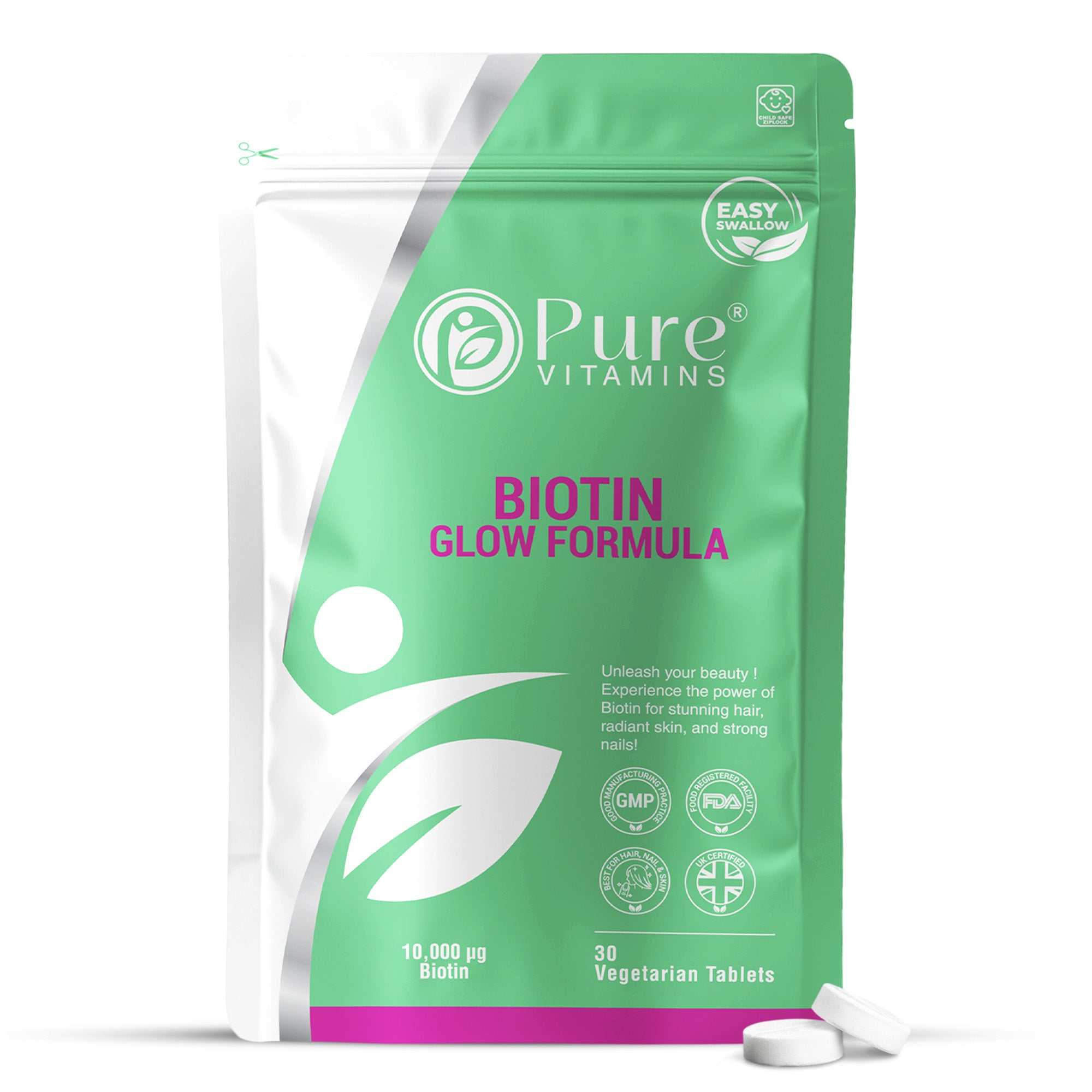
If you have decided biotin is worth a proper try, choose on a few simple points. Look for the actual dose in micrograms clearly stated on the label, the pure D-biotin form, and a product made to a proper standard. Our high-strength biotin tablets deliver 10,000 mcg of pure D-biotin in a one-a-day tablet, are vegan and gluten-free, and are manufactured in GMP-certified facilities and tested for purity and heavy metals at our own facility, so what is on the label is what is in the tablet. If you would rather cover hair, skin and nails more broadly, a biotin, zinc and selenium formula adds two more nutrients that carry their own authorised roles for normal nails and skin.
It is also worth remembering biotin is only one lever. For the bigger picture, see our guide to the best vitamins for hair, skin and nails, how biotin and collagen compare, and what genuinely supports normal nails. You can browse everything in one place in all our supplement guides, and see the full range at Pure Vitamins UK.
Shop High-Strength Biotin Tablets
Frequently asked questions
How many days does biotin take to work for hair?
It is measured in weeks and months rather than days. Because hair grows only about a centimetre a month on a fixed cycle, most people give a daily biotin habit at least two to three months before judging it, and six to twelve months for a fuller change.
Do you have to take biotin every day?
Yes. Biotin is water-soluble, so your body does not hold a large reserve. A steady daily intake is what supports the maintenance of normal hair, rather than occasional high doses.
Will biotin regrow my hair?
Biotin contributes to the maintenance of normal hair, and it tends to help most when someone is genuinely low in it. It is not a guaranteed hair-growth treatment, and if you are losing hair it is worth seeing your GP to check for causes like low iron or a thyroid issue.
Can you take biotin long term?
For most healthy adults a daily biotin supplement is well tolerated over the long term. The main thing to know is that high-dose biotin can interfere with some blood tests, so tell your doctor you take it before having bloods done.
Warm wishes,
Dr. Miron, Founder of Pure Vitamins UK
Food supplements should not be used as a substitute for a varied, balanced diet and a healthy lifestyle. This article is for general information and is not medical advice. If you are pregnant, breastfeeding, taking medication or have a medical condition, please speak to a healthcare professional before starting a supplement.

