

Last Updated: October 22, 2026
Quick Summary
To track hormonal changes throughout the month, start by recording your period start and end dates, then log physical symptoms and mood daily for at least three months to reveal patterns linked to hormone shifts across your cycle's four phases.
- Your menstrual cycle typically lasts 28 days, though 21 to 35 days is normal.
- The four cycle phases are menstruation, follicular phase, ovulation, and luteal phase, each with distinct hormone shifts.
- Track at least three physical symptoms daily, such as flow, cramps, energy, mood, and sleep quality.
- Cervical mucus changes and basal body temperature can help identify your ovulation window.
- Continue tracking for at least three months to spot genuine patterns in your cycle.
Table of Contents
- Understanding Your Menstrual Cycle and Hormonal Patterns
- What You'll Need to Start Tracking
- Step 1: Record Your Period Start and End Dates
- Step 2: Build Your Period Symptom Tracker
- Step 3: How to Track Ovulation and Your Fertile Window
- Creating Your Menstrual Cycle Tracking Chart
- How Long Should I Track My Cycle to Spot Patterns
- Common Mistakes to Avoid When Tracking
- Frequently Asked Questions
Understanding Your Menstrual Cycle and Hormonal Patterns
To track hormonal changes throughout your menstrual cycle, start by understanding the four distinct phases. Each phase brings shifts in oestrogen and progesterone that affect your body, mood, and energy levels. Awareness of these patterns is the first step toward supporting your natural wellness. (Source: the NHS)
Your menstrual cycle typically lasts 28 days, though 21 to 35 days is normal (the NHS). The cycle has four phases: menstruation, the follicular phase, ovulation, and the luteal phase. Each phase involves different hormone levels, which influence physical symptoms, mood, and energy.
The four cycle phases and their hormone shifts
Menstruation (Days 1-5): This phase begins on the first day of bleeding. Oestrogen and progesterone drop sharply, triggering the uterine lining to shed. Bleeding typically lasts 3 to 7 days (the NHS).
Follicular Phase (Days 1-13): This overlaps with menstruation and continues after bleeding stops. The pituitary gland releases follicle-stimulating hormone (FSH), which signals your ovaries to produce oestrogen.
Ovulation (Days 14-15): A surge in luteinising hormone (LH) triggers the release of an egg from your ovary. This is your most fertile window. Oestrogen peaks just before ovulation, then drops afterward.
Luteal Phase (Days 16-28): After ovulation, progesterone rises to prepare the uterus for a potential pregnancy. If fertilisation doesn't occur, progesterone and oestrogen both decline toward the end of this phase.
Why tracking matters for hormonal awareness
Understanding your cycle helps you recognise patterns in how your body responds to hormonal shifts. Tracking hormonal changes throughout the month reveals what is normal for you, making it easier to spot irregularities. Many people find that tracking also helps them plan activities, exercise, and nutrition around their cycle phases.
Tracking is not about predicting or controlling your cycle. It is about gathering information so you can support your body with the right approach at the right time. For example, some people adjust their workout intensity based on cycle phase, or pay closer attention to sleep during the luteal phase when fatigue is common.
What You'll Need to Start Tracking
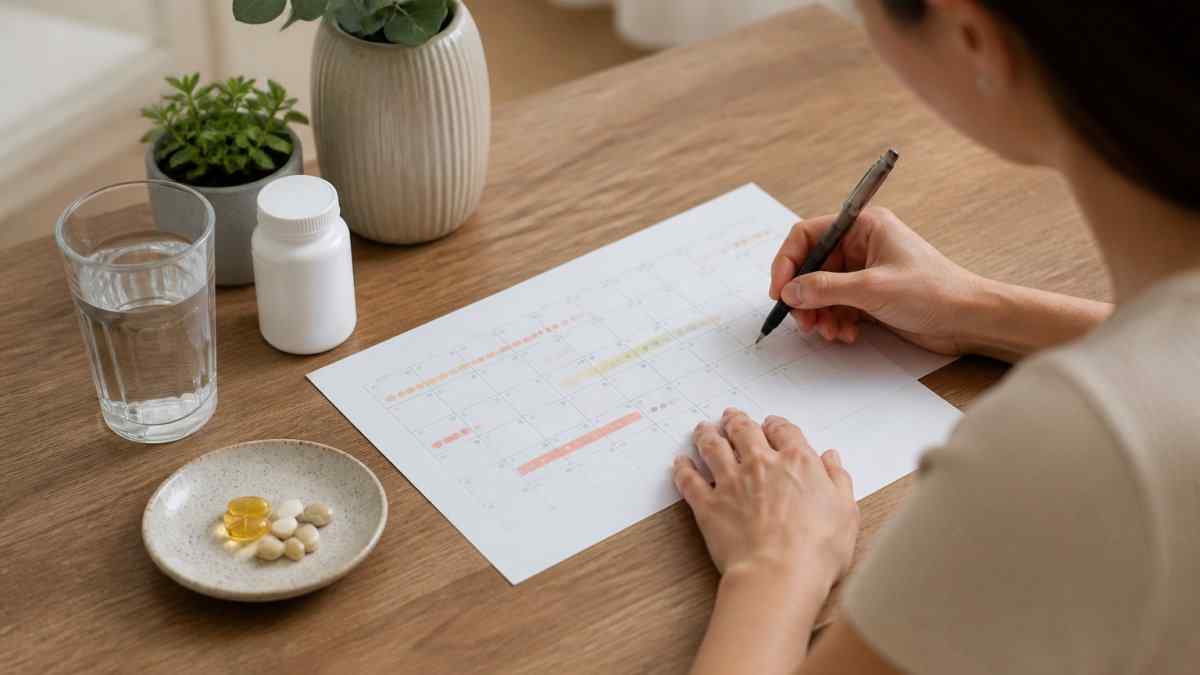
You need just three things: a way to record dates, a method to note symptoms, and consistency. Most people use one of these approaches:
- Paper notebook or printed tracker: Low-tech, private, and requires no app access
- Calendar or diary: Simple, familiar, and easy to reference
- Period tracking app: Automatic reminders, pattern analysis, and synced across devices
- Spreadsheet: Fully customisable, good for detailed data
Choose whatever method you will actually use. The best tracker is the one you stick with.
Step 1: Record Your Period Start and End Dates
Mark the first day of bleeding as Day 1 of your cycle. This is your period start date. Record it clearly in your chosen method.
Count the days until bleeding stops. That final day is your period end date. Write it down. Most cycles last 28 days from start date to start date, but yours may be shorter or longer.
Do this for at least three months. After three cycles, you will see your pattern. If your cycle length varies by more than a few days, note that too. Irregular periods are common and do not necessarily signal a problem, but tracking helps you understand your own baseline.
Record these dates even if nothing else changes. The cycle length is your foundation.
Step 2: Build Your Period Symptom Tracker
A symptom tracker records how your body feels each day. This reveals patterns linked to hormone shifts. Start simple: write down one or two symptoms per day. You can add more detail later.

Physical symptoms to log daily
Track these physical signs each day:
- Menstrual flow: Heavy, moderate, light, or spotting
- Cramps: None, mild, moderate, or severe
- Bloating: None, mild, moderate, or severe
- Breast tenderness: Present or absent
- Headaches: None, mild, or severe
- Skin changes: Breakouts, clarity, oiliness, or dryness
- Sleep quality: Good, fair, or poor
- Energy level: High, normal, or low
- Digestive changes: Constipation, normal, or loose stools
You do not need to track all of these. Choose three to five that you notice most. Write them down each evening or morning. One sentence is enough: "Day 5: heavy flow, mild cramps, tired."
Mood and energy patterns
Hormonal changes affect mood and energy significantly. Log these each day:
- Mood: Stable, happy, anxious, irritable, or sad
- Motivation: High, normal, or low
- Stress response: Calm, normal, or easily overwhelmed
- Social energy: Want to be around others or prefer solitude
- Focus: Sharp, normal, or scattered
Many people notice that mood shifts predictably across their cycle. The luteal phase often brings lower mood or anxiety. The follicular phase often brings higher mood and motivation. Tracking reveals your personal pattern, not a universal one.
Step 3: How to Track Ovulation and Your Fertile Window
Ovulation is when your ovary releases an egg. This happens roughly in the middle of your cycle, around day 14 of a 28-day cycle. The fertile window is the five days before ovulation plus ovulation day itself.
Cervical mucus and basal body temperature methods
Two observable signs help identify ovulation:
Cervical Mucus: As ovulation approaches, cervical mucus changes. It becomes clear, stretchy, and slippery, similar to raw egg white. This is the most fertile mucus. After ovulation, it becomes thick and sticky again. Check your mucus each day and note the change. This requires no equipment and is free.
Basal Body Temperature (BBT): Your resting body temperature rises slightly after ovulation, by about 0.3 to 0.5 degrees Celsius. Measure your temperature first thing each morning, before getting out of bed, using a digital thermometer. Record it daily. After three days of higher temperatures, ovulation has likely already occurred. This method confirms ovulation but does not predict it.
You can use one method or both. Neither is 100% accurate, but both provide useful clues.
What ovulation tracking can and cannot tell you
Tracking ovulation signs helps you understand your cycle pattern and identify your fertile window if you are trying to conceive. It does not measure hormone levels directly.
Many people assume that tracking these signs reveals exact hormone levels. It does not. Hormone levels vary widely between people. One person's "typical" oestrogen level may differ from another's. Symptoms and observable signs are individual, not standardised.
If you need to know your actual hormone levels, a blood test ordered by your GP is the only reliable method. These tests measure oestrogen, progesterone, FSH, and LH directly. Tracking symptoms is useful for awareness and pattern recognition, not for diagnosing hormonal conditions.
Creating Your Menstrual Cycle Tracking Chart
A tracking chart organises all your data in one place. You can see patterns across multiple cycles at a glance.
Sample tracking template and what to record
Here is a simple template you can use in a notebook or spreadsheet:
| Cycle Day | Date | Flow | Cramps | Mood | Energy | Cervical Mucus | BBT | Notes |
|---|---|---|---|---|---|---|---|---|
| 1 | 1 Oct | Heavy | Moderate | Irritable | Low | Sticky | 36.4°C | Headache |
| 2 | 2 Oct | Heavy | Mild | Neutral | Low | Sticky | 36.3°C | Better sleep |
| 3 | 3 Oct | Moderate | None | Happy | Normal | Creamy | 36.4°C | , |
| 14 | 14 Oct | None | None | Happy | High | Stretchy | 36.5°C | Ovulation likely |
| 21 | 21 Oct | None | None | Anxious | Low | Sticky | 36.8°C | Bloated |
Print this or create it in a spreadsheet. Fill it in daily. After three months, patterns emerge. You will see when your period typically starts, when energy peaks, and when mood dips.
Using a tracking app versus paper notebook
Apps: Period tracking apps like Clue, Flo, or Cycles automatically calculate cycle length, predict your next period, and flag patterns. They sync across devices and send reminders. However, they collect personal data, and privacy varies by app. Check their privacy policy before choosing one.
Paper: A notebook or printed chart is private, offline, and requires no account. You control all your data. It takes slightly more time to review patterns, but the act of writing can help you notice details you might miss with an app.
Many people use both: an app for convenience and a paper backup for privacy. Choose based on what feels right for your comfort and habits.
How Long Should I Track My Cycle to Spot Patterns
Track for at least three months. One cycle gives you one data point. Two cycles show variation. Three cycles reveal a genuine pattern.
After three months, you will know:
- Your typical cycle length
- When your period usually starts and ends
- Which days bring the heaviest flow
- When cramps or bloating typically peak
- How your mood and energy shift across phases
- When you are most likely to ovulate
If your cycle is irregular, tracking for four to six months helps you see the range of variation. Irregular cycles are common and often normal, but tracking clarifies whether yours falls within a typical range or differs significantly.
Do not stop after three months. Continue tracking indefinitely. Your cycle may change due to stress, illness, travel, or age. Ongoing tracking helps you spot these shifts early.
Common Mistakes to Avoid When Tracking
Starting and stopping: To track hormonal changes effectively throughout the month, you must do it consistently.
Waiting for perfection: Do not wait for the "perfect" tracker or app.
Assuming your cycle matches a textbook: The "standard" 28-day cycle is an average, not a rule.
Confusing correlation with causation: You may notice that mood dips on certain days.
Ignoring the bigger picture: Track symptoms, but also note stress, sleep, exercise, and diet.
Trying to change your cycle based on tracking: Tracking reveals patterns. It does not control them.
Tracking hormonal changes throughout the month gives you valuable insight into how your body works.
At Pure Vitamins UK, we recognise that hormonal awareness is part of broader wellness.
Frequently Asked Questions
How do I know if my hormonal changes are normal?
Normal hormonal changes follow predictable patterns across your cycle: higher oestrogen in the follicular phase, a surge before ovulation, and elevated progesterone in the luteal phase. Tracking for 2-3 months reveals your personal pattern. Symptoms like bloating, mood shifts, and energy changes are typical, but significant changes in cycle length, flow, or severity warrant a GP consultation. Keep your tracking records to share with your doctor if patterns shift unexpectedly.
Can period-tracking apps show actual hormone levels?
No. Apps cannot measure hormone levels, they estimate ovulation and cycle phases based on dates and symptoms you enter. Apps predict patterns but cannot replace blood tests for actual hormone measurement. If you need precise hormone data (for fertility planning, hormonal contraception assessment, or perimenopause evaluation), ask your GP about blood tests that measure oestrogen, progesterone, FSH, or LH. Tracking apps are useful for spotting trends; actual hormone measurement requires medical testing.
What's the difference between tracking for fertility versus general hormonal awareness?
Fertility tracking focuses on pinpointing ovulation and the fertile window using cervical mucus, basal body temperature, or cycle day calculations. General hormonal tracking logs all symptoms and patterns to understand how your hormones affect mood, energy, skin, and digestion throughout the month. You can track hormonal changes without fertility intent, many people use it for cycle syncing (matching exercise and nutrition to each phase) or spotting hormonal imbalances. Choose the depth that matches your goal.
How long should I track my cycle to spot reliable patterns?
Track for at least 2-3 months (3 full cycles) to identify consistent patterns. Most people need 3 cycles to confirm cycle length, ovulation timing, and symptom clusters. If your cycles are irregular, track for 4-6 months for clearer patterns. Once you have baseline data, continue tracking monthly to spot changes. Irregular cycles, hormonal contraception use, perimenopause, or postpartum changes may require longer tracking periods before reliable patterns emerge.


