

If your periods are heavy, iron is often the nutrient that runs low first. A blood test shows whether your stores are low, and if they are, your GP will advise how to restore them, often with iron tablets at a dose set for you. Iron will not stop the bleeding itself: the cause of the heavy bleeding needs its own conversation with your GP.
Below, we explain how heavy periods lead to low iron, what testing involves, how to take iron so your stomach tolerates it, and what to check on a label before you buy.
TL;DR
- Heavy periods are a common cause of iron deficiency, and up to 5% of women of childbearing age develop iron deficiency anaemia from blood loss.
- Ask your GP for a blood test, including ferritin, before starting a high dose. Fatigue has other causes too.
- Restoring low iron and managing the heavy bleeding are separate steps, and your GP can advise on both.
- Gentler routines (a lower dose, taking it with vitamin C, sometimes every other day) help many people keep going, and consistency matters more than the brand.
- Recovery takes months, not days. Do not stop the moment you feel better.
Table of Contents
- Why heavy periods drain your iron
- Get tested before you start
- Low iron and heavy bleeding are separate problems
- How to take iron so you can keep taking it
- Choosing an iron supplement: a label checklist
- Our perspective
- Our iron options
- How long recovery takes
- Food still counts
- FAQ
- Sources
Why heavy periods drain your iron
Every period removes a little iron along with the blood. When the loss is larger than your body can replace from food, your stores shrink gradually. The NHS explains that women lose both iron and red blood cells during a period, and stores become depleted if the loss outpaces replacement.
This is why a review of the topic describes menstrual blood loss as a leading cause of iron deficiency in women, which can progress to iron deficiency anaemia.
It helps to separate two terms:
- Iron deficiency means your stores (measured as ferritin) are too low. Your haemoglobin may still look normal. This can happen before anaemia develops.
- Iron deficiency anaemia means the shortage has become severe enough that haemoglobin has fallen below the normal range.
Many women live with the first stage for a long time and assume tiredness is simply part of a busy life.
What counts as a heavy period
There is no need to measure millilitres. The NHS describes heavy periods as needing to change a pad or tampon every one to two hours, or using two types of product together, such as a pad plus a tampon. If that sounds familiar, or your periods have changed recently, it is worth raising with your GP rather than putting up with it.
Signs your iron may be low
Common signs include persistent tiredness, weakness, looking paler than usual, breathlessness on stairs, headaches and feeling cold. None of these is specific to iron. Clinicians caution that fatigue can signal other health problems, which is why guessing is a poor strategy. If you want a wider look at tiredness and nutrients, our guide on which vitamins help with tiredness covers the options.
Get tested before you start
We would always rather you knew your numbers. A supplement taken blind can mask other causes, and high doses are unnecessary if your iron is fine.
UK guidance has moved on this recently. NICE’s heavy menstrual bleeding guideline notes that in July 2026 it removed an older recommendation not to routinely test serum ferritin, so testing ferritin in women with heavy bleeding is now supported.
What to expect when you speak to your GP:
- A blood test for haemoglobin and ferritin, sometimes more iron studies if the picture is unclear.
- A discussion of your bleeding pattern and what might be causing it.
- If the diagnosis is uncertain, your clinician may suggest a trial of oral iron for 2 to 4 weeks in premenopausal women. A haemoglobin rise of more than 10 g/L in that window strongly suggests iron deficiency.
If your symptoms include very heavy bleeding, dizziness, chest pain or marked breathlessness, contact your GP promptly or use NHS 111 rather than waiting to see how a supplement works.
Rule out other causes
Low iron is not always about periods. Conditions such as coeliac disease can impair absorption of nutrients, and less common causes of blood loss need excluding. Your GP is the right person to decide how far to investigate.
Low iron and heavy bleeding are separate problems
This is the most common misunderstanding we see. Iron tablets do not make periods lighter. Medical advice is to pair iron with managing the cause: the NHS lists treatments such as tranexamic acid, combined oral contraceptives or an intrauterine system that your doctor can discuss with you.
A 2025 review in a medical journal puts it the same way: oral iron and reducing menstrual loss are both first-line treatments for females with heavy menstrual bleeding. In practice, that means two tracks running together: replenish iron, and talk about the bleeding.
The same review notes that intravenous iron has a role when oral iron cannot be tolerated or absorbed. If tablets repeatedly upset you or your levels do not rise, tell your GP rather than quietly giving up.
How to take iron so you can keep taking it
The best iron supplement is the one you can take consistently. Experts reviewing iron deficiency in females say that adherence is the key, and the best option is the one a person tolerates. Stomach side effects such as constipation, nausea and abdominal discomfort are the main reason people stop.
Pair iron with vitamin C
NHS guidance suggests iron is best absorbed with a source of vitamin C, such as orange juice, ideally away from meals, though this can sometimes upset the stomach. If it does, taking it with a small snack is a reasonable compromise to discuss with your pharmacist.
Watch tea, coffee and antacids
Tea, coffee and common heartburn medicines such as Gaviscon or omeprazole can reduce absorption, so keep them away from your iron dose. Do not stop a prescribed medicine on your own. Ask your pharmacist how to space them out.
Consider a lower dose or alternate days
Gastrointestinal effects are dose-dependent. A strategy clinicians increasingly discuss is a lower dose, taken on alternate days. The idea is that hepcidin, the protein that regulates iron absorption, can fall between doses, and research suggests this may be as effective while being easier on the gut. Ask your GP or pharmacist whether that suits you.
Gentle habits that help
- Take it at the same time each day so it becomes routine. If evenings suit you, we have written about whether iron tablets at night are fine.
- Drink plenty of water and eat fibre-rich foods.
- If constipation is your main issue, our practical guide to an iron supplement without constipation goes through what tends to help.
Choosing an iron supplement: a label checklist
Searches like “gentle iron supplements” and “best iron for women” are really asking the same thing: which product will I be able to tolerate and trust? Check these points.
- Form of iron: Ferrous fumarate is a widely used form. Different forms suit different stomachs.
- Amount of elemental iron per tablet: Compare the actual iron, not just the compound weight.
- Daily dose guidance: A clear dose avoids taking more than you intend.
- Vitamin C: Vitamin C increases iron absorption.
- Allergens and fillers: Look for clear allergen information and no unexplained blends.
- Testing: Look for a brand that states how its products are tested, so you know the label matches the tablet.
On the dose question, many UK adults wonder whether a lower daily amount is enough. We looked at this in detail in is 14mg of iron a day enough. The short answer is that it depends on your starting point, which is why testing matters. A confirmed deficiency may need a different plan from your GP.
We would also point you to the form of iron explained in our article on ferrous fumarate with vitamin C and folic acid.
Our perspective
We built Pure Vitamins UK around one frustration: labels that leave you guessing. With iron, that frustration is sharper, because the person reading is often tired, busy and unsure whether to trust what they are buying.
So our approach is simple. Every formula states clear amounts, daily dosage guidance and allergen information, with no mystery blends and no unnecessary fillers. Our supplements are formulated in the UK and tested for purity and heavy metals at our GMP-certified facility.
We also try to be honest about what a supplement can do. No supplement can fix heavy periods, and a confirmed iron deficiency should be managed with your GP, who will set the dose you need. As a nutrient, iron contributes to normal formation of red blood cells and haemoglobin and to the reduction of tiredness and fatigue, but any iron routine sits alongside a proper conversation about the bleeding itself. We would much prefer you test, understand and then choose than buy on a hunch.
For most people, we think a lower-dose, well-tolerated iron taken steadily beats a stronger one abandoned after a week.
Dr. Miron, Founder of Pure Vitamins UK
Our iron options
If you and your GP or pharmacist decide that a daily iron food supplement suits you, these are our options. They are food supplements, not a treatment for anaemia; a diagnosed deficiency may need a different dose from your GP.
- Iron Tablets 14mg Ferrous Fumarate, Gentle Formula: a gentle 14mg ferrous fumarate tablet for a simple daily routine.
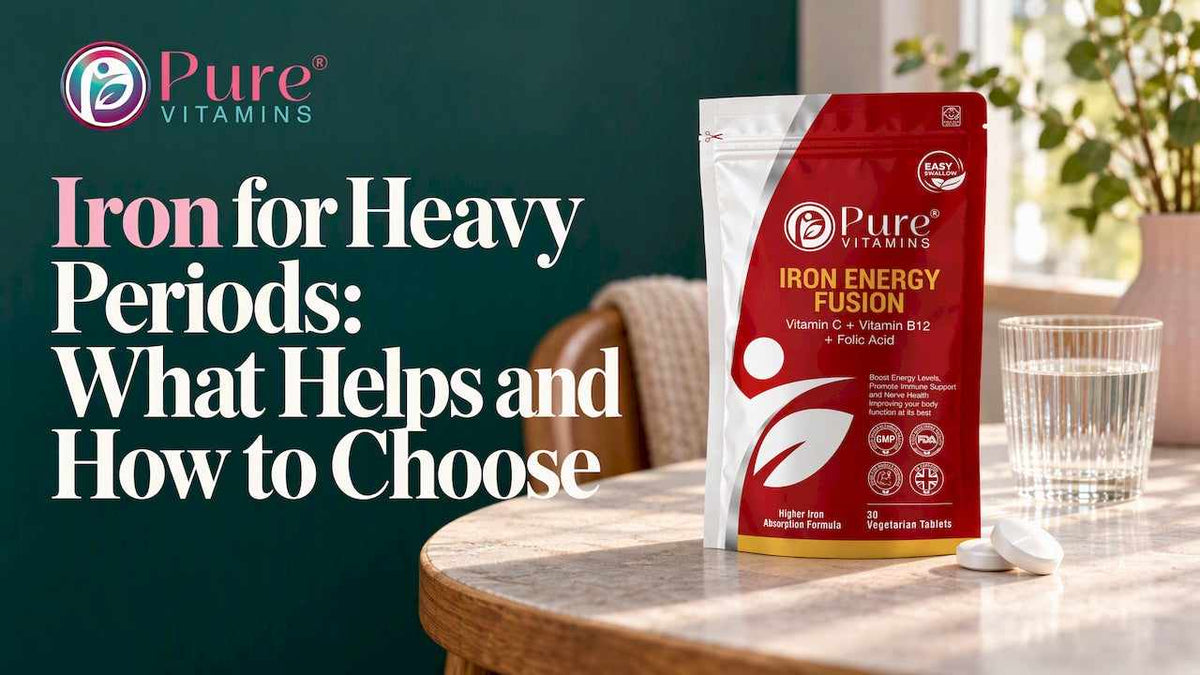
- Iron Tablets with Vitamin C, B12 & Folic Acid: ferrous fumarate combined with vitamin C, B12 and folic acid in one tablet.
- Iron & Energy Bundle for Women: iron, B12, folic acid, D3+K2, zinc and a probiotic together, for women who want a wider daily routine.
You can also browse our full range of supplements, including our supplements for energy. Check the label, follow the dosage guidance, and speak to your GP or pharmacist first if you are pregnant, take other medicines or have a diagnosed condition.

How long recovery takes
Be patient. Experts say that energy may start to improve within days to weeks, while full replenishment of iron stores takes months.
A normal haemoglobin result does not mean you are finished. A hospital patient leaflet explains that to restore ferritin, you typically continue iron for about 3 months after haemoglobin returns to normal, with ferritin rechecked at intervals such as 3, 6, 12 and 24 months. Follow the plan your own clinician sets, since it may differ.
If you want to understand the number itself, our guide on how to increase ferritin safely explains what ferritin shows and how food and supplements fit in.
Food still counts
Diet alone rarely fixes a deficiency caused by ongoing heavy blood loss, but it supports everything else. The NHS lists good sources of iron including red meat, beans, nuts, dried fruit and fortified cereals. Liver is on that list, but should be avoided in pregnancy.
A few practical pairings:
- Add a vitamin C source, such as peppers or citrus fruit, to iron-rich meals.
- Keep tea and coffee away from those meals.
- If you are vegan or vegetarian, plan plant sources deliberately and ask about testing.
The aim is not perfection. It is giving your body the best chance to absorb what you take in.
FAQ
Can iron supplements help with heavy periods?
They do not reduce the bleeding. If heavy periods have left you low in iron, your GP will advise how to restore your levels, which often includes iron tablets. The root cause needs separate medical management, such as tranexamic acid, hormonal contraception or an intrauterine system. Speak to your GP about both parts.
How do I choose a gentle iron supplement?
Look for a clear amount of elemental iron, vitamin C to support absorption and transparent allergen information. Lower doses, or taking iron every other day, are often easier on the stomach. Ask your pharmacist if you take other medicines.
Should I test before taking iron?
Yes, where you can. A blood test showing haemoglobin and ferritin tells you whether you are deficient and how much work your stores need. Symptoms like tiredness have many causes, so testing avoids treating the wrong problem.
Can iron tablets cause headaches or stomach problems?
Stomach effects such as constipation, nausea and discomfort are the most common reasons people stop iron, and they depend on the dose. If you get persistent side effects or headaches, speak to your pharmacist or GP about adjusting the dose or schedule rather than stopping silently.
Sources
- Heavy periods, NHS
- Iron deficiency anaemia, NHS
- Vitamins and minerals: Iron, NHS
- Heavy menstrual bleeding: update information, NICE
- Diagnostic trials of iron treatment, NICE CKS
- Diagnosis and management of iron deficiency in females, PMC
- Iron deficiency anaemia, Right Decisions (NHS Borders)
- Iron deficiency anaemia patient information, RUH NHS
- Heavy menstrual bleeding, iron deficiency and anaemia, AJOG
- Iron deficiency and anaemia in pregnancy, Plymouth Hospitals NHS Trust
Recommended
- Is 14mg of Iron a Day Enough? UK Intakes Explained
- Iron Tablets 14mg UK | Gentle Ferrous Fumarate
- Iron Tablets at Night: Is It OK?
- Iron Supplement Bundle for Women UK | Iron, B12 & Folic Acid
Food supplements should not be used as a substitute for a varied, balanced diet and a healthy lifestyle. This article is for general information only and is not medical advice. If you are pregnant, breastfeeding, taking medication or have a medical condition, speak to your GP or pharmacist before taking a supplement.


