

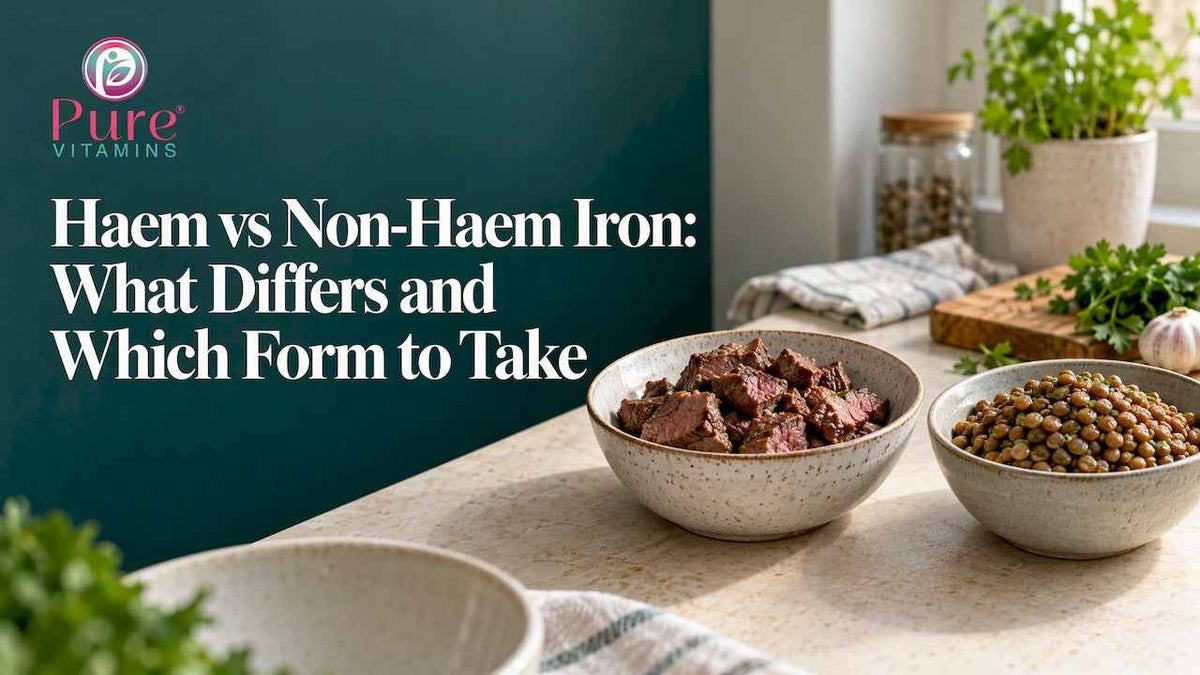
Haem iron comes from meat, fish and poultry, and your body absorbs it more readily. Non-haem iron comes from plants, eggs, fortified foods and most supplements, and absorption is lower and more easily disrupted. UK guidance puts the gap at 2 to 6 times in favour of haem iron. That does not make non-haem iron a poor choice. It means the way you eat, and the form of any supplement you take, matters more than many people expect.
Below, I explain the two types, what changes absorption in real life, and how the common supplement forms (ferrous sulfate, ferrous fumarate, bisglycinate) differ in what is actually known.
TL;DR
- Haem iron is found almost only in meat; non-haem iron is in plants, eggs, fortified foods and supplements.
- Haem iron is 2 to 6 times more available for absorption, but non-haem iron still counts, especially with vitamin C and without tea or coffee alongside.
- Supplement labels list the compound weight, not the elemental iron. Compare elemental iron, not tablet size.
- UK guidelines for confirmed iron-deficiency anaemia name ferrous sulphate, fumarate and gluconate; if one is not tolerated, alternate-day dosing is an option.
- Get a blood test and speak to your GP or pharmacist before taking iron for weeks on end.
Table of Contents
- What haem and non-haem iron actually are
- How different is absorption, really?
- What helps and what hinders absorption
- Who needs to think about this more carefully
- Iron supplements: the forms you will see
- Ferrous sulfate vs bisglycinate: how to decide
- Dosing, safety and side effects
- Our perspective on choosing iron
- If you are ready to choose a tablet
- A simple way to put this into practice
- FAQ
- Sources
What haem and non-haem iron actually are
Iron in food exists in two chemical settings. Haem iron is part of haemoglobin and myoglobin, the proteins that carry oxygen in blood and muscle. That is why it sits in animal tissue. Non-haem iron is iron that is not bound in that structure.
The UK’s Scientific Advisory Committee on Nutrition notes that haem iron is found almost exclusively in meat, while non-haem iron occurs in cereals, vegetables, nuts, eggs, fish and meat. Iron is also added to foods such as some breakfast cereals and flours, and it is the form used in supplements.
Two points often get lost:
- Meat contains both types. Even in beef, a share of the iron is non-haem.
- Plants, including spinach, lentils and tofu, contain only non-haem iron, however much they contain overall.
Common sources, grouped
- Haem: Typical sources: Beef, lamb, pork, poultry, fish, liver.
- Non-haem: Typical sources: Lentils, beans, chickpeas, nuts, seeds, wholegrains, green leafy vegetables, eggs, fortified cereals, iron supplements.
How different is absorption, really?
The headline figure is the 2 to 6 times difference quoted by the SACN report. A 2019 analysis of dietary iron intake in women describes haem iron as highly bioavailable, with roughly a quarter to a third absorbed, whereas non-haem is far lower. I would treat any single percentage as a rough guide: absorption varies from person to person and from meal to meal.
The most important variable is your own iron status. Your body adjusts. With higher iron stores, absorption of non-haem iron falls, while haem iron is taken up more steadily. With low stores, the gut absorbs more. This is why the same meal can give different amounts of iron to two different people.
SACN also stresses that the effects of tea or vitamin C seen in controlled experiments are often smaller across a whole mixed diet, and matter less for most healthy people than for those who already have low iron. I think that is a fair and reassuring reading. Most people do not need to engineer every meal.
What helps and what hinders absorption
These points mainly concern non-haem iron, and they matter most if your stores are low.
Helpful:
- Vitamin C. NHS dietary advice notes that vitamin C increases non-haem iron absorption. A glass of orange juice, peppers or a piece of fruit with your meal does the job.
- Meat, fish and poultry. A Nordic nutrition review notes that muscle tissue from red meat, poultry, fish and liver enhances iron absorption, and that digested peptides may help keep non-haem iron available.
Unhelpful:
- Tea, coffee and other drinks with tannins or phosphates, and high-bran foods, can interfere with absorption.
- For supplements, the NHS advises that tea, coffee, eggs and dairy should not be taken with ferrous sulfate, with a 2-hour gap.
A practical rule: put your tea or coffee between meals rather than with your iron-rich one, and add a vitamin C food to plant-based meals. That is enough for most people.
Who needs to think about this more carefully
The same review notes that dietary factors matter more for people with marginal or low iron stores, and that large menstrual blood losses are a risk factor for deficiency. In practice, I would pay closest attention if you:
- have heavy periods (our guide on iron and heavy periods covers testing and choosing);
- follow a vegetarian or vegan diet, where all dietary iron is non-haem;
- are pregnant, or have recently had a baby;
- have a digestive condition that affects absorption.
NHS figures give recommended daily intakes of 8.7 mg for men and 14.8 mg for women. If you want to know whether the 14 mg figure on labels is enough, we explain it in is 14mg of iron a day enough.
Iron supplements: the forms you will see
Supplements deliver non-haem iron. The differences are in the compound it is attached to, which affects how much iron is in each tablet and how well it sits in your stomach.
Elemental iron: the number that matters
The compound weight on a label is not the iron weight. NHS Greater Glasgow and Clyde’s table lists 200 mg of ferrous sulphate as 65 mg elemental iron, 210 mg of ferrous fumarate as 68 mg, and 300 mg of ferrous gluconate as 35 mg. Two tablets that look alike can deliver very different amounts, so compare elemental iron.

Ferrous sulfate
Ferrous sulfate is the long-standing standard. A 2022 review notes the British Society of Gastroenterology recommends it first-line because it is inexpensive, well absorbed, widely available and effective at replenishing stores. Its drawback is tolerability: the same review reports that gastrointestinal side effects are common, constipation most often, then nausea and diarrhoea, and they can lead people to stop treatment.
Ferrous fumarate and gluconate
The 2021 BSG guideline recommends one tablet a day of ferrous sulphate, fumarate or gluconate as initial treatment for adults with confirmed iron-deficiency anaemia. So fumarate is an established form, not one to be wary of. Our own iron tablets use ferrous fumarate at a food supplement level. They are not a treatment for anaemia, which needs a dose set by your GP. See the 14mg gentle formula and our article on ferrous fumarate with vitamin C and folic acid.

Iron bisglycinate and “gentle iron”
Bisglycinate is iron bound to the amino acid glycine, and it is usually described as gentler. “Gentle iron” is a marketing phrase, not a clinical category, so it helps to ask what is actually meant: a lower elemental dose per tablet, a different compound, or a formula taken with food. The UK guidelines above name ferrous salts, not bisglycinate, so the best-documented evidence in UK clinical practice sits with those. I would not claim bisglycinate is better or worse; the honest position is that people tolerate iron forms differently, and the dose and timing often matter as much as the compound.
Ferrous sulfate vs bisglycinate: how to decide
- Named in BSG guideline: Ferrous sulfate: Yes; Ferrous fumarate: Yes; Bisglycinate: No.
- Elemental iron in a typical tablet: Ferrous sulfate: 65 mg per 200 mg tablet; Ferrous fumarate: 68 mg per 210 mg tablet; Bisglycinate: Varies by product; check label.
- Common complaint: Ferrous sulfate: Constipation, nausea; Ferrous fumarate: Similar class of effects; Bisglycinate: Often described as gentler.
My advice is practical. Choose by the elemental dose on the label, by how you tolerate it, and by whether you will take it consistently. A well-tolerated tablet you take is worth more than a theoretically better one you stop after a week. If you tolerate one form poorly, changing dose frequency is often the first step.
Dosing, safety and side effects
A few facts worth knowing before you buy:
- NI Direct advises that 17 mg or less a day of supplemental iron is unlikely to cause harm, and very high doses can be fatal, particularly to children. Keep supplements out of children’s reach.
- UK advisory guidance lists more than 20 mg of iron in a food supplement as the point at which a label should warn that it may cause mild stomach upset in sensitive people.
- If the first daily tablet is not tolerated, the BSG suggests one tablet every other day, another oral preparation or intravenous iron. That applies to confirmed anaemia under clinical care; speak to your GP before adopting it yourself.
- The NHS notes ferrous sulfate works best on an empty stomach but can be taken with or after food if it upsets your stomach.
If constipation is your concern, our guide to taking iron without constipation goes through the practical steps, and if timing is your question, read iron tablets at night.
See your GP rather than self-treating if you are tired, breathless, pale or have heavy periods. Iron levels are best checked by a blood test, and you should not take iron long-term without knowing you need it.
Our perspective on choosing iron
We formulate in the UK, and we start from a simple principle: you should be able to read a label and know exactly how much iron you are taking. That means stating the elemental amount, giving a clear daily dose, and listing allergens, with no mystery blends.
On the haem question, we think food comes first. If you eat meat or fish, that is a reliable haem source; if you do not, plant sources plus vitamin C work, but your stores deserve closer checking. A supplement is for a gap, not a replacement for a varied diet.
On forms, we chose ferrous fumarate because it is a well-established form that carries a good amount of iron per tablet. We pair it with vitamin C, because vitamin C increases iron absorption. We would never tell you one form suits everyone. Tolerance is personal, and I would rather you test, ask your pharmacist and adjust than chase a perfect answer.
What I cannot tell you from research alone is how your body will respond. That is why we suggest a blood test first.
Dr. Miron, Founder of Pure Vitamins UK
If you are ready to choose a tablet
If your GP or pharmacist has confirmed that a supplement suits you, our Iron Tablets 14mg with ferrous fumarate are our gentle formula, and our iron tablets with vitamin C, B12 and folic acid suit those who want those nutrients together. Both state their ingredient amounts and allergen information plainly.

A simple way to put this into practice
- Check your diet: how often do you eat meat, fish or poultry, and how many plant-based iron foods?
- Add vitamin C foods to plant-based meals, and move tea and coffee away from them.
- If you have symptoms or heavy periods, ask for a blood test before supplementing.
- If you supplement, compare elemental iron, not tablet weight.
- Take it consistently, and review with your GP or pharmacist if side effects make you want to stop.
FAQ
Is haem iron better than non-haem iron?
Haem iron is absorbed more efficiently, 2 to 6 times more according to UK guidance. That makes it the more reliable source, but non-haem iron still meets needs for many people, particularly with vitamin C and when tea or coffee are kept apart from the meal.
Is iron bisglycinate better than ferrous sulfate?
There is no simple answer. Bisglycinate is often described as gentler, but UK guidelines for confirmed anaemia name ferrous sulphate, fumarate and gluconate. Compare elemental iron and tolerance, and ask your pharmacist if you have had side effects before.
What is the best form of iron to take?
The best form is one that suits your needs, that you tolerate, and that you take consistently. Ferrous salts have the strongest backing in UK clinical guidance. Whatever you choose, check the elemental iron per tablet and keep within the label dose.
Should I avoid anything when taking iron?
The NHS advises leaving a 2-hour gap between ferrous sulfate and tea, coffee, eggs and dairy products. Vitamin C alongside your dose can help absorption of non-haem iron.
Sources
- SACN: Iron and Health report
- Dietary advice to increase iron intake (NHS)
- Iron: a background article for the Nordic Nutrition Recommendations
- Analysis of heme and non-heme iron intake and iron dietary sources in adolescent menstruating females
- How and when to take ferrous sulfate (NHS)
- Elemental iron content of oral iron preparations (NHS GGC)
- Iron deficiency anaemia: pathophysiology, assessment, practical management
- British Society of Gastroenterology guidelines for iron deficiency anaemia
- Iron (nidirect)
- Food Supplements advisory statements (Department of Health)
Recommended
- Is 14mg of Iron a Day Enough? UK Intakes Explained
- Iron and Heavy Periods: Testing, Absorption and How to Choose
- Ferrous Fumarate: Iron with Vitamin C & Folic Acid for Better Absorption
- Iron Supplement Without Constipation | Effective Tips for Comfort (UK)
Food supplements should not be used as a substitute for a varied, balanced diet and a healthy lifestyle. This article is for general information only and is not medical advice. If you are pregnant, breastfeeding, taking medication or have a medical condition, speak to your GP or pharmacist before taking a supplement.


