

Table of Contents
- Why Your Supplement Choice Extends Beyond the Tablet
- The Measurable Environmental Benefits of Sustainable Packaging
- Comparing Materials: Glass, PCR Plastic, and Biopolymers
- Recyclable Supplement Pouches: Lightweight Alternatives to Rigid Containers
- Barrier Protection and Product Integrity in Eco-Friendly Supplement Packaging
- Understanding UK Plastic Packaging Tax Compliance for Your Brand
- Practical Steps for Consumers: What to Look For and How to Dispose
- Conclusion: Making Informed Choices for Your Health and the Planet
- Frequently Asked Questions
Last Updated: September 5, 2026
Why Your Supplement Choice Extends Beyond the Tablet
Most people choose a vitamin based on what is inside the bottle, but the vessel holding those nutrients carries its own set of consequences. The sustainable vitamin packaging benefits reach far beyond curb appeal, touching everything from shipping emissions to the shelf life of the product you swallow daily.
The supplement industry has historically relied on heavy plastic containers and multi-material pouches that are difficult to recycle. As awareness grows, many UK brands are moving toward materials that support a circular economy rather than contributing to landfill waste.
The Measurable Environmental Benefits of Sustainable Packaging
Sustainable packaging reduces the environmental impact of your supplement routine across its entire packaging lifecycle. The primary gains come from three areas: lower carbon footprint during manufacturing, reduced packaging waste at end of life, and more efficient transport due to lighter materials.
When brands switch from rigid plastic bottles to lighter alternatives, they cut greenhouse gas emissions tied to both production and shipping. A lighter parcel means fewer lorries on the road and less fuel burned per delivery. This is where the UK Environment Agency guidance on packaging waste becomes relevant, as it outlines how businesses can measure and reduce their footprint through better material choices.
Consumer education plays a role here too. Without correct disposal, even the most sustainable material ends up in the wrong stream, negating its benefits.
Comparing Materials: Glass, PCR Plastic, and Biopolymers
Each packaging material offers a distinct trade-off between protection, weight, and recyclability. Glass provides excellent barrier protection and is infinitely recyclable, but its weight increases shipping emissions considerably. Post-consumer recycled (PCR) plastic lightens the load while supporting demand for recycled content, yet it still relies on plastic recycling infrastructure. Biopolymers, derived from renewable resources, offer compostable potential but require specific industrial conditions to break down properly.
| Material | Barrier Protection | Weight Impact | End-of-Life | Best For |
|---|---|---|---|---|
| Glass | Excellent | Heavy | Infinitely recyclable | Products needing maximum stability |
| PCR Plastic | Good | Moderate | Recyclable via standard streams | Everyday multivitamins |
| Biopolymers | Variable | Light | Compostable (industrial) | Short-shelf-life products |
The concept of inert materials matters here. Glass is chemically inert, meaning it does not interact with the contents, which is critical for certain vitamins sensitive to moisture and oxygen. However, the WRAP report on packaging recyclability highlights that the best material is one that actually gets recycled in practice, not just in theory.
Recyclable Supplement Pouches: Lightweight Alternatives to Rigid Containers
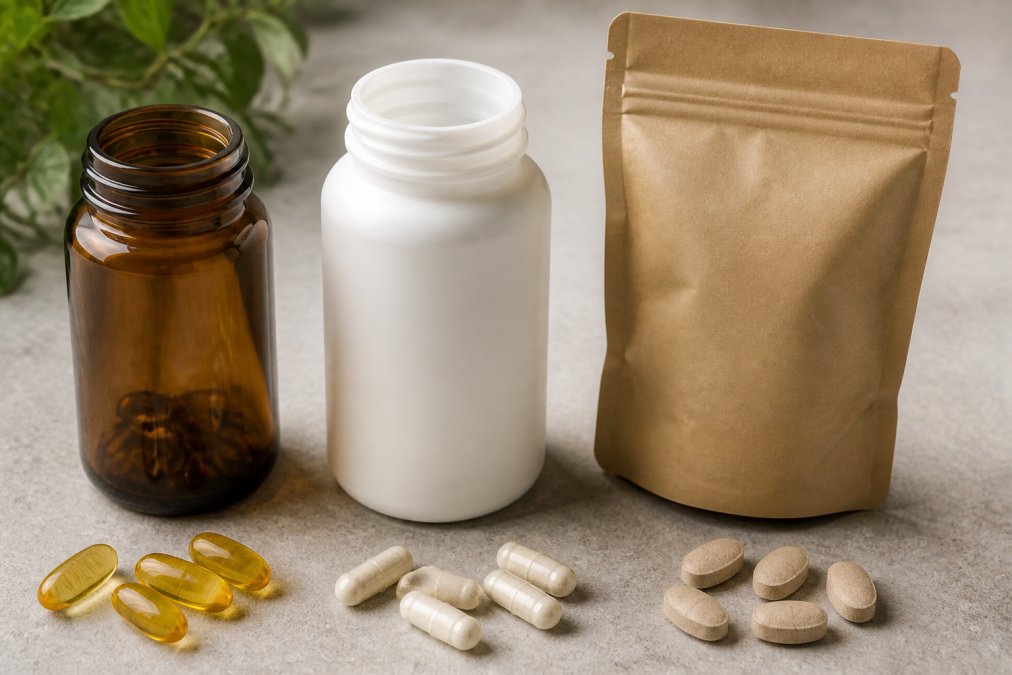
Recyclable supplement pouches are emerging as a practical middle ground between heavy glass and single-use plastic. These flexible packaging options use far less material by weight, which directly reduces transport emissions and packaging waste. Many are now designed as mono-material structures, meaning they can enter existing recycling streams rather than being landfilled.
The sustainability of pouches depends heavily on their construction. Multi-layer pouches that combine plastic and foil are notoriously difficult to recycle. Mono-material polypropylene pouches, by contrast, are increasingly accepted by UK kerbside recycling programmes. This distinction matters for the consumer who wants to do the right thing at the bin.
For brands, pouches also offer resource efficiency during manufacturing. They require less energy to produce and take up less warehouse space, which compounds the savings across the supply chain. If you are comparing a rigid bottle to a pouch for the same product, the pouch typically represents a smaller environmental burden from factory to front door.
Barrier Protection and Product Integrity in Eco-Friendly Supplement Packaging
The primary job of any supplement packaging is to protect the product, and sustainable materials must not compromise on this front. Barrier protection determines how well a package shields vitamins from oxygen, moisture, and light, all of which can degrade potency and shorten shelf life. The real question is how different materials perform under real-world conditions, and what testing actually proves that performance.
Glass remains the gold standard for barrier protection. Its chemical inertness means it does not leach compounds into the product, and its impermeability to oxygen and moisture is near-total. This is why probiotics, fish oils, and other oxidation-sensitive nutrients are almost always sold in glass. However, glass is not a universal solution. Its weight increases shipping emissions, and its fragility can lead to breakage during transit, which is both wasteful and costly.
Post-consumer recycled (PCR) plastic performs well for most dry tablet formats, but it is not identical to virgin plastic. The recycling process can introduce contaminants and shorten polymer chains, which may increase the material's oxygen transmission rate (OTR). A common pattern is that a bottle made with 100% PCR resin might allow 10-20% more oxygen ingress than a virgin PET bottle of the same design. For a daily multivitamin with a 24-month shelf life, this difference is usually negligible. For a product with a shorter shelf life or higher sensitivity, it can be the difference between a tablet that meets its label claim and one that falls short.
Biopolymers are the most variable category. Polylactic acid (PLA), derived from fermented plant starch, offers decent moisture resistance but poor oxygen barrier properties. It is a poor choice for vitamin C, which degrades rapidly in the presence of oxygen. Polyhydroxyalkanoates (PHAs), produced by bacterial fermentation, have better barrier properties but are more expensive and less widely available. Neither material is a drop-in replacement for glass or plastic; each requires formulation-specific testing to determine suitability.
This is where stability testing becomes non-negotiable. The standard protocol, aligned with ICH Q1A guidelines, involves storing packaged samples under controlled conditions, typically 25°C at 60% relative humidity for long-term studies, and 40°C at 75% relative humidity for accelerated studies. Samples are pulled at set intervals (0, 3, 6, 9, and 12 months) and assayed for active ingredient concentration. A packaging material passes if the vitamin retains at least 90% of its labelled potency through its stated shelf life.
What this testing often reveals is counterintuitive. A lightweight paper pouch lined with a thin aluminium foil layer can outperform a thick glass jar in protecting against light and oxygen, because the foil provides an absolute barrier. Conversely, a compostable bag made from plant-based materials might fail stability testing within six months, even though it looks and feels like a conventional plastic pouch. The most sustainable packaging is the one that keeps the product viable for its full intended life. A product that spoils early is not just a financial loss; it is a waste of every resource that went into formulating, manufacturing, and shipping it.
For consumers, the practical takeaway is to look for brands that publish their stability data or at least state that their packaging has been tested to maintain potency through the expiration date. If a brand cannot confirm this, its eco-friendly packaging claims are incomplete. The packaging is not sustainable if it forces you to throw away half-used bottles of degraded vitamins.
Understanding UK Plastic Packaging Tax Compliance for Your Brand
The UK Plastic Packaging Tax applies to plastic packaging manufactured in or imported into the country that contains less than 30% recycled plastic. This levy, enforced by HM Revenue and Customs on the Plastic Packaging Tax, charges businesses per tonne of packaging that does not meet the recycled content threshold.
For supplement brands, this creates a financial incentive to shift toward PCR materials or alternative substrates. A brand using virgin plastic bottles faces a higher tax bill than one using PCR plastic or paper-based packaging. These costs often pass down the supply chain, meaning consumers may see price differences that reflect packaging choices rather than product quality.
Compliance is not optional. Businesses that fail to register and report correctly face penalties. While this article focuses on benefits for consumers, understanding this regulatory landscape helps explain why some brands are changing their packaging while others lag behind. It also signals that sustainable packaging is becoming the commercially sensible default, not just an ethical choice.
Practical Steps for Consumers: What to Look For and How to Dispose
You do not need a degree in material science to make better choices, but a few guidelines help. The gap between 'recyclable in theory' and 'actually recycled in practice' is where most packaging fails. Understanding what happens after you put a container in the bin is just as important as the material choice itself.
Glass bottles and jars. Empty the container and rinse it thoroughly. Remove the lid, metal lids can go in with your regular recycling, but plastic lids often need to be checked separately depending on your local council. Glass is infinitely recyclable, but it is heavy, so transporting it for recycling has its own carbon cost. If your council offers kerbside glass collection, use it. If not, find your nearest bottle bank. Do not put broken glass in your kerbside recycling; it contaminates the stream and can injure sorting workers.
PCR plastic bottles. Check the resin identification code on the bottom. Most supplement bottles are made from PET (code 1) or HDPE (code 2), both of which are widely accepted in UK kerbside recycling. Empty the bottle, replace the lid (most modern sorting facilities can handle lids left on), and place it in your recycling bin. Do not crush the bottle completely, a slightly flattened bottle is fine, but a fully crushed one can be misidentified by optical sorters and sent to landfill.
Mono-material pouches. These are increasingly common and are designed to be recyclable. Check the label for the 'Recycle Now' logo or a statement confirming kerbside acceptance. Empty the pouch, wipe out any residue, and place it in your recycling. Do not include multi-layer pouches that combine plastic and foil, these are not kerbside recyclable and should go in general waste unless the brand offers a take-back programme.
Compostable biopolymers. This is the most misunderstood category. Most biopolymers require industrial composting conditions, sustained temperatures above 55°C, high humidity, and specific microbial activity, that do not exist in a home compost bin. Putting a PLA pouch in your home compost will result in it sitting there for years, not breaking down. Check whether your local authority or a nearby industrial composting facility accepts these materials. If not, the honest disposal route is general waste, which means the 'compostable' claim is aspirational rather than practical in your area.
What to look for on the label. Beyond the material type, look for three things: the percentage of recycled content (higher is better), the recyclability claim (check it matches your local council's acceptance), and any specific disposal instructions. If a label says 'recyclable' without specifying how or where, treat that claim with scepticism.
The role of local councils. Recycling infrastructure varies significantly across the UK. What is accepted in one borough may not be in another. The Recycle Now postcode locator is the definitive tool for checking what your local authority accepts. Bookmark it and use it before you assume a material is recyclable in your area. The most sustainable packaging choice you can make is one that your local infrastructure can actually process.
Conclusion: Making Informed Choices for Your Health and the Planet
Choosing a supplement is rarely just about the tablet anymore. The sustainable vitamin packaging benefits connect your personal health goals to broader environmental stewardship. Look for brands that prioritise lightweight, recyclable materials without sacrificing product integrity.
At Pure Vitamins UK, we formulate our clean-label supplements with transparent dosing and batch-tested quality, packaged in recyclable materials designed to protect potency while respecting the planet. The choice does not have to be between efficacy and environmental responsibility. Shop now and choose a supplement routine that supports both your health and the world around you.
Frequently Asked Questions
Does eco-friendly packaging affect the shelf-life or potency of vitamins?
No, not when it is designed correctly. The key is barrier protection. Materials like amber glass and recyclable supplement pouches with specialised liners protect contents from moisture, oxygen, and light, which are the main threats to vitamin potency. Responsible manufacturers conduct stability testing on their chosen materials to ensure the packaging maintains product integrity and shelf life, even if it is made from recycled or plant-based sources.
How can consumers identify truly sustainable supplement packaging?
Look beyond the green label and check the resin identification code inside the chasing arrows triangle. A '1' or '2' is widely recyclable in UK kerbside collections. Also look for packaging made from post-consumer recycled (PCR) content or materials certified by bodies like the Forest Stewardship Council (FSC). Check your local council's recycling guidelines, as accepted materials vary by area.
What are the primary environmental benefits of choosing sustainable vitamin packaging?
The main benefit is a reduction in landfill waste and greenhouse gas emissions. Using lighter materials like pouches reduces the carbon footprint of shipping. Choosing recyclable or compostable materials supports a circular economy, where resources are reused rather than discarded. This also helps to reduce the demand for virgin plastic production, which relies on non-renewable resources.
How does the UK plastic packaging tax affect supplement brands?
The UK Plastic Packaging Tax applies to packaging manufactured in or imported into the UK that contains less than 30% recycled plastic. This means supplement brands using packaging below this threshold pay a per-tonne levy. This financial incentive encourages brands to switch to packaging with higher recycled content or to explore alternative materials like pouches or glass, which can also appeal to eco-conscious consumers.
This article was written using GrandRanker
