

Table of Contents
- Understanding the Supplement Facts Panel
- Decoding the Ingredient List
- Bioavailable Forms of Vitamins and Minerals
- How to Identify High Quality Supplements
- Food Supplement Labelling Regulations UK
- Reading Labels: A Practical Checklist
- Conclusion
Last Updated: August 30, 2026
Understanding the Supplement Facts Panel
The supplement facts panel displays what you're actually getting in each serving, broken down by ingredient and dose. Unlike food labels, which highlight calories and macronutrients, supplement facts panels focus on micronutrients, botanical extracts, and active compounds. This is where transparency either shines or fails.
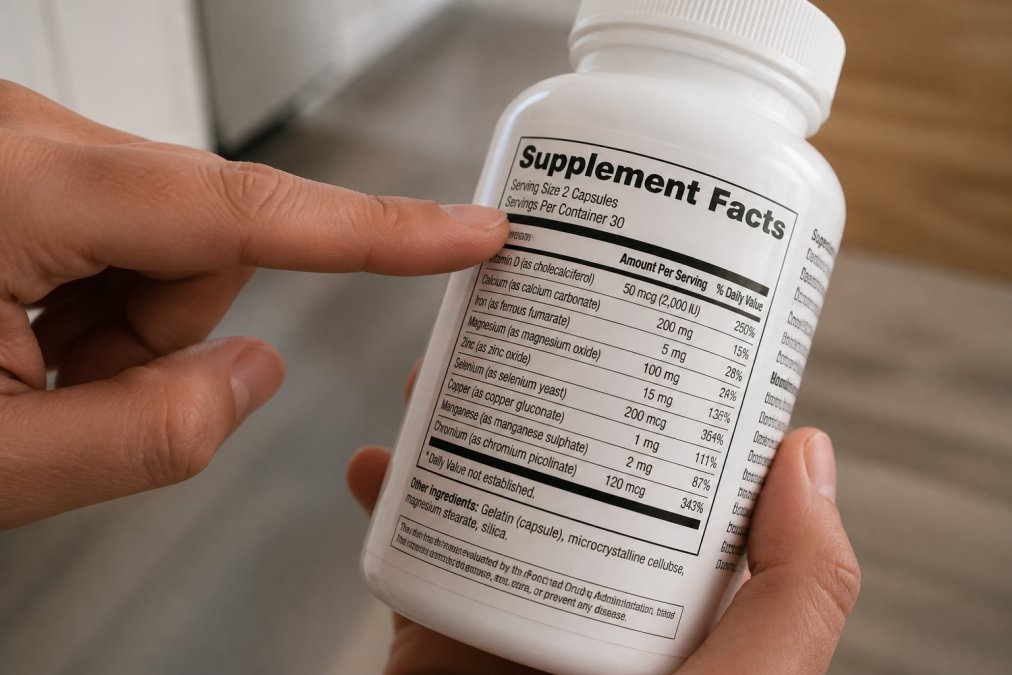
The panel follows a strict format set by the Medicines and Healthcare products Regulatory Agency (MHRA) and the Food Standards Agency (FSA) under the Food Supplement Labelling Regulations. Every ingredient must be listed with its quantity in milligrams (mg), micrograms (µg), or international units (IU). This standardisation means you can compare one brand's formula against another's with confidence.
Serving Size and Servings Per Container
Serving size is not necessarily what you should take daily, it's simply the quantity the manufacturer has chosen as their standard dose. Some supplements recommend one capsule per day; others suggest three. Servings per container tells you how many doses are in the bottle. Multiply the serving size by the number of servings to know the total quantity of each ingredient you're purchasing. A bottle with 60 capsules at two capsules per serving contains only 30 servings, not 60. When comparing prices across brands, always factor in servings per container alongside the per-serving dose.
Daily Value and Percent Daily Value (%DV)
The Daily Value (DV) is a reference standard set by UK and European regulatory bodies representing the recommended daily intake for a nutrient. The Percent Daily Value (%DV) shows how much of that standard a single serving provides. A %DV of 100% means one serving delivers the full recommended daily intake; 50% means it covers half. Some manufacturers list nutrients without a %DV, particularly for proprietary blends or botanical ingredients without established daily values. This is where label transparency becomes critical.
Decoding the Ingredient List
The ingredient list runs from highest to lowest concentration by weight. The first ingredient is present in the largest amount. A multivitamin that lists "proprietary blend" as the first ingredient is telling you that you don't know what the main ingredient actually is.
Active vs. Inactive Ingredients
Active ingredients are the compounds responsible for the supplement's claimed effects. In a collagen supplement, the active ingredient is hydrolysed collagen peptide. In a liver support formula, it might be milk thistle extract or silymarin. Inactive ingredients are the carriers, binders, and fillers that make the capsule function, including cellulose, magnesium stearate, and silicon dioxide.

Inactive ingredients reveal manufacturing quality. A formula with minimal inactive ingredients suggests the manufacturer prioritised potency. A clean formula has a short inactive list and high-dose actives. At Pure Vitamins UK, we keep inactive ingredients minimal and list everything transparently, so you see exactly what you're paying for.
Proprietary Blends: What They Hide
A proprietary blend lists the total weight of the blend but not the individual ingredient amounts. For example, a label might say "Proprietary Energy Blend: 500mg" and then list six ingredients underneath. You know the total is 500mg, but not the individual doses. This opacity allows manufacturers to use cheap fillers, under-dose expensive actives, and still claim efficacy.
When reading labels, treat proprietary blends with scepticism. Transparent brands break down every ingredient's exact dose because you deserve to know what you're taking.
Bioavailable Forms of Vitamins and Minerals
Not all forms of a nutrient are created equal. Bioavailability refers to how well your body absorbs and uses a nutrient. Magnesium oxide has only 4-5% bioavailability and often causes digestive upset. Magnesium glycinate has 25-30% bioavailability and is gentle on the stomach because it's bound to the amino acid glycine, which aids absorption.
When a mineral or vitamin is chelated (bound to an amino acid or organic compound), your body recognises it as food-like and absorbs it more readily. When it's a simple salt, absorption varies widely depending on stomach pH, food intake, and individual digestive health.
Common Nutrient Forms and Their Bioavailability
| Nutrient | High-Bioavailability Form | Lower-Bioavailability Form | Why It Matters |
|---|---|---|---|
| Magnesium | Glycinate, threonate, malate | Oxide, carbonate | Glycinate crosses the blood-brain barrier; oxide causes laxative effect |
| Vitamin D | D3 (cholecalciferol) | D2 (ergocalciferol) | D3 is 1.7× more potent and stays in the bloodstream longer |
| Vitamin B12 | Methylcobalamin, cyanocobalamin | Cyanocobalamin alone | Methylcobalamin is active immediately; cyanocobalamin requires conversion |
| Iron | Ferrous bisglycinate, ferrous fumarate | Ferrous sulfate, ferric forms | Chelated forms reduce nausea and constipation; ferric forms are poorly absorbed |
| Zinc | Zinc picolinate, zinc glycinate | Zinc oxide, zinc carbonate | Picolinate and glycinate forms have 40-50% higher absorption |
| Calcium | Calcium citrate, calcium malate | Calcium carbonate | Citrate absorbs without stomach acid; carbonate requires acidic environment |
| Folate | Methylfolate (5-MTHF), folinic acid | Folic acid | Methylfolate is the active form; folic acid requires conversion (problematic for those with MTHFR variants) |
How to Spot Superior Forms on a Label
When reading a supplement label, the ingredient list will often specify the form in parentheses. For example: "Magnesium (as magnesium glycinate)" indicates high bioavailability, while "Magnesium oxide" indicates low bioavailability. "Vitamin D3 (cholecalciferol)" is superior to D2. "Folate (as 5-methyltetrahydrofolate)" is the active form requiring no conversion.
If a label simply says "Magnesium: 400mg" without specifying the form, contact the manufacturer before buying. A brand unwilling to disclose ingredient forms is either using cheaper, less bioavailable versions or has something to hide. A 1000mg dose of poorly absorbed magnesium oxide is far less useful than 300mg of highly absorbable magnesium glycinate. (Source: recommended daily intake for a nutrient)
Why Manufacturers Choose Lower-Bioavailability Forms
Cost is the primary driver. Magnesium oxide costs roughly one-third the price of magnesium glycinate. Folic acid costs a fraction of methylfolate. A manufacturer using budget forms can undercut competitors on price while claiming the same nutrient dose. You're paying for nutrients your body excretes rather than absorbs. Premium supplements invest in superior forms because they deliver results at lower doses, making them more cost-effective over time despite a higher upfront price.
How to Identify High Quality Supplements
Quality separates supplements that work from those that sit unused. A high-quality supplement has transparent dosing, well-researched ingredient forms, minimal fillers, and third-party verification. Start by reading the supplement facts panel. Does every ingredient have a clear dose? Are the forms specified? Is the inactive ingredient list short? Next, check the brand's manufacturing standards. Look for ISO 22000, HACCP, and GMP certifications on the label or website.

Third-Party Testing and Quality Certifications
Third-party testing is the gold standard. An independent lab tests the finished product to verify it contains what the label claims and is free from contaminants like heavy metals, pesticides, and microbial pathogens. Look for certifications from recognised third-party testers such as the Vegan Society, Soil Association, or NSF International. Some brands publish batch-specific test results on their website. Pure Vitamins UK documents in-house batch testing and provides traceability, so you know exactly what you're getting.
Red Flags and Misleading Claims
Any claim that a supplement "treats," "prevents," or "cures" a disease is illegal under UK nutrition and health claims rules. Vague language like "supports" or "promotes" is regulatory-compliant, but watch for exaggerated language: "boosts immunity," "detoxifies," or "cleanses." Avoid supplements with long lists of unrelated ingredients claiming to support energy, digestion, immunity, and sleep simultaneously, they're either under-dosed or relying on marketing hype.
Also check the expiration date and lot number. A supplement without either is a red flag. The lot number allows manufacturers to trace batches if contamination occurs. Brands that omit these details aren't prioritising consumer safety.
Food Supplement Labelling Regulations UK
The Food Supplement Labelling Regulations in the UK require that all supplements carry specific information: the supplement name, ingredients in descending order by weight, the recommended daily dose, a warning not to exceed the recommended dose, storage statement, and the manufacturer's or distributor's name and address.
Under MHRA and FSA guidance, any health claim must be authorised and evidence-based. This is why you'll see "Vitamin C contributes to normal immune function" rather than "boosts immunity." The word "contributes" acknowledges the nutrient's role without overstating it. The regulations also prohibit certain ingredients and set maximum levels for others to prevent toxicity.
Reading Labels: A Practical Checklist
Use this checklist every time you evaluate a supplement:
| Element | What to Look For | Red Flag |
|---|---|---|
| Serving Size | Clear dose in mg, µg, or IU | Vague or missing |
| Ingredient Forms | Specific forms listed (e.g., D3, magnesium glycinate) | Generic names only |
| Proprietary Blends | Individual ingredient doses disclosed | Blended total only |
| Inactive Ingredients | Minimal list, recognisable compounds | Long list of fillers |
| Expiration Date | Clear date printed | Missing or unclear |
| Lot Number | Present for traceability | Absent |
| Third-Party Testing | Certification badge or batch results | No mention |
| Health Claims | Regulatory language ("contributes to") | Illegal claims ("cures," "treats") |
| Manufacturer Info | Full name and address | PO box only |
A supplement that ticks all boxes is built on transparency and quality. One that fails several is prioritising marketing over substance.
Reading supplement labels is a skill that pays dividends. Start with the supplement facts panel, decode the ingredient list, and check for third-party verification. A few minutes of label reading upfront saves you money and ensures you're actually getting what you pay for.
At Pure Vitamins UK, we've built our entire approach around transparent labelling. Every product shows exact doses, specifies ingredient forms like magnesium glycinate and vitamin D3 with K2, and includes batch-testing documentation. We believe you deserve to know precisely what you're taking and why. When you're ready to shop with confidence, explore our range of clean-label supplements formulated right here in the UK, manufactured to ISO 22000, HACCP, and GMP standards. Shop now and see the difference transparency makes.
Frequently Asked Questions
Q: How do I read a supplement label for beginners?
A: Start with the Supplement Facts panel, which shows the serving size and active ingredients with their amounts in milligrams or micrograms. Check the ingredient list order (listed by weight, highest first), then look for third-party certifications like GMP or NSF. Avoid proprietary blends that hide individual ingredient doses. Finally, verify the manufacturer's contact details and expiration date are clearly printed. This three-step approach, Facts panel, ingredients, certifications, covers what matters most.
Q: What are the mandatory requirements for supplement labelling in the UK?
A: Supplements sold in the UK must comply with the Food Supplement Regulations 2003 and the General Food Regulations 2004. Labels must display the supplement facts in a clear panel, list all ingredients by common name, state the daily value or nutrient reference value (NRV) where applicable, include the manufacturer or distributor's name and address, show batch/lot numbers and expiration dates, and declare allergens. Structure/function claims are permitted ('supports normal energy'), but disease claims ('treats fatigue') are prohibited. All labelling must be in English.
Q: Why is ingredient bioavailability important when reading labels?
A: Bioavailability refers to how well your body absorbs and uses an ingredient. Two supplements with the same dose can deliver very different results depending on the form used. For example, magnesium glycinate absorbs better than magnesium oxide, and vitamin D3 with K2 works synergistically better than D3 alone. Reading labels for specific forms, not just ingredient names, helps you choose supplements that actually deliver the nutrient your body can use. Look for terms like 'chelated', 'hydrolysed', or specific compound names rather than generic powders.
Q: How can I tell if a supplement label is misleading?
A: Watch for red flags: proprietary blends without individual ingredient doses, vague terms like 'natural blend' or 'herbal complex' without standardisation percentages, missing third-party certifications, claims that a supplement 'cures' or 'treats' disease (illegal in the UK), and no expiration date or batch number. Also check if the serving size is unrealistically small to inflate the perceived potency. Compare the label to independent third-party test results if available. Transparent brands like Pure Vitamins UK print exact doses for every ingredient, making comparison straightforward.
This article was written using GrandRanker

