



Table of Contents
- British Vitamins vs Pure Supplements: The Core Difference
- What Makes Filler-Free Vitamins Different
- How to Read Supplement Labels for Ingredient Purity
- Third-Party Testing and Quality Assurance
- Transparent Supplement Brands in the UK Market
- Locally Manufactured Supplements and Regulatory Compliance
- Addressing Specific Nutrient Deficiencies
- Making Your Choice: British Vitamins or Pure Formulations
- Frequently Asked Questions
Last Updated: August 31, 2026
British Vitamins vs Pure Supplements: The Core Difference
British vitamins typically refer to supplements made or formulated in the UK by established manufacturers. Pure supplements prioritise ingredient purity, minimal additives, no unnecessary fillers, and transparent dosing. These aren't mutually exclusive, a British vitamin can be pure, and a pure supplement can be made anywhere, but the marketing emphasis differs.
The real tension emerges when you examine what "pure" and "British" actually guarantee. A product made in the UK doesn't automatically contain purer ingredients than one formulated elsewhere. Similarly, a supplement marketed as "pure" might still contain excipients, binding agents, and stabilisers that enable the supplement to exist as a tablet or capsule. Understanding this gap between marketing claims and actual formulation separates informed buyers from those who simply trust the label.
At Pure Vitamins UK, the best supplements combine the manufacturing rigour of established British production standards with the transparency and ingredient selectivity that "pure" formulations demand. The two are complementary, not at odds.
What Makes Filler-Free Vitamins Different
Filler-free vitamins eliminate ingredients that serve no nutritional purpose. However, many fillers aren't harmful, they're functional. Magnesium stearate prevents powders from clumping. Cellulose capsules hold formulas together. The distinction between "filler" and "functional additive" is crucial.
Some manufacturers use these agents sparingly, only where manufacturing necessity demands. Others use them liberally, sometimes because it's cheaper or because it allows them to underdose active ingredients without the formula becoming unstable. A truly filler-free formulation requires more sophisticated manufacturing, using alternative production methods or plant-based capsules instead of relying on standard additives.
Common additives to avoid
Titanium dioxide appears as a whitening agent and opacifier. It's approved by food authorities, but it accumulates in the body over time. Some research suggests it may affect gut bacteria. If you're taking a supplement daily for years, avoiding unnecessary titanium dioxide is a reasonable precaution.
Synthetic colouring agents like FD&C dyes serve no nutritional function. They're added purely for appearance. A pure formulation uses no synthetic colours, relying instead on the natural colour of its ingredients.
Silica and silicon dioxide function as anti-caking agents. High-quality manufacturers minimise these by optimising their production environment rather than relying on chemical solutions.
Talc occasionally appears in supplement powders. Any supplement containing talc should be avoided entirely.
Bioavailability and absorption
Bioavailability is the percentage of a nutrient your digestive system can absorb and utilise. A 500mg dose of poorly absorbed magnesium oxide delivers far less usable magnesium than a 200mg dose of magnesium glycinate.
Pure formulations typically prioritise ingredient forms that maximise bioavailability. Magnesium glycinate binds magnesium to the amino acid glycine, which your body absorbs efficiently. Vitamin D3 (cholecalciferol) is more bioavailable than D2. Methylcobalamin (B12) is more readily used by your cells than cheaper cyanocobalamin.
High-bioavailability forms cost more per milligram. A budget supplement might use cheaper, less-absorbable forms to hit a lower price point. A pure formulation accepts that fewer milligrams of a superior form will deliver better results than more milligrams of an inferior one. A label showing "magnesium glycinate 200mg" tells you exactly what you're getting. A label showing "magnesium 200mg" without specifying the form leaves you guessing whether you're absorbing 30% or 80% of that dose.
How to Read Supplement Labels for Ingredient Purity
Your supplement label is a contract. Learning to read it properly is the single most valuable skill for navigating the British vitamins vs pure supplements choice.

Start with the ingredient list, ordered by weight. If magnesium stearate appears before active nutrients, the formulation prioritises manufacturing convenience over purity. Check the "other ingredients" section, a short list of three to five items suggests minimal additives, while a long list indicates heavy reliance on processing aids.
Look for specific nutrient forms. "Vitamin D3" is clear; "Vitamin D" without a number often means D2, which is less bioavailable. "Zinc picolinate" tells you the form; "zinc" alone doesn't. Forms determine absorption and efficacy.
Check the serving size and number of servings per container. A bottle claiming 60 servings at one capsule per serving is straightforward. A bottle claiming 30 servings at two capsules per serving hides the fact that you need to take two capsules daily.
Understanding excipients and manufacturing standards
Excipients are non-active ingredients used in manufacturing. They're necessary for creating a stable, shelf-stable product. The question is whether the manufacturer has minimised them or maximised them for cost savings.
Common excipients include cellulose capsules (plant-based or animal-derived), magnesium stearate (a flow agent used sparingly in quality formulations), microcrystalline cellulose (a binder acceptable in small quantities), silica (an anti-caking agent that should be minimal), and maltodextrin (a carbohydrate filler indicating lower ingredient density).
Manufacturing standards determine how tightly a manufacturer controls excipient use. ISO 22000 (food safety management), HACCP (hazard analysis), and GMP (good manufacturing practice) are baseline standards that separate professional operations from amateur ones (iso.org). These standards don't guarantee purity, but they do guarantee that the facility is audited, documented, and held accountable.
A supplement formulated in the UK to ISO 22000 and GMP standards has undergone third-party verification. When you see these certifications listed, you're looking at a manufacturer willing to be inspected and held to measurable standards.
Third-Party Testing and Quality Assurance
The supplement industry is regulated, but regulations differ significantly from pharmaceuticals. A supplement manufacturer isn't required to prove efficacy before selling, only safety. Third-party testing bridges that gap by testing finished products for identity (does it contain what the label claims?), potency (is the dose accurate?), purity (are contaminants present?), and dissolution (will the capsule break down in your digestive system?).
A supplement brand that publishes third-party test results is claiming: "We're confident enough in our formulation to have it independently verified." That confidence should be backed by actual certificates, not just marketing language.
The most credible approach is batch testing. Each production batch is tested before release, with results available to customers. This requires investment in both testing and transparency infrastructure. Budget brands don't do this. Serious brands do.
When evaluating a brand's testing claims, look for named third-party laboratories (not in-house testing), specific test results published online (not just a claim that testing happens), batch numbers traceable to test results, and testing for contaminants, not just potency. A brand claiming "all our products are third-party tested" without providing accessible results is making a vague claim. A brand providing batch numbers with specific test dates and results is providing verifiable evidence.
Transparent Supplement Brands in the UK Market
The UK supplement market includes brands ranging from mass-market retailers to specialist formulators. Transparent brands share common characteristics: they publish ingredient forms (not just ingredient names), disclose excipient use, make third-party testing results accessible, and explain why they've chosen specific ingredients and doses.
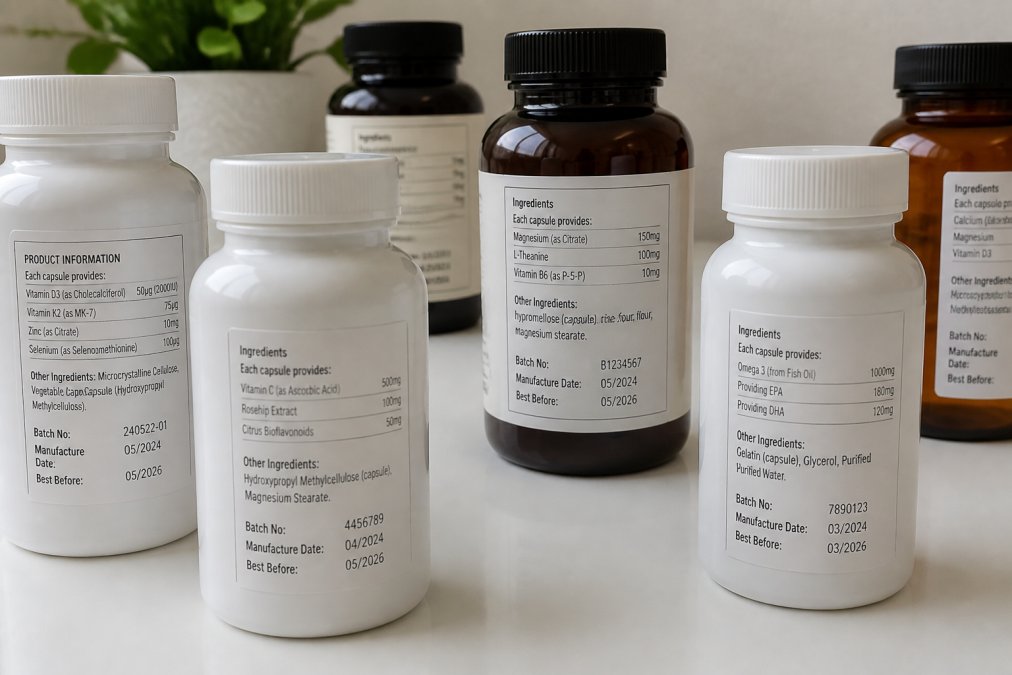
What transparency actually means
Transparency isn't a marketing claim, it's a practice. A truly transparent brand answers questions before you ask them. The label shows the specific form of each nutrient. The website explains why magnesium glycinate was chosen over magnesium oxide. Test results are published with batch numbers. If a batch failed testing, the brand discloses that and explains what happened.
Transparency also means acknowledging limitations. A brand might say: "Our vitamin D3 comes from lanolin (sheep's wool), so it's not vegan. We're developing a vegan D3 source and expect to launch it in Q3 2026." That's transparency. The opposite is vagueness, phrases like "natural ingredients," "clinically tested," and "pharmaceutical grade" sound impressive and mean almost nothing.
Cost-per-dose comparison
Price alone is meaningless. Cost-per-dose is the metric that matters. A supplement costing £15 for 60 capsules at two per day is £30 per month. A supplement costing £12 for 30 capsules at one per day is also £30 per month. The first appears cheaper but costs the same.
The honest cost comparison requires knowing serving size, number of servings per container, monthly cost at the recommended dose, bioavailability of the ingredient forms, and whether third-party testing is included. A budget brand might offer a multivitamin for £6 per month. A premium brand might cost £20 per month. If the premium brand uses better-absorbed forms and includes batch testing, the additional cost might represent better value.
Pure Vitamins UK positions itself between these extremes, with pricing that reflects ingredient quality and manufacturing rigour rather than marketing spend.
Locally Manufactured Supplements and Regulatory Compliance
Manufacturing location matters. A supplement "made in the UK" could mean formulated here but manufactured abroad. A supplement "manufactured in the UK" means the entire production process happens in a UK facility.
UK manufacturing facilities operate under strict regulatory oversight. The Food Standards Agency (FSA) enforces food safety standards that apply to supplements. Facilities must maintain documented processes, staff training records, and traceability systems. Products must comply with the Nutrition and Health Claims Regulation (EC 1924/2006), which governs what health claims can legally be made (europa.eu).
This regulatory framework isn't perfect, but it's comprehensive. A supplement manufactured in the UK has undergone more rigorous oversight than one manufactured in countries with less stringent standards. A British brand using UK manufacturing operates under the full weight of UK food safety law. A British brand outsourcing manufacturing to lower-cost countries may be cutting corners on oversight.
Compliance also extends to labelling. UK supplements must declare all ingredients, specify nutrient forms where relevant, and avoid health claims that haven't been approved by the European Commission's Register of Authorised Claims. A brand claiming a supplement "boosts immunity" is violating regulations. A brand saying it "contributes to normal immune function" is complying with approved language.
Addressing Specific Nutrient Deficiencies
The choice between British vitamins and pure supplements becomes practical when targeting a specific deficiency.
Vitamin D deficiency is common in the UK due to limited winter sunlight. The Department of Health recommends 10 micrograms (400 IU) daily (gov.uk). An optimised formulation pairs vitamin D3 with K2, which works synergistically to direct calcium to bones rather than soft tissues. A pure formulation specifies D3 (not D2) and uses a form of K2 with proven bioavailability, typically MK-7.
Iron deficiency requires careful formulation because iron interacts with other nutrients. Ferrous forms like ferrous bisglycinate are more bioavailable than ferric forms. Iron should be separated from calcium and magnesium, which inhibit absorption. A pure iron supplement accounts for these interactions.
B12 deficiency is relevant for vegans and older adults. Methylcobalamin (a natural form) is more bioavailable than cyanocobalamin (a synthetic form), though both are effective. A pure formulation uses methylcobalamin.
Magnesium deficiency affects muscle function, stress response, and sleep. Magnesium oxide is cheap but has a laxative effect. Magnesium glycinate is absorbed efficiently without laxative effects. Magnesium threonate crosses the blood-brain barrier, supporting cognitive function. A pure formulation specifies which form you're getting and why.
A basic supplement addresses the deficiency with a cheap, effective ingredient. A pure supplement addresses it with a form optimised for absorption and minimal side effects. The cost difference can be modest, and the benefit difference can be measurable.
Making Your Choice: British Vitamins or Pure Formulations
The decision hinges on what you're optimising for. If you want a supplement made under UK oversight, a British vitamin serves that purpose. If you want maximum ingredient purity and bioavailability, a pure formulation, regardless of where it's manufactured, serves that purpose. The best choice combines both.
Start by defining your goal. Are you addressing a specific deficiency, supporting general health, or optimising performance? Different goals justify different formulations. A basic multivitamin covers nutritional gaps adequately for most people. A targeted formulation addressing a specific deficiency warrants investment in bioavailability and purity.
Next, evaluate the brand's transparency. Can you access third-party test results? Are ingredient forms specified? Does the brand explain why it chose specific forms and doses? A brand that answers these questions has earned your trust.
Finally, calculate cost-per-dose over a realistic timeframe. A supplement is only valuable if you take it consistently. An expensive supplement you abandon after two months costs more than a cheaper one you sustain for a year.
Pure Vitamins UK combines UK manufacturing rigour with pure formulation principles. Products are formulated in the UK to ISO 22000, HACCP, and GMP standards. Ingredient forms are specified and chosen for bioavailability. Batch testing is documented and accessible. Pricing reflects ingredient quality without premium lifestyle markup. The result is a middle ground between budget supplements and luxury brands, you're paying for formulation quality and manufacturing rigour, not for packaging or celebrity endorsement.
Frequently Asked Questions
Q: What does 'filler-free' actually mean on a supplement label?
A: Filler-free supplements aim to contain no unnecessary inactive ingredients that don't contribute to the formula's therapeutic dosage. Instead, every ingredient serves a purpose, either delivering the nutrient or ensuring stability and absorption. This matters because fillers can affect bioavailability and may trigger sensitivities in some people. When checking labels, look for short ingredient lists where each item is either the active nutrient or a recognised carrier form like glycinate for minerals.
Q: How do I verify the quality of supplements manufactured in the UK?
A: Check for three markers: ISO 22000 or HACCP certification (food safety standards), GMP (Good Manufacturing Practice) accreditation, and third-party testing certificates. These should be displayed on the brand's website or available on request. UK-manufactured supplements must also comply with the Food Standards Agency's regulations on health claims and ingredient safety. Transparency about where and how products are tested is a strong signal of quality assurance.
Q: Are British vitamin brands regulated differently than pure supplement brands?
A: All supplements sold in the UK, regardless of branding or positioning, must comply with the same Food Standards Agency regulations and the Medicines and Healthcare products Regulatory Agency (MHRA) standards for safety and labelling. The distinction between 'British vitamins' and 'pure supplements' is marketing rather than regulatory, the real difference lies in formulation choices (fillers versus clean ingredients) and manufacturing rigour. Both types must declare all ingredients and adhere to the same regulatory compliance framework.
Q: What's the difference between bioavailable and standard supplement forms?
A: Bioavailability refers to how much of a nutrient your body can actually absorb and use. For example, magnesium glycinate absorbs better than magnesium oxide because the glycine form crosses the gut barrier more efficiently. Vitamin D3 with K2 works synergistically for bone health better than D3 alone. Higher bioavailability means you may need smaller doses to achieve health outcomes, making cost-per-dose a key consideration. Check ingredient forms on the label, glycinate, citrate, and methylated forms typically indicate superior absorption.
The supplement market rewards informed decisions. Whether you choose a British vitamin, a pure formulation, or something in between, the difference lies in what you're willing to verify and what you're willing to trust. Shop now with Pure Vitamins UK and see exactly what you're buying, transparent dosing, documented batch testing, and formulations designed for actual absorption and results.
This article was written using GrandRanker

