



Table of Contents
- What Bioavailability Means for Your Supplements
- Why Bioavailability Matters for Supplement Efficacy
- Factors Affecting Nutrient Bioavailability
- Synthetic vs Natural: The Bioavailability Difference
- Bioavailable Forms of Magnesium and Other Key Minerals
- How to Improve Supplement Absorption
- The Bioavailability vs Potency Trap
- Conclusion
Last Updated: August 15, 2026
What Bioavailability Means for Your Supplements
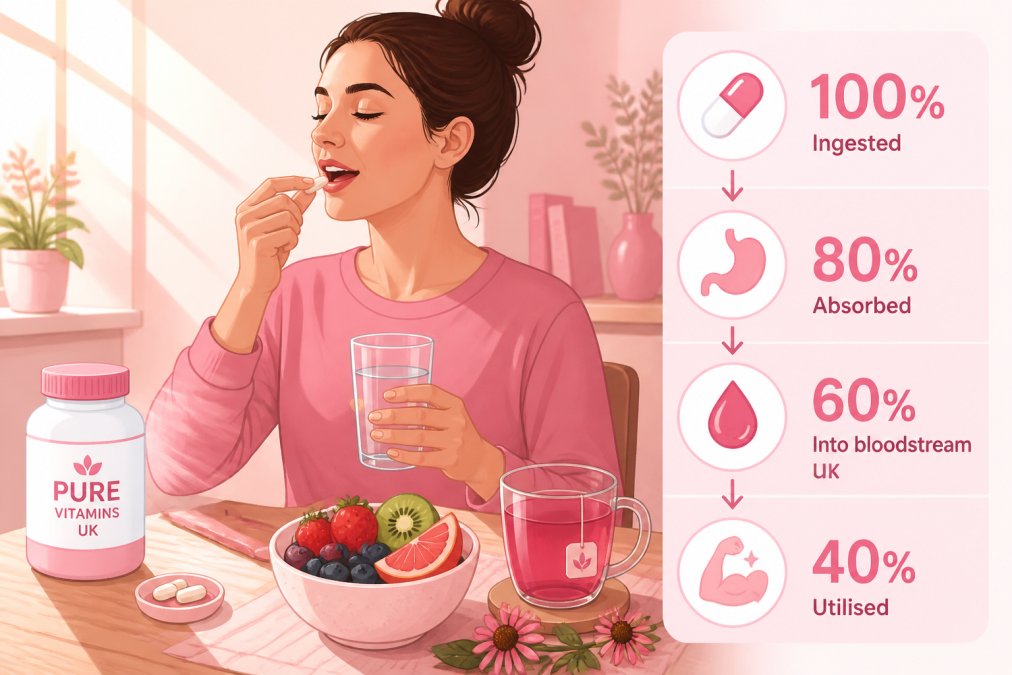
Bioavailability is the proportion of a nutrient your body can actually absorb and use after taking a supplement. It's not the amount listed on the label, what matters is how much reaches your cells and enters your metabolic pathways.
A supplement containing 500mg of magnesium doesn't mean your body uses all 500mg. Depending on the form, your digestive system, and other factors, you might absorb anywhere from 10% to 70% of that dose. The difference between a poorly absorbed form and a highly bioavailable one can mean the difference between a supplement that works and one that doesn't.
At Pure Vitamins UK, we've built our formulations around this principle. A transparent dosing label means nothing if the ingredient form can't be properly utilised by your body. Understanding nutrient absorption and bioavailability directly affects whether your investment in supplements delivers real results.
Why Bioavailability Matters for Supplement Efficacy
Supplement efficacy depends almost entirely on bioavailability. A high-potency formula with poor absorption rates will underperform a lower-dose formula using highly bioavailable ingredient forms. Many consumers buy what looks impressive on paper and see minimal results.
Your digestive system is selective. Not all chemical forms of nutrients can pass through your gastrointestinal tract efficiently. Some forms require specific pH conditions to dissolve. Others need co-factors to be absorbed. Still others are too large or poorly soluble to cross the intestinal barrier effectively. When a nutrient can't be absorbed, it simply passes through your system unused.

A supplement that looks impressive in marketing but lacks bioavailable forms is essentially expensive filler. Conversely, a well-formulated supplement using chelated minerals, active co-enzyme forms, and proven delivery systems can produce measurable results within weeks.
Factors Affecting Nutrient Bioavailability
Several interconnected factors determine how much of a nutrient your body actually absorbs and utilises.
Nutrient form and molecular structure
The chemical form of a nutrient is the single biggest driver of bioavailability. Magnesium oxide is poorly absorbed, your digestive system struggles to break it down and most passes through unused. Magnesium glycinate uses a chelated form where magnesium is bound to the amino acid glycine, crossing the intestinal barrier far more efficiently.
The same principle applies across all micronutrients. Zinc picolinate has superior absorption compared to zinc oxide. Vitamin D3 (cholecalciferol) is more bioavailable than D2 (ergocalciferol). Methylcobalamin and adenosylcobalamin forms of B12 are immediately usable by your body, whereas cyanocobalamin requires conversion.
Pure Vitamins UK formulates with bioavailable forms because molecular structure determines cellular uptake. Our Magnesium Glycinate Capsules use three complementary forms to support different metabolic pathways, ensuring consistent absorption across your digestive system.


Your digestive system and metabolism
Your gastrointestinal tract is a selective barrier. It actively transports specific nutrient forms across the intestinal wall, a process depending on your digestive health, stomach acid levels, enzyme production, and gut microbiota composition.
If your digestive system is compromised, whether from stress, medication, age, or underlying conditions, your ability to absorb nutrients declines significantly. Someone with low stomach acid will struggle to absorb certain minerals regardless of supplement form. Your gut bacteria influence nutrient metabolism too; certain strains help convert precursor forms into active compounds your body can use.
Timing and food context matter. Taking magnesium with food can improve absorption for some forms but reduce it for others. The interaction between your digestive state and the nutrient form determines the actual bioavailability you experience.
Nutrient-nutrient interactions
Nutrients don't work in isolation. Some enhance each other's absorption; others compete for the same transport mechanisms. Vitamin D and K2 work synergistically, D3 supports calcium absorption while K2 directs that calcium to bone and away from soft tissues. Taking them together yields superior bio-utilisation.
Conversely, too much zinc can impair copper absorption because they use the same transport pathways. Iron and calcium compete for absorption, which is why timing matters if you supplement both. Well-designed supplements account for these interactions, either by using forms that don't compete or by spacing doses strategically.
Age-related absorption changes
Bioavailability isn't static across your lifespan. As you age, your stomach acid production declines, your digestive enzyme output decreases, and your intestinal absorption capacity diminishes. A nutrient form that worked well at 30 may be poorly absorbed at 60.
Older adults often need different nutrient forms and higher doses simply to achieve the same absorption as younger people. B12 absorption declines particularly sharply; many people over 50 struggle to absorb B12 from food sources, making supplementation with highly bioavailable forms like methylcobalamin increasingly important.
Synthetic vs Natural: The Bioavailability Difference
The synthetic-versus-natural debate in supplements often misses the real point: bioavailability depends on molecular structure, not origin. A synthetic nutrient with superior absorption might outperform a "natural" form that your body struggles to utilise.
Some naturally-derived forms do offer bioavailability advantages. Plant-based sources come packaged with co-factors that enhance absorption. But synthetic forms can be engineered for maximum absorption, chelated minerals are synthesised specifically to cross your intestinal barrier efficiently.
The real distinction isn't synthetic versus natural, it's well-absorbed versus poorly absorbed. A synthetic magnesium glycinate will outperform a natural magnesium oxide. Origin matters less than bioavailability.
What matters is transparency. You should know exactly what form you're taking and why. Budget supplements often use the cheapest forms (oxide, carbonate) regardless of absorption. Premium supplements use bioavailable forms because they deliver results. Pure Vitamins UK uses well-absorbed forms at transparent dosing levels without the markup of luxury brands.
Bioavailable Forms of Magnesium and Other Key Minerals
Different minerals have different optimal forms.
Chelated minerals and glycinate forms
Chelated minerals are bound to amino acids or other molecules that facilitate intestinal absorption. Magnesium glycinate pairs magnesium with glycine, an amino acid your body recognises and transports efficiently. This form doesn't require stomach acid to be absorbed, making it gentler while maintaining high bioavailability.
Zinc picolinate uses a similar principle, zinc bound to picolinic acid, which enhances cellular uptake. Copper glycinate offers superior absorption compared to copper sulphate. These chelated forms are more expensive to produce than simple mineral salts, but they deliver measurably better results because more of the nutrient reaches your cells.
The Pure Vitamins UK Zinc and Copper Supplement uses triple zinc picolinate specifically because this form supports optimal absorption and cellular utilisation.

Why oxide forms underperform
Magnesium oxide, zinc oxide, and similar forms are poorly absorbed because they require acidic conditions to dissolve and lack efficient transport mechanisms. Most passes through your system unused. They're common in cheap supplements because they're inexpensive to manufacture, not because they're effective.
Calcium carbonate similarly requires stomach acid for absorption. If you have low stomach acid, increasingly common with age, these forms become nearly useless. Iron oxide and ferrous sulphate are better absorbed than oxide forms, but chelated iron forms still outperform both.
How to Improve Supplement Absorption
Even well-formulated supplements require proper timing, food context, and lifestyle support to deliver optimal bioavailability.
Timing, food and lifestyle factors
Take magnesium with food to improve absorption, but avoid taking it within 2 hours of high-calcium meals because they compete for transport. Fat-soluble vitamins (D, K, A, E) require dietary fat for absorption, take them with meals containing oil or fatty foods. Water-soluble vitamins like B12 and C are absorbed more efficiently on an empty stomach.
Stress impairs nutrient absorption by reducing digestive enzyme production and diverting blood flow away from your gut. Sleep deprivation has the same effect. Getting adequate sleep, managing stress, and maintaining consistent meal timing all improve bioavailability more than switching supplements.
Hydration status affects mineral absorption. Dehydration reduces your body's ability to transport minerals across your intestinal barrier. Alcohol consumption impairs B vitamin absorption and increases mineral excretion. These lifestyle factors are often overlooked, but they're as important as choosing the right supplement form.
Reading labels for bioavailable ingredients
Learn to identify bioavailable forms on supplement labels:
- Magnesium as glycinate, malate, or threonate (avoid oxide, carbonate, sulphate)
- Zinc as picolinate or citrate (avoid oxide)
- Iron as ferrous bisglycinate or citrate (avoid ferrous sulphate)
- Copper as glycinate (avoid oxide or sulphate)
- Vitamin B12 as methylcobalamin or adenosylcobalamin (avoid cyanocobalamin)
- Vitamin D3 with K2 as menaquinone-7 (superior to K1 phylloquinone)
- Calcium as citrate or malate if you have low stomach acid (carbonate requires acid)
Transparent labelling should show the exact form, not just the nutrient name. If a supplement lists "magnesium" without specifying the form, that's a red flag.
Pure Vitamins UK specifies every ingredient form on our labels because transparency matters. You should know exactly what form you're taking and why.
The Bioavailability vs Potency Trap
Many consumers chase high-dose supplements, assuming more is better. A 1000mg supplement of magnesium oxide might deliver only 100-150mg of actual absorbable magnesium. A 400mg supplement of magnesium glycinate might deliver 350mg of bioavailable magnesium. The second option is superior despite the lower label claim.
This is the bioavailability versus potency trap: supplement companies tout high label amounts because they look impressive. In reality, bioavailability determines results. A well-formulated supplement with moderate doses of bioavailable forms will outperform an over-dosed supplement using poorly absorbed forms.
Comparing supplements by label dose alone is misleading. You need to compare bioavailable forms and realistic absorption rates. A supplement costing more per serving but using superior forms often delivers better value because you're actually absorbing the nutrients you're paying for.
Understanding why bioavailability matters in supplements transforms how you evaluate supplement quality and effectiveness. The most expensive supplement won't help if your body can't absorb it. The cheapest supplement will waste your money if it uses poorly absorbed forms. The real value lies in transparent formulations using bioavailable ingredient forms at realistic dosing levels, the approach Pure Vitamins UK takes across our entire range.
When you're ready to upgrade your supplement routine with formulations designed for actual absorption, explore our collection of bioavailable minerals and targeted wellness formulas. Shop now and discover supplements formulated to deliver measurable results.
Frequently Asked Questions
What does bioavailability mean in supplements?
Bioavailability is the percentage of a nutrient your body can actually absorb and use. A supplement may contain 100mg of magnesium, but if only 30% is bioavailable, your body absorbs just 30mg. The rest passes through your digestive system unused. This is why the form of the nutrient matters as much as the dose on the label.
Why does bioavailability matter for supplement efficacy?
A high-dose supplement with poor bioavailability delivers less active nutrient to your cells than a lower dose in a highly absorbable form. For example, magnesium glycinate absorbs significantly better than magnesium oxide, so you need less of it to achieve the same cellular effect. This is the bioavailability versus potency trap: a large dose doesn't guarantee results if your body can't absorb it.
What factors affect how well my body absorbs supplements?
Absorption depends on nutrient form (chelated minerals absorb better than oxides), your digestive health, stomach acid levels, age, medication interactions, and what you eat with the supplement. Taking magnesium with food improves absorption for some forms but reduces it for others. Nutrient-nutrient interactions also matter: vitamin C enhances iron absorption, while calcium can inhibit zinc uptake. Age affects absorption too; stomach acid declines after 50, reducing mineral bioavailability.
How can I identify high-bioavailability supplements?
Look for specific ingredient forms on the label: magnesium glycinate, zinc picolinate, methylcobalamin (B12), and hydrolysed collagen indicate higher absorption. Avoid oxide, carbonate, and oxide forms. Check for chelated minerals, which bind nutrients to amino acids for better absorption. Transparent brands list exact ingredient forms and doses. If a label just says 'magnesium' without specifying the form, it's likely a cheaper, less-absorbable option.
Does synthetic versus natural affect bioavailability?
Not always. A well-formulated synthetic nutrient (like methylcobalamin B12) can be more bioavailable than a poorly processed natural form. What matters more is the specific molecular form. Synthetic doesn't mean inferior; it means lab-created. The real question is whether that form is chelated, soluble, and designed for cellular uptake. Both synthetic and natural can be highly bioavailable if formulated correctly.
How does age affect supplement absorption?
As you age, stomach acid production declines, reducing how efficiently your digestive system breaks down and absorbs minerals and certain vitamins. After 50, this becomes more pronounced. People over 50 often benefit from more bioavailable forms like chelated minerals and methylcobalamin rather than standard oxide or cyanocobalamin forms. If you're managing specific health goals later in life, bioavailable supplement forms become even more important for consistent results.
Can nutrient interactions affect how well I absorb supplements?
Yes. Vitamin C significantly improves iron absorption, while calcium can reduce zinc uptake if taken together. Magnesium and vitamin D work synergistically, enhancing each other's cellular effects. Fat-soluble vitamins (A, D, E, K) absorb better with dietary fat. Taking supplements at different times or with specific foods optimises these interactions. Understanding these relationships helps you get maximum benefit from your daily supplement routine and avoid wasting money on nutrients your body can't use together.

