


Table of Contents
- What Makes a Vitamin Brand Non-GMO
- How to Read Supplement Labels for Non-GMO Claims
- Bioavailable Vitamin Forms That Actually Absorb
- Are Expensive Vitamins Actually Better
- Top Non-GMO Vitamin Brands Compared
- What to Look for When Choosing Non-GMO Vitamins
- Frequently Asked Questions
Last Updated: September 2, 2026
What Makes a Vitamin Brand Non-GMO
Non-GMO means the vitamins and minerals in your supplement haven't been derived from genetically modified organisms. It's a straightforward claim, but one that demands transparency from the manufacturer. Most brands don't volunteer this information, you have to look for it.
The distinction matters because GMO crops are treated with herbicides and pesticides that leave residues. If your supplement ingredients come from GMO sources, you're getting those residues too. A genuinely non-GMO brand sources from suppliers who can prove their ingredients started with non-modified seeds and plants, then tracks them through manufacturing.
At Pure Vitamins UK, we work backwards from this principle. We specify non-GMO raw materials in every formula, test incoming ingredients for purity, and maintain certificates of analysis that prove what we claim. This transparency isn't standard in the supplement industry.
The real cost of non-GMO sourcing is higher. Non-GMO crops yield less per acre, cost more to grow, and require separate supply chains to avoid cross-contamination. Budget brands cut corners here. They source cheaper, GMO-derived ingredients and rely on the fact that most consumers won't dig deep enough to notice.
How to Read Supplement Labels for Non-GMO Claims
The label is where most brands hide or reveal the truth. A proper non-GMO supplement declares its ingredient sources clearly and includes certifications or batch-test results you can verify.

Start with the ingredient list. A legitimate non-GMO brand lists every ingredient by its actual name, not a proprietary blend. You should see "magnesium glycinate" not "mineral complex." You should see "vitamin D3" not "vitamin D." Vague names are a red flag, they're often hiding ingredient forms that are cheaper and less bioavailable.
Next, look for certifications. The Non-GMO Project Verified butterfly logo is the most recognised, but it's not the only one. Some brands use NSF Certified for Sport, Informed Choice, or their own third-party testing. The key is that something external has verified the claim. If the label says "non-GMO" with no certification or test results backing it up, treat it with skepticism.
Check the "manufactured in" line. If it says manufactured in a facility that also processes GMO ingredients, cross-contamination is possible. The best non-GMO brands use dedicated facilities or at least separate production lines with cleaning protocols between runs.
Look for batch numbers and testing dates. A brand serious about purity publishes certificates of analysis, documents that show exactly what was tested, when, and what the results were. If you can't find these on the website or by emailing customer service, the brand isn't being transparent enough.
Finally, read the fine print. Legitimate claims come with qualifications: "non-GMO ingredients" not "non-GMO formula" (the difference matters, one refers to the raw materials, the other to the finished product). Watch for hedging language like "may contain" or "may be derived from" GMO sources. That's a sign the brand isn't confident in its supply chain.
Bioavailable Vitamin Forms That Actually Absorb
The form your vitamin takes determines how much of it your body actually uses. Two supplements with the same dose can deliver vastly different results based on whether the ingredient is in a form your body recognises.
Bioavailability is the percentage of a nutrient that crosses your gut lining and enters your bloodstream. A vitamin that's poorly absorbed might as well be inert, you're paying for something your body can't use. This is where most budget supplements fail. They use cheap forms that your digestive system struggles to break down.
Magnesium is a perfect example. Magnesium oxide is the cheapest form, but it's poorly absorbed and often causes digestive upset (peer-reviewed research). Magnesium glycinate costs more because it's bound to an amino acid that your gut recognises and transports efficiently. You absorb significantly more of a glycinate dose than an oxide dose at the same strength.

Vitamin D3 (cholecalciferol) absorbs better than D2 (ergocalciferol) (peer-reviewed research). Your skin produces D3 from sunlight, so your body has evolved to handle D3 specifically. D2 is cheaper and more shelf-stable, which is why budget brands use it. But if you're supplementing to fix a deficiency, D3 raises your blood levels faster and more reliably.
Vitamin K2 as MK-7 (menaquinone-7) has a longer half-life in your body than MK-4 (peer-reviewed research). This means it stays active longer and you need fewer doses to maintain steady levels. The shorter-chain forms are cheaper, which is why most supplements use them. The best non-GMO vitamin brands pair D3 with K2 as MK-7 because the two work together on calcium regulation, but only if both are in forms your body can actually absorb.
Zinc picolinate and zinc citrate absorb better than zinc oxide. Vitamin B12 as methylcobalamin absorbs better than cyanocobalamin. These aren't minor differences, they're the gap between a supplement that works and one that's expensive urine.
The best non-GMO vitamin brands specify the form of every ingredient because they're confident in their choices. Budget brands list only the nutrient name because the form they're using would make readers uncomfortable.
Are Expensive Vitamins Actually Better
The price of a supplement doesn't always reflect its quality, but it rarely reflects nothing. There's a meaningful difference between budget, mid-range, and premium supplements, and understanding where that difference comes from helps you avoid overpaying without sacrificing results.
Budget supplements (under £5 per bottle) cut corners on ingredient form, sourcing, and testing. They use cheaper mineral forms, synthetic ingredients, and often don't test for heavy metals or purity. You might get what the label claims, or you might not, there's no way to know because they don't publish batch results. The savings are real, but so is the risk.
Mid-range supplements (£8-£20 per bottle) are where most quality brands sit. This is where Pure Vitamins UK positions itself. At this price point, you can afford to use bioavailable ingredient forms, non-GMO sources, and batch testing. You're paying for transparency and efficacy, not marketing or premium packaging. Most people get better results at this price point than at either extreme.
Premium supplements (£25+ per bottle) often charge for things that don't improve results: fancy packaging, celebrity endorsement, or a brand name built on hype. Some premium brands do justify their price, they use rare or highly concentrated extracts, or they combine multiple synergistic ingredients. But many are simply expensive for being expensive.
The real question isn't whether expensive vitamins are better, it's whether you're paying for quality or paying for the label. A £15 bottle of magnesium glycinate with batch testing is objectively better than a £3 bottle of magnesium oxide with no transparency. A £50 multivitamin with 47 ingredients in underdosed amounts is often worse than a £12 focused duo of two well-dosed essentials.
Test results and transparency are what separate genuinely better supplements from expensive ones. If a brand publishes certificates of analysis, maintains ISO and GMP certifications, and sources documented non-GMO ingredients, you're paying for something real. If a brand relies on marketing copy and celebrity testimonials, you're paying for the brand.
Top Non-GMO Vitamin Brands Compared
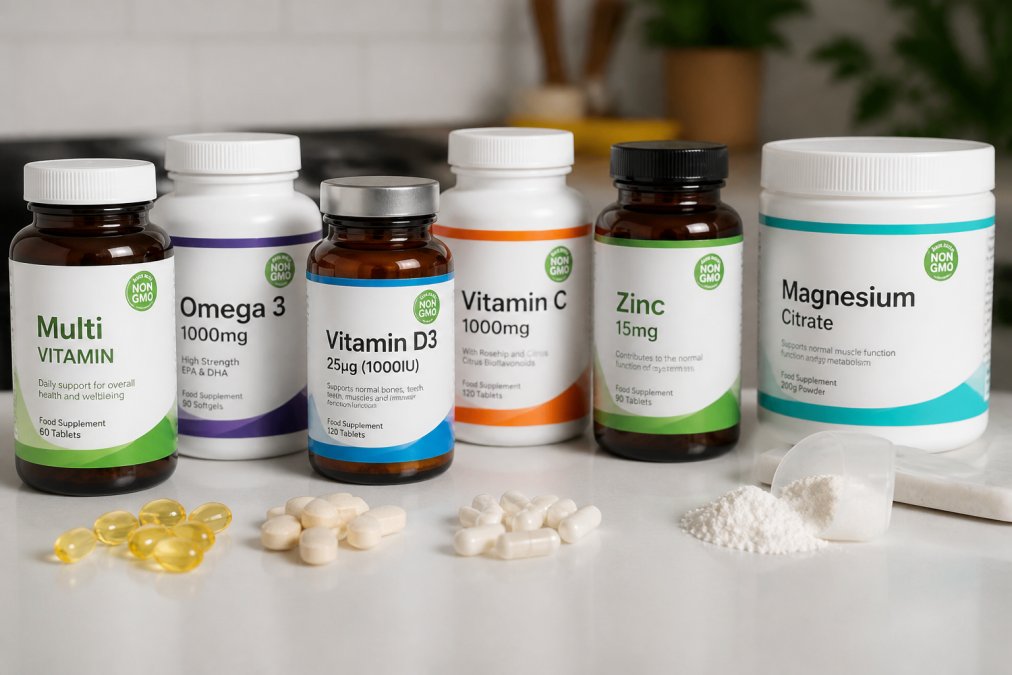
| Brand | Starting Price | Key Focus | Testing Transparency | Best For |
|---|---|---|---|---|
| Pure Vitamins UK | £8.99 | Bioavailable forms, UK-made | Documented in-house batch testing | Quality-conscious UK adults |
| Cytoplan | £12-£18 | Whole-food sourced | Third-party testing | Those seeking food-derived nutrients |
| Wild Nutrition | £15-£25 | Food-based formulas | Published testing | Premium whole-food approach |
| Nutravita | £6-£12 | Budget-friendly range | Basic testing | Cost-conscious shoppers |
| Dr Vegan | £10-£20 | Vegan-specific formulas | Published certificates | Ethical vegans |
Pure Vitamins UK: Transparent Dosing and UK Manufacturing
Pure Vitamins UK stands out because it does the unglamorous work most brands skip: publishing batch test results, specifying ingredient forms, and manufacturing everything in the UK to ISO 22000, HACCP, and GMP standards. You're not paying for a celebrity face or premium packaging. You're paying for proof.
Every formula uses bioavailable ingredient forms. Magnesium comes as glycinate, not oxide. Vitamin D3 pairs with K2 as MK-7. Zinc balances with copper. These aren't marketing choices, they're evidence-based decisions that cost more but deliver better results. The brand's range spans from focused duos like the Daily Foundation Duo (vitamin D3+K2 with magnesium glycinate at £22.49) to specialised bundles like the Gut & Immunity Duo (14-strain probiotic with zinc and copper at £18.49).
What sets Pure Vitamins UK apart is the willingness to be specific. Most brands hide behind vague claims. Pure Vitamins UK lists the exact dose of every ingredient, the form it's in, and makes the test results available on request. The company positions itself between budget supplements (which cut corners) and premium brands (which charge for hype). For someone serious about non-GMO, bioavailable nutrition, this is where the value actually sits.
The Immunity & Energy Support Trio (£26.99) combines three nutrients most UK diets run short of, zinc with copper, vitamin D3 with K2, and magnesium glycinate, in a single, honest bundle. No filler, no overstated claims, just three ingredients that each carry directly authorised health claims and work together.

What Sets This Brand Apart
Pure Vitamins UK competes on transparency and ingredient quality, not price or marketing. The brand publishes certificates of analysis, specifies every ingredient form, and manufactures in certified UK facilities. Most competitors either hide their sourcing or charge premium prices for the same level of transparency.
Cytoplan and Wild Nutrition use whole-food sourced ingredients, which appeals to some consumers, but at significantly higher price points (£15-£25 per product). Nutravita competes on price but doesn't publish batch testing or specify ingredient forms. Dr Vegan focuses on vegan certifications but doesn't differentiate on bioavailability or testing transparency.
Pure Vitamins UK's positioning is deliberately middle-ground: better quality than budget brands, better value than premium ones, and more transparent than most competitors. The Magnesium & Adaptogen Bundle (£35.99) pairs magnesium glycinate with KSM-66 ashwagandha, L-theanine, vitamin B12, and vitamin D3+K2, a considered evening routine built on evidence, not hype.
For specific health concerns, the brand offers targeted formulas. The Probiotic Capsules for Women (£12.50) deliver 100 billion CFU across 14 strains with delayed-release technology to survive stomach acid. The Biotin Tablets (£9.95) provide 10,000mcg of D-biotin, addressing the low-dose gummies that dominate the market. The Ashwagandha Supplement (£11.99) uses KSM-66, the most clinically studied ashwagandha extract, paired with L-theanine and vitamin B6.
What to Look for When Choosing Non-GMO Vitamins
The best non-GMO vitamin brand for you depends on your specific needs, but a few universal markers separate genuine quality from marketing noise.
Ingredient form specificity. A brand that lists "magnesium glycinate" instead of just "magnesium" has done its homework. Specificity signals confidence in the formulation. Vagueness is a red flag.
Published testing. Brands serious about purity publish certificates of analysis or make them available on request. If you email and they refuse or delay, move on. Testing is the only way to verify a non-GMO claim actually holds up.
Manufacturing standards. ISO 22000, HACCP, and GMP certifications matter. They indicate the facility follows documented procedures for contamination prevention and quality control. UK-manufactured supplements face higher regulatory scrutiny than imports, which is why it's worth prioritising.
Non-GMO sourcing documentation. Look for brands that specify where their ingredients come from and can prove non-GMO status through supplier certifications or third-party testing. Vague claims of "natural" or "clean" without proof are worthless.
Realistic dosing. If a multivitamin claims to deliver therapeutic doses of 15+ nutrients in a single tablet, the doses are almost certainly underdosed. The best non-GMO brands either deliver meaningful doses of fewer nutrients or use multiple tablets per serving.
Clear labelling. Every ingredient, dose, and form should be listed plainly. No proprietary blends, no hidden ingredients, no marketing speak replacing actual information.
Absence of unnecessary fillers. Magnesium stearate, silica, and other flow agents are sometimes necessary, but the best brands minimise them. If the ingredient list is longer than the nutrient list, something's off.
Frequently Asked Questions
Q: What does non-GMO mean for vitamin supplements?
A: Non-GMO means the vitamin ingredients come from plants or sources not genetically modified in a laboratory. For supplements, this typically applies to vitamins derived from plant sources like vitamin D from lichen, or minerals extracted from non-GMO crops. Non-GMO certification verifies the supply chain and manufacturing process avoided genetic modification. Many consumers choose non-GMO vitamins to align with their preference for minimally processed, naturally sourced nutrients, though both GMO and non-GMO forms are chemically identical once absorbed by your body.
Q: How can I verify if a vitamin brand is truly non-GMO?
A: Look for third-party certifications on the label: Non-GMO Project Verified is the most recognised standard. Check the brand's website for certificates of analysis, batch testing results, and supplier transparency. Reputable non-GMO vitamin brands like Pure Vitamins UK publish testing documentation and manufacturing standards (ISO 22000, HACCP, GMP certification). Ask the brand directly for proof, legitimate companies provide batch certificates and sourcing details. Avoid brands that claim non-GMO without third-party verification or transparency about their testing process.
Q: Are non-GMO vitamins better than synthetic alternatives?
A: Non-GMO and synthetic are separate qualities. A synthetic vitamin (made in a lab) can be non-GMO, and a naturally derived vitamin can contain GMO ingredients. What matters more for effectiveness is bioavailability, how well your body absorbs and uses the vitamin. Magnesium glycinate absorbs better than magnesium oxide regardless of GMO status. Vitamin D3 from lichen (non-GMO) and D3 from lanolin (potentially GMO-adjacent) work identically in your body. Choose non-GMO if it aligns with your values, but prioritise bioavailable forms and transparent dosing for actual health impact.
Q: Do clean-label, non-GMO vitamins cost more?
A: Not always. Non-GMO vitamins range from £8.99 to £35.99 depending on formula complexity and ingredient quality. Pure Vitamins UK's non-GMO range spans this spectrum: single-nutrient formulas like Biotin start at £9.95, while comprehensive bundles like the Magnesium & Adaptogen Bundle cost £35.99. Budget brands often use cheaper, less absorbable forms (magnesium oxide instead of magnesium glycinate), which justifies a higher price for better-absorbed alternatives. Compare ingredient form and dose, not just price, a £15 formula with magnesium glycinate often outperforms a £8 product with magnesium oxide.
Q: What certifications should I look for on non-GMO vitamin labels?
A: Look for Non-GMO Project Verified, GMP (Good Manufacturing Practice), ISO 22000, and HACCP certifications. In the UK, check that the brand follows Medicines and Healthcare products Regulatory Agency (MHRA) guidance for food supplements. These certifications confirm the product was manufactured in audited facilities, tested for purity and heavy metals, and sourced from verified non-GMO suppliers. Vegan certification matters if you avoid animal-derived ingredients. Brands that publish batch testing certificates and third-party analysis are more transparent than those with only label claims.
Choosing the best non-GMO vitamin brand comes down to verifying claims rather than trusting marketing. The brands that publish batch testing, specify ingredient forms, and manufacture to documented standards are the ones worth your money. Pure Vitamins UK delivers exactly this, transparent, bioavailable, UK-made supplements at a fair price point. If you're serious about knowing what you're putting in your body, start here.
This article was written using GrandRanker
