


Last Updated: October 27, 2026
Quick Summary
Clean label turmeric tablets use standardised 35:1 extract with declared curcuminoid content and black pepper for enhanced absorption, delivering far more active compounds per dose than raw powder. A 100mg standardised extract tablet equals 500mg or more of raw turmeric powder, making them more effective and bioavailable.
- Raw turmeric powder contains only 2-5% curcumin by weight, while standardised extracts concentrate active compounds significantly.
- Black pepper extract (piperine) enhances curcumin absorption, meaning you may need less total curcumin to achieve the same effect.
- Clean labels display extract ratios, curcuminoid content, and all ingredients with doses, with no hidden blends or vague information.
- Turmeric can interact with blood thinners, diabetes medications, and anti-inflammatory drugs, so consult a healthcare professional before starting.
- Pure Vitamins UK turmeric tablets combine 35:1 standardised turmeric extract, 23:1 ginger extract and black pepper extract at £13.99.
Table of Contents
- Why Clean Label Matters for Turmeric Curcumin Tablets
- Turmeric and Curcumin Benefits: What the Evidence Actually Shows
- Turmeric Versus Curcumin: Understanding Active Compounds
- How to Read a Turmeric Supplement Label for Quality
- Turmeric Capsules Dosage: Finding the Right Amount
- Turmeric Curcumin Side Effects and Safety Considerations
- What Sets Clean Label Formulations Apart
- Choosing Your Clean Label Turmeric Tablets
- Frequently Asked Questions
Why Clean Label Matters for Turmeric Curcumin Tablets
A clean label means transparency: you see what's in the tablet, at what dose, and in what form.
Our turmeric tablets combine a 35:1 standardised turmeric extract with black pepper extract.
Turmeric and Curcumin Benefits: What the Evidence Actually Shows
Turmeric contains active compounds called curcuminoids, with curcumin being the most studied. The evidence suggests turmeric and curcumin support several aspects of health, though claims must stay within what the science actually supports. Turmeric and Joints: The Honest Position explores what research shows about turmeric's role in joint health and how to choose an effective supplement.
Anti-inflammatory and antioxidant activity
The formulation makes this difference tangible. When turmeric is extracted and standardised, typically to a 35:1 ratio or higher, you receive a concentrated dose of curcuminoids in a single tablet. This matters because raw turmeric powder contains only 2-5% curcumin by weight, meaning you'd need to consume far larger quantities to achieve equivalent curcuminoid levels.
Joint health and digestive support
Here's what most guides miss: bioavailability matters more than dose alone. A 500mg tablet of raw turmeric powder delivers far less usable curcumin than a 100mg tablet of standardised 35:1 extract. The extraction process concentrates the active compounds, and the addition of black pepper extract (piperine) enhances absorption. This is why clean label formulations with declared extract ratios outperform simple powdered tablets; you're actually absorbing what you're taking.
Standardised turmeric extracts deliver far more active compounds than raw powder, making them more effective per dose.
| Form | Curcumin Content | Key Difference |
|---|---|---|
| Raw turmeric powder | 2-5% by weight | Requires large quantities for effect |
| Standardised 35:1 extract | Concentrated dose | 100mg extract equals 500mg+ raw powder |
| Extract with black pepper | Enhanced absorption | Piperine increases bioavailability |
| Extract without piperine | Standard absorption | Lower usable curcumin levels |
Turmeric Versus Curcumin: Understanding Active Compounds
For supplement efficacy, this matters profoundly. A clean label turmeric tablet using a standardised extract delivers predictable curcuminoid levels. You know a 35:1 extract tablet contains significantly more active compounds than the same weight in raw powder. This is why supplement standardisation research emphasises extract ratios as a key quality indicator; they ensure consistency and efficacy across batches.
How to Read a Turmeric Supplement Label for Quality
Reading a turmeric supplement label correctly separates effective products from marketing noise. How to Read Supplement Labels: A Step-by-Step Guide covers the principles you need to evaluate any supplement type. Here's what to look for.
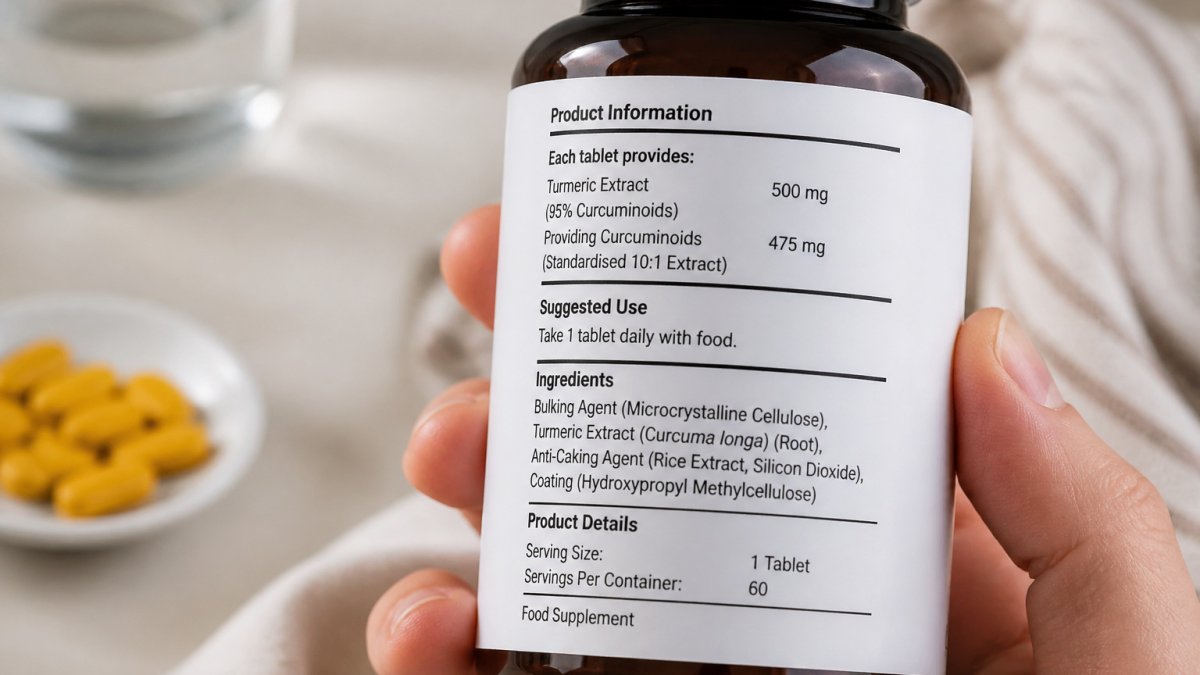
Standardised extract ratios and curcuminoid content
A clean label turmeric tablet will display all of these. If a label is vague or omits extract information, move on. You can learn more about supplement label requirements to understand what manufacturers are obligated to disclose, following Food Standards Agency guidance on labelling.
Turmeric Tablets with 35:1 Curcumin, Ginger & Black Pepper →
Clean excipients and what to avoid
The excipients matter because they affect bioavailability and tolerability. Excessive fillers reduce the space available for active ingredients. Some people react poorly to certain binders. Transparency lets you make an informed choice. Our turmeric tablets at Pure Vitamins UK list every ingredient and its dose, no hidden blends, no surprises.
Turmeric Capsules Dosage: Finding the Right Amount
Start with the manufacturer's recommended dose and adjust based on your response. If you're taking other supplements or medications, check for potential interactions before increasing your dose. The addition of black pepper extract (piperine) in quality formulations enhances curcumin absorption, meaning you may need less total curcumin to achieve the same effect compared to formulations without it.
Turmeric Curcumin Side Effects and Safety Considerations
More importantly, turmeric can interact with certain medications. If you take blood thinners, diabetes medications, or anti-inflammatory drugs, consult a healthcare professional before starting turmeric supplements. Turmeric may also increase the risk of kidney stones in susceptible individuals, particularly at very high doses. For comprehensive safety information tailored to your circumstances, review turmeric safety considerations or speak with your GP.
What Sets Clean Label Formulations Apart
At Pure Vitamins UK, batch testing is documented in-house.
Choosing Your Clean Label Turmeric Tablets
Compare supplement quality standards to understand what certification marks like GMP and ISO 22000 mean. These indicate manufacturing rigour, though they're not the only quality markers to consider.
Our Turmeric Tablets with 35:1 Curcumin, Ginger & Black Pepper combine a 35:1 standardised turmeric extract, 23:1 Ginger Extract and Black Pepper Extract. They are listed at £13.99.

Choosing a clean label turmeric supplement means prioritising transparency and formulation rigour over marketing claims. The difference between a tablet that works and one that doesn't often comes down to standardised extract ratios, bioavailability enhancement, and honest labelling. When you understand what makes supplements effective, you make better purchasing decisions. Start by checking the extract ratio and curcuminoid content on any turmeric tablet you're considering; that single step eliminates most poorly formulated products and points you toward genuine quality.
Frequently Asked Questions
What is the difference between turmeric and curcumin in tablets?
Turmeric is the whole root powder; curcumin is the active compound extracted from it. Clean label turmeric tablets use standardised extracts (often 35:1 or higher) to concentrate curcuminoids, the beneficial compounds. This means you get a measurable dose of the active ingredient rather than relying on variable amounts in raw powder. A tablet standardised for curcumin delivers consistent potency across every dose.
How much curcumin should I take daily in tablet form?
Most research on turmeric curcumin benefits uses doses between 500-2000 mg of curcumin daily, often split across meals. Clean label tablets typically declare their curcumin content clearly on the label; look for 'standardised extract' percentages. Start with the serving size on the label and take with food to improve absorption. If you're on medication or have health concerns, speak to your GP before starting any supplement regimen.
What should I avoid when taking turmeric curcumin tablets?
Avoid taking turmeric on an empty stomach if you have a sensitive digestive system. Do not combine with blood thinners or diabetes medications without medical advice, as turmeric may interact. Check the label for fillers, artificial additives and unnecessary excipients; clean label formulas should list every ingredient with its purpose. Avoid brands that hide ingredient amounts behind 'proprietary blends', as you cannot verify the actual curcumin dose.
Why do clean label turmeric tablets cost more than budget alternatives?
Clean label formulas use standardised, high-potency extracts (like 35:1 turmeric extract) instead of raw powder, ensuring consistent curcumin content per tablet. They include absorption enhancers such as black pepper extract (piperine) and often ginger extract, which add genuine cost. Batch testing, transparent labelling, and GMP manufacturing standards also increase production expenses. The result is a tablet your body can actually absorb and use, making the higher price justified by efficacy and ingredient quality.


