



Table of Contents
- Why Magnesium Glycinate for Sleep and Recovery
- How Magnesium Supports Relaxation and Nervous-System Function
- Potential Sleep Benefits: Sleep Latency, Efficiency and Nighttime Waking
- Magnesium Glycinate Dosage for Sleep: Elemental Magnesium and Labels
- The Best Time to Take Magnesium Glycinate
- Magnesium Glycinate for Muscle Recovery and Post-Exercise Soreness
- Magnesium Glycinate Side Effects, Interactions and Who Should Avoid It
- A Practical, Evidence-Aware Trial Plan
- Frequently Asked Questions
Last Updated: October 18, 2026
Why Magnesium Glycinate for Sleep and Recovery
Magnesium glycinate is a form of magnesium bound to glycine, an amino acid, and it is one of the better-tolerated ways to top up this mineral. At Pure Vitamins UK, we explain it plainly: the bond matters because it affects how well you absorb each dose and how gently it sits on your stomach.

Most people searching for the benefits of taking magnesium glycinate for sleep and recovery are tired of guessing. They want to know if it works, how much to take, and when. Below, we cover exactly that, plus the parts most guides skip: label maths, who should avoid it, and how to run a fair trial.
A common mistake is expecting a sedative effect. Magnesium is not a sleeping pill. It supports normal nerve and muscle function, and the evidence around sleep is promising but mixed.
How Magnesium Supports Relaxation and Nervous-System Function
Magnesium contributes to the normal functioning of the nervous system and normal psychological function. Those are authorised nutrient function claims, not marketing spin.
In practice, this means magnesium plays a role in the processes that keep nerve signalling steady. Low intakes are common, and UK government dietary advice on vitamins and minerals sets out reference intakes rather than promising outcomes.
GABA, Melatonin and the Glycine Bond
Glycine is an amino acid with its own calming role in the nervous system. Some people find the glycinate form easier on digestion than oxide, which is a practical reason to choose it.
What most guides miss is that glycine is not a sedative. It supports the body's own relaxation pathways. Claims about GABA and melatonin are often overstated online.
Potential Sleep Benefits: Sleep Latency, Efficiency and Nighttime Waking
Most guides list the possible sleep benefits and stop there. The more useful question is how strong the evidence is for each one, and for whom.
What the research actually measures
Sleep studies tend to use a small set of measures, and it helps to know what they mean before reading any claim:
- Sleep latency: how long it takes to fall asleep after lights out.
- Sleep efficiency: the proportion of time in bed actually spent asleep.
- Nighttime waking: how often you wake and how long for.
- Subjective sleep quality: how rested you feel, which is what most people actually care about but is the easiest measure to bias.
A common pattern across trials is that improvements are modest and inconsistent. Many studies are small, use different forms and doses of magnesium, run for only a few weeks, and enrol people whose baseline magnesium intake is unknown. Some show small improvements in latency or subjective quality; others show nothing. That is not a reason to dismiss magnesium, but it is a reason to treat sleep benefits as possible rather than established.
Who is most and least likely to benefit
The people most likely to notice a difference are those with low magnesium intake or status, older adults, and people under sustained stress. The people least likely to benefit are those already meeting their reference intake through diet, and anyone whose poor sleep has a clear behavioural or medical cause.
Before blaming your magnesium level, rule out the more common explanations:
- Late caffeine or alcohol
- Irregular sleep and wake times
- Screen use in bed
- A bedroom that is too warm or too light
- Untreated stress, anxiety or low mood
- Conditions such as sleep apnoea, which need medical assessment rather than a supplement
If any of those apply, a mineral will not override them, and you will wrongly conclude magnesium does nothing.
The GABA and melatonin question
Claims that magnesium directly boosts GABA or melatonin are often overstated. Magnesium contributes to normal nervous-system function, and glycine has its own calming role, but the evidence does not support describing the supplement as a sedative or a hormonal switch. Treat mechanism claims as plausible context, not proof of effect.
The honest summary: magnesium glycinate may produce small improvements in how quickly you fall asleep and how rested you feel, particularly if your intake is low. It is not a treatment for insomnia, and the evidence is too uneven to promise results for everyone.
Magnesium Glycinate Dosage for Sleep: Elemental Magnesium and Labels
Magnesium glycinate dosage for sleep confuses people because labels hide the real number. The figure that matters is elemental magnesium, not the weight of the compound.
Our Magnesium Glycinate Capsules, Triple Complex 384mg delivers 384mg of elemental magnesium per daily serving, which is 102% of the adult Nutrient Reference Value. That is a transparent dose, clearly labelled.
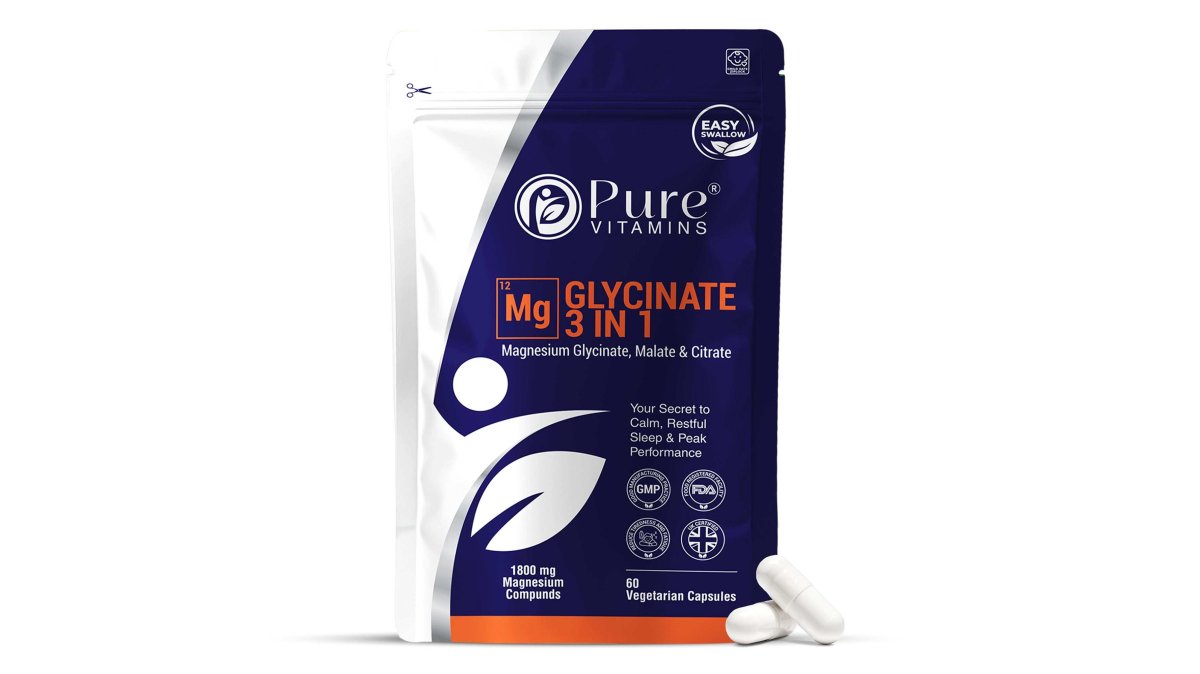
Check your own label like this:
- Find the elemental magnesium figure, usually in milligrams
- Ignore the compound weight, such as "magnesium glycinate 1000mg"
- Compare the elemental figure to the NRV
- Start at the lower end if you are new to supplements
The Best Time to Take Magnesium Glycinate
The best time to take magnesium glycinate is usually in the evening, roughly an hour before bed, if sleep is your goal. Timing is flexible, though. Consistency matters more than the exact clock.
Magnesium Glycinate Capsules, Triple Complex 384mg →
Take it with food if it upsets your stomach. Split doses across the day if you are taking a larger amount.
- Evening: best if you want sleep support
- With dinner: gentle on digestion
- Split doses: useful for higher intakes
- Same time daily: builds a habit
Magnesium Glycinate for Muscle Recovery and Post-Exercise Soreness
Recovery is the half of this keyword most sleep articles ignore, so it is worth being precise about what magnesium does and does not do after training.
Magnesium contributes to normal muscle function and to the maintenance of normal electrolyte balance. It is also involved in normal protein synthesis and in the reduction of tiredness and fatigue. Those are authorised nutrient function claims, which means they describe the role the mineral plays in normal physiology. They do not mean a supplement treats delayed-onset muscle soreness (DOMS), speeds repair after a hard session, or improves performance.
What the evidence does and does not show
A common pattern in the research is that benefits are clearest in people whose intake is low to begin with. Where baseline magnesium status is adequate, trials tend to show little or no change in soreness, strength loss or recovery markers. Where intake is poor, topping up restores normal function rather than adding a performance edge.
That distinction matters practically:
- If you eat few magnesium-rich foods (nuts, seeds, wholegrains, pulses, leafy greens, cocoa), a gap is plausible and correcting it supports normal muscle function.
- If you already eat well, expect little change in soreness or recovery time.
- Magnesium is not an anti-inflammatory and is not a substitute for sleep, protein intake, hydration or sensible training progression.
Claims that magnesium 'flushes out lactic acid' or 'prevents cramps' are common online but are not supported by the authorised claims framework. Muscle cramps have multiple causes, and magnesium supplementation is not a reliable fix for all of them.
Why the glycinate form suits active people
Glycinate is bound to the amino acid glycine, which makes it gentle on the stomach compared with magnesium oxide. For people taking a daily dose alongside training, tolerability matters: oxide is more likely to cause loose stools at higher intakes, which is unhelpful when you are already managing hydration and recovery.
Glycine itself has a calming role in the nervous system, which is one reason the glycinate form is popular in the evening. That is a practical reason to choose it, not proof that it improves recovery.
If recovery is your main goal, track it the same way you would track sleep: note soreness, readiness and training quality over four to six weeks rather than judging a single session.
Magnesium Glycinate Side Effects, Interactions and Who Should Avoid It
Magnesium glycinate side effects are usually mild. The glycinate form is gentler than oxide, so loose stools are less common, though some people still notice digestive changes at higher doses.
Speak to a healthcare professional before starting if you take medication or have kidney problems. Magnesium can interact with some medicines, and impaired kidney function affects how your body clears it.
- Common: mild stomach upset at high doses
- Less common with glycinate: loose stools
- Check first: kidney conditions, heart medication, antibiotics
- Always: consult your doctor if unsure
A Practical, Evidence-Aware Trial Plan
Run a fair trial instead of guessing. Give it four to six weeks, keep the dose steady, and change nothing else about your sleep routine.
Track three things nightly: time to fall asleep, number of wakings, and how you feel on waking. Score each out of five.
| Week | What to Do | What to Record |
|---|---|---|
| 1 | Start at the label dose, evening | Baseline sleep scores |
| 2-3 | Keep dose steady | Latency and wakings |
| 4-6 | Review your notes | Trends, not single nights |
| End | Decide: keep, adjust or stop | Honest verdict |
If nothing changes by week six, magnesium is probably not your lever. Look at caffeine, light exposure, and stress instead. That is not failure; it is useful information.
Sleep and recovery are built on small, consistent choices, and a well-dosed mineral is one of them. Pure Vitamins UK makes that easier with clean-label formulas, transparent dosing, and documented in-house batch testing, so you know exactly what you are taking. Our Magnesium Glycinate Capsules, Triple Complex 384mg gives you a clearly labelled 384mg elemental magnesium per serving, and the Daily Foundation Duo pairs it with vitamin D3 and K2 for everyday support.

Frequently Asked Questions
Will magnesium glycinate help you sleep better?
It can help, but the effect depends on where you start. Magnesium contributes to normal psychological function and the reduction of tiredness and fatigue, and it is involved in normal nervous-system function. If your intake is already adequate, the change is likely to be modest. If you sit below the reference intake, as many adults do, correcting that gap is where the clearest difference tends to show. Magnesium glycinate is not a sedative, and it will not override poor sleep habits, late caffeine or an inconsistent bedtime.
How much magnesium glycinate should you take before bed?
Check the elemental magnesium figure on the label, not the weight of the compound. A daily serving of around 375mg of elemental magnesium covers the adult Nutrient Reference Value of 375mg per day. Many people start lower, at roughly half that, for a week or two before building up. Magnesium Glycinate Capsules from Pure Vitamins UK deliver 384mg elemental magnesium per two-capsule serving, which is 102% of the NRV, so one serving covers your daily base without guesswork.
When should you take magnesium glycinate for sleep?
Most people take it 30 to 60 minutes before bed, which suits the glycinate form because it is gentle on the stomach and does not need food. Timing matters less than consistency: taking it at the same point each evening makes it easier to judge whether it is doing anything. If you also use it for muscle recovery, splitting the dose so one serving lands after training and one in the evening is a reasonable approach, provided the total stays within the label's daily serving.
Does magnesium glycinate help with muscle recovery?
Magnesium contributes to normal muscle function and electrolyte balance, both of which matter after hard training. The honest position is that the evidence for soreness specifically is mixed and study-by-study results vary. Where intake is low, correcting it supports the normal processes recovery depends on. It is not a painkiller and it will not replace protein, sleep or sensible training loads. Think of it as one input among several rather than a standalone recovery fix.


