


Reviewed and updated: 22 September 2026
Best magnesium for sleep: the short answer
If you are looking for the best magnesium for sleep, the practical answer is a well-absorbed, gentle form such as magnesium glycinate (also called bisglycinate), taken in the evening as part of a wind-down, roughly 30 to 60 minutes before bed if you want a simple rule. Magnesium has become one of the most popular things people reach for at night, alongside a warm drink and dimmed lights, and I think that is exactly the right way to picture it: a supportive everyday mineral inside a routine, rather than a switch that turns sleep on. Below I will take you through the forms compared properly, the timing question, the elemental magnesium arithmetic on the label, what to space it away from, and what the research genuinely shows.

TL;DR
- Best form for the evening: magnesium glycinate or bisglycinate, because it is well absorbed and notably gentle on the stomach.
- Best time: evening, around 30 to 60 minutes before bed, is the common pattern. There is no compulsory hour and consistency beats the clock.
- Read the label properly: the number that matters is elemental magnesium per serving, not the weight of the compound.
- UK numbers: around 300 mg a day for men and 270 mg for women, a label NRV of 375 mg, and a 250 mg upper level for supplemental magnesium on top of food.
- Honest caveat: magnesium contributes to normal nervous-system and psychological function. The direct sleep research is mixed and the effects modest, so treat it as part of a routine rather than a remedy.
What magnesium does in the body
Magnesium is an essential mineral involved in hundreds of processes, and it earns its place in an evening routine honestly: magnesium contributes to normal muscle function, to the normal functioning of the nervous system, and to normal psychological function, as well as to normal energy-yielding metabolism, a reduction of tiredness and fatigue, electrolyte balance and the maintenance of normal bones. Those nervous-system and psychological-function roles are the reason so many people fold magnesium into their wind-down, next to the habits that genuinely help rest: a consistent bedtime, a dark and cool room, and less screen time late on. Some people pair it with other calming favourites, and I look at one common combination in taking magnesium and ashwagandha together.
Why bisglycinate in particular suits the evening
This is the bit most articles skip, and it is the most interesting part of the answer. Magnesium bisglycinate is magnesium chelated to two molecules of the amino acid glycine. That chelation is why it is gentle: the magnesium travels bound to an amino acid rather than sitting as a loose salt drawing water into the bowel, which is the mechanism behind the laxative effect of cheaper forms.
Glycine is also the reason the form has an evening reputation of its own, since it is a naturally occurring amino acid that appears in its own right in the sleep literature. I would not oversell that, because a magnesium bisglycinate serving is not a glycine supplement and the two should not be conflated. But it does mean bisglycinate is the form where the carrier and the mineral both point in the same direction for night-time use, and it is a more honest reason to prefer it than vague talk of being the calming one.
What the research actually shows on magnesium and sleep
Here is the evidence, read honestly. According to research retrieved from PubMed, a randomised, double-blind, placebo-controlled trial had 155 healthy adults reporting poor sleep take 250 mg of elemental magnesium as bisglycinate daily, or a placebo, for four weeks. The magnesium group showed a greater reduction in Insomnia Severity Index scores than placebo, around minus 3.9 versus minus 2.3 points, though the authors were clear the effect was small and modest, with the biggest improvements in people who started with lower dietary magnesium (Schuster and colleagues, 2025, Nature and Science of Sleep, DOI 10.2147/NSS.S524348, read it on PMC).
A separate randomised trial tested a different form, magnesium L-threonate, in adults aged 35 to 55 with self-reported sleep problems and reported improvements in subjective and device-measured sleep over 21 days (Hausenblas and colleagues, 2024, Sleep Medicine: X, DOI 10.1016/j.sleepx.2024.100121, read it on PMC).
The fair reading across this literature is that findings are mixed, effects tend to be modest, they vary by form, and they appear most relevant when magnesium intake was low to begin with. That last point is worth sitting with, because it reframes the whole question: magnesium is most likely to be useful to you if your diet is genuinely short of it, and least likely to do much if it is not. That is interesting science about the mineral, reported as science, which is exactly why I frame magnesium as part of a routine rather than as a solution.

The magnesium forms, compared for an evening routine
Most of the real-world difference between magnesium supplements comes down to the form, because forms vary in how well they are absorbed, how much elemental magnesium they carry, and how comfortable they are to take.
Magnesium glycinate (bisglycinate)
Magnesium bound to glycine. Well absorbed, notably gentle on the stomach, and the form most people prefer for daily and evening use. Elemental magnesium content is relatively low by weight, typically around 10 to 14 per cent, which is why a bisglycinate capsule delivering a meaningful dose is not a small capsule. If comfort and consistency matter to you, this is the sensible default. If you have wondered whether glycinate and bisglycinate are two different things, the answer is in magnesium glycinate compared with bisglycinate.
Magnesium citrate
Also well absorbed, and carries more elemental magnesium by weight than bisglycinate, but it can have a mild laxative effect at higher doses, so some people find it less comfortable for nightly use. It is a good all-rounder and a poor choice if your digestion is sensitive. The full comparison, including which is gentler, is in magnesium glycinate versus citrate.
Magnesium oxide
Cheap, very high in elemental magnesium by weight at around 60 per cent, and poorly absorbed, which is the combination that makes it misleading on a label. It is used more often for its laxative effect than as a useful source of magnesium. Generally not the choice if absorption is your goal, and worth spotting when a cheap high-milligram product turns out to be oxide.
Magnesium malate
Magnesium with malic acid, well tolerated, and often chosen by people who take their magnesium in the daytime rather than at night.
Magnesium taurate
Magnesium with taurine. Popular in some formulas and generally well tolerated, though it is studied far less than the forms above.
Magnesium L-threonate
The form used in the threonate sleep study mentioned above. It is considerably more expensive per serving and typically supplies a low elemental magnesium amount, so read the label carefully rather than assuming a premium price means a bigger dose.
The key point runs through all of them: judge a magnesium on absorption, elemental content and tolerability rather than on the name alone.
What about sprays, flakes and Epsom salt baths?
A fair question, and one worth answering plainly. Topical magnesium products are popular and pleasant, and an Epsom salt bath is a perfectly nice part of a wind-down. But the evidence that meaningful amounts of magnesium cross intact skin is weak, the studies are small, and the claims made for sprays and flakes generally run well ahead of the data. If you enjoy a magnesium bath, enjoy it for what it is: a warm bath before bed, which is itself a reasonable sleep habit. If your aim is to raise your magnesium intake, an oral form with the elemental content stated on the label is the route with actual numbers behind it.
How much magnesium per day, and the elemental arithmetic
UK guidance puts adult requirements at roughly 300 mg per day for men and 270 mg per day for women, while the Nutrient Reference Value used on supplement labels is 375 mg. The Tolerable Upper Intake Level for supplemental magnesium is 250 mg a day on top of what you get from food, which is worth knowing, since going well above that, especially with poorly absorbed forms, is the usual cause of loose stools.
Now the arithmetic that catches people out. A label may say "magnesium bisglycinate 1,000 mg", and that is the weight of the whole compound, not the magnesium in it. At roughly 10 to 14 per cent elemental magnesium, that 1,000 mg is delivering somewhere around 100 to 140 mg of actual magnesium. Magnesium oxide at 400 mg, by contrast, carries around 240 mg of elemental magnesium on paper, while being absorbed poorly enough that the higher number flatters it. So always find the line that says elemental magnesium, or magnesium as a percentage of NRV, and compare products on that. Our own 3-in-1 states 384 mg of elemental magnesium per serving, which is 102 per cent of the NRV.

When to take it: morning, evening, or how long before bed?
There is no compulsory time of day, and consistency matters more than the clock. That said, here is the practical guidance people are actually asking for:
- Evening, 30 to 60 minutes before bed is the most common pattern, and it is the one I would suggest if you are taking it as part of a wind-down. Some people prefer a wider window of one to two hours before bed, which is equally fine.
- Morning is perfectly valid, especially if that is when you will genuinely remember it. Magnesium is not a sedative you are timing to an effect, it is a mineral you are topping up.
- With a little food helps if magnesium unsettles your stomach, and there is no absorption penalty worth worrying about.
- Splitting the dose, half in the morning and half in the evening, is a reasonable option if a full serving is uncomfortable, and it is the first thing I would try before abandoning a form. Keep the daily total the same.
- Give it weeks, not nights. The trial above ran for four weeks. If you are judging a magnesium after two evenings, you are not judging it fairly.
If you also take vitamin D, the stacking question is covered in the best time to take vitamin D3 and magnesium glycinate, and the D3 and K2 pairing specifically in which magnesium to take with vitamin D3 and K2.
Absorption: what helps, and what to space apart
A few practical habits make the magnesium you take more useful. Take it consistently, with food if your stomach is sensitive, and give it a little space from the things that genuinely compete or interact.
- Other minerals: high-dose calcium, iron and zinc are best taken at a different time from magnesium, since minerals compete for the same absorption pathways. A couple of hours apart is plenty.
- Certain antibiotics: tetracycline and quinolone antibiotics bind to magnesium, which reduces the absorption of the medicine. The usual advice is to separate them by several hours, and your pharmacist will give you the exact window for your prescription.
- Bisphosphonates for bone density are also affected, and should be separated as directed on the medicine.
- Very high-fibre or high-phytate meals can reduce mineral absorption when taken at exactly the same moment.
- Coffee is fine alongside it, though leaning on caffeine late in the day works against the very thing you are taking magnesium for.
None of this needs obsessive scheduling. A little spacing, and a pharmacist check if you take regular medication, covers it.

A few cautions worth knowing
For most healthy adults, magnesium at sensible doses is well tolerated. The most common issue is a laxative effect, more likely with citrate and oxide than with glycinate. People with reduced kidney function should not take magnesium supplements without medical advice, because the kidneys are what regulate magnesium levels. If you are pregnant or breastfeeding, taking medication or managing a health condition, check with your GP or pharmacist first. And if you have ongoing problems sleeping, it is genuinely worth speaking to your GP, since persistent sleep difficulty has many causes that no supplement will address.
Suitability and what to look for when buying
If diet or lifestyle matters to you, check the basics on the label: whether the capsule suits vegetarians or vegans, and whether it is free from common allergens such as gluten. Beyond that, a good magnesium for an evening routine comes down to a short checklist:
- A well-absorbed, gentle form, with glycinate or bisglycinate the popular choice for comfort.
- The elemental magnesium per serving stated clearly, not just the compound weight.
- The serving size made obvious, since a generous-looking figure spread across three capsules is a different product from a one-capsule serving.
- A clean formulation with every dose declared and no unnecessary fillers.
- Formulated in the UK and tested for purity and heavy metals at our GMP-certified facility.
For the fuller buyer's framework across the whole category, see our guide to what to look for in a magnesium supplement before buying, which also covers the triple-form approach and the glycinate research in depth. For the calm-evening context specifically, see what magnesium is good for stress and a busy mind.
Where Pure Vitamins fits
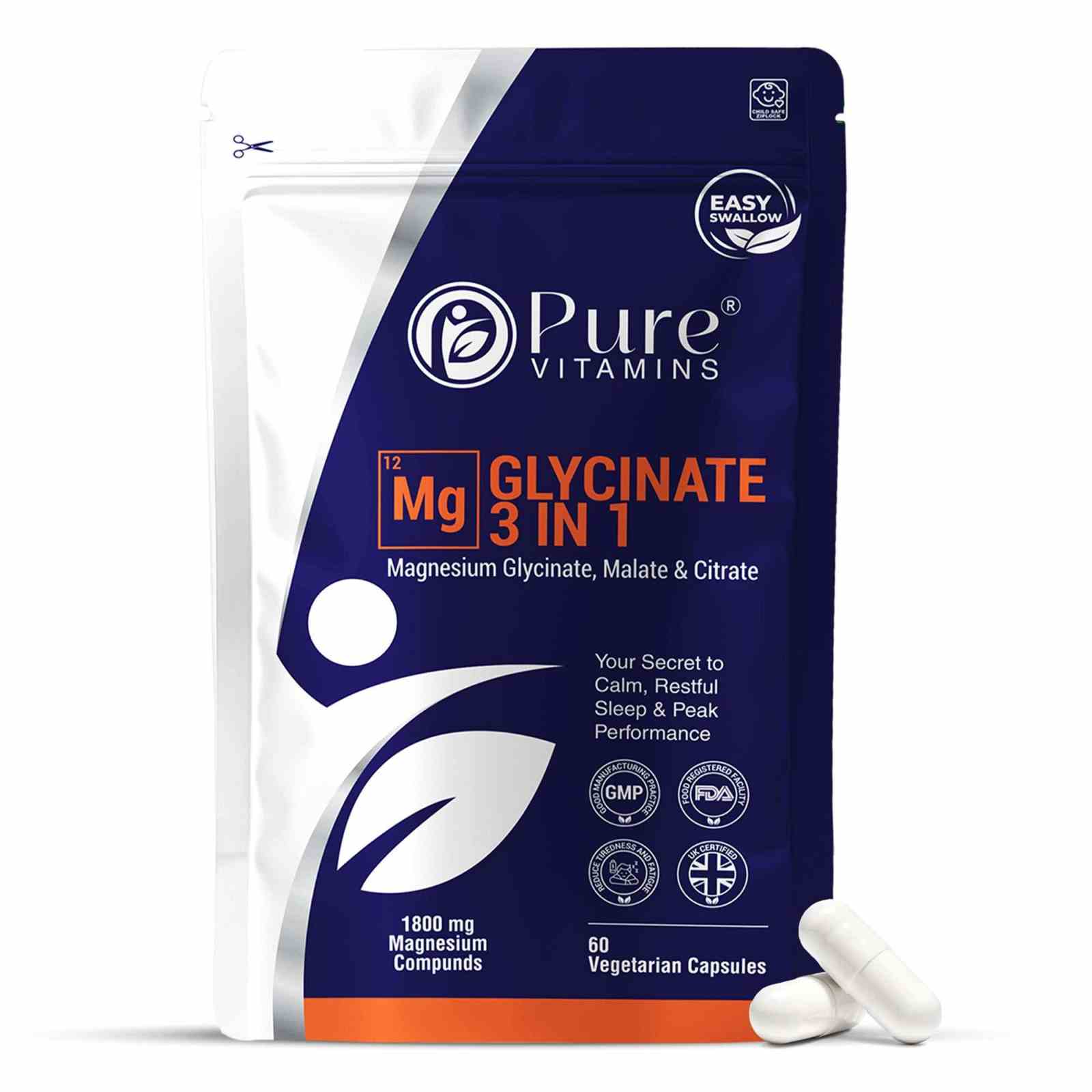
Our Magnesium Glycinate 3-in-1 is a triple-form complex built around well-absorbed, gentle magnesium, delivering 384 mg of elemental magnesium per serving (102% of the NRV) in vegetarian capsules. Magnesium contributes to normal muscle function, to the normal functioning of the nervous system, and to normal psychological function. Every dose is declared on the label, and it is formulated in the UK and tested for purity and heavy metals at our GMP-certified facility. Every guide we publish sits on the supplement guides hub, and you can browse the full range on our Pure Vitamins UK home page.
Shop Magnesium Glycinate 3-in-1
Frequently asked questions
Which form of magnesium is best for sleeping?
Magnesium glycinate, also called bisglycinate, is the form most people choose for the evening, because it is well absorbed and notably gentle on the stomach. Citrate is also well absorbed but can loosen the bowels at higher doses, and oxide is poorly absorbed despite carrying a lot of magnesium by weight.
What time of day should I take magnesium bisglycinate for sleep?
Evening, around 30 to 60 minutes before bed, is the common pattern and a sensible default, though anywhere in a one to two hour window before bed is fine. There is no compulsory hour, and taking it consistently matters more than the exact clock time.
Should I take magnesium with or without food?
Either works. With a little food helps if magnesium unsettles your stomach, and there is no absorption penalty worth worrying about. Space it a couple of hours from high-dose calcium, iron or zinc.
Can I split my magnesium dose?
Yes. Half in the morning and half in the evening is a reasonable option if a full serving is uncomfortable, and it is the first thing I would try before giving up on a form. Keep the daily total the same.
Does magnesium help you sleep?
Magnesium contributes to the normal functioning of the nervous system and to normal psychological function, and many people include it in a wind-down routine for that reason. The direct sleep research is mixed and the effects modest, and appear largest in people whose magnesium intake was low to begin with. Best seen as part of a routine rather than a remedy.
How much magnesium should I take?
Adult requirements are roughly 270 to 300 mg per day in the UK, with a label NRV of 375 mg and a 250 mg upper level for supplemental magnesium on top of food. Check the elemental magnesium per serving and follow the dose on the label.
Do magnesium sprays and Epsom salt baths work?
The evidence that meaningful amounts of magnesium cross intact skin is weak and the studies are small. Enjoy a magnesium bath as a warm bath before bed, which is a reasonable sleep habit in itself, but use an oral form with the elemental content stated if your aim is to raise your magnesium intake.
How long before I should expect anything?
Think weeks rather than nights. The four-week trial above is a fair model, so give any magnesium a month of consistent use before judging it.
This article is for general information and is not medical advice. If you have ongoing problems sleeping, speak to your GP. Food supplements should not be used as a substitute for a varied, balanced diet and a healthy lifestyle. Always consult a healthcare professional before use if you are pregnant, breastfeeding, taking medication or managing a medical condition.
Signed, Dr. Miron, Founder of Pure Vitamins UK.
Related articles
- Best magnesium supplements UK: what to look for before buying
- Magnesium glycinate vs citrate: what's the difference?
- Is glycinate or bisglycinate better?
- What magnesium is good for stress and a busy mind?
- Magnesium and ashwagandha: can you take them together?
- Magnesium Glycinate 3-in-1 triple complex
Sources
- Schuster J and colleagues (2025). Magnesium bisglycinate and sleep quality: a randomised, double-blind, placebo-controlled trial. Nature and Science of Sleep. DOI 10.2147/NSS.S524348. PMC12412596
- Hausenblas HA and colleagues (2024). Magnesium L-threonate and sleep: a randomised controlled trial. Sleep Medicine: X. DOI 10.1016/j.sleepx.2024.100121. PMC11381753
