


Table of Contents
- What Makes a Clean Label Supplement
- Supplement Manufacturing Regulations and FSA Compliance
- Third-Party Testing for Supplements: What It Means
- Understanding Minimum Order Quantities for Supplements
- How to Verify Quality When Ordering Clean Label Supplements
- Ingredient Sourcing and Bioavailability in Clean Label Formulas
- Packaging and Labelling Transparency
- Conclusion
Last Updated: August 13, 2026
What Makes a Clean Label Supplement
A clean label supplement is a product formulated with minimal, recognisable ingredients and transparent labelling that shows exactly what you're taking and at what dose. Clean label formulas avoid synthetic binders, artificial colours, unnecessary preservatives, and undisclosed ingredient combinations. Instead, they use well-absorbed forms of nutrients: magnesium glycinate rather than magnesium oxide, vitamin D3 with K2 rather than D2 alone, hydrolysed collagen peptides rather than standard collagen powder.

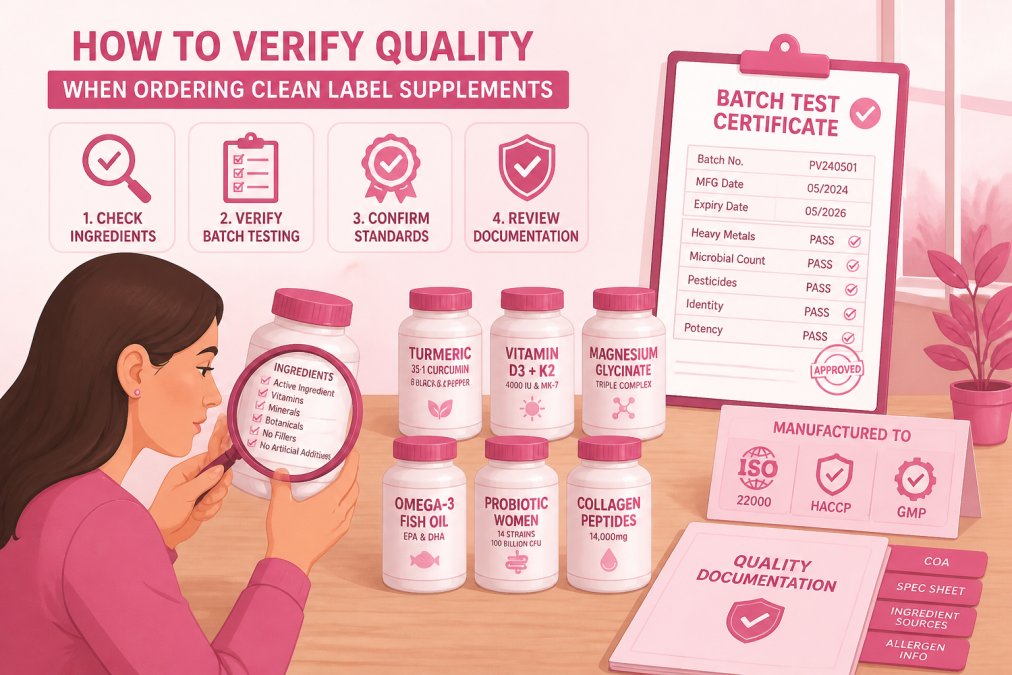
When ordering clean label supplements, you should expect clear dosing information, batch testing documentation, and certification evidence. Pure Vitamins UK exemplifies this approach: every product displays the exact dose of each active ingredient, comes with in-house batch testing records, and uses ingredient forms selected specifically for absorption and efficacy.
The regulatory landscape in the UK is governed by the Food Standards Authority (FSA) and the Medicines and Healthcare products Regulatory Agency (MHRA). Clean label supplements must comply with GB nutrition and health claims rules, which means manufacturers cannot claim their products treat, prevent, or cure any condition. What distinguishes genuine clean label brands is providing transparent evidence that their formulations deliver the stated nutrient content and meet quality standards.
Supplement Manufacturing Regulations and FSA Compliance
Supplement manufacturing in the UK operates under strict regulatory frameworks designed to protect consumer safety. The Food Standards Authority oversees food safety, including supplements classified as food products. Manufacturers must comply with General Food Law regulations, which require documented hazard analysis and preventive controls.
ISO 22000 and HACCP (Hazard Analysis and Critical Control Points) certifications demonstrate a manufacturer's commitment to food safety systems. These frameworks require documented processes at every stage: ingredient sourcing, storage, manufacturing, testing, and packaging. GMP (Good Manufacturing Practice) certification establishes minimum requirements for facilities, equipment, personnel training, and quality control. A GMP-certified facility undergoes regular audits to verify compliance.
The FSA requires clear labelling that includes: product name, ingredient list with quantities, allergen information, storage instructions, and contact details for the manufacturer. Clean label supplements take this further by providing batch numbers, testing dates, and sometimes direct links to test results.
FSA guidance on food labelling requirements outlines the specific information that must appear on supplement packaging. When ordering from UK manufacturers, verify that the brand can demonstrate FSA compliance documentation.
Third-Party Testing for Supplements: What It Means
Third-party testing is the independent verification that a supplement contains what the label claims and is free from contaminants. When you order clean label supplements, you're ideally purchasing products that have undergone both in-house batch testing and independent third-party verification.
Third-party testing laboratories analyse finished products for: potency verification (does the product contain the stated dose?), contaminant screening (heavy metals, pesticides), microbiological analysis (harmful bacteria, moulds, pathogens), and identity confirmation (the ingredient is actually what the label claims).
The testing standard most relevant to supplements is USP (United States Pharmacopeia) standards for dietary supplements, which many UK manufacturers adopt as a benchmark. When evaluating a clean label supplement brand, ask to see third-party testing certificates. Reputable manufacturers like Pure Vitamins UK publish batch-specific test results or provide them on request. The certificate should include the testing date, laboratory name, specific parameters tested, and results. If a brand refuses to share this documentation, that's a red flag.
Understanding Minimum Order Quantities for Supplements
Minimum order quantities (MOQ) are the smallest volume a manufacturer will produce in a single batch. For private label and contract manufacturing, MOQ directly affects your cost per unit and the viability of ordering custom formulations.
Most supplement manufacturers set MOQs between 500 and 5,000 units per SKU (stock-keeping unit), depending on the product type and manufacturing complexity. Capsules and tablets typically have lower MOQs (500-1,000 units), while gummies, powders, and RTD formulations often require higher MOQs (2,000-5,000 units) because the production equipment is more specialised.
A 1,000-unit order of a custom formulation will have a higher per-unit cost than a 5,000-unit order of the same formula. Some manufacturers offer tiered pricing: lower per-unit cost at higher volumes. Before committing to a manufacturer, clarify their MOQ policy, volume discounts, and lead times for different order sizes.
How to Verify Quality When Ordering Clean Label Supplements
Verifying quality before ordering clean label supplements requires examining multiple data points: ingredient forms, testing documentation, certifications, and manufacturing standards.
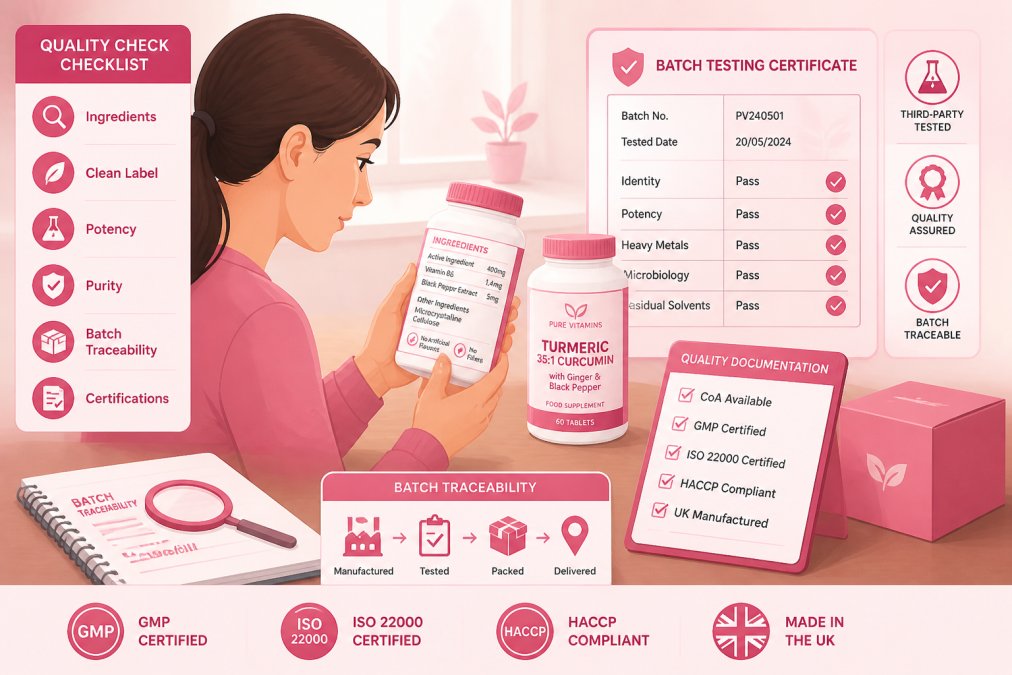
Start with the ingredient list. Look for specific ingredient forms rather than generic names. "Magnesium glycinate" is more specific than "magnesium." Bioavailability, how well your body absorbs and utilises a nutrient, depends on the chemical form. Chelated minerals are absorbed more efficiently than oxide or carbonate forms.
Examine the label for exact dosing. Clean label supplements state the precise milligram amount of each active ingredient. If a label says "proprietary blend" without breaking down individual doses, that's not genuinely clean label.
Request batch testing certificates. A legitimate clean label manufacturer can provide documentation showing that each batch has been tested for potency, purity, and contaminants. Cross-reference the batch number on the bottle with the certificate to confirm it matches.
Verify certifications: GMP certification, ISO 22000, HACCP compliance, and third-party testing accreditation. Check for allergen transparency. Clean label supplements clearly disclose potential allergens and confirm products have been tested for those substances.
Ingredient Sourcing and Bioavailability in Clean Label Formulas
The source of an ingredient and its chemical form determine how effectively your body can use it. Ingredient sourcing refers to where and how raw materials are obtained. Clean label brands prioritise suppliers with documented traceability to prevent contamination from heavy metals, pesticides, or undisclosed additives.
Bioavailability is the percentage of an ingested nutrient that your body actually absorbs and can use. Two supplements with identical nutrient quantities can have vastly different bioavailability depending on ingredient form. Magnesium oxide has high elemental magnesium content but your body absorbs only 4% of it. Magnesium glycinate, a chelated form where magnesium is bound to the amino acid glycine, has bioavailability around 25-30%. Similarly, vitamin D3 (cholecalciferol) is more bioavailable than D2 (ergocalciferol). Vitamin D3 with K2 is superior to D3 alone because K2 helps direct calcium to bones rather than soft tissues.
Clean label manufacturers invest in bioavailable forms because they're more expensive. When ordering clean label supplements, examine the ingredient form. If the label doesn't specify the form, contact the brand and ask. Transparency about ingredient form is a marker of genuine clean label commitment.
Packaging and Labelling Transparency
Transparent labelling means every piece of information a consumer needs is clearly visible: ingredient name and quantity, allergen warnings, batch number, manufacturing date, expiry date, storage instructions, and the manufacturer's contact information. Some brands include QR codes linking to batch testing results or detailed ingredient sourcing information.
Many clean label brands use recyclable or compostable materials rather than plastic-heavy packaging. Glass bottles, cardboard, and paper align with sustainability principles and reduce environmental impact.
Batch numbering is critical for traceability. Every batch should have a unique identifier printed on the packaging. If a safety issue arises with a specific batch, the brand can identify exactly which customers received it and issue a recall if necessary. When you order clean label supplements, note the batch number, it's your link to testing documentation and traceability records.
Conclusion
Ordering clean label supplements means prioritising transparency, bioavailability, and verified quality over cost alone. When you choose a brand like Pure Vitamins UK, you're selecting products formulated in the UK with transparent dosing, documented batch testing, and ingredient forms selected for absorption and efficacy. Every product in the range reflects this commitment to clean label standards.
The difference between a clean label supplement and a budget alternative is the choice between magnesium glycinate and magnesium oxide, between documented third-party testing and no testing at all, between genuine FSA compliance and cutting corners. The FSA's published guidance on supplement regulations makes clear that manufacturers have a legal obligation to ensure safety and accurate labelling.
When you're ready to order, verify certifications, request batch testing documentation, examine ingredient forms, and confirm allergen information. These steps take minutes but protect your investment and your health. Shop now with Pure Vitamins UK and experience the difference that genuine clean label formulation makes.
Frequently Asked Questions
What defines a clean label supplement in the UK?
A clean label supplement contains only essential active and inactive ingredients with no artificial additives, fillers, binders, or preservatives. It lists every ingredient with transparent dosing information. Clean label products avoid synthetic colourings, flavourings, and unnecessary excipients. In the UK, the Medicines and Healthcare products Regulatory Agency (MHRA) requires clear labelling of all components. Look for supplements that disclose ingredient forms (such as magnesium glycinate rather than oxide) and third-party testing confirmation on the label or manufacturer website.
How do I verify the quality of a supplement manufacturer?
Check for GMP certification (Good Manufacturing Practice), ISO 22000 and HACCP accreditation, and evidence of third-party testing. Request batch-specific test results showing heavy metal screening and pesticide analysis. Reputable manufacturers publish these certificates on their website or provide them on request. Verify FSA compliance and look for transparent dosing on the label. Contact the manufacturer directly to ask about their quality assurance process and whether they conduct in-house testing. Avoid brands that make unsubstantiated health claims or refuse to share testing data.
What are minimum order quantities for supplements, and why do they matter?
Minimum order quantities (MOQ) are the smallest batch size a manufacturer will produce for a private label order, typically ranging from 500 to 5,000 units depending on the product type and manufacturer. MOQs matter because they affect your total cost per unit and initial investment. Lower MOQs suit smaller retailers or new product launches, while higher MOQs reduce per-unit costs but require more capital upfront. When ordering clean label supplements, understand the MOQ structure before committing, as it influences pricing and your ability to test market demand before scaling.
Why is third-party testing for supplements important?
Third-party testing verifies that supplements contain exactly what the label claims and no harmful contaminants. Independent laboratories test for heavy metals (lead, cadmium, mercury), pesticide residues, microbial contamination, and ingredient identity. This testing protects consumers from underdosed or mislabelled products and builds trust. In the UK, whilst third-party testing is not legally mandatory for all supplements, it is a hallmark of quality manufacturers and demonstrates commitment to safety. Request certificates of analysis from your supplier showing batch-specific results before ordering.

