

Reviewed and updated: 5 November 2026
Pure zinc supplements in the UK usually mean one of two things to shoppers: zinc on its own in a single form, or the Pure Encapsulations Zinc 15 and Zinc 30 capsules by name. I'm Dr. Miron, founder of Pure Vitamins UK, and in this guide I'll put those two capsules side by side with our Zinc and Copper tablet on the facts you can check yourself: zinc form, amount per day, what else is in the capsule or tablet, pack size, price per day and delivery.
Pure zinc supplements compared: the quick answer
- Pure Encapsulations Zinc 15: 15 mg of zinc as zinc picolinate in one vegetarian capsule a day, 60 capsules for £15.24 (£13.72 on subscription), about 25p a day.
- Pure Encapsulations Zinc 30: 30 mg of zinc as zinc picolinate in one vegetarian capsule a day, 60 capsules for £18.06, about 30p a day.
- Pure Vitamins Zinc and Copper: 25 mg of elemental zinc from zinc picolinate, zinc glycinate and zinc citrate, plus 2 mg of copper from copper glycinate, in one tablet a day, 30 tablets for £9.00, 30p a day.
- The NHS advises not taking more than 25 mg of zinc from supplements a day unless a doctor advises it. Count any zinc in a multivitamin too.
- If a doctor or practitioner recommended a specific zinc product to you, check with them before switching.

Our pick for this guide
Looking for zinc and copper together in one daily tablet?
Our Zinc and Copper tablet provides 25 mg of elemental zinc (250% NRV) from three zinc forms and 2 mg of copper (200% NRV) as copper glycinate, 30 tablets per pouch. A food supplement, not a replacement for medical advice.
From £9.00 · 30 tablets
What people mean by "pure zinc"
When someone searches for "pure zinc" they are usually after one of three things. Some want zinc on its own rather than a multivitamin. Some want a short ingredient list without additives they would rather avoid. And some are simply looking for the Pure Encapsulations zinc range by name. These are different questions, so it helps to take them one at a time.
On the first, both Pure Encapsulations capsules are single-mineral products: zinc picolinate only, with no copper. Ours is not a single-ingredient product. It is a blend of three zinc forms with copper added, so if you want one zinc compound and nothing else, the Pure Encapsulations capsules are the closer match. On the second, the Zinc 15 capsule lists microcrystalline cellulose (a plant fibre) and zinc picolinate in a hydroxypropyl methyl cellulose capsule, and Zinc 30 adds ascorbyl palmitate, an antioxidant. Our tablet is described on our product page as vegan-friendly, with no artificial colours, flavours or preservatives and no added sugars. On the third, our brand name is Pure Vitamins, a different company altogether, as the note above explains.

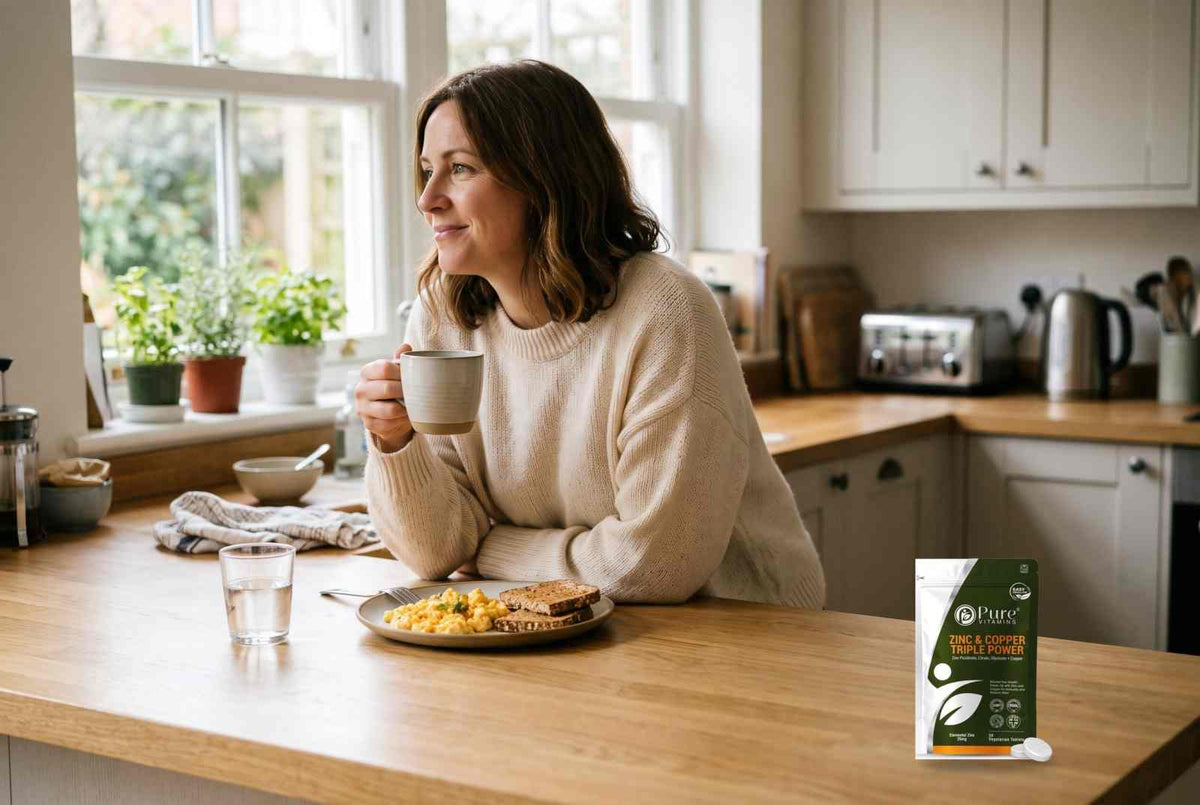
Zinc goes with breakfast in my house, next to the kettle. Illustrative image.
The products side by side
Here is everything in one place. The Pure Encapsulations details were read from the brand's own UK website today, and ours from our product page and its published Certificate of Analysis. Price per day is the pack price divided by the number of days the pack lasts at the label's daily serving.
Pure Vitamins Zinc and Copper
- Form: zinc picolinate, zinc glycinate and zinc citrate, plus copper glycinate; tablet
- Per daily serving: 25 mg zinc (250% NRV) and 2 mg copper (200% NRV), 1 tablet
- Pack: 30 tablets, 30 days
- Price: £9.00, so £9.00 ÷ 30 = 30p a day
- Described as vegan-friendly; free from gluten, dairy, soy and nuts
Pure Encapsulations Zinc 15
- Form: zinc picolinate; HPMC vegetarian capsule
- Per daily serving: 15 mg zinc, 1 capsule (15 mg is 150% of the 10 mg NRV)
- Pack: 60 capsules, 60 days
- Price: £15.24, so £15.24 ÷ 60 = about 25p a day (£13.72 on subscription, about 23p a day)
- Labelled vegan, vegetarian, gluten free, dairy free, non-GMO, soya free
Pure Encapsulations Zinc 30
- Form: zinc picolinate; HPMC vegetarian capsule, with ascorbyl palmitate
- Per daily serving: 30 mg zinc, 1 capsule (30 mg is 300% of the 10 mg NRV)
- Pack: 60 capsules, 60 days (a 180-capsule size is listed; its price was not shown)
- Price: £18.06, so £18.06 ÷ 60 = about 30p a day
- Labelled vegan, vegetarian, gluten free, dairy free, soya free
Pure Encapsulations UK lists standard delivery at £4.49, free on orders of £50 or more, delivered to mainland UK (checked 5 November 2026). Our own delivery options are shown at checkout.
15 mg, 25 mg or 30 mg: how much zinc do you need?
The NHS says men aged 19 to 64 need about 9.5 mg of zinc a day and women about 7 mg, and that most people can get all the zinc they need from their daily diet. For supplements, the NHS guidance is clear: do not take more than 25 mg of zinc supplements a day unless advised to by a doctor (NHS). The European Food Safety Authority sets a tolerable upper intake level of 25 mg a day for adults from all sources, as summarised in a 2024 review of zinc safety (Schoofs and colleagues, 2024).
Here is how the three products sit against that line, as plain arithmetic:
- Zinc 15: 15 mg a day, below the 25 mg supplement guidance, leaving room for zinc from a multivitamin.
- Pure Vitamins Zinc and Copper: 25 mg a day, exactly at the guidance. I would not take it on top of another zinc-containing supplement.
- Zinc 30: 30 mg a day, above the NHS 25 mg supplement guidance. Pure Encapsulations' own UK page notes that long-term intake of this amount of zinc may lead to anaemia. It is a strength best taken on a practitioner's advice, which is how many people come to it in the first place.
If you simply want a gentle top-up alongside a varied diet, the 15 mg capsule is the lowest dose in this comparison. If you want a higher daily amount that still sits within the NHS supplement guidance, with copper included, that is where our tablet fits.
Zinc contributes to the normal function of the immune system and to the maintenance of normal skin, hair and nails. Copper contributes to the normal function of the immune system and to normal energy-yielding metabolism. Those are the roles of the minerals themselves, and they apply to any product that provides a meaningful amount of them, whichever brand you choose.
Why copper is paired with zinc
This is the biggest difference between the products, so it deserves its own section. Zinc and copper share absorption routes in the gut, and a steady high zinc intake makes the body hold on to less copper. The NHS puts it plainly: taking high doses of zinc reduces the amount of copper the body can absorb, which can lead to anaemia and weakening of the bones. The 2024 review cited above describes zinc-induced copper deficiency as one of the main recognised risks of too much zinc.
That is why some formulators add copper to a higher-strength zinc product, and why our tablet includes 2 mg of copper as copper glycinate. For context, the NHS says adults need about 1.2 mg of copper a day and that 10 mg or less a day from all sources is unlikely to cause harm. Neither Pure Encapsulations capsule contains copper according to its ingredient list, so if you are taking either one for a long time, it is worth asking your practitioner whether your copper intake is covered. My pillar guide on zinc forms, why copper is added and how much to take goes into this in more depth.

Writing the numbers down is the quickest way to compare two labels fairly. Illustrative image.
Zinc picolinate, glycinate and citrate: does the form matter?
Zinc picolinate is zinc bound to picolinic acid. It is the only form in both Pure Encapsulations capsules and one of the three forms in ours. The best-known human study on it is a small 1987 trial in 15 healthy volunteers, which compared zinc picolinate, zinc citrate and zinc gluconate at 50 mg of zinc a day for four weeks each. Zinc levels in hair, urine and red blood cells rose significantly during the picolinate period, but not during the citrate or gluconate periods (Barrie and colleagues, 1987). It is an old study and a small one, so it is a reasonable reason to like picolinate rather than a final verdict.
A more recent isotope study in healthy adults found that zinc citrate was absorbed about as well as zinc gluconate, at around 61% of a 10 mg dose taken without food, while zinc oxide was absorbed noticeably less well, at about 50% (Wegmüller and colleagues, 2014). Zinc glycinate is zinc bound to the amino acid glycine. My honest summary: picolinate, citrate and glycinate are all well-regarded organic forms, and none of the products in this comparison uses zinc oxide. Beyond that, the amount you take each day, and whether you take it consistently, matters more than the exact form. If you want the detail on picolinate specifically, see zinc picolinate benefits: what you're actually getting.
How the "mg" on a zinc label works
One small trap when comparing labels: zinc can be listed as the weight of the whole compound or as elemental zinc, the zinc itself. Both Pure Encapsulations pages state the zinc amount per capsule (15 mg and 30 mg). Our label and product page state 25 mg of elemental zinc. Our published Certificate of Analysis lists the compound weights per tablet instead (41 mg zinc picolinate, 27.5 mg zinc glycinate and 27 mg zinc citrate) and notes that together they supply the elemental zinc stated on the label. When you compare any two zinc products, make sure you are comparing elemental zinc with elemental zinc.
The cost per day, worked out
Pack prices can mislead, because packs last different lengths of time. Dividing by the days each pack lasts gives a fairer picture:
- Pure Encapsulations Zinc 15: £15.24 ÷ 60 days = about 25p a day (about 23p on subscription at £13.72).
- Pure Vitamins Zinc and Copper: £9.00 ÷ 30 days = 30p a day.
- Pure Encapsulations Zinc 30: £18.06 ÷ 60 days = about 30p a day.
So on today's prices, Zinc 15 is the lowest cost per day in this comparison, and ours and Zinc 30 are level at about 30p. Per milligram of zinc the order changes: about 1.0p per mg for Zinc 30, 1.2p for ours and 1.7p for Zinc 15. Two more points are worth knowing. Each Pure Encapsulations pack lasts two months, twice as long as one of our pouches, so you reorder less often. And Pure Encapsulations UK adds £4.49 delivery on orders under £50, so a single pack bought on its own costs a little more than the shelf price.

Food first. A board like this is where most of our zinc should come from. Illustrative image.
Where zinc comes from in food
Before any supplement, it helps to look at your plate. The NHS lists meat, shellfish, dairy foods such as cheese, bread and cereal products such as wheatgerm as good sources of zinc. Seeds, nuts and pulses add more, though zinc from plant foods tends to be less available because of compounds called phytates, which is one reason people on plant-based diets are among the most common zinc buyers. If you are wondering whether you need a supplement at all, my guide to what zinc does for skin and nails and the article on zinc and vitamin C for immunity are good next reads.
Which one suits you
I want this section to be useful even if you end up buying from someone else.
A Pure Encapsulations zinc capsule may suit you better if:
- You want one zinc form, zinc picolinate, and nothing else. Ours is a blend with copper added.
- You want a lower daily dose. Zinc 15 gives 15 mg, which leaves room for zinc from a multivitamin.
- You want the lowest cost per day in this comparison, which on today's prices is Zinc 15.
- You prefer a capsule to a tablet, or want a vegan-labelled HPMC capsule.
- You want a two-month pack so you reorder less often.
- A doctor, nutritionist or practitioner recommended Zinc 15 or Zinc 30 for you. In that case, speak to them before changing anything.
Our Zinc and Copper may suit you better if:
- You want copper included in the same tablet rather than buying it separately.
- You like the idea of three zinc forms (picolinate, glycinate and citrate) rather than one.
- You want 25 mg of zinc a day, which sits at the NHS supplement guidance rather than above it.
- You are happy with one small tablet taken with a meal.
For a wider look at UK alternatives in other categories, see our page on a UK alternative to Pure Encapsulations.

A slow breakfast on the sofa, and one small tablet with it. Illustrative image.
A few cautions worth knowing
- Keep supplemental zinc at 25 mg a day or less unless your doctor advises otherwise, and count the zinc in any multivitamin, immune blend or hair, skin and nails product you already take.
- Take zinc with food if it upsets your stomach on an empty one.
- Zinc can reduce the absorption of some antibiotics (tetracyclines and quinolones) and of penicillamine. Iron supplements can also compete with zinc. Ask your pharmacist how to space them.
- If you have been told you are low in zinc or copper, follow your GP's plan rather than choosing a dose yourself.
- If you are pregnant or breastfeeding, check with your midwife or GP before adding a new supplement.
- Keep all supplements out of reach of children.
Frequently asked questions
Is Pure Vitamins the same company as Pure Encapsulations?
No. Pure Vitamins UK is an independent British brand. We are not connected to, endorsed by or affiliated with Pure Encapsulations or its owner.
What is the difference between Pure Encapsulations Zinc 15 and Zinc 30?
Both are zinc picolinate in a vegetarian capsule taken once a day. Zinc 15 gives 15 mg of zinc per capsule and Zinc 30 gives 30 mg, according to the brand's UK website on 5 November 2026. Zinc 30 also lists ascorbyl palmitate.
Is 30 mg of zinc a day too much?
The NHS advises not taking more than 25 mg of zinc supplements a day unless advised to by a doctor. A 30 mg daily capsule is above that guidance, so it is best taken on a practitioner's advice.
Does your zinc contain copper?
Yes. Each tablet provides 25 mg of elemental zinc from zinc picolinate, zinc glycinate and zinc citrate, plus 2 mg of copper as copper glycinate. The Pure Encapsulations Zinc 15 and Zinc 30 capsules do not list copper.
Is your product zinc picolinate only?
No. Ours is a blend of three zinc forms with copper added. If you want zinc picolinate as the only zinc form, the Pure Encapsulations capsules are the closer fit.
Our pick for this guide
Want three zinc forms and copper in one tablet a day?
One tablet gives 25 mg of elemental zinc from zinc picolinate, glycinate and citrate, with 2 mg of copper glycinate, and each pouch of 30 tablets lasts a month. A food supplement, not a replacement for medical advice.
From £9.00 · 30 tablets
Where these facts come from
- Pure Encapsulations Zinc 15, £15.24 (subscribe £13.72), 60 capsules, 15 mg zinc as picolinate, checked 5 November 2026: pure-encapsulations.co.uk
- Pure Encapsulations Zinc 30, £18.06, 60 capsules, 30 mg zinc as picolinate, checked 5 November 2026: pure-encapsulations.co.uk
- Pure Encapsulations UK delivery (£4.49, free on orders of £50 or more), checked 5 November 2026: delivery and returns
- Pure Vitamins Zinc and Copper, £9.00, 30 tablets, 25 mg zinc and 2 mg copper per tablet: our product page and Certificate of Analysis
Sources
- NHS. Vitamins and minerals: others (zinc and copper). nhs.uk
- Schoofs H, Schmit J, Rink L. Zinc toxicity: understanding the limits. Molecules, 2024. PMC11243279
- Wegmüller R and colleagues. Zinc absorption by young adults from supplemental zinc citrate is comparable with that from zinc gluconate and higher than from zinc oxide. Journal of Nutrition, 2014. PMC3901420
- Barrie SA and colleagues. Comparative absorption of zinc picolinate, zinc citrate and zinc gluconate in humans. Agents and Actions, 1987. PubMed 3630857
More reading: our supplement guides hub and the Pure Vitamins UK home page.
Dr. Miron, Founder of Pure Vitamins UK
Food supplements should not be used as a substitute for a varied, balanced diet and a healthy lifestyle. This article is for general information and is not medical advice. Always speak to your GP or pharmacist if you have a medical condition, take medication, or are pregnant or breastfeeding.

