


Reviewed and updated: 23 September 2026
Should You Take Collagen When You're Eating Much Less? The Short Answer
If you are wondering whether to take collagen when you're eating much less, my honest answer is this: collagen is a perfectly reasonable thing to add, but it is not the first thing I would add, and it should never be the thing you count on to hold your muscle together. When your portions shrink, the single biggest lever you have is total protein, and collagen is a poor choice for that particular job. Where collagen genuinely earns its place is elsewhere, in the skin, hair and connective tissue side of things, and as an easy, low-volume way to top up protein you are already struggling to reach.
I get asked this a lot, usually by people who have seen their appetite drop away and noticed their skin looking a little tired and their hair thinning at the same time. It is a fair question and it deserves a fair answer rather than a sales pitch, so let me take it apart properly.

TL;DR
- What it is: collagen is the body's main structural protein. A supplement is almost always hydrolysed collagen peptides, meaning the long collagen strands have been broken into short, easily dissolved fragments.
- Who it suits when intake is low: people whose protein is already roughly where it should be, who want to support skin, hair and connective tissue, and who find a scoop in a drink easier to swallow than another meal.
- Who should sort something else first: anyone whose total daily protein has collapsed along with their appetite. Fix that before you buy collagen.
- The one thing to know: collagen is an incomplete protein. It is very low in the amino acids that drive muscle building, so a 10 g scoop does not do the same work as 10 g of whey, dairy, egg or meat protein.
- The honest caution: if you have lost weight quickly and feel weak, that is a conversation for your GP or a dietitian, not something a powder fixes.
What collagen actually is, and what "hydrolysed peptides" means
Collagen is the scaffolding protein of the human body. It makes up roughly a third of all the protein you are carrying around, and it is the main structural material in skin, tendons, ligaments, cartilage, bone matrix and the walls of blood vessels. It is built from long, rope-like triple helices, which is exactly why you cannot simply eat a piece of raw collagen and expect much to happen. Those helices are tough and poorly soluble.
Hydrolysis is the step that changes that. Manufacturers use enzymes to chop the long chains into short fragments, typically two to twenty amino acids long, and what you are left with is a fine powder that dissolves in a cold drink without clumping and is absorbed readily. That is what "hydrolysed collagen peptides" means on a label, and it is the form used in essentially all of the human research. If you want the full breakdown of forms, types and how to read a label properly, my guide to choosing a collagen supplement in the UK goes through it in detail.
Why total protein matters far more than collagen when you're eating less
Here is the part most articles skip. When your food intake drops sharply, your body still needs the raw materials to rebuild muscle every single day. Muscle protein turnover does not pause because you are eating smaller plates. What changes is the supply.
The research on this is consistent and it is worth knowing. A review in the American Journal of Clinical Nutrition, gathering several meta-analyses of controlled feeding studies, reported that higher-protein energy-restricted diets were associated with greater loss of fat mass and better retention of lean mass than lower-protein diets at the same calorie level, with the useful range landing somewhere around 1.2 to 1.6 g of protein per kilogram of body weight per day, and meals containing roughly 25 to 30 g of protein each (Leidy and colleagues, 2015, DOI 10.3945/ajcn.114.084038; record on PubMed).
Run that arithmetic for a real person. Someone weighing 70 kg is looking at roughly 84 to 112 g of protein a day. If your appetite has fallen to the point where you are managing two small meals, you might be landing at 45 or 50 g. That gap is the thing that actually matters, and it is the reason I always steer this conversation towards protein first and collagen second.
Does collagen count towards your protein target?
Technically yes, it is protein and it carries nitrogen. Practically, it is the weakest protein on the shelf for this purpose, and I would rather you knew that before you spend money.
Collagen's amino acid signature is unusual. Roughly a third of it is glycine, with large amounts of proline and hydroxyproline, an amino acid that barely appears in other dietary proteins. What it is missing matters more: collagen contains no tryptophan at all, and it is low in the branched-chain amino acids, particularly leucine, which is the amino acid that acts as the main trigger for muscle protein synthesis. That is why nutritionists call collagen an incomplete protein.
The clearest test of what this means in practice comes from a randomised controlled trial in older adults, run precisely under the conditions we are discussing here: a week of energy balance, then a week at 500 calories below maintenance, then two weeks of restricted calories combined with a sharp drop in daily steps. Everyone ate 1.6 g of protein per kilogram per day, and half of that protein came from supplements: either 60 g a day of whey protein or 60 g a day of collagen peptides. Leg lean mass fell in both groups, and neither supplement spared it. But in the recovery week, only the whey group regained leg lean mass and saw muscle protein synthesis rise again (Oikawa and colleagues, American Journal of Clinical Nutrition, 2018, DOI 10.1093/ajcn/nqy193; record on PubMed).
A systematic review of fifteen randomised controlled trials on collagen peptides and exercise reached a similar conclusion from a different angle. Collagen synthesis rates rose at around 15 g a day, and the clearest benefits appeared in joint function and joint discomfort, but collagen did not have a significant effect on muscle protein synthesis when compared against an equal amount of nitrogen from a higher-quality protein source (Khatri and colleagues, Amino Acids, 2021, DOI 10.1007/s00726-021-03072-x; full text in PMC).
In plain English: count collagen towards your daily protein if you like, but do not let it replace the complete protein in your diet. If muscle is the thing worrying you, my piece on what actually helps you hold on to muscle when you are eating less covers the nutrients and the training side properly.

The nuance worth knowing: blends behave differently
I want to be even-handed here, because there is a genuine counterpoint. A crossover trial in healthy older men compared a 20 g oral nutritional drink made from a collagen hydrolysate and milk protein blend against 20 g of milk protein alone, which contained more essential amino acids. Muscle protein synthesis rose to an equivalent degree with both, whether at rest after the drink or after the drink plus resistance exercise (Brook and colleagues, Clinical Nutrition, 2021, DOI 10.1016/j.clnu.2021.01.002; full text in PMC). The study was small, eight men, and used one specific commercial product, so I would not overstate it.
The sensible reading across all three of those papers is that collagen on its own is a poor stand-in for a complete protein, but collagen alongside dairy, eggs, fish or meat sits perfectly comfortably in a day's eating. Nobody has to choose. Put the complete protein in first, then add collagen for the reasons collagen is actually good at.
So what is collagen genuinely good for here?
Two honest answers.
Skin. A 2023 systematic review and meta-analysis pooled 26 randomised controlled trials covering 1,721 participants and found that hydrolysed collagen supplementation was associated with improvements in skin hydration and skin elasticity compared with placebo, though the authors flagged several biases in the included trials and called for larger studies (Pu and colleagues, Nutrients, 2023, DOI 10.3390/nu15092080; full text in PMC). That is a real body of evidence, and it is also research about an ingredient rather than a promise about a tub. Skin often looks flatter and drier during a period of rapid weight change, partly because of the weight change itself and partly because intake of protein, zinc and vitamin C has usually fallen at the same time.
Ease. This is the underrated one. When appetite is low, volume is the enemy. A scoop of unflavoured collagen peptides stirred into tea, coffee, soup or a smoothie adds around 9 to 10 g of protein without adding a plate of food you cannot face. It is not the best protein, but protein you actually consume beats better protein you push away.
Marine or bovine when you're eating less?
Neither is a nutrient-gap decision, so pick on practical grounds.
- Bovine collagen is sourced from cattle hide and bone and supplies Types I and III, the types dominant in skin, tendon and bone matrix. It is generally the better value per gram and is what most powders use.
- Marine collagen comes from fish skin and scales, is almost entirely Type I, and suits people who avoid beef for dietary or religious reasons. It is usually more expensive per gram because the raw material is scarcer.
- Peptide size is marketed heavily and matters less than the marketing suggests. Any properly hydrolysed collagen is absorbed well.
If you want to weigh this up properly, I have written a fuller comparison of marine and bovine collagen. Worth knowing: the 2023 meta-analysis above found no significant difference between collagen sources on skin elasticity, so this really is a preference and budget decision rather than a quality one.
How much, and how to read a collagen label
Human trials have typically used somewhere between 2.5 g and 15 g of collagen peptides a day, with 10 g being the most common serving in skin studies and the 15 g end appearing more often in connective-tissue and exercise work. There is no official UK reference intake for collagen, because it is not an essential nutrient, so those study ranges are the best guide we have.
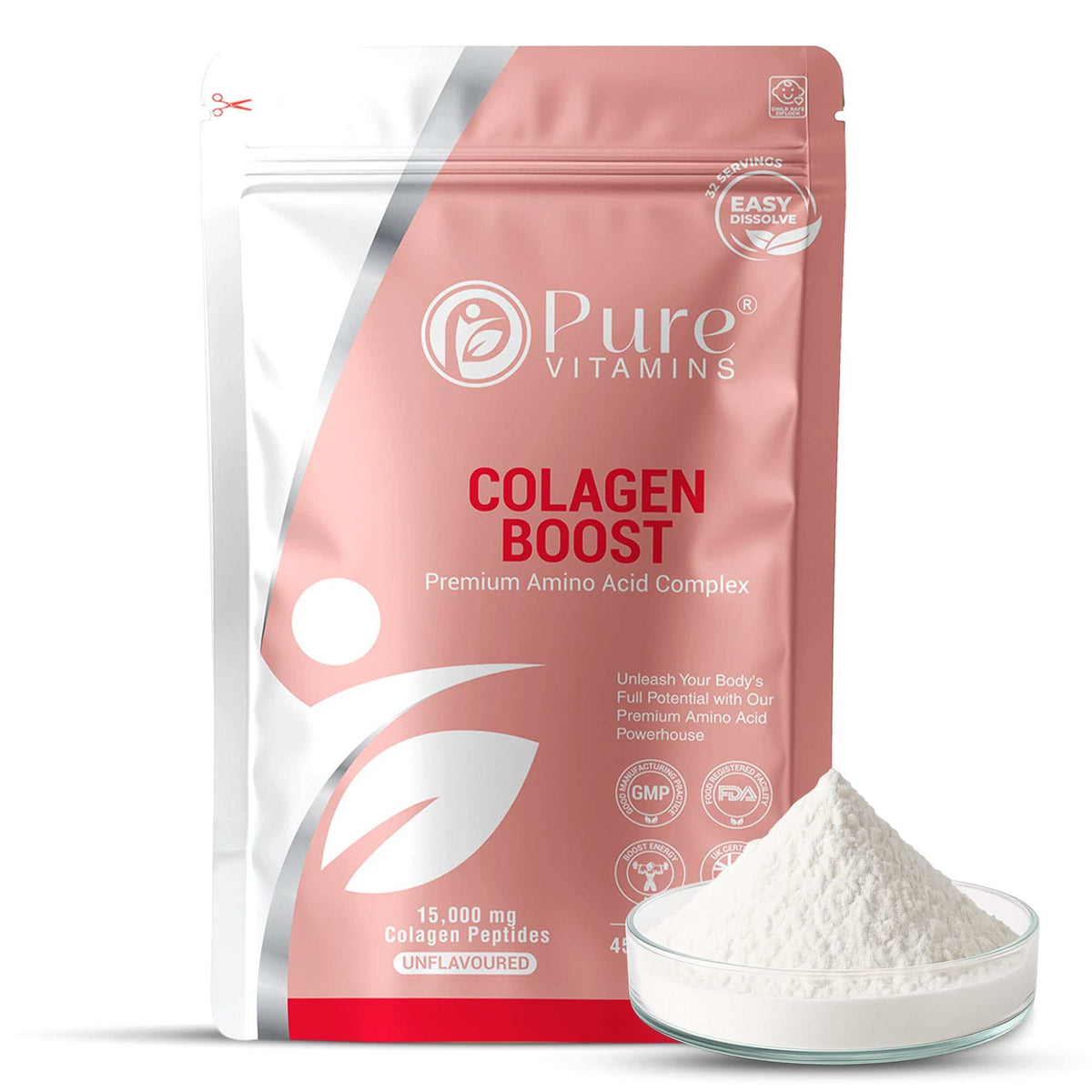
Labels are where people get caught out, so here is the arithmetic. A tub advertising "14,000 mg" is telling you the collagen content of one serving in milligrams. 14,000 mg is 14 g. That is a generous serving and it is usually delivered as a scoop of powder. Capsules are a different proposition entirely: a typical collagen capsule holds 400 to 600 mg of powder, so reaching 10 g from capsules alone would mean swallowing something like twenty of them. In practice, capsule products pair a smaller collagen dose with other actives rather than trying to match a powder gram for gram.
Three numbers are worth finding on any label before you buy: the collagen in grams per serving, the number of servings in the tub, and therefore the cost per serving. A 300 g tub at 10 g per serving is thirty servings, and dividing the price by thirty tells you far more than any front-of-pack claim.
Powder or capsules on a small appetite?
This is the practical question nobody answers well, so let me be specific.
- Powder wins on dose. It is the only realistic way to get a full 10 to 15 g serving, and unflavoured peptides genuinely do disappear into hot drinks and soups. Stir it into something you were drinking anyway rather than making it another item on the list.
- Capsules win on tolerance. If drinks are sitting heavily or nausea is an issue, a few capsules with water may be all you can manage. Accept the lower dose rather than forcing a shake you will skip.
- Timing barely matters. Collagen does not need a particular time of day. Consistency across weeks matters much more than the hour.
- Split it if volume is the issue. Half a scoop twice a day is easier on a small stomach than a full scoop at once.

The vitamin C pairing, and why it is the part that carries a claim
Your body cannot assemble collagen without vitamin C. It is an essential cofactor for the enzymes that hydroxylate proline and lysine, the step that lets the collagen triple helix hold its shape. This is not marketing, it is basic biochemistry, and it is the reason scurvy presents the way it does.
It is also the one piece of this page where a formal nutrient function claim applies. Where a product supplies vitamin C at a meaningful amount, vitamin C contributes to normal collagen formation for the normal function of skin, and to normal collagen formation for the normal function of bones, cartilage, gums, teeth and blood vessels. Collagen itself carries no such wording, which is exactly why the better formulations pair the two. Our marine collagen capsules are built that way, with hyaluronic acid and vitamin C alongside the peptides. I have written more on why collagen and vitamin C are paired if you want the full picture.
Vitamin C is one of the nutrients that quietly falls away when portions shrink, because it lives almost entirely in fruit and vegetables, which are often the first things to go when appetite drops.
Food first: where to get protein and vitamin C when you cannot eat much
Before any powder, try to fortify what you are already eating. Small and dense beats large and thin.
- Protein, high value per mouthful: Greek yoghurt (around 10 g per 100 g), eggs (about 6 g each), tinned fish, cottage cheese, chicken, tofu, milk rather than water in porridge and soups, and skimmed milk powder stirred into mashed potato or sauces.
- Vitamin C, no cooking needed: a kiwi, half a pepper, a small glass of orange juice, strawberries, or frozen berries stirred into yoghurt. Vitamin C degrades with heat and long storage, so raw and fresh does more work here.
- Little and often: four small protein-containing snacks often land more grams in a day than two meals you cannot finish.
If you are trying to work out which nutrients to prioritise across the board, start with my guide to what to take if you are not eating enough, and the wider pillar on supplements when you are eating much less, which covers B12, iron, magnesium, vitamin D and electrolytes in turn.
Skin, hair and joints during rapid weight change, stated honestly
Three things tend to happen at once during a period of sharply reduced intake, and it is easy to blame the wrong one.
Skin can look less full simply because there is less underlying fat, which is a structural change rather than a nutritional one. Hair shedding a few months after rapid weight change is a recognised pattern and usually reflects the intake drop rather than any single missing nutrient; I go into that in detail in my piece on which vitamins matter for hair when you are eating much less. And joints can feel more achy when activity patterns change, which is the area where the collagen evidence is actually at its strongest.
Collagen is not going to undo the first of those. It may be relevant to the second and third. Anyone telling you it addresses all three is selling rather than explaining.
A few cautions worth knowing
- Allergens. Marine collagen is a fish product and is not suitable if you have a fish allergy. Bovine collagen is not suitable on a vegetarian or vegan diet, and there is no true vegan collagen, only vegan formulas supplying the building blocks and vitamin C.
- Kidney disease. If you have been told to limit protein, adding a protein supplement of any kind is a conversation for your clinician first.
- Pregnancy and breastfeeding. There is little safety data on collagen supplements in pregnancy, so I would leave it and focus on food.
- Fullness. Protein is the most satiating macronutrient. If your appetite is already very low, a large collagen drink close to a meal may crowd out food you needed to eat.
- Rapid weight change with weakness, dizziness or hair loss deserves a GP appointment and probably a blood test. A supplement is not the right first response to that, and no powder substitutes for finding out what is actually going on.

What to realistically expect
The skin trials that reported changes generally ran for eight to twelve weeks, so this is not a fortnight's experiment. Nothing about collagen is dramatic, and the honest expectation is a modest, gradual change in how skin feels rather than anything visible in the mirror on day ten.
What you should not expect is for collagen to hold your muscle for you while your protein intake sits well below where it needs to be. That is the single most common mistake I see with this question, and it is the reason I have spent most of this page on protein rather than on the product.
My practical order of priority
- Get total daily protein as close as you reasonably can to 1.2 to 1.6 g per kilogram, from complete sources, spread across the day.
- Keep some resistance work in the week, even light, because protein without a training stimulus does far less.
- Cover the nutrients that fall first on a smaller intake: vitamin D, B12, iron if your bloods warrant it, magnesium, and vitamin C.
- Then, if you want it and the budget allows, add 10 g of collagen peptides daily for skin and connective tissue, paired with vitamin C.
In that order, collagen makes sense. Out of that order, it is an expensive way to miss the point.
Shop Hydrolysed Collagen Peptides
Frequently asked questions
Should I take collagen when I'm eating much less?
You can, but not as your main protein source. Collagen is an incomplete protein that is very low in leucine and contains no tryptophan, so it does not do the muscle-supporting job that whey, dairy, eggs, fish or meat do. Get total protein close to 1.2 to 1.6 g per kilogram of body weight first, then add collagen for skin and connective tissue if you want it.
Does collagen count towards my daily protein target?
It contributes protein and nitrogen, so technically yes, but it is the least useful protein for muscle. A randomised controlled trial in older adults under energy restriction found that 60 g a day of collagen peptides did not spare leg lean mass, and only the whey group regained lean mass and increased muscle protein synthesis during recovery. Count collagen as a bonus on top of your target rather than part of it.
How much collagen should I take a day?
Human studies have generally used between 2.5 g and 15 g a day, with 10 g the most common serving in skin research. There is no official UK reference intake because collagen is not an essential nutrient, so those study amounts are the best guide available.
Is marine or bovine collagen better when appetite is low?
Neither has an advantage for nutrient gaps. Bovine supplies Types I and III and is usually better value per gram; marine is almost entirely Type I and suits those avoiding beef. A 2023 meta-analysis found no significant difference between collagen sources on skin elasticity, so choose on diet, budget and preference.
Do I need vitamin C with collagen?
Vitamin C is an essential cofactor for the enzymes that build collagen in the body, and where a product supplies it at a meaningful amount, vitamin C contributes to normal collagen formation for the normal function of skin. Vitamin C intake often falls when portions shrink, since it comes mostly from fruit and vegetables, so pairing the two makes sense.
Powder or capsules if I struggle to eat?
Powder is the only practical way to reach a 10 to 15 g serving, and unflavoured peptides dissolve into tea, coffee or soup without adding bulk to a meal. Capsules deliver much less collagen per dose, but they are easier if drinks are sitting heavily. Splitting the dose across the day helps if volume is the problem.
Where to start
If your protein is broadly where it should be and you want the skin and connective-tissue side covered, our unflavoured hydrolysed collagen peptides powder is the straightforward choice, and the marine collagen capsules pair peptides with hyaluronic acid and vitamin C if you prefer capsules or avoid beef. Everything we make is formulated in the UK and tested for purity and heavy metals at our GMP-certified facility. You can browse the whole range of explainers on our supplement guides hub, or start from the shop.
Warmly,
Dr. Miron, Founder of Pure Vitamins UK
Sources
- Leidy HJ and colleagues. The role of protein in weight loss and maintenance. American Journal of Clinical Nutrition, 2015;101(6):1320S-1329S. DOI 10.3945/ajcn.114.084038. PubMed record
- Oikawa SY and colleagues. A randomized controlled trial of the impact of protein supplementation on leg lean mass and integrated muscle protein synthesis during inactivity and energy restriction in older persons. American Journal of Clinical Nutrition, 2018;108(5):1060-1068. DOI 10.1093/ajcn/nqy193. PubMed record
- Khatri M and colleagues. The effects of collagen peptide supplementation on body composition, collagen synthesis, and recovery from joint injury and exercise: a systematic review. Amino Acids, 2021;53(10):1493-1506. DOI 10.1007/s00726-021-03072-x. Full text in PMC
- Brook MS and colleagues. A collagen hydrolysate/milk protein-blend stimulates muscle anabolism equivalently to an isoenergetic milk protein-blend containing a greater quantity of essential amino acids in older men. Clinical Nutrition, 2021;40(6):4456-4464. DOI 10.1016/j.clnu.2021.01.002. Full text in PMC
- Pu SY and colleagues. Systematic review and meta-analysis of 26 randomised controlled trials on oral hydrolysed collagen, skin hydration and skin elasticity. Nutrients, 2023;15(9):2080. DOI 10.3390/nu15092080. Full text in PMC
Study records located via PubMed.
Food supplements are not a substitute for a varied and balanced diet and a healthy lifestyle. This article is for information only and is not medical advice. If you are losing weight quickly, feel unwell, or take prescribed medicines, speak to your GP, pharmacist or a registered dietitian.
