


Reviewed and updated: 22 September 2026
How to choose the best collagen supplement in the UK: the short answer
If you want the best collagen supplement in the UK without wading through marketing, here is my honest shortcut: look for hydrolysed Type I (or Types I and III) peptides from a clearly stated marine or bovine source, at a sensible daily dose in grams, ideally paired with vitamin C. That phrase, hydrolysed peptides, is also the answer to the question people ask in a dozen different ways, whether that is the healthiest form of collagen, the best form to take, or which collagen is best in the UK. Everything else on the label is detail, and below I will walk you through the detail the way I would for a friend, including the amino acids involved, the sourcing questions worth asking, the price-per-serving arithmetic and an honest read of what the evidence does and does not show.

TL;DR
- What it is: hydrolysed collagen peptides, a broken-down form of the body's main structural protein that mixes and digests easily.
- The healthiest form: hydrolysed peptides, every time. Whole collagen and gelatin have to be broken down anyway, so the hydrolysis has simply been done for you.
- Who it is for: adults who want a simple, high-quality protein addition to a skin, hair or everyday wellness routine. It is animal-derived, so never vegan.
- The one thing to know: collagen pairs beautifully with vitamin C, which genuinely contributes to normal collagen formation, so a formula that includes it is the sensible pick.
- Honest caveat: the skin research is encouraging but the trials are small, industry funding is common and effects are modest. Judge a product on what is in it, not on a single study.
What collagen actually is
Collagen is the scaffolding of the body. It is the most abundant structural protein we have, woven through skin, bone, tendon and connective tissue, and it is what gives those tissues their strength and springiness. What makes it distinctive as a protein is its amino acid profile: it is unusually rich in glycine, proline and hydroxyproline, and that last one, hydroxyproline, barely appears in other dietary proteins. That is why collagen is not simply interchangeable with a scoop of whey.
The collagen in a supplement is almost always hydrolysed, which simply means it has been broken into shorter chains called peptides so it dissolves cleanly and is gentle to digest. When you compare products, the things that genuinely differ are the collagen type, the source, the format, the dose and whether vitamin C comes with it. I take each in turn below.
Hydrolysed peptides, gelatin or whole collagen: what "healthiest form" really means
People ask which form of collagen is healthiest, and the honest answer is more mechanical than mystical. Your gut cannot absorb a large, intact collagen molecule. It has to be broken down first, into peptides and amino acids, before anything crosses into the bloodstream at all. So the three forms on sale differ mainly in how much of that work has already been done:
- Whole or native collagen is the intact protein. It does not dissolve well in a cold drink and your digestion has the most work to do.
- Gelatin is collagen that has been partially broken down by heat. It gels when cold, which is lovely in a dessert and inconvenient in a morning coffee.
- Hydrolysed collagen peptides are broken down further still, into short chains. They dissolve in hot or cold liquid without gelling, and they are the form used in essentially all the human research.
So when a label says hydrolysed collagen peptides, that is not marketing garnish, it is the meaningful distinction. According to research retrieved from PubMed, work on collagen peptides found that small hydroxyproline-containing fragments such as Gly-Pro-Hyp and Pro-Hyp were enzymatically stable in the gut and able to cross the intestinal barrier, reaching higher levels in the blood than large, intact collagen (Sontakke and colleagues, 2016, Journal of Agricultural and Food Chemistry, DOI 10.1021/acs.jafc.6b02955). That is absorption science about the peptides themselves rather than a promise about any cosmetic result, but it is exactly why hydrolysed peptides are the sensible format to choose.
Collagen type: I, II or III?
Different collagen types dominate different tissues. Type I is the most abundant and is concentrated in skin, bone and tendon. Type III usually sits alongside it in skin and connective tissue. Type II is more of a cartilage collagen and turns up mainly in joint-specific products rather than general or beauty-oriented ones. Most general supplements centre on Type I, very often with Type III added, and the practical reading is simple: Types I and III together give you the broader structural profile, while a Type I-only product is the skin-led choice.
Our Marine Collagen capsules are Type I, while our Bovine Collagen capsules and Bovine Collagen powder give you Types I and III together.

What people mean by "regular collagen", and how bovine compares
This one causes real confusion, because "regular collagen" is not a defined thing. In practice, when someone asks whether bovine collagen is better than regular collagen, they usually mean one of two things: a generic multi-type blend with the source not clearly stated, or a marine product they have assumed is the default. So the useful comparison is a three-way one.
- Bovine collagen comes from cattle and supplies hydrolysed Types I and III. It is typically the best value per gram and the broadest structural profile.
- Marine collagen comes from fish skin and scales and is predominantly Type I. It suits pescatarians and people avoiding beef, and it is the skin-led pick.
- Generic or unspecified collagen is the one I would avoid, not because it is necessarily poor, but because a label that will not tell you the source or the types is telling you something about how much scrutiny it expects.
Is one absorbed better than the others? Both marine and bovine are sold as hydrolysed peptides, and marine peptides are sometimes described as slightly smaller on average, which is where the claims about faster absorption come from. In practice the total daily dose you actually take matters far more than a modest difference in average peptide size. I set the two side by side properly in marine versus bovine collagen.
Powder, capsules or a liquid sachet?
This is a lifestyle choice rather than a quality one, but the formats genuinely differ in what dose they can realistically deliver.
- Powder lets you take a proper multi-gram dose and stir it into coffee, tea or a smoothie. Our powder delivers 14,000 mg (14 g) per serving, which is at the generous end of what trials have used. It needs measuring and mixing.
- Capsules give you convenience and precise, tasteless dosing on the go, which suits travel and work. The trade-off is dose: fitting 10 g of collagen into capsules would mean swallowing a great many of them, so capsule products typically sit lower and often pair the collagen with vitamin C and hyaluronic acid rather than competing on grams alone.
- Liquid sachets and drinks are the most expensive route per gram, and often the most heavily flavoured and sweetened. They are convenient, and there is nothing wrong with them, but read the collagen amount per sachet before you judge the price.
How much collagen per day, and what UK products actually contain
Collagen research commonly uses daily amounts in the region of 2.5 g to 15 g. On UK shelves you will typically see sachets and drinks around 8,000 to 10,000 mg (8 to 10 g), powders anywhere from 10 g to 20 g per serving, and capsule products lower than both. Our powder provides 14,000 mg (14 g) per serving. If your appetite has dropped and portions are small, I have covered taking collagen when you're eating much less in its own guide.
My best tip when comparing products is to ignore the front of the pack entirely and read the grams per serving on the back, then check how many scoops or capsules a serving actually is. Two things regularly catch people out: a headline milligram figure that turns out to be per three capsules, and a small collagen amount tucked inside a proprietary blend where you cannot tell how much is collagen and how much is filler. A clear, stated dose is one of the surest signs of a well-made product.
Working out the price per serving
Here is the arithmetic almost no roundup does for you, and it is where the real differences show up. Take the pack price, divide by the number of servings, and then sanity-check the serving size in grams. A 300 g powder at 10 g per serving gives you 30 servings; the same tub used at 14 g gives you roughly 21. A sachet product at 10 g may look comparable per serving and cost several times more per gram once you account for the packaging. And a capsule product at a modest daily collagen amount is not a like-for-like alternative to a 14 g powder, however similar the monthly price looks. Compare cost per gram of collagen, not cost per pack.

The vitamin C pairing
Here is the detail most collagen marketing skates over, and it is the one I would tell you to focus on. Vitamin C contributes to normal collagen formation for the normal function of skin, bones, cartilage, gums, teeth and blood vessels. That makes it the natural partner to a collagen supplement, and it is why both of our capsule products include it. There is more on why the two belong together in collagen and vitamin C.
What the evidence actually shows, and where it is weak
Collagen is a genuinely researched ingredient, and it deserves a fair, unexcited summary rather than either hype or dismissal.
According to research retrieved from PubMed, a 2023 systematic review and meta-analysis pooled 26 randomised controlled trials covering 1,721 participants and found that hydrolysed collagen supplementation significantly improved skin hydration and elasticity compared with placebo, while explicitly noting that several of the included trials carried a risk of bias and that larger studies are still needed (Pu and colleagues, 2023, Nutrients, DOI 10.3390/nu15092080, read it on PMC). An earlier meta-analysis of 19 randomised, double-blind trials in 1,125 participants reported broadly similar findings on hydration, elasticity and wrinkles (de Miranda and colleagues, 2021, International Journal of Dermatology, DOI 10.1111/ijd.15518, read it on PubMed).
More recently, a randomised controlled trial in 119 healthy women aged 35 to 55 compared 2.5 g and 10 g of a specific bioactive collagen peptide daily for 12 weeks against a non-supplemented control group, and reported improvements in measured skin elasticity and hydration in both collagen groups (Paula-Vieira and colleagues, 2026, Dermatology and Therapy, DOI 10.1007/s13555-026-01654-9, read it on PMC). Worth noting honestly: the comparator there was a non-supplemented control rather than a placebo, and the study used one named branded peptide, so it is a useful data point rather than a verdict.
Two older individual trials are often quoted in this space and are worth mentioning for balance. A randomised, placebo-controlled trial in 99 healthy women found that daily collagen peptides increased skin water content over twelve weeks while skin elasticity was unchanged (Miyanaga and colleagues, 2021, Skin Pharmacology and Physiology, DOI 10.1159/000513988), and a double-blind, placebo-controlled trial in women aged 35 to 55 found a statistically significant improvement in skin elasticity after eight weeks (Proksch and colleagues, 2014, Skin Pharmacology and Physiology, DOI 10.1159/000351376).
So where does that leave you? The pooled picture leans positive on hydration and elasticity. The individual trials are mixed, many are small, industry funding is common in this field, and the effects reported are modest rather than dramatic. That is genuinely promising science, and it is not a guarantee about any product, including ours. The honest position is that collagen is worth taking consistently at a proper dose if the research interests you, and worth walking away from if a brand promises to erase wrinkles.
Sourcing: grass-fed, sustainability and dietary or religious requirements
Collagen is animal-derived, so it is never vegan and never vegetarian, and no amount of clever packaging changes that. Beyond that:
- Bovine is from cattle. Grass-fed sourcing is commonly stated and is a reasonable quality and welfare signal, though it does not change the peptide profile in any dramatic way.
- Marine is from fish, usually skin and scales that would otherwise be discarded as by-products, which some buyers prefer on sustainability grounds. It is the pescatarian option and it is not suitable if you have a fish or shellfish allergy.
- Halal and kosher requirements vary by product and certification, so check the specific label rather than assuming that a source alone settles it.
- Allergens and extras: scan for common allergens and for added ingredients. Hyaluronic acid is a frequent companion in collagen beauty formulas, and our capsule products include it alongside vitamin C. I cover that pairing and how to take collagen in collagen and hyaluronic acid.

If bones, joints, hair or nails are your real goal
One friendly pointer, because collagen is often bought for goals other nutrients serve better. If your priority is hair and nails specifically, biotin and zinc contribute to the maintenance of normal hair, zinc and selenium contribute to the maintenance of normal nails, and zinc also contributes to the maintenance of normal skin. Our Biotin, Zinc and Selenium tablets bring all three together, and plenty of people run them alongside a collagen-and-vitamin-C product. If your interest is bones and joints, I have set out where the recognised nutrient roles genuinely sit in supplements for bones and joints, and there is a direct head-to-head in biotin versus collagen for hair and skin.
An honest buyer's checklist
- Hydrolysed peptides, stated as such on the label.
- Stated collagen type: Type I for a skin focus, Types I and III for broader structural support.
- Clear source: marine or bovine, named, not hidden behind "collagen complex".
- Grams per serving printed on the label, with the serving size in scoops or capsules made clear.
- Vitamin C included, or taken alongside, since it contributes to normal collagen formation.
- Cost worked out per gram of collagen rather than per pack.
- Quality standards: formulated in the UK and tested for purity and heavy metals at our GMP-certified facility.
- No miracle language: a product promising to erase wrinkles or rebuild joints is overselling, and I would treat that as a reason to look elsewhere.
What to realistically expect
Collagen is a supplement, not a transformation. Taken consistently at a sensible dose, it is a simple way to add well-absorbed peptides and a little vitamin C to your routine, and the skin research is cautiously encouraging rather than dramatic. In the trials that do show effects, changes tend to appear around the 8 to 12 week mark of daily use rather than in days. Give any routine a few months, keep your expectations grounded, and judge a product on what is genuinely in it.
A few cautions worth knowing
Collagen is well tolerated for most healthy adults, with occasional mild digestive upset or a feeling of fullness. Avoid marine collagen if you have a fish or shellfish allergy, and check the source if you avoid bovine products. If you have kidney disease or are on a protein-restricted diet, speak to your clinician before adding a multi-gram protein supplement. As with any supplement, speak to your GP or pharmacist first if you are pregnant, breastfeeding, taking medication or managing a health condition, and introduce it gradually if you have a sensitive stomach.
Where our range sits
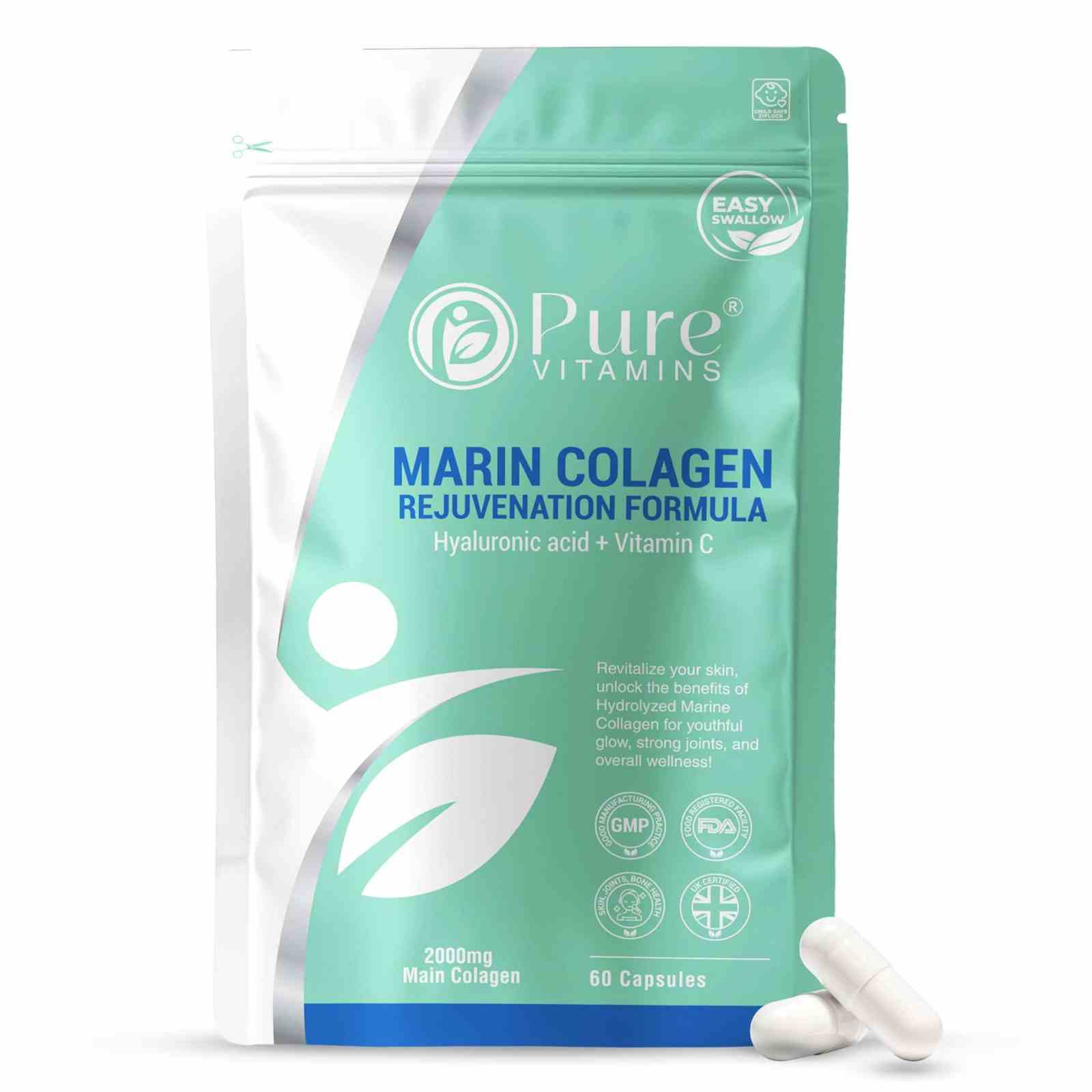
We built three collagen options around exactly these principles: Marine Collagen capsules (Type I, with hyaluronic acid and vitamin C), Bovine Collagen capsules (Types I and III, with hyaluronic acid and vitamin C), and Bovine Collagen powder (Types I and III, 14,000 mg, unflavoured). Each is described by what is genuinely in it, all are formulated in the UK and tested for purity and heavy metals at our GMP-certified facility. Every guide we publish sits on the supplement guides hub, and you can browse the wider range on our Pure Vitamins UK home page.
Frequently asked questions
What is the healthiest form of collagen to take?
Hydrolysed collagen peptides. Collagen has to be broken down into peptides and amino acids before any of it is absorbed, so a hydrolysed product has simply had that work done already. It also dissolves in hot or cold liquid without gelling, unlike gelatin, and it is the form used in essentially all the human research.
Is bovine collagen better than regular collagen?
"Regular collagen" usually means either a generic blend with an unstated source or a marine product. Bovine gives you hydrolysed Types I and III and is typically the best value per gram; marine is predominantly Type I and suits pescatarians. Neither is universally better, but a clearly labelled source beats an unspecified one every time.
Which collagen is best in the UK?
The one whose label tells you the source, the collagen types and the grams per serving, uses hydrolysed peptides, and either includes vitamin C or is taken alongside it. Work out the cost per gram of collagen rather than per pack, and treat any anti-wrinkle promise as a reason to look elsewhere.
What is the best type of collagen supplement?
For most people, hydrolysed Type I or Types I and III peptides from a clearly stated source, paired with vitamin C. Whether you pick marine or bovine depends on your diet.
Is marine or bovine collagen better?
Neither is universally better. Marine is Type I and pescatarian-friendly; bovine adds Type III and is often better value per gram.
How much collagen should I take?
Studies commonly use around 2.5 g to 15 g per day. UK products range from roughly 8 to 10 g sachets to 10 to 20 g powders, with capsules lower. Check the grams per serving on the back of the pack rather than the front-of-pack headline.
Does collagen work for skin?
The pooled research leans positive on skin hydration and elasticity, with two meta-analyses covering more than 2,800 participants between them reporting improvements against placebo. The individual trials are small, several carry a risk of bias, and the effects are modest. It is best read as promising science rather than a guarantee, and vitamin C is the ingredient that contributes to normal collagen formation.
Is collagen suitable for vegans?
No, collagen is animal-derived. Marine collagen is suitable for pescatarians but not for vegetarians or vegans.
This article is for general information and is not medical advice. Food supplements should not be used as a substitute for a varied, balanced diet and a healthy lifestyle. Marine collagen is not suitable for those with a fish allergy. If you are pregnant, breastfeeding, taking medication or managing a medical condition, speak to your GP or pharmacist before starting a new supplement.
Signed, Dr. Miron, Founder of Pure Vitamins UK.
Related articles
- Marine vs bovine collagen: which should you choose?
- Collagen and vitamin C: why they're paired
- Collagen and hyaluronic acid, and how to take collagen
- Supplements for bones and joints in the UK
- Biotin vs collagen: which is better for hair and skin?
- Bovine Collagen Powder (hydrolysed Type I and III peptides)
Sources
- Pu SY and colleagues (2023). Effects of oral collagen for skin: a systematic review and meta-analysis of 26 randomised controlled trials. Nutrients. DOI 10.3390/nu15092080. PMC10180699
- de Miranda RB and colleagues (2021). Effects of hydrolyzed collagen supplementation on skin: a systematic review and meta-analysis. International Journal of Dermatology. DOI 10.1111/ijd.15518. PubMed 33742704
- Paula-Vieira RHR and colleagues (2026). Bioactive collagen peptides and skin health in middle-aged women: a randomised controlled trial. Dermatology and Therapy. DOI 10.1007/s13555-026-01654-9. PMC12936244
