

Reviewed and updated: 21 September 2026
If you are wondering which vitamins are best for hair when you are eating much less than usual, the honest answer is that the nutrients doing the most work are iron, zinc, selenium, biotin and vitamin D, sitting on top of enough protein and enough total food. Hair is one of the first things the body economises on when intake drops, because a hair follicle is not essential to keeping you alive. The good news is that this kind of shedding is usually temporary, and the fix is almost always about what has gone missing from the plate rather than what needs adding to the bathroom cabinet.
Which Vitamins Are Best for Hair When You're Eating Much Less? The Short Answer
I hear this question most often from people a couple of months into eating noticeably smaller portions. They are pleased with how things are going, and then the shower drain starts telling a different story. The timing feels random and it rarely is.
Hair follicles are among the most metabolically demanding structures in the body. The matrix cells at the base of a growing follicle divide faster than almost anything else you have, and that kind of turnover needs a steady delivery of amino acids, iron, zinc and B vitamins to keep going. A review of vitamins and minerals in the hair cycle in Dermatology and Therapy makes exactly this point: micronutrients are major elements in the normal hair follicle cycle precisely because of how rapidly those matrix cells divide, and shortfalls represent a modifiable risk factor rather than an inevitability (Almohanna and colleagues, 2019, DOI 10.1007/s13555-018-0278-6).
So the useful question is not which single vitamin is best for hair. It is which nutrients have quietly dropped out of your diet since your portions shrank, and which of them your hair actually depends on. That has clear answers, and the rest of this guide works through them.
Quick Answer
- Protein comes first. Hair is a protein structure. If protein has fallen with your food volume, nothing else on this list compensates.
- Iron is the one worth testing. It is the most common nutritional shortfall in the UK and it falls fast when red meat and bulk leave the plate.
- Zinc, selenium and biotin all carry authorised wording for the maintenance of normal hair, and all three come from foods that shrink with portion size.
- Vitamin D contributes to normal cell division, which is the process a growing follicle lives on, and British winters make a supplement sensible anyway.
- Who this is for: anyone eating much less than they used to, for any reason, who has noticed more hair in the brush than usual.
- One honest caution: shedding that carries on past six months, or comes with patches, scalp soreness or other symptoms, belongs with your GP rather than a supplement.

Why Hair Changes When You Eat Much Less
Your body runs a triage system. When energy coming in drops sharply, it protects the organs that keep you alive and pulls resources away from the ones that do not. Hair sits near the bottom of that list, alongside nails and skin. It is not a malfunction. It is your physiology being sensible with a smaller budget.
Three things tend to happen at once. Total energy falls, so there is less fuel for tissue that is expensive to maintain. Protein falls, because protein-rich foods are usually the filling ones that get cut. And micronutrient intake falls roughly in proportion to food volume, so a third less food is a third less iron, zinc and B vitamins unless you deliberately change what you are eating.
A narrative review in Medicina looking at hair health after rapid weight change found the same combination behind it each time: low calorie intake, low protein intake and micronutrient shortfalls, with shedding following the drop rather than accompanying it (Smolarczyk and colleagues, 2024, DOI 10.3390/medicina60020325). That is a helpful finding because every one of those three is something you can do something about.
The Hair Cycle, and Why the Delay Confuses Everyone
At any moment, around 85 to 90 percent of the hairs on your head are in their growing phase, and the remaining 10 to 15 percent are resting. A resting hair sits in the follicle for roughly three months before it is pushed out by the new one growing underneath. Losing somewhere between 50 and 100 hairs a day is completely normal and always has been.
When something pushes a larger than usual share of follicles into the resting phase at once, you do not see it straight away. You see it two to three months later, when all of those hairs reach the end of their rest and come out together. This is why people so often connect the shedding to whatever is happening this week, when the actual trigger was back in the spring. It is also why the improvement is delayed in the same way: put the nutrients back and it will still be a couple of months before the mirror agrees with you.
Protein First, Because Hair Is Made of Protein
A hair shaft is keratin, and keratin is a protein. If your amino acid supply is short, the follicle cannot build a shaft properly, and this is the part no capsule addresses.
Protein requirements do not drop when your food does. If anything they rise, because with less total energy arriving, more of the protein you eat gets burned for fuel instead of being used to build tissue. For most adults eating much less than usual, somewhere between 1.2 and 1.6 grams of protein per kilogram of body weight per day is a reasonable everyday target. For a 70 kg adult that is roughly 84 to 112 grams a day, and it is worth spreading across three or four portions rather than stacking it into one evening meal.
In practical UK terms, 25 to 30 grams of protein looks like a chicken breast, a tin of tuna, a 170 g pot of Greek yoghurt with a spoon of seeds, two large eggs with a slice of cheese, or a generous serving of lentils with bread. When appetite is the limiting factor, liquid and soft options do the job better than a plate you cannot face: milk, yoghurt, soups thickened with pulses, or a scoop of protein powder stirred into something you were drinking anyway. Anyone with kidney disease should take individual advice on protein targets before changing anything. I have written more about holding onto lean tissue in our guide to the nutrients involved in maintaining muscle, and the same logic applies to hair.
Iron, and Why It Is the First Thing Worth Checking
If I could get one thing tested in someone whose hair has started shedding after a period of eating much less, it would be ferritin, which is the marker of stored iron rather than circulating iron.
Iron is required by the rapidly dividing cells in the hair follicle matrix, and it is also the most common nutritional shortfall in the UK. It falls quickly when portions shrink, faster still if red meat has largely left the diet, and faster again for anyone with heavy periods. Iron contributes to the normal formation of red blood cells and haemoglobin, to normal oxygen transport in the body, and to the reduction of tiredness and fatigue. When it runs low, weakness and breathlessness usually arrive alongside the hair changes, which is a useful clue.
Iron is also the nutrient where I would most strongly discourage guessing. Excess iron is stored rather than excreted, so supplementing blind is one of the few genuinely bad ideas in this area. Ask for a full blood count and ferritin, and take it from there. Our guide on how to increase ferritin covers what to ask for and how to read the numbers you get back. Pairing plant sources of iron with vitamin C at the same meal helps absorption considerably, which is why our iron tablets combine ferrous fumarate with vitamin C, B12 and folic acid rather than iron on its own.

Zinc, Selenium and the Minerals Behind Keratin
Zinc is the mineral with the broadest authorised wording of the group. Zinc contributes to the maintenance of normal hair, skin and nails, and separately to normal protein synthesis, which matters here because keratin is a structural protein that has to be synthesised continuously. Zinc lives in meat, shellfish, pulses, nuts, seeds and cheese, which is to say it lives in exactly the foods that get cut when portions shrink.
Selenium contributes to the maintenance of normal hair and normal nails, and it sits in a narrower window than most minerals. Brazil nuts, fish, eggs and wholegrains are the usual sources. UK soil is relatively low in selenium compared with North American soil, so British intakes tend to sit lower than the equivalent American figures, which is worth knowing when you read advice written for a US audience.
The important nuance with both minerals, and it applies to every nutrient on this page, is that correcting a genuine shortfall is a different thing from topping up when you are already replete. The review of diet and hair in Dermatology Practical and Conceptual is refreshingly blunt about this: where deficiencies exist they should clearly be corrected, but the evidence for supplementation in the absence of a documented deficiency is lacking, and some supplements taken in excess carry the risk of making hair worse rather than better (Guo and Katta, 2017, DOI 10.5826/dpc.0701a01). That is not a comfortable thing for a supplement company to write down, but it is what the literature says, and you deserve to know it before you spend anything.
Biotin, Honestly
Biotin is the nutrient most heavily marketed for hair, so it deserves a straight answer rather than the usual enthusiasm.
Biotin contributes to the maintenance of normal hair and to normal macronutrient metabolism. That authorised wording is real. What the clinical literature does not support is the idea that more biotin produces more hair in somebody who is not short of it. A systematic review in Skin Appendage Disorders went looking for every reported case and trial of biotin used for hair and nail changes and found eighteen cases of benefit, every single one of which occurred in a person with an underlying cause of biotin deficiency or a specific condition such as brittle nail syndrome. The authors concluded that such cases are uncommon and that there is insufficient evidence to support supplementation in otherwise healthy people (Patel and colleagues, 2017, DOI 10.1159/000462981).
So where does that leave biotin when you are eating much less? In a reasonable place, actually. Biotin comes from eggs, liver, nuts, seeds, oily fish and wholegrains, and it is also made in small amounts by gut bacteria. If your intake of those foods has genuinely dropped, so has your biotin, and that is the scenario where topping up makes sense. What it is not is a growth stimulant for hair that is already well supplied. Our piece on how much biotin you actually need goes through the dosing arithmetic, including why tablets often contain two hundred times the reference intake.
Vitamin D and the B Group
Vitamin D contributes to normal cell division, and cell division is the entire business of a growing follicle. Vitamin D receptors are present in the hair follicle itself, which is a fairly direct hint that it has work to do there. The evidence linking supplementation to hair outcomes in people who are not deficient is still thin, and I would not oversell it. What is not in doubt is that between October and March British sunlight is too weak at our latitude for skin to make meaningful amounts, and the NHS advises that adults consider a daily supplement containing 10 micrograms of vitamin D through autumn and winter, with some people taking it year round (NHS, Vitamin D).
The wider B group matters for a less glamorous reason. Riboflavin, niacin, B6, B12 and biotin all contribute to normal energy-yielding metabolism, and B12 and folate are both required for the kind of rapid cell division a follicle runs on. B12 in particular comes almost entirely from animal foods, so anyone whose meat, fish, eggs and dairy intake has dropped is an obvious candidate. If your food volume has fallen across the board, the whole B group has fallen with it, which is the honest argument for a sensible base rather than picking nutrients off one at a time. The broader picture sits in our guide to which supplements to take while you are eating less.

How to Read the Label Instead of the Marketing
Most hair supplements are sold on the front of the pack. The information that decides whether they are worth buying is on the back.
- Check the NRV percentage, not the milligram number. A nutrient has to be present at 15 percent or more of the Nutrient Reference Value before any authorised function wording can be used at all. Below that it is decoration.
- Check the serving size. A pack promising 10,000 micrograms of biotin often means across two tablets, not one. Work out the daily serving before comparing prices.
- Prefer well-absorbed forms. Chelated minerals such as zinc bisglycinate, and selenium as selenomethionine, are absorbed more reliably than cheap oxide forms.
- Decide about iron deliberately. Iron belongs in your routine if you need it and nowhere near it if you do not. That is a blood-test decision, not a label decision.
- Avoid doubling up. If you already take a multivitamin, adding a hair complex on top can push zinc or selenium past sensible levels without you noticing.
- Look for purity testing. Ours are tested for purity and heavy metals at our GMP-certified facility, with certificates of analysis available on request.
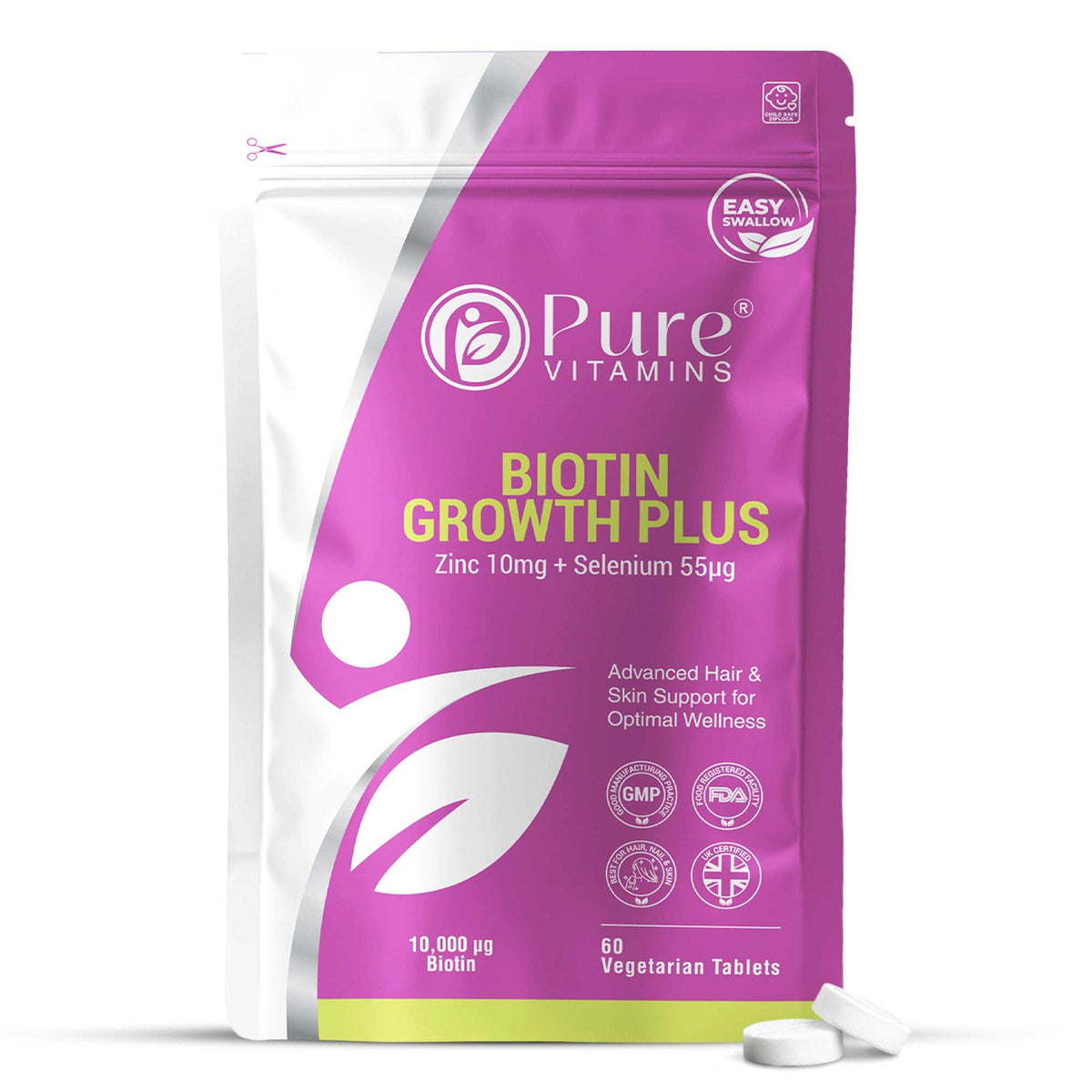
Our Biotin Zinc Selenium tablets were built around exactly this reasoning: biotin, zinc bisglycinate and selenium as selenomethionine in one daily serving, because all three carry authorised wording for the maintenance of normal hair and all three come from the same foods that thin out when portions shrink. The wider comparison across the category sits in our honest guide to vitamins for hair, skin and nails.
Food Sources Worth Getting Back Into the Diet
- Protein: eggs, chicken, fish, Greek yoghurt, cheese, soya, lentils, chickpeas, beans with grains.
- Iron: red meat, liver, sardines, lentils, chickpeas, fortified cereals, dried apricots. Add a vitamin C source to plant sources.
- Zinc: shellfish, beef, pumpkin seeds, cashews, chickpeas, cheese.
- Selenium: brazil nuts, tuna, sardines, eggs, wholemeal bread.
- Biotin: eggs, liver, almonds, sunflower seeds, salmon, sweet potato.
- Vitamin D: oily fish, egg yolks, fortified spreads and cereals, and very hard to reach from British food alone in winter.
- Vitamin B12: meat, fish, eggs, dairy, fortified plant milks, nutritional yeast.
If appetite itself is the obstacle rather than willpower, that is a separate problem with its own answers, and we have covered it in which vitamins are involved in appetite and in what to take if you are simply not eating enough.
How Long Before Anything Changes
This is where I would rather disappoint you now than have you give up in week three.
Because of the delay built into the hair cycle, nothing you change today shows up in the mirror for roughly two to three months, and a visible improvement in density takes longer still, often six months and sometimes closer to a year. That is not a failure of the nutrients. It is simply how fast hair grows, which is around a centimetre a month.
A realistic sequence looks like this. Fix the protein and the total food intake first, because they carry the most weight. Get iron checked rather than guessed. Cover the minerals and vitamin D. Then leave it alone for three months before judging anything. Shedding triggered by a period of eating much less is typically self-limiting and settles as intake normalises, which is genuinely reassuring and worth holding onto while you wait.

Safe Upper Limits Worth Knowing
- Selenium: keep total intake from all sources at or below 350 micrograms a day. This is a narrow window and excess selenium can itself cause hair and nail problems, which is the irony worth avoiding.
- Zinc: keep supplemental zinc at or below 25 mg a day. Sustained higher intakes interfere with copper absorption.
- Vitamin D: do not exceed 100 micrograms, which is 4,000 IU, a day from all sources for adults.
- Iron: the NHS advises not taking more than 17 mg a day of supplemental iron unless a doctor has recommended it.
- Vitamin A: worth naming because excess vitamin A and high-dose retinol are associated with hair shedding in their own right. Keep an eye on it if you take a multivitamin plus a separate supplement.
- Biotin: water soluble with no established upper limit, and the surplus is excreted. The issue with high-dose biotin is not toxicity, it is blood tests.
A Few Cautions Worth Knowing
High-dose biotin can interfere with certain laboratory blood tests, including some thyroid and cardiac markers, and it can skew them in both directions. This matters a great deal if you are being investigated for anything, so tell whoever takes your blood that you are taking a biotin supplement, and ask whether to pause it beforehand. Almost nobody mentions this and it is the single most useful caution on this page.
Iron interacts with levothyroxine and with some antibiotics, so leave four hours between them. Zinc also reduces absorption of certain antibiotics, so separate those by a couple of hours. If you are pregnant or breastfeeding, avoid high-dose anything and be particularly careful with vitamin A. If you have kidney disease or thyroid disease, or you take prescribed medicines of any kind, have the conversation with your GP or pharmacist before adding something new rather than after.
And the honest general point: food supplements fill gaps in a diet. They are not a substitute for eating enough, and if your intake has dropped far enough to affect your hair, more food is the first intervention and everything else is support.
When to See Your GP or Pharmacist
Diffuse shedding that follows a period of eating much less usually settles on its own. Some things are not that, and are worth a proper look.
- Shedding that is still getting worse after six months, or that has not begun to settle once you are eating normally again.
- Bald patches, a receding or widening pattern, or hair coming out in clumps from one area rather than diffusely.
- Scalp itching, flaking, pain, redness or scarring.
- Shedding alongside unexplained weight loss, fatigue, feeling cold, a change in periods, or new skin and nail changes, any of which can point to thyroid or iron issues that need a blood test.
- Any hair change that is genuinely distressing you. That is reason enough to ask for help.
Frequently Asked Questions
Which vitamins are best for hair if I am eating much less than usual?
Iron, zinc, selenium, biotin and vitamin D are the ones with the most direct roles, on top of adequate protein and enough total food. Zinc contributes to the maintenance of normal hair, skin and nails, selenium and biotin contribute to the maintenance of normal hair, and vitamin D contributes to normal cell division. Iron is the one worth having tested rather than guessed.
Why has my hair started shedding two months after I changed how I eat?
Because of the hair cycle. When more follicles than usual move into their resting phase, those hairs stay in place for around three months before they are shed, so the visible shedding happens two to three months after whatever triggered it rather than at the same time.
Does biotin actually make hair grow?
Biotin contributes to the maintenance of normal hair, and a systematic review found that every reported case of benefit occurred in people with an underlying biotin deficiency or a specific nail or hair condition. There is insufficient evidence that extra biotin does anything for hair in people who are not short of it. It makes most sense when your intake of eggs, nuts, seeds, fish and wholegrains has genuinely dropped.
How much protein do I need for hair if my portions are small?
Between roughly 1.2 and 1.6 grams per kilogram of body weight per day suits most adults eating much less than usual, spread across three or four portions of 25 to 35 grams rather than eaten in one sitting. Hair is a protein structure, so this matters more than any single vitamin. Anyone with kidney disease should get individual advice first.
Will my hair grow back once I am eating normally again?
Shedding linked to a period of reduced intake is typically temporary and settles as intake and nutrient status recover. Expect a delay of two to three months before you see any change, and six months or more before density looks different, because hair grows at around a centimetre a month.
Can taking too many supplements make hair worse?
Yes, and it is a real risk rather than a theoretical one. Excess selenium and excess vitamin A are both associated with hair shedding, and high zinc intakes interfere with copper. Stay within the upper limits, and avoid stacking a multivitamin and a hair complex without checking the totals.
Where to Start
If you are eating much less than you used to and your hair has started to thin, the order I would suggest is the boring one: get protein back up, keep total food high enough to be sustainable, ask your GP for a ferritin test rather than guessing at iron, and cover the minerals and vitamin D that fall with portion size. Then give it three months. You can browse everything we have written on the subject at our supplement guides hub, or start from the Pure Vitamins UK homepage.
Shop Biotin Zinc Selenium Tablets
Dr. Miron, Founder of Pure Vitamins UK
Sources
- Almohanna HM, Ahmed AA, Tsatalis JP, Tosti A. The Role of Vitamins and Minerals in Hair Loss: A Review. Dermatology and Therapy, 2019. DOI 10.1007/s13555-018-0278-6. Full text
- Guo EL, Katta R. Diet and hair loss: effects of nutrient deficiency and supplement use. Dermatology Practical and Conceptual, 2017. DOI 10.5826/dpc.0701a01. Full text
- Patel DP, Swink SM, Castelo-Soccio L. A Review of the Use of Biotin for Hair Loss. Skin Appendage Disorders, 2017. DOI 10.1159/000462981. Full text
- Smolarczyk K, Meczekalski B, Rudnicka E, Suchta K, Szeliga A. Association of Obesity and Bariatric Surgery on Hair Health. Medicina, 2024. DOI 10.3390/medicina60020325. Full text
- NHS. Vitamins and minerals: Vitamin D. nhs.uk
Records retrieved via PubMed and PubMed Central.
Food supplements are not a substitute for a varied, balanced diet and a healthy lifestyle. This article is for general information and is not medical advice. If you have a medical condition, are pregnant or breastfeeding, or take prescribed medicines, speak to your GP or pharmacist before starting a supplement.
