


Reviewed and updated: 10 August 2026
If you are weighing up ashwagandha or L-theanine for sleep, the honest answer is that they are not really rivals. L-theanine is a fast-acting amino acid from green tea that many people reach for to wind down on the night itself, while ashwagandha is a root extract that research has studied over several weeks for its effect on stress and cortisol. Which one suits you depends on whether your evenings are disrupted by acute, in-the-moment tension or by a longer-running feeling of being wound up. This guide walks through what each ingredient is, what the research actually shows, sensible amounts, timing, side effects and who each one tends to suit, so you can decide for yourself.

Ashwagandha or L-theanine for sleep: the short answer
For sleep, ashwagandha or L-theanine solve slightly different problems. L-theanine is the quicker option for calming a busy mind close to bedtime, with research showing effects within an hour or so of a single dose. Ashwagandha works on a slower, cumulative basis: the studies that report changes in stress markers and sleep quality generally run for eight weeks or more. Neither is a sedative, and in the UK neither carries an authorised health claim, so the fair way to compare them is on how they behave in research and how they fit an evening routine, not on any promise of a result.
TL;DR: the quick answer
- What they are: L-theanine is an amino acid found in tea leaves. Ashwagandha (Withania somnifera) is a root used in Ayurvedic tradition, usually taken as a standardised extract such as KSM-66.
- Speed: L-theanine acts fast, often within about an hour. Ashwagandha is studied over weeks, not minutes.
- Best for: L-theanine suits acute, in-the-evening wind-down. Ashwagandha suits people looking at a longer-running sense of stress across the whole day.
- Together: The two are commonly combined, and many people take them side by side.
- Key caution: Neither is a sedative or a sleep medicine. Speak to your GP or pharmacist first if you are pregnant, breastfeeding, taking medication or managing a health condition.
What is L-theanine?
L-theanine is a naturally occurring amino acid found mainly in the leaves of the tea plant, Camellia sinensis, and to a smaller degree in some mushrooms. It is the compound often credited with the calm, focused feeling that green tea can give without the jittery edge of caffeine on its own. In supplements it is isolated and delivered as a measured dose, and the amount varies by product: single-ingredient L-theanine tends to sit higher, while combination formulas typically use a smaller amount alongside their other ingredients. Either way it is considerably more than a single cup of tea provides. Because it is an amino acid rather than a herb, it is straightforward to standardise, and a good label will simply state the milligrams per serving.
What is ashwagandha?
Ashwagandha is the root of Withania somnifera, a small shrub used for centuries in Ayurvedic tradition and often described as an adaptogen. Its characteristic active compounds are a group of naturally occurring molecules called withanolides, and the quality of an extract is usually judged by how well the withanolide content is standardised. A widely used branded extract, KSM-66, is drawn only from the root rather than the leaves and is standardised to a minimum of 5% withanolides. The species name somnifera means sleep-bearing, which is partly why the root has attracted so much interest, though that historical name is heritage rather than evidence.

What the research shows on L-theanine
According to PubMed, a single 200 mg dose of L-theanine has been studied in healthy, moderately stressed adults using brain-activity and hormone measures. In a randomised, placebo-controlled crossover trial, that single dose produced a greater increase in frontal alpha brain-wave activity, a pattern associated with a relaxed but alert state, along with a fall in salivary cortisol within an hour of taking it, compared with placebo (Evans et al., 2021, DOI 10.1007/s40120-021-00284-x). A separate four-week trial in healthy adults reported that daily L-theanine was associated with improvements in Pittsburgh Sleep Quality Index scores, including the subscales for how quickly people fell asleep and how disturbed their sleep was, alongside lower stress and anxiety scores (Hidese et al., 2019, DOI 10.3390/nu11102362). Taken together, these are small studies rather than definitive proof, but they point to a fast, calming profile that some people also notice as smoother sleep over a few weeks.
What the research shows on ashwagandha
Ashwagandha has been studied mostly over longer periods. In an eight-week randomised, double-blind, placebo-controlled study in healthy but stressed adults, a standardised root extract at 250 mg and 600 mg per day was associated with reductions in perceived stress scores and in serum cortisol, with the higher amount showing the larger effect, and participants also reported improved sleep quality (Salve et al., 2019, DOI 10.7759/cureus.6466). A systematic review and meta-analysis that pooled five randomised trials in 400 adults found a small but statistically significant effect of ashwagandha extract on overall sleep, with the effect more pronounced in the subgroup diagnosed with insomnia, at doses of 600 mg a day or more and over supplementation lasting eight weeks or longer (Cheah et al., 2021, DOI 10.1371/journal.pone.0257843). The honest reading is that the effect on sleep is modest and builds slowly, and the authors themselves called for more long-term safety data.

Onset: how fast does each one work?
This is the clearest practical difference. L-theanine acts quickly, with the single-dose research showing measurable changes in brain activity and cortisol within about one to three hours (Evans et al., 2021). Ashwagandha is the opposite. The studies that report changes in stress and sleep measures generally run for eight weeks, and the meta-analysis found the effect grew with longer use (Cheah et al., 2021). So if you want something to reach for on a specific restless evening, L-theanine is the faster tool. If you are thinking about a steadier, background approach to a stressful stretch of life, ashwagandha is the one designed to be taken daily and judged over a month or two.
Does either one cause drowsiness?
Neither is a sedative in the way a sleeping tablet is. L-theanine is generally described in the research as promoting a calm, alert state rather than sleepiness, which is one reason it is sometimes taken in the daytime as well as the evening. Ashwagandha is not a knockout agent either, though some people do report feeling more settled or occasionally a little drowsy, particularly at higher amounts. Because responses vary, it is sensible to try either one on an evening when you do not need to drive or operate machinery afterwards, and to be cautious about combining them with alcohol or with medicines that already cause drowsiness.
Typical amounts people use
For L-theanine, the trials described above used a single 200 mg dose, and supplement servings vary a good deal in practice: single-ingredient products tend to sit at the higher end, while combination formulas commonly use a smaller amount because the ingredient is working alongside others rather than on its own. For ashwagandha, studies commonly use 300 to 600 mg a day of a standardised root extract, and the meta-analysis found the clearer effects at 600 mg a day or more. A useful point when reading any label is to check the standardisation, not just the milligrams: 300 mg of a root extract standardised to 5% withanolides is a very different thing from 300 mg of unstandardised powder. More is not automatically better with either ingredient.
Best time to take each for an evening routine
If your goal is winding down, both are usually taken in the evening. L-theanine is often taken around 30 to 60 minutes before bed, which lines up with its fast onset. Ashwagandha can be taken at any consistent time of day, and many people choose the evening, but because its effect is cumulative the important thing is taking it daily rather than hitting an exact minute. Both work with or without food. For more on timing an ashwagandha routine, see our guide on when to take ashwagandha, morning or night.

Should you combine ashwagandha and L-theanine?
Because they behave so differently, one fast and one slow, they are frequently paired in a single formula rather than framed as an either-or. The idea is that L-theanine covers the acute wind-down while ashwagandha is taken consistently in the background. Many evening-oriented supplements, including our own, bring the two together for exactly this reason. If you want the detail on why the pairing is common, we cover it in why L-theanine is added to ashwagandha, and you can see how these ingredients sit alongside magnesium and others in what is actually in a natural sleep supplement.
Side effects, safe amounts and who should be cautious
L-theanine is well tolerated in the research, with few reported side effects at the amounts used. Ashwagandha is also generally well tolerated but is more likely to cause mild stomach upset, loose stools or drowsiness in some people, and there have been rare reports of liver-related reactions, so it is worth stopping and seeking advice if you feel unwell. Some formulas, including ours, also contain vitamin B6; UK guidance advises keeping long-term supplemental vitamin B6 modest, at around 10 mg a day, and the European Food Safety Authority has set a tolerable upper intake in the region of 12 mg a day for adults, so a sensible product keeps the B6 amount well within these limits.
Certain groups should be more careful. Ashwagandha is not recommended during pregnancy or breastfeeding, and anyone taking thyroid medication, sedatives, blood pressure medication or immune-affecting medicines, or managing an autoimmune or thyroid condition, should check with a GP or pharmacist first. If you take HRT or any prescribed medicine, the same applies. For a fuller rundown, see our guide to ashwagandha safety and who should take care.
Who each one suits
As a simple decision framework: choose L-theanine if your main issue is a racing mind at bedtime and you want something that acts on the night itself, or if you prefer a single, well-defined amino acid. Choose ashwagandha if you are looking at a longer, more stressful phase of life and are happy to take something daily and judge it over a couple of months. If you are not sure, there is no rule against trying a combined formula that includes both, since they do different jobs. People who mainly struggle with muscle relaxation or an evening routine may also want to compare these with magnesium, which we cover in our guide to the best magnesium for sleep.
How long should you trial each?
Give each ingredient a fair test. L-theanine can reasonably be judged over a handful of evenings to a couple of weeks, since its effect is quick. Ashwagandha needs patience: the research points to eight to ten weeks of consistent daily use before the fuller picture emerges, so judging it after only a few days is not a fair trial. Keeping a short note of how your evenings feel across that period is more reliable than trying to remember.
How to choose a quality product
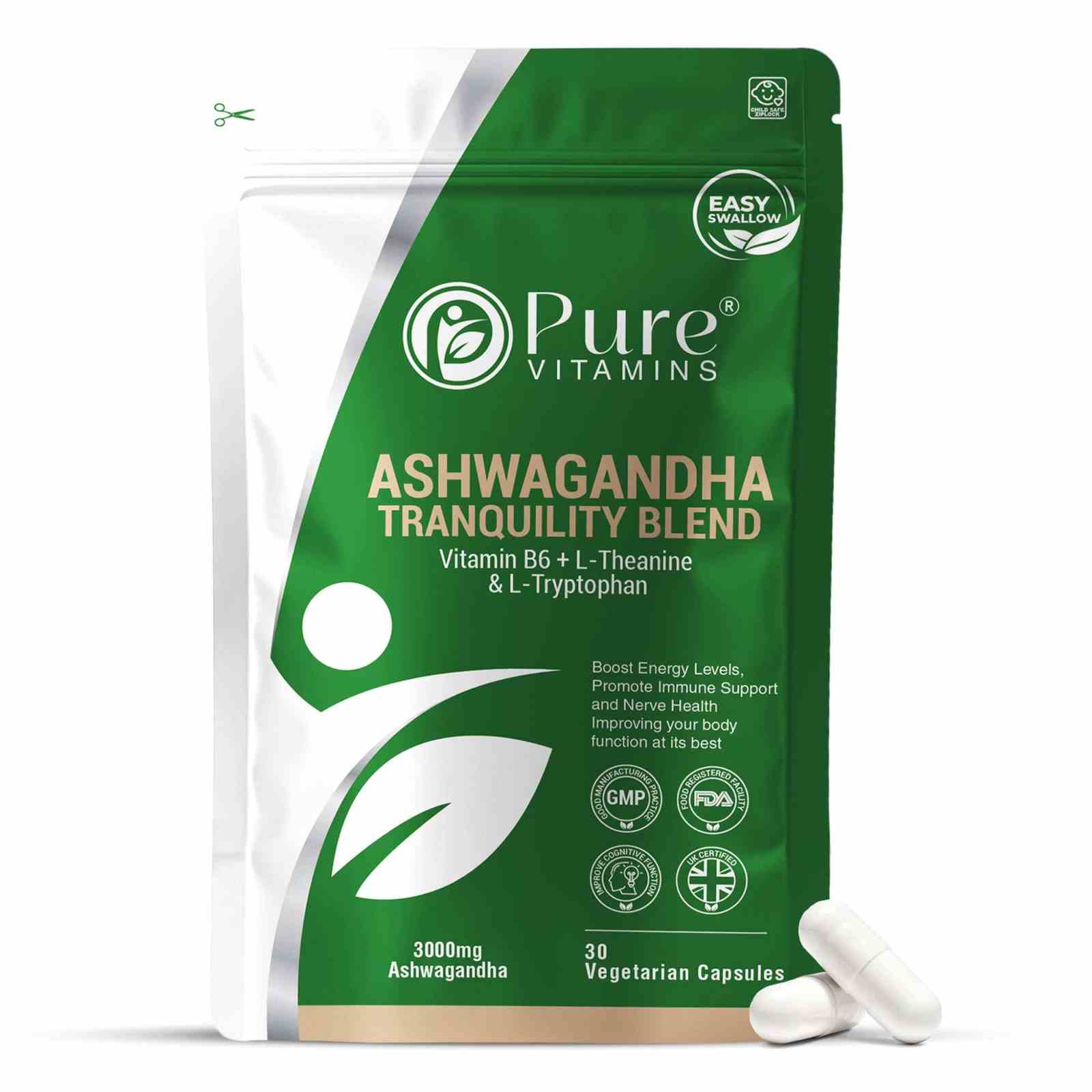
Whichever route you take, the label matters more than the marketing. For L-theanine, look for the amount stated clearly in milligrams. For ashwagandha, look for a standardised root extract with the withanolide percentage stated, ideally a recognised extract such as KSM-66 drawn from the root only. Check that the product is made to a proper standard; ours is formulated in the UK and manufactured in a GMP-certified facility. One honest point on claims: in the UK, neither ashwagandha nor L-theanine carries an authorised health claim, so any label promising a specific result is overstepping the rules. The only part of our KSM-66 ashwagandha with L-theanine and vitamin B6 formula that carries an authorised claim is the vitamin B6, which contributes to normal psychological function and to the normal functioning of the nervous system. That is a nutrient claim about B6, not a sleep claim about the botanicals, and we think being clear about that distinction is part of choosing well. You can browse the wider range on our home page.
Frequently asked questions
Is ashwagandha or L-theanine better for sleep?
They suit different needs. L-theanine acts quickly and is often chosen for calming a busy mind close to bedtime, while ashwagandha is taken daily and studied over eight weeks or more for its effect on stress and sleep quality. Neither is a sedative, and in the UK neither carries an authorised sleep claim.
Can you take ashwagandha and L-theanine together?
They are commonly combined, and many evening formulas pair the fast-acting amino acid with the slower, daily root extract. If you take any medication or have a health condition, check with your GP or pharmacist before combining supplements.
How quickly does each one work?
Research on a single 200 mg dose of L-theanine shows changes in brain activity and cortisol within about one to three hours. Ashwagandha is studied over weeks, with effects on stress and sleep measures typically reported after eight weeks or more.
How much should you take?
The L-theanine trials above used a single 200 mg dose, though supplement servings vary and combination formulas commonly use a smaller amount alongside other ingredients. Ashwagandha studies commonly use 300 to 600 mg a day of a standardised root extract, with clearer effects seen at 600 mg a day or more.
Does either cause next-day grogginess?
Neither is a sedative, so next-day grogginess is not typical, though a minority of people report feeling drowsy on ashwagandha, especially at higher amounts. Try either on an evening when you do not need to drive afterwards, and avoid pairing them with alcohol.
Shop KSM-66 Ashwagandha with L-Theanine and B6
Written by Dr. Miron, Founder of Pure Vitamins UK.
Food supplements should not be used as a substitute for a varied, balanced diet and a healthy lifestyle. This article is for general information and is not medical advice. Always consult a healthcare professional before starting a supplement if you are pregnant, breastfeeding, taking medication or managing a health condition.

