

Reviewed and updated: 8 September 2026
Is NMN worth taking? My honest answer is that it depends entirely on what you are expecting from it, because the human evidence is real but much narrower than the marketing around it suggests. NMN is one of the most researched supplements of the last decade and one of the most oversold, and those two things are true at the same time. So rather than tell you yes or no, I want to walk you through exactly what the trials have measured, what they have not, where UK law currently sits, and what you are actually spending per day. Then you can make the call yourself.
I sell an NMN formula, so you should read this knowing that. I have tried to write the piece I wish had existed when I first started reading the literature, which means being just as clear about the gaps as about the findings.

Is NMN worth taking? The short answer
- What it is: beta-nicotinamide mononucleotide, a small molecule the body uses on the way to making NAD+, a coenzyme involved in energy metabolism inside every cell.
- What the trials consistently show: oral NMN at 250mg to 900mg a day raises blood NAD levels in humans, dose-dependently, and is well tolerated at those amounts over 8 to 12 weeks.
- What the trials do not show: that raising blood NAD in a healthy adult reliably changes how you feel, how long you live, or how you age. Functional results are mixed, mostly small, and often measured in narrow groups.
- Who it suits: someone who has read the science, finds it interesting, is comfortable that the outcome data is still immature, and has the budget for a daily spend without expecting a transformation.
- Who should skip it: anyone under 18, pregnant or breastfeeding, anyone taking medication or managing a health condition without speaking to their GP or pharmacist first, and frankly anyone whose diet, sleep and training are not sorted yet. Those move the needle far more than any capsule.
- One honest caution: NMN has not completed the novel food authorisation process in Great Britain. That does not make it dangerous, but it does mean the regulatory picture can change, and you should know that before you subscribe to anything.
What NMN actually is, and how it relates to NAD+
Strip away the marketing and NMN is a fairly simple molecule: a nicotinamide group, a ribose sugar and a phosphate. Nicotinamide is a form of vitamin B3, which is the useful starting point most articles skip. NMN is not exotic. It appears in small amounts in foods like broccoli, avocado and edamame, at quantities far below anything used in a trial.
Its job in the body is to sit one step away from NAD+, nicotinamide adenine dinucleotide. NAD+ is a coenzyme that shuttles electrons around during energy metabolism and acts as a substrate for enzyme families involved in DNA repair and cellular signalling. It is genuinely central to how cells work. If you want the fuller picture of that chemistry, I have written a separate explainer on what NAD+ is and why it matters.
The logic behind supplementing is straightforward: give the body more of the precursor and it can make more of the end product. That logic holds up in the blood measurements. Whether it translates into anything you would notice is a different question, and it is the question most product pages quietly step around.
How NAD+ changes with age, and what the research actually shows
You will have seen the charts: NAD+ falling steadily from your twenties onwards. The underlying observation is real, and it comes largely from tissue and animal work plus a smaller set of human tissue analyses. NAD+ availability does appear to decline with age in several tissues, and that decline is associated with reduced activity of the enzymes that depend on it.
Here is where I want to be careful, because this is the exact point where honest science gets converted into overreach. "NAD+ declines with age" is an observation. "Therefore topping it up will change how you age" is a hypothesis, and it is still being tested. Association is not the same as a lever you can pull. Rodent work has been encouraging, and rodents are not people. The human trials that followed are the real test, and they are much more modest than the animal literature implied they would be.
So when you see NAD+ decline used as the entire argument for buying something, read it as the beginning of the case rather than the whole of it.
NMN, NR and plain nicotinamide: three routes to the same place
Three precursors dominate the shelf, and it is worth knowing how they differ.
- NMN sits one step from NAD+ and is the one with the most consumer attention right now.
- NR, nicotinamide riboside, sits one step further back and converts to NMN inside the cell. It has the longer clinical track record in Western trials and is a fully authorised ingredient in more markets.
- Nicotinamide, plain vitamin B3 in its amide form, also raises NAD+ and costs a fraction of either. It is the cheap comparator nobody in the NAD space likes to talk about.
A well-run crossover trial of NR in healthy middle-aged and older adults found that 1000mg a day for six weeks was well tolerated and effectively stimulated NAD+ metabolism, with early signals on blood pressure and arterial stiffness that the authors themselves flagged as warranting further study rather than as conclusions (Martens et al., Nature Communications, 2018). That is a fair summary of the whole field: the biochemistry works, the outcomes are still open.
If you are weighing the two directly, I have gone deeper into the comparison in NMN vs NR: which NAD+ precursor, and into practical amounts in how much NR people take daily.

What the human trials have measured so far
This is the section that decides the question, so let me take it slowly. There are now a reasonable number of randomised, placebo-controlled NMN trials in people. Read together, they say something quite specific.
Blood NAD levels: the finding that replicates
A multicentre, double-blind, placebo-controlled trial in 80 healthy middle-aged adults compared placebo against 300mg, 600mg and 900mg of NMN daily for 60 days. Blood NAD concentrations were significantly higher in every NMN group at both day 30 and day 60 compared with placebo and with baseline, with the highest levels in the 600mg and 900mg groups (Yi et al., GeroScience, 2022). This is the most reliable finding in the field. Oral NMN raises the marker it is supposed to raise, and it does so in proportion to the amount taken.
Physical performance: small, real, and easy to over-read
In that same trial, six-minute walking distance improved in the NMN groups. In a separate six-week randomised, double-blind study in 48 amateur runners, adding 300mg, 600mg or 1200mg of NMN a day to training was associated with greater improvements in aerobic capacity measures than training plus placebo (Liao et al., Journal of the International Society of Sports Nutrition, 2021). Worth noting: those runners were training hard throughout. The supplement was measured on top of a strong stimulus, not instead of one.
A 2025 systematic review and meta-analysis of randomised trials looking at muscle and liver function in middle-aged and older adults found the picture less tidy than individual papers suggest, with effects that were inconsistent across outcomes (Huang et al., Current Pharmaceutical Biotechnology, 2025). When you pool the studies rather than reading the best one, enthusiasm cools.
Sleep, fatigue and daily function: mixed
A 12-week randomised, double-blind, placebo-controlled study gave 250mg of NMN or placebo to 108 older Japanese adults, split by whether they took it in the morning or the afternoon, and assessed sleep quality, subjective fatigue and several physical performance measures (Kim et al., Nutrients, 2022). Some measures shifted in the afternoon-dosing group and many did not. It is an interesting result and a long way from a reliable one.
Metabolic measures: the most-quoted study is also the narrowest
The paper everybody cites is a 10-week randomised, placebo-controlled trial in which 250mg of NMN daily increased insulin-stimulated glucose disposal and muscle insulin signalling (Yoshino et al., Science, 2021). It is careful work published in a serious journal. It is also, importantly, a study in postmenopausal women with prediabetes who were overweight or obese, which is a specific clinical group. A finding in that population tells you very little about what a healthy forty-year-old should expect, and I think it gets stretched well past what it can carry.
What has not been measured
No human trial has shown that NMN extends lifespan, slows biological ageing in any validated way, or changes long-term health outcomes. Trials so far run for weeks to months, in dozens of people, using surrogate markers. That is the honest state of play. Anyone telling you otherwise is selling harder than the data allows.
The absorption debate: does NMN get in whole?
There is a genuine open scientific argument here, and it matters for anyone comparing NMN with NR. One line of research proposed a dedicated transporter that carries NMN directly into cells. Other work argues that most orally taken NMN is broken down in the gut and liver, converted to nicotinamide riboside or nicotinamide, and reassembled into NMN inside the cell rather than crossing intact.
Practically, the destination is the same either way, which is why the blood NAD results hold up regardless of which mechanism dominates. But it does undercut the marketing line that NMN is uniquely direct. If you see a product page insisting NMN is definitively superior because it is "one step closer", that page is presenting a contested question as settled.
What does follow from the chemistry is that NMN metabolism runs through methylation-dependent pathways, which is the reasoning behind pairing it with a methyl donor like trimethylglycine. I have written that up separately in NMN with TMG and resveratrol, and when to take it.
Study doses versus what is actually on the shelf
This is where a lot of money gets wasted, and it is the easiest thing to check before you buy.
- Human trials cluster between 250mg and 900mg a day, with a few going to 1200mg.
- The clearest dose-response on blood NAD appeared at 600mg and above, though 250mg to 300mg still produced measurable rises.
- Plenty of retail products sit at 100mg to 250mg per serving, which is at or below the bottom of the studied range.
So the first question is not whether NMN works. It is whether the specific product in front of you contains an amount anyone has actually tested. A 125mg capsule is not a smaller version of a 500mg capsule in evidence terms. It is a different proposition. Our own formula is built at 500mg of NMN per daily serving specifically so it sits inside the studied range rather than gesturing at it.

Safety and tolerability: what the trials report
On safety, the record is reassuring within the amounts and durations studied. A single-dose study in ten healthy men gave 100mg, 250mg and 500mg of NMN and monitored clinical parameters, metabolite pharmacokinetics, ophthalmic examination and sleep quality over five hours, finding the doses safely metabolised without significant adverse effects (Irie et al., Endocrine Journal, 2020).
A randomised, double-blind, placebo-controlled study went further and looked at repeated daily oral administration at higher amounts in healthy adult men and women, reporting that NMN was well tolerated across the range tested (Fukamizu et al., Scientific Reports, 2022). A separate 12-week trial in 36 healthy middle-aged adults taking 125mg twice daily also reported good tolerability alongside its NAD metabolite measurements (Katayoshi et al., Scientific Reports, 2023).
Two caveats I would want you to hold onto. First, "well tolerated over 12 weeks in a few dozen adults" is not the same as a long-term safety record over years in the general population, because that study has not been done. Second, none of these trials included pregnant or breastfeeding women, under-18s, or people on complex medication regimes, so they tell you nothing about those groups.
Where NMN stands in UK law right now
This is the part most international articles get wrong for a British reader, and it is genuinely relevant to whether NMN is worth your money.
In Great Britain, an ingredient without a significant history of consumption before May 1997 is treated as a novel food and needs to complete an authorisation process before it can be freely marketed. NMN falls into that category. Applications have been submitted and, at the time of writing, NMN has not completed that authorisation process in Great Britain. The Food Standards Agency maintains a public register of regulated product applications where you can see the current position for yourself, and I would encourage you to check it rather than take any brand's word for it, including mine.
What that means in practice for you as a buyer: the regulatory status is live and can move. It is not a statement about safety, and it is not a reason to panic if you have a pouch in the cupboard. It is a reason to be sceptical of any brand that presents NMN as a settled, fully cleared ingredient, and a reason to think twice before committing to a long subscription.
How to judge an NMN product
If you decide it is worth trying, these are the things I would check, in this order. Most of them apply to any supplement, which is rather the point.
- Declared amount per serving, not per pouch. Compare the daily serving against the 250mg to 900mg studied range.
- No proprietary blends. A blend total of 800mg can be almost entirely the cheapest ingredient. If every quantity is not printed separately, you cannot compare anything.
- Which isomer. With resveratrol in a formula, "trans-resveratrol" is the stable, better-studied form. A label that just says "resveratrol" has not told you what you are getting.
- Whether a methyl donor is included. Experienced users often buy TMG separately for the methylation reasoning above. A formula that includes it at a meaningful amount saves you a second purchase.
- Purity testing. Ours is manufactured in a facility certified to ISO 22000:2018, HACCP and GMP, and tested for purity and heavy metals, with certificates of analysis available on request.
- Capsule and allergen detail. Vegan capsules, gluten status, and no artificial colours, flavours, sweeteners or preservatives if that matters to you.
For a fuller walkthrough of the buying decision, including formats and what the different supporting ingredients are doing, see my guide to choosing an NMN supplement in the UK. You will find that and every other guide I have written collected on the supplement guides hub.
The cost question: what you are actually spending
Nobody frames this properly, so let me. Work out your cost per day and then ask whether that money would do more elsewhere.
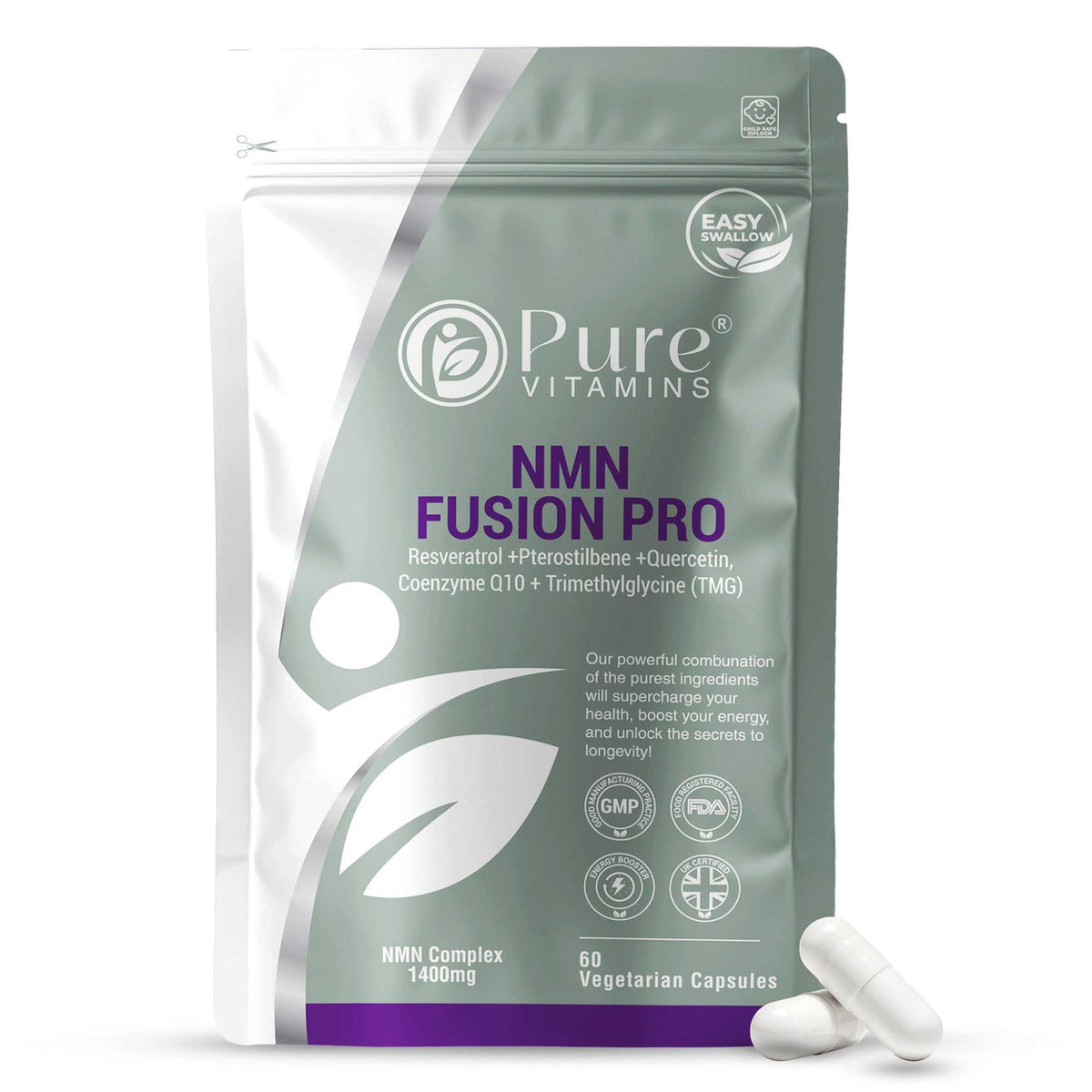
Our NMN Fusion Pro is £24.99 for 60 vegan capsules, taken two a day, so a pouch is a month and the daily cost is roughly 83 pence. For that you get 500mg of NMN, 500mg of TMG matched one to one with it, 100mg of trans-resveratrol, 125mg of quercetin, 100mg of CoQ10, 50mg of pterostilbene and 5mg of piperine, every quantity declared per serving.
Compare that honestly against what else 83 pence a day buys. If your vitamin D is untested going into a British winter, or your iron has never been checked, or you are sleeping six hours a night, those are bigger levers and cheaper ones. NMN is a supplement for someone who has the basics covered and finds the biochemistry genuinely interesting, not a substitute for them. I would rather say that plainly than sell you a pouch you will resent.

Who might consider it, and who should not
People who tend to get on with it: adults in their forties and beyond who already have their diet, sleep and movement in reasonable order, who have read around the topic, and who are comfortable buying into an area where the biochemistry is solid and the outcome data is still developing. Also people who were already buying NMN and TMG as two separate purchases and would rather not.
People I would steer away: anyone under 18. Anyone pregnant or breastfeeding, because these trials simply did not include them. Anyone hoping a capsule will offset a diet or sleep pattern they know is not working. Anyone on a tight budget who has not yet covered the fundamentals. And anyone taking prescribed medication or managing a health condition, who should talk to their GP or pharmacist before adding anything, NMN included. Women weighing this up specifically may also find NMN for women: what to know useful.
What to realistically expect
If you take a properly dosed NMN product consistently for three months, the outcome the trials would predict is a measurable rise in blood NAD that you cannot feel, alongside a set of functional changes that are small, inconsistent between studies, and difficult to distinguish from the effect of paying more attention to your health generally.
Some people report feeling steadier or more able through the day. I take that seriously as a report and not as evidence, because none of these trials were designed to capture it and expectation is powerful. If you try it, give it a fair run of eight to twelve weeks, change one thing at a time, and be willing to conclude it did nothing for you. That is a perfectly legitimate result and a fairly common one.
A few cautions worth knowing
- Speak to your GP or pharmacist before starting if you take any prescribed medication, particularly if you are on treatment that requires monitoring.
- Not suitable for anyone under 18, or for women who are pregnant or breastfeeding.
- Formulas containing resveratrol, pterostilbene or high-dose quercetin warrant a conversation with your clinician if you take anticoagulants or antiplatelet medication.
- CoQ10 and the stilbenoids are fat-soluble, so take the capsules with or shortly after food rather than on an empty stomach.
- Do not exceed the stated dose, and do not use any supplement as a reason to delay getting a symptom looked at.
- If you have a health condition, or if persistent tiredness is what brought you here, see your GP first. Low iron, low B12 and thyroid problems are common, checkable and treatable, and none of them is solved by NMN.
So, is NMN worth taking? My verdict
For most people, no, not yet, and not as a first move. If your foundations are shaky, the money is better spent elsewhere and I will say so even though I sell the stuff.
For a smaller group, yes, with clear eyes. If you already have the basics handled, you have read what the trials do and do not show, you are comfortable with an ingredient still working through GB novel food authorisation, and you can spend roughly 83 pence a day without expecting a transformation, then NMN is a rational thing to try. Buy a properly dosed formula with every quantity declared, give it three months, and judge it honestly.
What I would not do is buy it because a chart showing NAD+ declining with age made you anxious. That chart is real. The leap from it to a promise about how you will feel is not.
See NMN Fusion Pro, seven declared actives
Frequently asked questions
Does NMN actually raise NAD levels in people?
Yes, and this is the most consistently replicated finding in the field. In a placebo-controlled trial in 80 healthy middle-aged adults, blood NAD concentrations were significantly higher in the 300mg, 600mg and 900mg groups at both 30 and 60 days, with the largest rises at 600mg and above.
How much NMN did the studies use?
Most human trials sit between 250mg and 900mg a day, with a few going up to 1200mg. Many retail products contain 100mg to 250mg per serving, which is at or below the bottom of the tested range, so check the amount per daily serving rather than the amount per pouch.
Is NMN legal to buy in the UK?
NMN is treated as a novel food in Great Britain and has not completed the authorisation process. Applications are with the Food Standards Agency, which publishes a register of regulated product applications where you can check the current position. The status is live and can change.
Is NMN better than NR?
Not demonstrably. NMN sits one step closer to NAD+ in the pathway, but there is an unresolved scientific argument about whether oral NMN enters cells intact or is broken down and reassembled first. NR has the longer clinical track record. Both raise NAD in trials.
How long before I notice anything?
Blood NAD shifts within weeks, but that is a laboratory measure rather than something you can feel. If you are trying it, give it eight to twelve weeks, change one variable at a time, and be prepared to conclude it did nothing noticeable for you.
Is NMN safe?
Within the amounts and durations studied, trials report good tolerability, including single doses up to 500mg and repeated daily use over 8 to 12 weeks. Long-term safety data across years and across the general population does not yet exist, and no trials included pregnant or breastfeeding women or under-18s.
Should I take TMG with NMN?
NMN metabolism runs through methylation-dependent pathways, which is why many experienced users add trimethylglycine. Some formulas, including ours, include it at a matched amount so you do not need a second purchase.
Sources
- Irie J. et al. Effect of oral administration of nicotinamide mononucleotide on clinical parameters and nicotinamide metabolite levels in healthy Japanese men. Endocrine Journal, 2020. https://doi.org/10.1507/endocrj.EJ19-0313
- Yoshino M. et al. Nicotinamide mononucleotide increases muscle insulin sensitivity in prediabetic women. Science, 2021. https://doi.org/10.1126/science.abe9985
- Liao B. et al. Nicotinamide mononucleotide supplementation enhances aerobic capacity in amateur runners: a randomized, double-blind study. Journal of the International Society of Sports Nutrition, 2021. https://doi.org/10.1186/s12970-021-00442-4
- Kim M. et al. Effect of 12-week intake of nicotinamide mononucleotide on sleep quality, fatigue, and physical performance in older Japanese adults. Nutrients, 2022. https://doi.org/10.3390/nu14040755
- Fukamizu Y. et al. Safety evaluation of beta-nicotinamide mononucleotide oral administration in healthy adult men and women. Scientific Reports, 2022. https://doi.org/10.1038/s41598-022-18272-y
- Yi L. et al. The efficacy and safety of beta-nicotinamide mononucleotide supplementation in healthy middle-aged adults: a randomized, multicenter, double-blind, placebo-controlled, parallel-group, dose-dependent clinical trial. GeroScience, 2022. https://doi.org/10.1007/s11357-022-00705-1
- Katayoshi T. et al. Nicotinamide adenine dinucleotide metabolism and arterial stiffness after long-term nicotinamide mononucleotide supplementation. Scientific Reports, 2023. https://doi.org/10.1038/s41598-023-29787-3
- Martens C.R. et al. Chronic nicotinamide riboside supplementation is well-tolerated and elevates NAD+ in healthy middle-aged and older adults. Nature Communications, 2018. https://doi.org/10.1038/s41467-018-03421-7
- Huang Y. et al. Effects of nicotinamide mononucleotide supplementation on muscle and liver functions among the middle-aged and elderly: a systematic review and meta-analysis of randomized controlled trials. Current Pharmaceutical Biotechnology, 2025. https://doi.org/10.2174/0113892010306242240808094303
Study findings above are reported as science and describe what researchers measured in those trials. They are not statements about what any supplement will do for you.
Thanks for reading this one properly. If you want the wider picture on how we formulate and what we publish, everything starts from the Pure Vitamins UK home page.
Dr. Miron, Founder of Pure Vitamins UK
A food supplement is not a substitute for a varied, balanced diet and a healthy lifestyle. This article is general information and not medical advice. Speak to your GP or pharmacist before starting a new supplement, particularly if you take medication, have a health condition, or are pregnant or breastfeeding.
