

Reviewed and updated: 22 September 2026
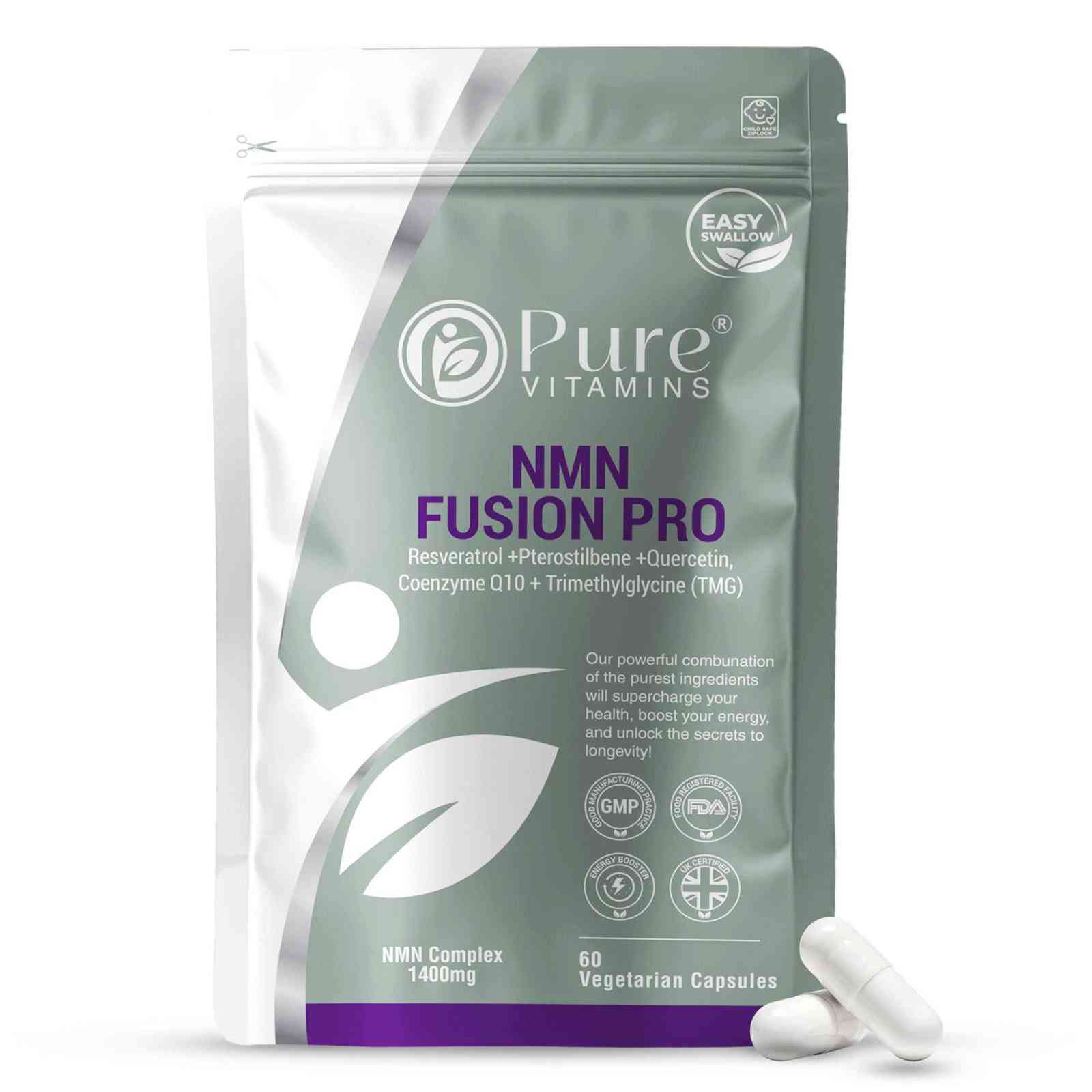
NMN with TMG and resveratrol is the combination you will see in most NAD+ precursor formulas, and the short version is that these ingredients are grouped together for good composition and convenience reasons: NMN as the NAD+ building block, TMG as a methyl donor, resveratrol as a grape-skin polyphenol, and CoQ10 as a mitochondrial companion. On timing, the honest answer is that there is no established best hour for any of them, so most people take the capsule in the morning with food and let consistency do the work. This guide explains why they are paired, what the research actually shows, when to take NMN, nicotinamide riboside and pterostilbene, and how to read a formula honestly.

NMN with TMG and resveratrol: the quick answer (TL;DR)
- What it is: a multi-ingredient capsule built around NMN (nicotinamide mononucleotide), a compound the body uses within NAD+ metabolism, combined with TMG, resveratrol and CoQ10.
- Why they are combined: they are the recognisable companions in the NAD+ precursor category. TMG goes in as a methyl donor, resveratrol as a plant polyphenol, and CoQ10 as a mitochondrial compound.
- When to take it: morning with a normal meal is the common pattern. There is no good human evidence that a particular hour works better, for NMN, for nicotinamide riboside or for pterostilbene.
- Who it is for: adults who already know they want an NMN-based formula and prefer a fixed, pre-measured blend over juggling single ingredients.
- Key things to know: NMN is treated as a Novel Food in Great Britain and is under regulatory assessment; resveratrol's absorption picture is genuinely mixed; and consistency matters far more than timing.
NMN with TMG: why are they combined?
TMG (trimethylglycine, also called betaine) is the ingredient most often paired with NMN, and the reasoning is methylation chemistry. The body clears excess nicotinamide partly through methylation, which uses up methyl groups, so many formulas add a methyl donor such as TMG on that basis. Betaine itself is well studied as a methyl donor: a randomised controlled trial found that betaine supplementation (6 g/day for 12 weeks) lowered plasma homocysteine, although in the same trial total and LDL cholesterol rose compared with placebo, a genuinely mixed result worth stating plainly (Schwab and colleagues, 2002, American Journal of Clinical Nutrition, DOI 10.1093/ajcn/76.5.961). We include TMG in NMN Fusion Pro on that composition and mechanism basis.
Worth being candid about the size of the argument. The methyl-donor rationale is chemically reasonable, but it is a rationale rather than a demonstrated requirement, and the betaine doses used in the trial above are far larger than what sits in a typical NAD+ capsule. Think of TMG as a sensible companion ingredient rather than something the formula would fail without.
Can you take NMN with resveratrol?
Yes, and the two are very commonly combined. Resveratrol is a stilbene polyphenol found in grape skins, and it is the compound people often associate with the old folklore around red wine. It appears alongside NMN in most NAD+ precursor blends, which is why our formula contains both. The honest scientific picture is that resveratrol is well absorbed but rapidly metabolised, so the amount of unchanged resveratrol circulating in the blood is low: a human pharmacokinetics review found that at least about 70% of an oral dose is absorbed, yet most of it is quickly converted to sulfate and glucuronide conjugates (Cottart and colleagues, 2010, Molecular Nutrition and Food Research, DOI 10.1002/mnfr.200900437). Knowing that helps you keep expectations realistic and read marketing sensibly. If you are weighing resveratrol against pterostilbene, its methylated cousin, I set the two side by side in which is better, resveratrol or pterostilbene, and I answer the amount question specifically in how much pterostilbene to take a day.
Why is CoQ10 in the formula?
CoQ10 (coenzyme Q10) is a fat-soluble compound involved in energy production inside the mitochondria. It is another familiar companion in NAD+ precursor blends and rounds out a recognisable formula. Because CoQ10 is lipophilic, it is the ingredient in this blend with the clearest case for being taken with a meal that contains some fat.

When should you take NMN?
There is no established best time, and I would rather be straight with you than invent one. The practical pointers most people follow are:
- Morning: many take their NMN formula in the morning simply because it is an easy thing to make part of a daily routine.
- With food: sensible for tolerability, and helpful for the fat-soluble CoQ10 component.
- Consistency over timing: regular daily intake is the pattern people use, rather than expecting an acute, same-day effect.
What is the best time of day to take nicotinamide riboside?
This question comes up as often as the NMN one, and it deserves its own answer rather than being folded in, because NR is a different molecule with its own research base. The short version: morning is the common choice, evening is not wrong, and the evidence that either is better is essentially absent.
What we do have is decent human pharmacokinetic work. According to PubMed, a clinical study of NR pharmacokinetics found that single oral doses of 100mg, 300mg and 1000mg produced dose-dependent increases in the blood NAD+ metabolome, and that NR is orally bioavailable in a way that distinguishes it from nicotinic acid and nicotinamide (Trammell and colleagues, 2016, DOI 10.1038/ncomms12948, read it on PMC). A separate open-label study in eight healthy volunteers escalated NR from 250mg up to 1000mg twice daily and reported that whole-blood NAD+ rose by around 100 per cent from baseline, with no adverse events over the study period (Airhart and colleagues, 2017, DOI 10.1371/journal.pone.0186459, read it on PMC).
Notice what those studies establish and what they do not. They establish that oral NR reaches the blood and shifts NAD+ metabolism, which is genuinely interesting science. They say nothing about morning versus evening, because nobody has run that comparison properly in humans. Anyone telling you confidently that NR must be taken before noon is filling a gap in the literature with an opinion.
The circadian argument, and how far it actually goes
The most sophisticated version of the timing case runs through the body clock, so it is worth setting out fairly.
NAD+ is not a static pool. According to PubMed, work in cell and mouse models showed that intracellular NAD+ levels cycle with a 24-hour rhythm driven by the circadian clock, with the CLOCK:BMAL1 machinery regulating the daily expression of NAMPT, the rate-limiting enzyme in the NAD+ salvage pathway (Nakahata and colleagues, 2009, DOI 10.1126/science.1170803, read it on PMC). That is a real and elegant finding, and it is where the "take it in the morning to match your NAD+ rhythm" advice originally comes from.
Here is my honest reading of it. That work is preclinical, done in mouse embryo fibroblasts rather than in people taking capsules, and it describes the rhythm of the salvage pathway rather than testing whether dosing a precursor at one time of day beats another. Going from "NAD+ oscillates over 24 hours in cells" to "therefore take your capsule at eight in the morning" is a long leap across a lot of missing evidence. The rhythm is real; the dosing instruction people build on top of it is not established.
So my practical position is unchanged. Pick a time you will keep, and keep it. If you find the circadian reasoning appealing, morning is a perfectly sensible choice and costs you nothing. Just do not believe that an evening capsule is being wasted.
What time of day should you take pterostilbene?
Pterostilbene turns up in the same formulas as NMN and trans-resveratrol, ours included, and it gets asked about separately because people assume a different molecule must need a different schedule. The honest answer is the same shape as the others, with one genuine difference: the hour barely matters, but the meal does. Pterostilbene is fat-soluble, so taking it with a meal that contains some fat is a far more useful habit than picking a particular time on the clock.
There is no human study comparing morning with evening pterostilbene dosing, so anyone telling you it must be taken at a set hour is filling a gap in the literature with an opinion. What the chemistry does tell you is that pterostilbene is the dimethylated cousin of trans-resveratrol, and those two methyl groups make it more lipophilic and less vulnerable to the rapid sulfation and glucuronidation that clears resveratrol so quickly. That is why pterostilbene is generally described as having higher oral bioavailability and a longer half-life than trans-resveratrol, and it is the practical reason timing is forgiving: a compound that hangs around longer is less sensitive to exactly when you took it.
Why our formula pairs a smaller amount of pterostilbene with a larger amount of trans-resveratrol
This is the part label-readers actually want explained. NMN Fusion Pro carries trans-resveratrol at 100 mg and pterostilbene at 50 mg, and the asymmetry is deliberate rather than a cost decision. They are not two versions of the same ingredient competing for the same slot: trans-resveratrol is the extensively studied parent stilbene and goes in at the larger amount, while pterostilbene goes in at a smaller amount precisely because it is the more bioavailable of the two, so less of it is needed to contribute meaningfully to the stilbene content of the capsule. Formulas that stack both are choosing breadth of the stilbene family over a single isolate. If you want the two compared head to head, I have done that in which is better, resveratrol or pterostilbene, and the amount question on its own in how much pterostilbene to take a day.
Typical amounts, splitting, and stacking
- Amounts used in human studies have generally sat in the region of 50 mg to 250 mg per day, and UK products typically sit at the lower end of that range, often as one component of a multi-ingredient capsule rather than as an isolate. Follow the label rather than assuming more is better.
- Splitting has no established advantage here. Given the longer half-life relative to trans-resveratrol, a single daily dose is the simpler and entirely defensible choice. If your product is two or three capsules, take them together or spread them, whichever you will remember.
- Stacking with NMN, trans-resveratrol and TMG needs no spacing. There is no evidence that any of these compete for absorption or need to be separated, which is exactly why they are formulated into one capsule in the first place.
- Caffeine is not a reason to move your dose. There is no known interaction, and if your morning coffee is what makes you remember the capsule, that is a better argument than any theoretical one.
- Watch for duplication. If you take a separate pterostilbene or resveratrol capsule alongside a multi-ingredient NAD+ formula, add up the totals before deciding your routine.
The circadian argument set out above for NAD+ precursors is sometimes borrowed for pterostilbene too. It transfers even less well: the salvage-pathway rhythm is about NAD+ metabolism, not about stilbene absorption, and the underlying work is preclinical. Take the capsule with a meal containing some fat, at whichever time you will genuinely keep to, and give it a couple of months before you judge it.
Should you take it with food and fat? The honest answer
This is where a lot of online advice overstates things. For CoQ10, taking it with dietary fat is a reasonable, well-recognised approach because it is lipophilic. For resveratrol the evidence is genuinely mixed: some human data suggest a high-fat meal can slow or even reduce resveratrol absorption rather than improve it, and at least one review concluded that the rate of absorption (but not the total amount) was delayed by food (Chachay and colleagues, 2011, British Journal of Clinical Pharmacology, DOI 10.1111/j.1365-2125.2011.03966.x). So "take it with a fatty meal to boost resveratrol" is not well supported.
For NMN and NR themselves, both are water-soluble and neither needs fat to be taken up, so food is about comfort rather than absorption. Some people find a capsule on a completely empty stomach a little unsettling and some do not. Taking the capsule with a normal meal is the sensible default: fine for tolerability, useful for the CoQ10 and the pterostilbene, and neutral for everything else. Just do not expect food to transform resveratrol's bioavailability.
Splitting the dose, or taking it all at once
People ask this a lot, usually after reading that split dosing is better for minerals. The honest answer is that for NAD+ precursors there is no established advantage either way, and the human studies have used both patterns. The pharmacokinetic work above used single doses, while the healthy-volunteer study used a twice-daily schedule at the top dose (Airhart and colleagues, 2017, DOI 10.1371/journal.pone.0186459).
What I would actually weigh is practicality. A once-daily capsule is a habit most people can hold. A twice-daily schedule is one more thing to forget, and a schedule you follow four days a week is worse than a simpler one you follow seven. If a product's daily amount is delivered in a single capsule, take it once. If it is two or three capsules, either take them together or split them across the day, whichever you find easier to remember. Neither choice is a mistake.
What about caffeine, and stacking generally?
There is no known interaction between NAD+ precursors and caffeine, so there is no reason to avoid taking your capsule with your morning coffee, and for a lot of people the coffee is the anchor that makes them remember it at all. That is a good enough reason on its own.
On stacking more broadly: TMG, resveratrol, pterostilbene and CoQ10 are already in the formula, which is rather the point of a blend, so the main thing to watch is doubling up. If you take a separate CoQ10 capsule, a resveratrol capsule and a multi-ingredient NAD+ formula, add up what you are actually taking rather than assuming the amounts are trivial. Fat-soluble CoQ10 in particular is easy to duplicate without noticing.

NMN, NR and niacinamide: how the precursors differ
NMN and NR (nicotinamide riboside) are the two precursors most often discussed and studied, and niacinamide (nicotinamide, the plain form of vitamin B3) is the third name that turns up in this conversation. They are related but not interchangeable, and the differences matter when you are reading a label.
- Nicotinamide riboside (NR): the most extensively studied of the three in human pharmacokinetic terms, with the dose-response and bioavailability work described above.
- NMN: one step further along the salvage pathway than NR. Studied in humans at more modest doses, and the ingredient with the UK Novel Food question attached to it.
- Niacinamide: an ordinary form of vitamin B3 with an established Nutrient Reference Value, far cheaper, and the one whose clearance draws on methyl groups, which is where the TMG rationale comes from in the first place.
A review of human studies on NAD+-boosting compounds reported that NR, NR with pterostilbene, and NMN are the most commonly investigated, that supplementation has generally been safe and well tolerated, and that it can raise NAD+ and related metabolite levels, while noting that small sample sizes and varied dosing still limit firm conclusions about physiological outcomes (Freeberg and colleagues, 2023, DOI 10.1093/gerona/glad106, read it on PMC). In a 12-week randomised, placebo-controlled trial, oral NMN at 250 mg/day was well tolerated and raised NAD+ metabolism in healthy middle-aged adults (Katayoshi and colleagues, 2023, DOI 10.1038/s41598-023-29787-3, read it on PMC). Those are findings about what the compounds did in studies, reported here as science.
Does timing advice transfer between them? In practice yes, because there is no timing evidence for any of them to transfer. All three are water-soluble, none needs fat, and none has a demonstrated best hour. For a fuller side-by-side of the two headline precursors, see our guide on NMN vs NR, and for the NR dosing question specifically, how much NR to take daily.
How much do people take, and is it safe?
NMN and NR are not vitamins or minerals, so neither has a Nutrient Reference Value or an official Tolerable Upper Intake Level. What we have instead is the range used in published studies.
For NMN, doses around 250 mg/day have been studied over several weeks and reported as well tolerated (Katayoshi and colleagues, 2023, DOI 10.1038/s41598-023-29787-3). For NR, human work has spanned single doses of 100mg to 1000mg (Trammell and colleagues, 2016, DOI 10.1038/ncomms12948) and a short escalation to 1000mg twice daily in a small healthy-volunteer study (Airhart and colleagues, 2017, DOI 10.1371/journal.pone.0186459). UK products typically sit at the lower end of those ranges. That tells you what has been studied, not an optimal amount. Follow the dose on the label and do not assume more is better.
How long before you reassess?
A fair question that almost nobody answers. The human trials in this area have generally run for weeks to a few months rather than days, so if you are going to give a formula a fair trial, think in terms of two to three months of consistent daily use rather than two weeks.
Equally, be realistic about what you would be assessing. These are compounds studied for what they do to NAD+ metabolism, and that is a laboratory measurement rather than something you can feel. If you are waiting for a dramatic day-to-day sensation to tell you whether it is working, you are likely to be disappointed, and that is not a criticism of the ingredient so much as an honest description of what the science currently supports.
The UK Novel Food status of NMN
One point many guides skip: in Great Britain, NMN is treated as a Novel Food, which means it needs authorisation before it can be sold as a food supplement, and applications are currently under assessment. This is a regulatory status rather than a safety verdict, but it is a relevant fact to weigh when you compare products, and it is a reasonable thing to expect a brand to tell you rather than leave you to discover. We describe NMN's composition and the published science openly.
Interactions and who should be cautious
- Pregnancy and breastfeeding: there is little safety data for these compounds in pregnancy or breastfeeding, so they are best avoided unless a GP advises otherwise.
- Medication and medical conditions: if you take prescription medication (including blood pressure or cholesterol medicines) or manage a health condition, check with your GP or pharmacist first, since resveratrol and other polyphenols can in theory interact with some drugs.
- Blood thinners: resveratrol has been discussed in the context of platelet function, so if you take an anticoagulant or antiplatelet medicine, raise it with your pharmacist before starting rather than afterwards.
- Cholesterol note: as above, one trial of betaine reported a rise in LDL and total cholesterol, so anyone monitoring their lipids should be aware of that finding.
- Under 18: these compounds have not been studied in children or adolescents and are not appropriate for them.
NMN powder vs capsules: which is better?
This is a format preference, not a quality difference.
- Capsules: convenient, pre-measured, tasteless, and the simplest way to combine fixed amounts of several ingredients, which is exactly what a multi-ingredient formula needs.
- Powder: lets you adjust amounts and can cost less per gram, but it needs measuring and has a taste some people dislike.
For a multi-ingredient blend like this one, capsules make the most practical sense.

How to judge an NMN or NR product
- Clear amounts per ingredient: a transparent label that states how much NMN, TMG, resveratrol, pterostilbene and CoQ10 you actually get, rather than a hidden "proprietary blend".
- The form named properly: "nicotinamide riboside" or "nicotinamide mononucleotide" spelled out, not a vague "NAD+ complex" that could be mostly plain niacinamide at a fraction of the cost.
- Dose per capsule, not per serving: a generous-looking serving that turns out to be three capsules is a different product from the one you thought you were buying.
- Sensible companion ingredients: recognisable NAD+ category companions rather than a long list of trace "fairy dusting".
- Quality and testing: a product tested for purity and heavy metals at a GMP-certified facility, and formulated in the UK.
- Honest marketing: be wary of any product making dramatic promises about these ingredients. A good NMN formula sells itself on transparency and quality.
The takeaway
NMN with TMG and resveratrol (plus pterostilbene and CoQ10) is a composition decision: TMG as a methyl donor, the stilbenes as plant polyphenols, and CoQ10 as a mitochondrial compound, brought together in one capsule. Take it consistently, with a normal meal that contains some fat, at whatever time suits your routine. The same goes for nicotinamide riboside and pterostilbene: the circadian science is genuinely interesting but it has not been turned into a dosing instruction, so morning is a fine default rather than a requirement. Keep your expectations realistic about resveratrol's limited absorption and the overstated food-and-fat advice, give any formula a couple of months rather than a fortnight, and remember NMN's Novel Food status in Great Britain.
For the wider category and how to choose, see our NMN buyer's guide, for the underlying biology see what NAD+ is and why it matters, and for the women's angle see NMN for women. Everything we publish is collected on the supplement guides hub, or browse the full range at the Pure Vitamins UK home page.
Frequently asked questions
What is the best time of day to take nicotinamide riboside?
There is no evidence-based best hour. Morning with food is the common choice and a sensible default, but no human study has compared morning with evening dosing for NR. Consistency matters far more than the time you pick.
Does the NAD+ circadian rhythm mean I should take NR in the morning?
Not necessarily. Cell and mouse work showed NAD+ levels cycle over 24 hours with the clock regulating NAMPT, the rate-limiting salvage enzyme, but that is preclinical and does not test whether dosing time changes the outcome in people. Morning is a reasonable choice, not a requirement.
Why is NMN combined with TMG?
TMG (trimethylglycine, also called betaine) is included as a methyl donor. The reasoning is that the body clears excess nicotinamide partly through methylation, so many formulas add a methyl donor alongside NMN. It is a composition and mechanism choice rather than a demonstrated requirement.
Can you take NMN with resveratrol?
Yes, the two are very commonly combined. Resveratrol is a grape-skin polyphenol included as a recognisable companion ingredient. It is well absorbed but rapidly metabolised, so circulating levels of unchanged resveratrol are low.
Should I take NMN or NR with food or on an empty stomach?
Both are water-soluble, so food is about comfort rather than absorption. A normal meal is the sensible default, and it also suits the fat-soluble CoQ10 and pterostilbene in a multi-ingredient formula.
Should I split the dose or take it all at once?
There is no established advantage either way, and human studies have used both patterns. Choose whichever you will remember reliably.
Can I take it with coffee?
Yes. There is no known interaction with caffeine, and pairing the capsule with your morning coffee is a practical way to remember it.
What time of day should you take pterostilbene?
There is no evidence-based best hour, and no human study has compared morning with evening pterostilbene dosing. What matters more is that pterostilbene is fat-soluble, so take it with a meal containing some fat. Its longer half-life relative to trans-resveratrol makes the timing forgiving.
Why does a formula contain more trans-resveratrol than pterostilbene?
Because pterostilbene is the more bioavailable of the two, so a smaller amount contributes meaningfully alongside a larger amount of the extensively studied parent stilbene. In NMN Fusion Pro that is trans-resveratrol at 100 mg and pterostilbene at 50 mg. It is a breadth decision across the stilbene family rather than two versions of the same ingredient.
How long should I take it before deciding whether it suits me?
Human trials in this area typically run for weeks to a few months, so two to three months of consistent use is a fairer trial than a fortnight. Be realistic that what is being measured in studies is NAD+ metabolism rather than a day-to-day sensation.
Is NMN a Novel Food in the UK?
In Great Britain, NMN is treated as a Novel Food, which means it requires authorisation before sale as a food supplement, and applications are under assessment. This is a regulatory status rather than a safety verdict.
Is NMN better as powder or capsules?
It is a format preference. Capsules are convenient, pre-measured and tasteless and suit a multi-ingredient blend; powder lets you adjust amounts and can be cheaper per gram but needs measuring and has a taste some dislike.
Sources
- Trammell SAJ and colleagues (2016). Nicotinamide riboside is uniquely and orally bioavailable in mice and humans. Nature Communications. DOI 10.1038/ncomms12948. PMC5062546
- Airhart SE and colleagues (2017). An open-label, non-randomized study of the pharmacokinetics of nicotinamide riboside and its effects on blood NAD+ levels in healthy volunteers. PLoS One. DOI 10.1371/journal.pone.0186459. PMC5718430
- Nakahata Y and colleagues (2009). Circadian control of the NAD+ salvage pathway by CLOCK-SIRT1. Science. Preclinical, cell and mouse models. DOI 10.1126/science.1170803. PMC6501775
- Katayoshi T and colleagues (2023). Nicotinamide adenine dinucleotide metabolism and arterial stiffness after long-term nicotinamide mononucleotide supplementation. Scientific Reports. DOI 10.1038/s41598-023-29787-3. PMC9935856
- Freeberg KA and colleagues (2023). Human studies of NAD+-boosting compounds. The Journals of Gerontology Series A. DOI 10.1093/gerona/glad106. PMC10692436
Signed, Dr. Miron, Founder of Pure Vitamins UK.
Sources are drawn from the published literature; findings are paraphrased as science and are not product claims. NMN is under UK Novel Food assessment. Food supplements should not be used as a substitute for a varied, balanced diet and a healthy lifestyle. If you are pregnant, breastfeeding, taking medication or managing a medical condition, speak to your GP or pharmacist before starting a new supplement.
