

NMN vs NR: which NAD+ precursor is right for you?
NMN vs NR comes down to this: both are precursors the body uses to make NAD+, they sit at slightly different points in the same pathway, and there is no settled scientific consensus that one is universally better. So the practical choice is really about formulation and transparency rather than the molecule itself. This guide compares the two plainly, what each is, how they differ, and what actually matters when choosing, without the hype.
Reviewed and updated: 23 July 2026

TL;DR
- What they are: NMN and NR are both precursors the body uses to make NAD+, a coenzyme in every cell.
- How they differ: NR sits one step earlier in the pathway and can convert to NMN, which sits one step closer to NAD+. NR is the smaller molecule.
- The one thing to know: the research is early with no clear winner, so choose on formulation, transparency and price rather than the molecule.
What they have in common: NAD+
Both NMN (nicotinamide mononucleotide) and NR (nicotinamide riboside) are precursors to NAD+ (nicotinamide adenine dinucleotide), a coenzyme found in every cell and involved in fundamental cellular processes such as energy metabolism. The body can use either molecule as a building block in the pathway that produces NAD+. As general science, NAD+ levels are understood to decline with age, which is why both compounds have become a focus of research interest. It is worth being upfront that this is an area of active, mostly early-stage research, and neither NMN nor NR holds an authorised UK health claim, so this is a comparison of the molecules and how to choose, not a promise of any outcome. For more, see what NAD+ is and why it matters.
How NMN and NR differ
The simplest way to picture it: NR and NMN sit at slightly different points along the same pathway to NAD+. NR is a smaller molecule, and in the body's NAD+ production pathway NR can be converted into NMN, which in turn contributes to NAD+. NMN is one step further along that pathway than NR. That single fact is the source of most of the online debate: some argue NR's smaller size affects how it is absorbed and used, others argue NMN's position closer to NAD+ is an advantage. The honest answer is that the research is ongoing and there is no settled consensus that one is universally superior. They are best understood as two routes to the same destination. We cover a related angle in what women should know about NMN before buying.

NMN vs NR at a glance
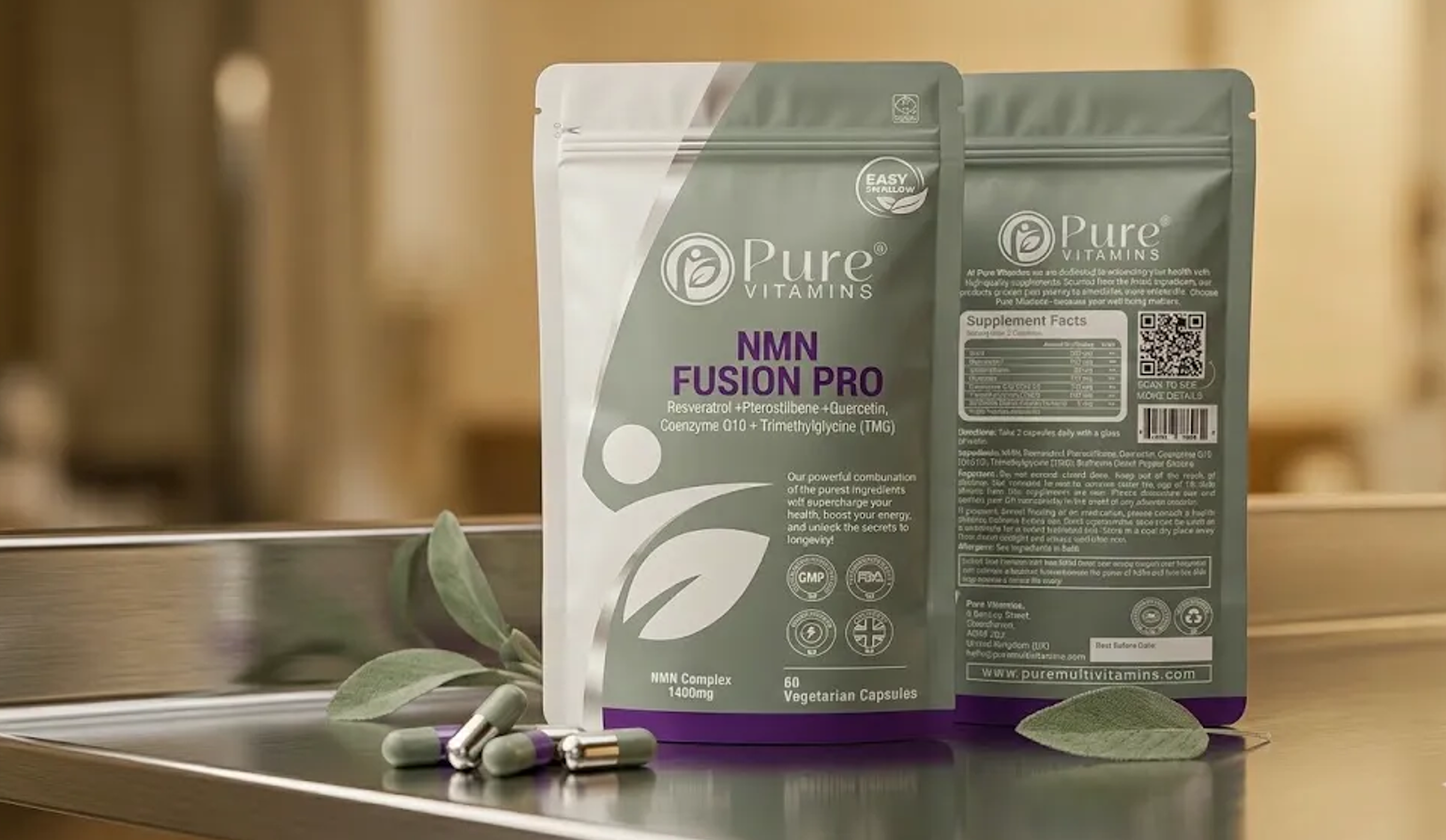
Stated as plain points rather than a grid: both are NAD+ precursors without authorised UK health claims; NR sits one step earlier in the pathway and can convert to NMN, while NMN sits one step closer to NAD+; NR is the smaller molecule; and both are areas of active, early-stage research with no large, long-term human-outcome evidence that settles the debate. One extra point specific to NMN: it currently sits under UK Novel Food assessment, so its regulatory status may still change. In the Pure Vitamins NMN supplement UK range, the NR option is our NAD+ supplement (with quercetin and resveratrol), and the NMN option is NMN Fusion Pro (a multi-ingredient formula).
What the early human research shows
For honest expectation-setting, it helps to look at both molecules. On the NMN side, a clinical study retrieved from PubMed found a single oral dose of NMN (100, 250 or 500 mg) in ten healthy men was safely metabolised, with no significant changes in routine clinical parameters (Irie et al., 2020, DOI), and a later placebo-controlled trial found 250 mg of NMN daily for 12 weeks was well tolerated, with the researchers observing a rise in blood NAD levels (Okabe et al., 2022, DOI). On the NR side, an open-label study retrieved from PubMed reported oral NR was well tolerated in healthy volunteers and increased whole-blood NAD (Airhart et al., 2017, DOI). Read all three as early absorption-and-tolerability science in small groups, not proof of a benefit. Neither body of evidence crowns a winner, which is exactly why we frame the choice around transparency rather than outcome, and if you want the NMN trials weighed up one by one I have done that in is NMN worth taking.
So which should you choose?
Since the science does not crown a clear winner, the practical decision usually comes down to three things. First, single ingredient or a formulated stack: a simpler formula appeals if you want a focused product, while a formulated one makes sense if you would rather have complementary ingredients (resveratrol, CoQ10 or TMG) in one place. Second, transparency: whichever molecule you choose, favour products that disclose exact doses (no proprietary blends), state purity, and make a Certificate of Analysis available. That matters far more than the NMN-versus-NR question itself. Third, personal preference and budget, since both are widely available in the UK in capsule and powder formats. For a fuller checklist, see our guide to the best NMN supplement in the UK.

A few cautions worth knowing
Both NMN and NR were well tolerated in the small human studies to date, but the long-term evidence is still limited, and NMN's Novel Food status is under assessment. If you are pregnant or breastfeeding, taking medication, or managing a medical condition, speak to your GP or pharmacist before starting either one, and follow the label rather than assuming more is better.
The Pure Vitamins options
If you would prefer NR, our NAD+ supplement is built around nicotinamide riboside with quercetin and trans-resveratrol, in vegetarian capsules. If you would prefer NMN, our NMN Fusion Pro pairs NMN with resveratrol, pterostilbene, quercetin, CoQ10, TMG and BioPerine. With both, every ingredient and dose is declared on the label, with no proprietary blends, and both are Formulated in the UK and tested for purity and heavy metals at our GMP-certified facility, with a Certificate of Analysis available on request. Browse the range on our Pure Vitamins UK home page. See also NMN with TMG and resveratrol, and when to take it.

Frequently asked questions
Is NMN better than NR? There is no settled scientific consensus that one is superior. Both are NAD+ precursors at slightly different points in the same pathway; the research is ongoing.
Can you take NMN and NR together? People do, though there is no established benefit to combining them over choosing one. Follow the label and consult a healthcare professional if unsure.
Do NMN or NR have approved UK health claims? No. Neither holds an authorised claim on the GB register, and NMN's Novel Food status is under assessment.
Which is more researched? Both have a growing body of early-stage research; neither has the large, long-term human-outcome evidence that would settle the debate.
Food supplements should not be used as a substitute for a varied, balanced diet and a healthy lifestyle. NMN is under UK Novel Food assessment. Consult a healthcare professional before use if you are pregnant, breastfeeding, taking medication or managing a medical condition.
Dr. Miron, Founder of Pure Vitamins UK.
