
Reviewed and updated: 31 August 2026
Best NMN supplement UK: what actually matters when choosing
To choose the best NMN supplement in the UK, look for a disclosed NMN dose per serving, stated purity, a Certificate of Analysis, manufacture in a GMP-certified facility, and full transparency with no proprietary blends. NMN is one of the most talked-about supplements of recent years, sitting right at the frontier of ageing and cellular-energy research, and that buzz is exactly why it pays to compare products on substance rather than slogans. Let me walk you through what genuinely separates a good NMN from a poor one, what the early human research shows, how people take it, and who should take care. On amounts, see how much of an NAD+ precursor people typically take daily.

TL;DR
- What it is: NMN (nicotinamide mononucleotide) is a molecule the body uses as a building block toward NAD+, a coenzyme every cell relies on.
- Who it is for: healthy adults interested in the NAD+ research area who want a transparent, well-made formula.
- The one thing to know: quality is all about transparency. A disclosed NMN dose, stated purity and a Certificate of Analysis matter far more than the boldest label.
What is NMN?
NMN (nicotinamide mononucleotide) is a molecule found naturally in the body and in trace amounts in some foods. Biologically it is a direct precursor to NAD+ (nicotinamide adenine dinucleotide), a coenzyme present in every living cell and involved in fundamental cellular processes such as energy metabolism and DNA repair. As a point of general science, NAD+ levels are understood to decline with age, which is the reason NMN has drawn so much research interest. NMN is one of several precursor molecules, alongside NR (nicotinamide riboside), that the body can use in the pathway that produces NAD+. I explain the coenzyme itself, and how it changes over time, in what NAD+ is and why it matters.
NMN's status in the UK: food supplement and Novel Food
One genuinely useful thing to understand before you buy is the regulatory picture, because it is unusual for NMN. NMN is sold in the UK as a food supplement, and its position under Novel Food regulation is currently under assessment, so the landscape may evolve. That is not a reason to avoid it, but it is a reason to favour a transparent, established brand that keeps you informed rather than one making outsized promises. I cover the wider context, including for women, in what women should know about NMN before buying.
What to look for in a quality NMN supplement
This is where the real differences between products show up, and it is where I would spend your attention:
- Disclosed NMN dose per serving. Check the actual NMN content per serving, not just the headline on the front. Some products quote a blend weight rather than the NMN amount itself.
- Stated purity. Look for products that state their NMN purity and do not hide the active behind a proprietary blend. Full transparency on the label is a good sign.
- A Certificate of Analysis. This is a batch document confirming what is actually in the product. Reputable brands make one available, so ask for it if it is not published.
- Purity and heavy-metal testing. Ours is tested for purity and heavy metals at our GMP-certified facility, with a Certificate of Analysis available on request.
- Manufacturing standards. Products made in a GMP-certified facility are produced to recognised quality-management standards, which speaks to consistency.
- Transparent formulation. Some NMN products are NMN alone; others combine it with related compounds. Either can be fine, provided every ingredient and dose is disclosed.
My rule of thumb: the more a brand tells you (exact doses, purity, testing, Certificate of Analysis), the more confidence you can place in it. Vagueness usually hides something.

Formulation: NMN alone or a stack?
NMN supplements come either as NMN on its own or as a formulated stack pairing NMN with related compounds such as resveratrol, pterostilbene, quercetin, CoQ10 and TMG, sometimes with a black pepper extract (piperine) included as an absorption aid. Neither approach is inherently better; it depends on whether you want a single ingredient or a combined formula, and crucially on whether every ingredient and its dose is declared. I look at the common companion ingredients in NMN with TMG and resveratrol, I compare the two stilbenes side by side in which is better, resveratrol or pterostilbene, and I set out the actual human trial amounts for the pterostilbene component in how much pterostilbene to take a day.
NMN vs NR: what's the difference?
NMN and NR (nicotinamide riboside) are both precursors the body can use toward NAD+, sitting at slightly different points in the same pathway. The research is ongoing and there is no settled consensus that one is universally superior, so they are best understood as two routes to the same destination. If you would prefer an NR-based formula, our NAD+ supplement is built around nicotinamide riboside with quercetin and resveratrol. I compare them in NMN vs NR: which NAD+ precursor, and explain the wider NAD+ picture in what NAD+ and its precursors are.
What the early human research shows
To set honest expectations, here is where the human evidence stands, framed as science. According to research retrieved from PubMed, a clinical study gave single oral doses of NMN (100, 250 or 500 mg) to ten healthy men and found it was safely metabolised, with no significant changes in heart rate, blood pressure, oxygen saturation or sleep, and a dose-dependent rise in NMN metabolites in the blood (Irie et al., 2020, DOI). According to further research retrieved from PubMed, a larger randomised, double-blind, placebo-controlled trial in 80 healthy middle-aged adults found that daily NMN raised blood NAD concentrations in a dose-dependent way and was well tolerated over 60 days (Yi et al., 2022, DOI). This is early-stage human research about the molecule rather than a promise about any single product, but it is useful because it speaks to NMN being absorbed and metabolised, and to its tolerability at studied doses. If you want the fuller evidence picture, including where the trials stop short, I have set it out in is NMN worth taking.

How people take NMN
NMN is typically taken once daily, often in the morning. Doses on the UK market vary widely between products, which is yet another reason checking the per-serving NMN content matters. As with any food supplement, more is not automatically better, so follow the dose on the label of the product you choose. If you are weighing up the NR precursor instead, our guide to how much NR to take daily in the UK walks through the amounts, and our guide to when to take NMN and nicotinamide riboside covers the timing question in full.
A few cautions worth knowing
NMN is sold as a food supplement for healthy adults. If you are pregnant, breastfeeding, taking medication or managing a health condition, consult a healthcare professional before starting NMN or any new supplement. Follow the serving on the label, and I would treat any brand promising dramatic, life-changing results as a warning sign rather than a recommendation, given how early the human research still is.

A quick buyer's checklist
- A disclosed NMN dose per serving, with no proprietary blends.
- Stated purity and a Certificate of Analysis available.
- Tested for purity and heavy metals, made in a GMP-certified facility.
- Every companion ingredient and dose declared on the label.
- Honest, measured marketing rather than dramatic promises.
Where NMN Fusion Pro fits
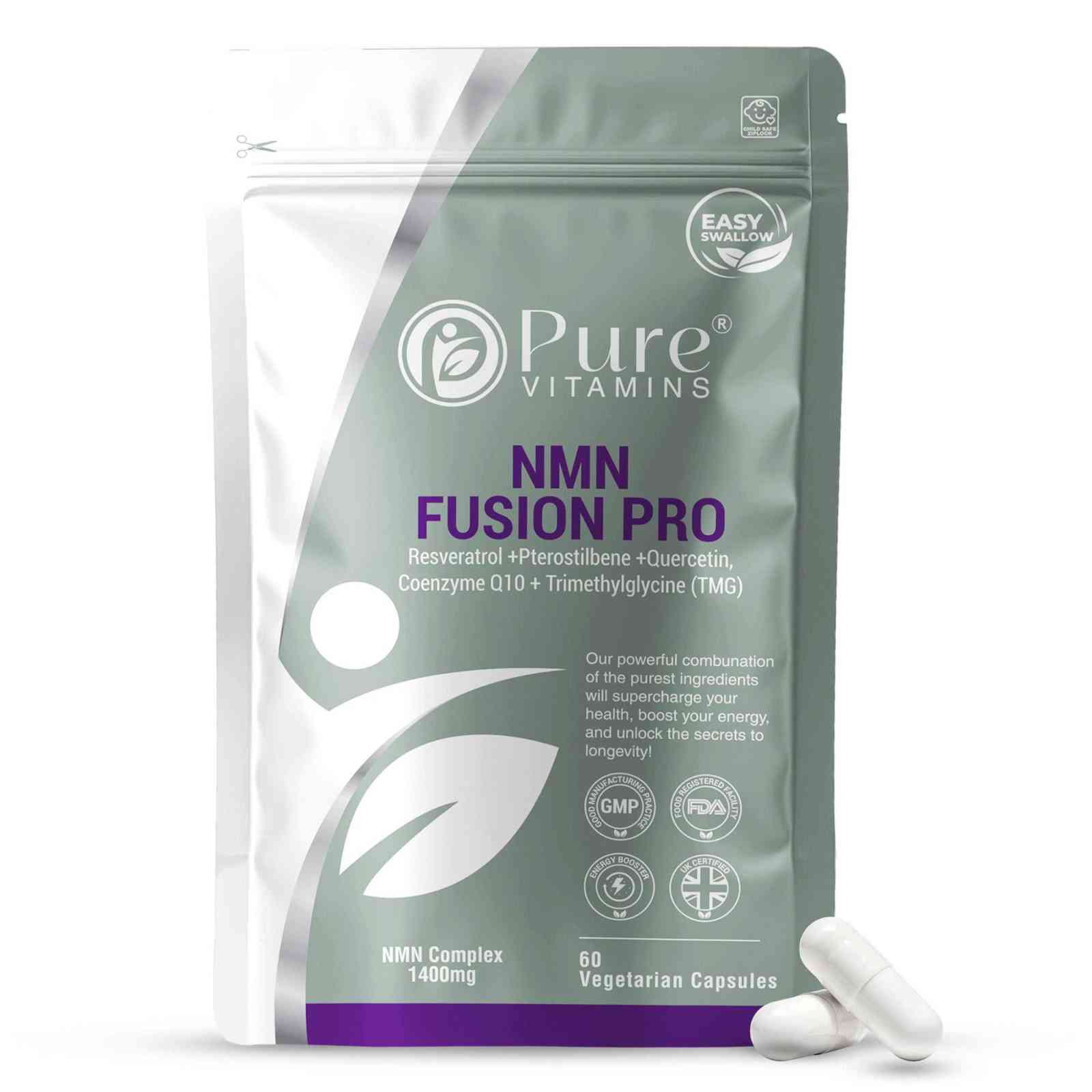
Our NMN Fusion Pro is a formulated NMN supplement that pairs NMN with resveratrol, pterostilbene, quercetin, CoQ10, TMG and piperine, in vegetarian capsules. In keeping with everything above, every ingredient and its dose is declared on the label with no proprietary blends, and it is manufactured in a GMP-certified facility and tested for purity and heavy metals at our GMP-certified facility, with a Certificate of Analysis available on request. I built it this way precisely because transparency is what UK buyers should be able to expect. Everything we publish is collected on the supplement guides hub, and you can browse the wider range on our Pure Vitamins UK home page.
Frequently asked questions
Is NMN sold in the UK? Yes, NMN is sold in the UK as a food supplement. Its status under Novel Food regulation is under assessment, so the regulatory picture may change over time.
What's the difference between NMN and NAD+? NAD+ is the coenzyme the body uses; NMN is one of the precursor molecules the body can use as a building block toward producing NAD+.
NMN or NR, which should I choose? Both are NAD+ precursors and there is no settled consensus that one is superior. The choice comes down to formulation preference and how transparent the brand is about dose and testing.
How do I judge NMN quality? Look for a disclosed NMN dose (no proprietary blends), stated purity, a Certificate of Analysis, purity and heavy-metal testing, and manufacture in a GMP-certified facility.
When do people take NMN? Usually once daily, often in the morning. Follow the dose on the label of the product you choose.
This article is for general information and is not medical advice. Food supplements should not be used as a substitute for a varied, balanced diet and a healthy lifestyle. Consult a healthcare professional before use if you are pregnant, breastfeeding, taking medication or managing a medical condition.
Dr. Miron, Founder of Pure Vitamins UK.
Related articles
- NMN vs NR: which NAD+ precursor is right for you?
- NMN with TMG and resveratrol (and when to take it)
- What NAD+ is and why it matters
- How much NR should I take daily?
- NMN for women: what to know
- Is NMN worth taking? An honest look at the human evidence
- Which is better, resveratrol or pterostilbene?
- How much pterostilbene should I take a day?
- NMN Fusion Pro (NMN with CoQ10, Resveratrol & TMG)
