
Reviewed and updated: 24 July 2026
NAD+ (nicotinamide adenine dinucleotide) is a coenzyme found in every living cell that sits right at the centre of energy metabolism, which is exactly why it anchors the whole NMN and NR supplement conversation. In this guide I will give you an honest, complete explainer of what NAD+ is, why it matters, how it changes with age, and how to think sensibly about NAD+ precursor supplements, kept firmly as biology rather than hype.
One honest note up front, because it matters: the biology of NAD+ is genuinely fascinating, but the human evidence for precursor supplements is still early. I will walk you through what the science shows and where it stops, and I will not pretend a NAD+ supplement is a proven fix for ageing or energy. The hype in this category runs well ahead of the data.

TL;DR: NAD+ and why it matters
- What it is: an essential coenzyme in every cell, central to turning food into cellular energy.
- Why it matters: it is both a redox cofactor and a substrate for important regulatory enzymes.
- Age: research shows NAD+ levels decline with age, which is the foundation of the supplement category.
- Supplements: you take precursors (NR or NMN), not NAD+ itself.
- Honest status: the biology is real and interesting; human benefits are still being studied and are not proven.
What is NAD+ and why it matters
NAD+ is a coenzyme present in every living cell, and it acts as a metabolic hub. It works as a redox cofactor in energy metabolism, helping convert the food you eat into usable cellular energy, and it is also the limiting substrate for a range of regulatory enzymes such as the sirtuins and PARPs that are involved in cellular signalling and DNA repair (Chini and colleagues, 2023, DOI). In short, without NAD+ cells simply could not produce energy, which is why it attracts so much scientific and commercial interest.
How does NAD+ change with age?
In short, NAD+ availability declines with age, and that single observation is the foundation the whole precursor category is built on. For the detail — why levels fall, what it affects, and what the evidence does and does not show — see our dedicated explainer: how does NAD+ change with age.
NAD+ precursors: NR and NMN
You do not take NAD+ directly in these supplements. You take precursors the body can convert into it. A review of the two leading precursors notes that both nicotinamide riboside (NR) and nicotinamide mononucleotide (NMN) are biosynthetic precursors of NAD+, and that supplementation with either raises NAD+ in research settings (Yang and colleagues, 2024, DOI). The two main options are:
- NR (nicotinamide riboside), a vitamin B3-related precursor used in our NAD+ supplement; I explain it in what is nicotinamide riboside.
- NMN (nicotinamide mononucleotide), the basis of our NMN Fusion Pro; see what is NMN.
I compare them directly in NMN vs NR.

How precursors become NAD+
Inside cells, NR and NMN feed a shared biosynthetic route. NMN and NR have comparable NAD+ boosting capability, largely because they share a common pathway: extracellular NMN is generally converted to NR before cellular uptake, then phosphorylated back to NMN inside the cell and finally converted to NAD+ by NMN adenylyltransferases (Vinten and colleagues, 2026, DOI). This is mechanism, not a promise: "the body can make NAD+ from it" is not the same as a proven health benefit. For how much of the NR precursor people take, see our guide on how much NR to take daily.
What human research can and cannot say
This is where honesty matters most. Much of the headline NAD+ research has been in animals or laboratory models, and the human work is still developing. In healthy volunteers, a single oral dose of NR measurably raised NAD+ in the brain, showing the precursor reaches human tissue (Nanga and colleagues, 2024, DOI). At the same time, reviews note that NR and NMN have shown only modest clinical effects so far, with the NAD+ rise often limited to around two-fold and a good deal of precursor degraded in the gut before it is used (Vinten and colleagues, 2026, DOI). The responsible position is "this is being researched and the biology is interesting", not "this is proven to do X", and I weigh that trial-by-trial in is NMN worth taking.
Why are quercetin and resveratrol added?
NAD+ formulas often include companion compounds such as quercetin and resveratrol, polyphenols that are popular in the longevity conversation. They are included to build a recognisable, comprehensive blend, and I write about them honestly on what they are rather than on outcomes in quercetin and resveratrol in NAD+ supplements. Many formulas also carry pterostilbene, resveratrol's methylated relative, and I compare the two stilbenes in which is better, resveratrol or pterostilbene. For more, see what a quercetin and nettle complex is.

How to choose a NAD+ supplement
- Precursor and dose: check which precursor (NR or NMN) and how much per serving.
- Companion ingredients: quercetin, resveratrol, TMG, CoQ10 and similar, if you want a fuller formula.
- Quality: made in a GMP-certified facility and tested for purity and heavy metals.
- Honest marketing: be wary of any brand making bold anti-ageing promises; in this young field that is a red flag.
Safety and who should take care
NAD+ precursors are generally well tolerated in studies, but the long-term human picture is still being built. Because the evidence base is young, the sensible approach is caution if you are pregnant or breastfeeding (best avoided), taking prescription medication, or managing a health condition: speak to your GP or pharmacist first. One regulatory note worth knowing: NMN in particular is treated as a novel food in the UK and its authorisation status continues to be assessed, which is useful context when you compare products.

How our NAD+ products are formulated
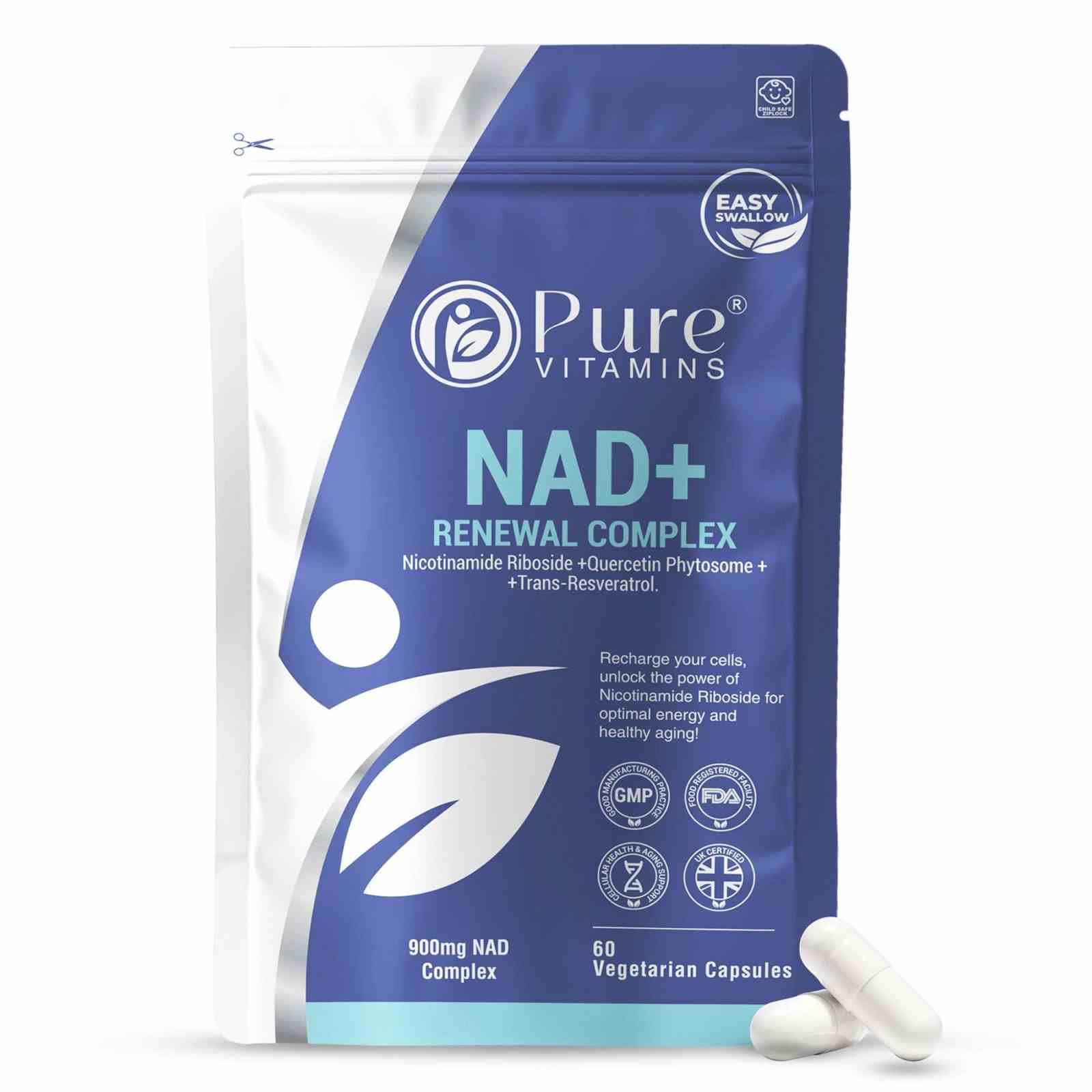
Our NAD+ supplement uses NR with quercetin and resveratrol, while our NMN Fusion Pro combines NMN with CoQ10, resveratrol and TMG. Both are formulated in the UK and tested for purity and heavy metals at our GMP-certified facility. Browse the full range on the Pure Vitamins UK home page.
Frequently asked questions
What does NAD+ actually do?
It is a coenzyme in every cell that acts as a redox cofactor in energy metabolism and as a substrate for regulatory enzymes involved in signalling and DNA repair. It is essential biology rather than an optional extra.
Does NAD+ really decline with age?
Research consistently reports that NAD+ levels fall with age. This is a scientific observation, and it is the reason the precursor-supplement category exists. It does not by itself prove that supplements deliver a health benefit.
Do you take NAD+ directly?
No. Supplements provide precursors such as NR or NMN, which the body converts into NAD+ through a shared biosynthetic pathway.
Are NAD+ supplements proven to work?
Human research is still developing and effects seen so far are modest. The honest position is that the biology is interesting and under active study, not that benefits are proven.
This article is for general information and composition education, not medical advice. Food supplements should not be used as a substitute for a varied, balanced diet and a healthy lifestyle. If you are pregnant, breastfeeding, taking medication or managing a medical condition, speak to your GP or pharmacist before starting a new supplement. Signed, Dr. Miron, Founder of Pure Vitamins UK.
