


Reviewed and updated: 23 July 2026
Vitamin D3 vs D2: which is better?
On vitamin D3 vs D2, D3 (cholecalciferol) is the form most people should choose, because it is more effective at raising and maintaining vitamin D levels in the body than D2 (ergocalciferol). That is the short answer. The other common question, what the signs of low vitamin D are, needs a bit more care, because the signs are real but too non-specific to diagnose yourself, so a blood test through your GP is the honest route. This guide covers both, plus food sources, the safe upper limit, and why UK winters make supplementing sensible.

Quick answer (TL;DR)
- D3 (cholecalciferol): the form your skin makes from sunlight, and the more effective form at raising and holding your levels. This is the one most people should choose.
- D2 (ergocalciferol): a plant or fungal form, generally less effective at maintaining levels than D3.
- Signs of low vitamin D: real but vague (tiredness, aches, low mood), so a GP blood test is the only reliable check.
- UK context: from about October to March there is too little strong sunlight to make vitamin D, so supplementing over autumn and winter is widely advised.
- Upper limit: stay within 4,000 IU (100 micrograms) a day unless your GP advises otherwise.
Vitamin D3 vs D2: which form to choose
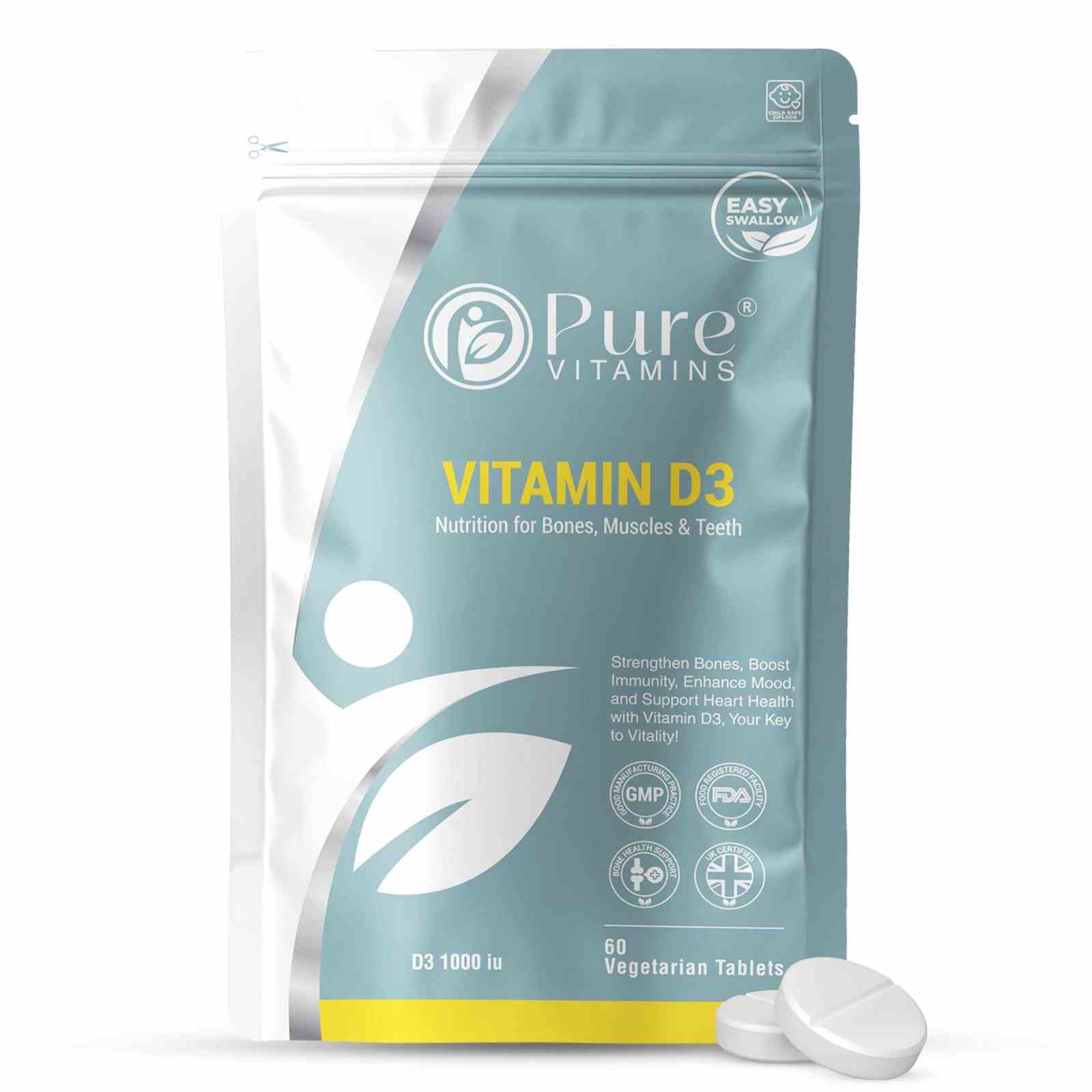
There are two dietary forms of vitamin D. Vitamin D3 (cholecalciferol) is the form your skin makes from sunlight and the form found in animal sources, and it is widely regarded as the more effective at raising and maintaining vitamin D levels. Vitamin D2 (ergocalciferol) is a plant or fungal-derived form, generally considered less effective. The research backs this up. According to a randomised trial retrieved from PubMed, vitamin D3 increased blood 25-hydroxyvitamin D, the standard marker of vitamin D status, to a greater extent than vitamin D2 (Shieh et al., 2016, DOI), and a systematic review and meta-analysis of randomised trials reached the same conclusion, that D3 is more efficacious than D2 at raising 25(OH)D (Tripkovic et al., 2012, DOI). For most people, D3 is the preferred choice, which is why it is the form in both our Vitamin D3 1000 IU and our D3+K2 4000 IU. Most D3 is animal-derived, so strict vegans should check the source on the label.
What are the signs of low vitamin D?
Here I will be careful, because this is where a lot of online content overreaches. Low vitamin D is genuinely common, particularly in the UK, and is associated with non-specific signs such as tiredness, aches and low mood. But those signs are vague and overlap with countless other causes, so they cannot tell you that you are low. The "weird symptoms" lists that circulate online can cause needless worry or false reassurance. The honest answer is that you cannot diagnose vitamin D deficiency from symptoms alone; if you are concerned, your GP can arrange a simple blood test.

Why low vitamin D is so common in the UK
Vitamin D is made in the skin from sunlight, and at UK latitudes there simply is not enough strong sunlight from roughly October to March for the body to make what it needs. This is exactly why UK health authorities advise that adults consider a daily 10 microgram vitamin D supplement, particularly over autumn and winter, with some at-risk groups advised to take it year-round. I cover the seasonal detail in vitamin D in winter, and how much to take in how much vitamin D3 and K2 to take daily.
Vitamin D in food
Food alone rarely supplies enough vitamin D in the UK, but it helps to know the sources. The richest are oily fish such as salmon, mackerel, sardines and trout, followed by egg yolks, red meat and liver, and small amounts in fortified foods like some breakfast cereals and fat spreads. Because these amounts are modest and sunlight is limited for half the year, a supplement is the reliable way most people keep their levels topped up through the darker months.
What vitamin D does for you
Stated plainly, vitamin D contributes to the maintenance of normal bones and teeth, to normal muscle function, to the normal function of the immune system, and to normal blood calcium levels, and it contributes to the normal absorption and utilisation of calcium. Those are the genuine reasons it is worth keeping your levels up, and they are the honest foundation for taking it. If you are choosing a bone-focused pairing, vitamin K also contributes to the maintenance of normal bones, which is why our D3+K2 pairs the two, covered in vitamin D3 and K2 for bone health.

How much, and the safe upper limit
UK advice for the general adult population is 10 micrograms (400 IU) a day, mainly over autumn and winter. Higher-strength products such as a 4000 IU tablet are popular with people topping up more assertively, and the general adult upper limit is 4,000 IU (100 micrograms) a day. Staying within that ceiling is sensible unless your GP has advised a specific higher dose, for example while correcting a diagnosed deficiency. More is not better with a fat-soluble vitamin, and I explain the 4000 IU question in D3 vs D3+K2, and is 4000 IU safe. For the lower end of the range, see whether 1000 IU of vitamin D3 a day is a good dose.
How to take vitamin D
Take vitamin D with your largest meal, ideally one containing some fat, since it is fat-soluble and absorbs better with food. Daily, consistent intake through autumn and winter, and often year-round for higher-risk groups, is the usual approach. Consistency matters more than the exact time of day.
A few cautions worth knowing
Vitamin D is well tolerated within sensible amounts, but a few points are worth knowing. Do not exceed 4,000 IU (100 micrograms) a day without medical advice, as very high intakes over time can raise blood calcium. If you have a condition affecting calcium, take digoxin or thiazide diuretics, or have kidney problems, check with your GP first. Suspected deficiency should always be assessed with a blood test rather than self-treated at high doses. If you are pregnant, breastfeeding, taking medication or managing a medical condition, speak to your GP or pharmacist before starting.
The takeaway
D3 is the more effective form and the one to choose. The signs of low vitamin D are real but too non-specific to self-diagnose, so a blood test via your GP is the honest route, and UK winters are why supplementing is so widely advised. Our Vitamin D3 and D3+K2 both use D3, are formulated in the UK, and are tested for purity and heavy metals at our GMP-certified facility. Browse the range on our Pure Vitamins UK home page.
Frequently asked questions
Is D3 better than D2? D3 is generally more effective at raising and maintaining vitamin D levels, which is why it is the form most people choose.
Can I tell if I am low on vitamin D from symptoms? No. The signs are non-specific, so a GP blood test is the reliable way to check.
Is vitamin D3 vegan? Most D3 is animal-derived, so strict vegans should check the source on the label.
What is the safe upper limit for vitamin D? For general adults it is 4,000 IU (100 micrograms) a day; stay within this unless your GP advises otherwise.
Why do UK adults often need to supplement? From about October to March, UK sunlight is too weak for the skin to make vitamin D, so supplementing over autumn and winter is widely advised.
Food supplements should not be used as a substitute for a varied, balanced diet and a healthy lifestyle. Suspected vitamin D deficiency should be assessed by your GP, who can arrange a blood test. If you are pregnant, breastfeeding, taking medication or managing a medical condition, speak to your GP or pharmacist before starting a new supplement.
Dr. Miron, Founder of Pure Vitamins UK.
