


Reviewed and updated: 16 September 2026
There is no single best time of day to take vitamin D. Take it with whichever meal of your day contains the most fat, and take it every day. That answer holds whether you take vitamin D3 on its own or paired with vitamin K2 in one tablet, and it holds for morning, lunchtime and evening alike. Both nutrients are fat-soluble, so a little food alongside them helps your body take them up, and the exact hour on the clock matters far less than almost everything written about it would suggest. What genuinely moves the needle is food and consistency, day after day, rather than getting the timing perfect once and then forgetting for a fortnight.

The best time of day to take vitamin D3 and K2
If you would like a gentle default to follow, I usually suggest breakfast or lunch with something containing healthy fat. That keeps absorption sensible and sidesteps the small number of people who feel that vitamin D taken late in the evening unsettles their sleep. But if dinner is your biggest, fattiest meal and it is easier to remember then, dinner is perfectly fine too. There is no magic window, and nobody should feel they have ruined anything by taking their tablet at seven in the evening instead of eight in the morning.
I want to be straightforward about why I answer it this way. There is no good human trial showing that a specific clock time for vitamin D3 or K2 produces better blood levels than another. There is decent evidence that food, and specifically fat, affects how much you absorb from a single dose. So the honest hierarchy is: take it, take it with food, take it every day, and only then worry about the hour.
One more thing worth saying at the start, because it is the reason this page exists. Most articles that answer this question answer it for vitamin D alone, then treat K2 as an afterthought or as a separate entry in a long list. And the pages that do answer for vitamin D on its own tend to tell you how much to take and which months to take it in, rather than what time of day. D3 and K2 are usually bought in one tablet and swallowed at the same moment, so the useful answer is the combined one, with the vitamin-D-alone answer sitting inside it. That is what the rest of this page gives you.
The short version
- What it is: a pairing of vitamin D3 (cholecalciferol) and vitamin K2 (as MK-7), two fat-soluble nutrients that sit naturally alongside each other in a daily routine.
- Best time: with your largest fat-containing meal. Morning or lunchtime suits most people.
- If you take vitamin D on its own: exactly the same answer. The fat matters, the hour does not.
- Morning or night: both are fine. Choose morning if evening vitamin D seems to unsettle your sleep, otherwise choose whichever you will actually remember.
- Who it is for: UK adults topping up through the darker autumn and winter months, and anyone who would rather have D3 and K2 together than D3 on its own.
- The one thing to know: consistency and taking it with food matter far more than the precise time of day.
- The one caution: if you take warfarin or another anticoagulant, speak to your GP or pharmacist before starting any vitamin K2 supplement.
If you take vitamin D on its own, without K2
Plenty of people arrive here taking a plain vitamin D tablet, spray or capsule with no K2 in it at all, so let me answer that version directly rather than making you infer it.
The answer does not change. Vitamin D3 is fat-soluble whether or not K2 is sitting next to it in the tablet, so the same rule applies: take it with the meal of your day that has the most fat in it, and take it consistently. Dropping K2 out of the equation removes one nutrient, not one reason to take it with food.
The only practical differences worth knowing are these. First, if you take vitamin D as an oil-based softgel or an oral spray rather than a plain compressed tablet, the fat question matters a little less, because the delivery form has already dissolved the vitamin in oil for you. Second, without K2 there is no anticoagulant conversation to have, so the one caution most relevant to the combined product does not apply to you. And third, if you are taking vitamin D specifically for bone reasons, it is worth understanding why the two are so often paired, which the calcium section further down explains.
Taking D3 and K2 in the morning
Morning is the option I suggest most often, and the reasons are practical rather than biological. Breakfast is the meal most people eat at the same time every day, which makes it the easiest place to anchor a habit. It usually contains some fat. And it removes the sleep question entirely, so if you are the sort of person who would rather not have one more variable to think about at bedtime, morning settles it.
There is no evidence that a morning dose raises your blood levels more than an evening one. It simply tends to be the easier appointment to keep, and for a nutrient whose whole benefit comes from steady daily intake over months, easy to keep is the quality that matters.
Taking D3 and K2 at night
Evening works perfectly well too, and for some households it is the better choice. If dinner is the meal with real fat in it, if breakfast is a coffee on the way out of the door, or if your evening routine is simply more reliable than your morning one, take it at night and stop worrying.
The one thing worth watching is the sleep question below. If you take your D3 and K2 in the evening and notice nothing, there is no reason at all to move it. Plenty of people have taken theirs at dinner for years quite happily.
The sleep and melatonin question, answered honestly
This is the argument that drives most of the morning-versus-night debate online, so let me set out exactly how strong it is, which is to say not very.
The usual version of the story goes like this: vitamin D is made in the skin in response to daylight, so taking it late is somehow a signal of daytime to the body, and it may interfere with melatonin, the hormone that rises in the evening as you settle towards sleep. It is a tidy-sounding argument. The trouble is that supplemental vitamin D does not behave like sunlight, blood levels of vitamin D change over weeks rather than minutes, and there is no good randomised evidence in healthy adults showing that an evening dose disturbs sleep compared with a morning one. What exists is a lot of self-reported experience online, which is worth acknowledging but is not the same thing as a finding.
So here is where I land. A minority of people genuinely report feeling a bit wired, or sleeping less soundly, when they take vitamin D late in the evening. I have no way of telling you whether you are one of them, and the fix costs nothing: if you notice it, move your tablet to the morning and the question disappears. If you have never noticed anything, take it whenever you will genuinely remember. A tablet taken at the wrong hour beats a perfectly timed one still sitting in the cupboard.
On the K2 side the picture is more settled, and it argues that the clock barely matters at all. According to a review of MK-7 indexed on PubMed Central, the long-chain menaquinone MK-7 has notably higher bioavailability and a considerably longer half-life than vitamin K1 or the shorter-chain MK-4, staying measurable in the blood for days rather than hours (Sato and colleagues, 2020). When a nutrient lingers like that, there is no special hour to chase, and one modest daily dose is enough rather than needing to be split.
Why a fat-containing meal matters more than the clock
Vitamin D3 and vitamin K2 are both fat-soluble, which means they dissolve in fat rather than water. In plain terms, your gut takes them up more comfortably when there is some dietary fat present to carry them across. This is why I suggest taking a tablet with a meal rather than on an empty stomach first thing.
The research here is more interesting than the usual one-line advice lets on, and it is worth being honest about all of it. A single-dose absorption study in fifty healthy older adults found that peak plasma vitamin D3 twelve hours after a large dose was around 32 per cent higher when the supplement was taken with a fat-containing breakfast than with a fat-free one, and that the type of fat made no measurable difference (Dawson-Hughes and colleagues, 2015). That is the clearest single piece of support for the advice, and notably it is about fat being present at all rather than about eating a rich meal.
Now the nuance, because you deserve it. The same research group ran a ninety-day study and found that although meal conditions did change how much vitamin D3 appeared in the blood after a dose, the differences in 25-hydroxyvitamin D levels at thirty and ninety days were not statistically significant between the groups (Dawson-Hughes and colleagues, Journal of Bone and Mineral Research, 2013). And a randomised crossover study in healthy adults found that when vitamin D3 was already fully dissolved in an oily solution, a high-fat breakfast made no measurable difference compared with fasting (Cavalier and colleagues, 2016).
Read together, those three papers say something quite reassuring. Fat helps a plain tablet along, the delivery form does some of the work for you, and over the weeks and months that actually matter, your levels are driven far more by taking it regularly than by engineering the perfect breakfast. So take it with food because it is free and it helps, not because skipping the butter will undo your routine.
What a fat-containing meal actually looks like
Nothing elaborate is required, and you do not need to count anything. Roughly ten to fifteen grams of fat in the meal is plenty, which is a far lower bar than people imagine. Some worked examples from an ordinary UK week:
- Two scrambled eggs on buttered toast, with or without half an avocado.
- Porridge made with whole milk and a heaped spoon of peanut or almond butter.
- Greek yoghurt with a handful of nuts and seeds.
- A cheese sandwich, or beans on toast with a bit of grated cheddar.
- Salmon, mackerel or sardines at lunch, which brings its own omega-3 along for the ride.
- Any main meal cooked with a tablespoon of olive oil.
A normal, balanced plate is plenty. Black coffee on its own, or a piece of fruit on the way out of the door, is the situation worth avoiding.

How vitamin D3 and K2 work together on calcium
This is the part that explains why the two nutrients are so often sold in one tablet, and it is the part most timing articles skip entirely. It is worth understanding, because it changes how you think about the pairing.
Vitamin D contributes to the normal absorption and utilisation of calcium and phosphorus, and to the maintenance of normal bones. That is the front half of the story: D3 is largely about how much calcium you take up from your food. Vitamin K contributes to the maintenance of normal bones too, and it earns that through a rather elegant bit of biochemistry.
A review of the vitamin K-dependent proteins explains that vitamin K acts as the cofactor for gamma-carboxylation, the chemical step that switches certain proteins into their active form. Osteocalcin is the best known of them: once carboxylated, it is able to bind calcium and help deposit it into the bone matrix, whereas the uncarboxylated version cannot do that job (Wen and colleagues, 2018). So the intuitive shorthand people use, that D3 brings calcium in and K2 helps direct where it goes, is a fair description of the underlying biochemistry rather than marketing invention.
I will be candid about where I stop. That same family of proteins is studied in the context of arteries and long-term health outcomes, and you will find plenty of pages online that turn it into bold promises about hearts and disease risk. I am not going to do that, because a food supplement is not the right vehicle for that kind of statement and the honest science is a good deal more cautious than the headlines. What I am comfortable saying is that the bone biochemistry is real, well described, and a sensible reason to take the two nutrients together rather than separately. If you would like the fuller picture, our guide on vitamin D3 and K2 for bone health goes deeper.
Why the K2 form on the label matters
Not all vitamin K is the same, and this is one of the few places where reading the label genuinely rewards you. We use K2 as MK-7, the long-chain menaquinone, for the bioavailability and half-life reasons set out above.
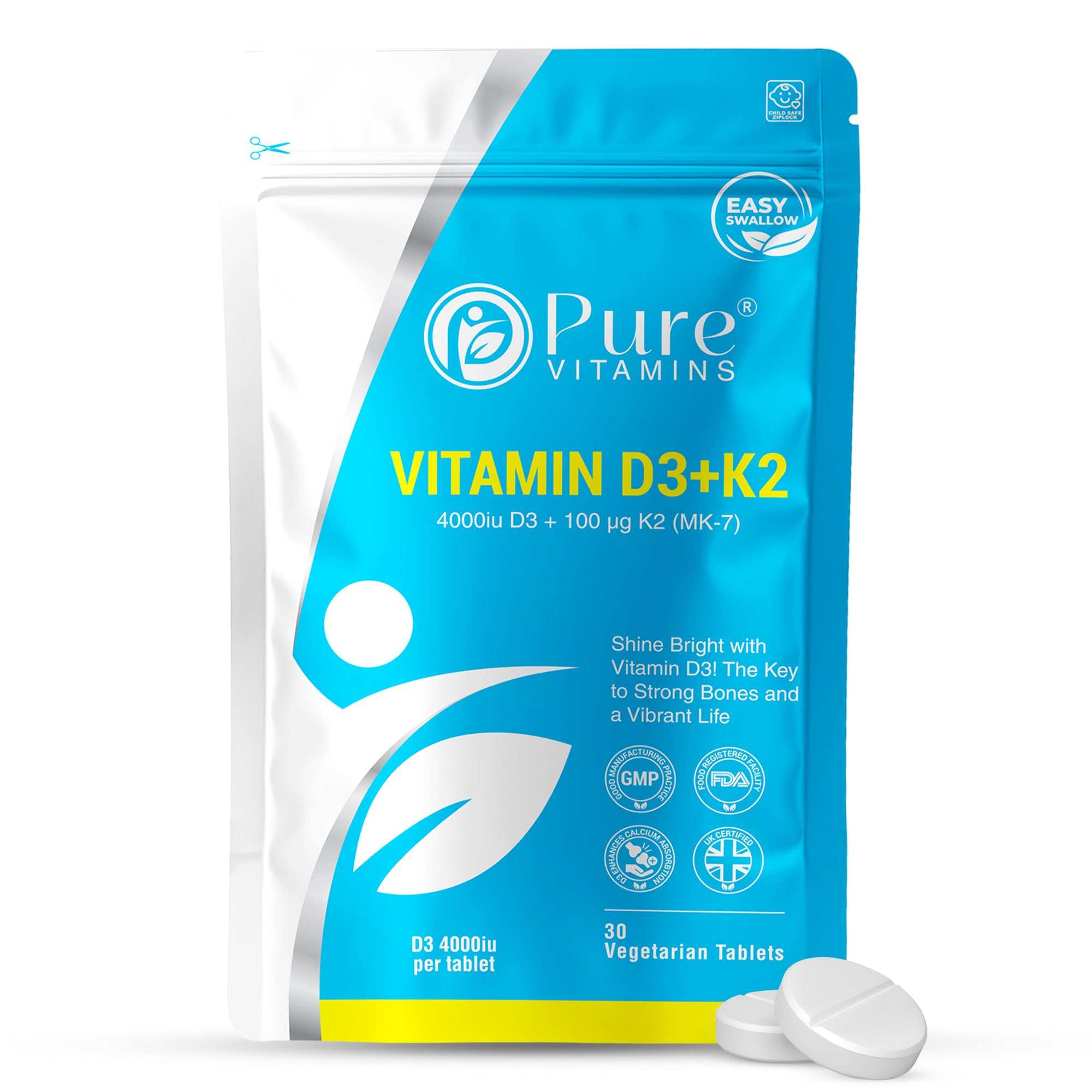
Practically, that means a label saying "vitamin K2 as MK-7" with the microgram amount printed next to it tells you more than one that simply says "vitamin K complex". Our tablet provides 100 micrograms of K2 as MK-7 alongside 4000 IU of D3, in one tablet, once a day. The long half-life is also the reason a once-daily habit is forgiving: MK-7 does not clear from the body overnight, so an occasional late tablet or missed day does not undo the pattern.

Magnesium, calcium and the rest of the stack
If you take magnesium as well, there is a nice bit of biology worth knowing, and it also settles a timing question people often ask alongside this one.
A review of magnesium and vitamin D explains that the enzymes which activate and process vitamin D in the liver and kidneys rely on magnesium as a cofactor, so magnesium status and vitamin D status are quietly linked (Uwitonze and Razzaque, 2018). A twelve-week randomised, double-blinded controlled trial went further and found that participants taking magnesium glycinate together with vitamin D showed a greater rise in serum 25-hydroxyvitamin D than those taking the same vitamin D dose alone (Cheung and colleagues, Nutrition, 2022). It is one trial in a specific group of participants, so I would call it encouraging rather than settled, but it is a reasonable argument for running the two together.
Magnesium in its own right contributes to normal muscle function, to the normal functioning of the nervous system, and to the maintenance of normal bones. Many people prefer glycinate in the evening because it is gentle and easy on the stomach, so a common rhythm is D3 and K2 with a morning or midday meal and magnesium later on. There is no clash in taking them at the same time if you would rather, it is simply a matter of what you find easiest.
Calcium is the other one people ask about. There is no need to avoid taking calcium and vitamin D together, and in fact they are frequently combined on purpose. The only practical note is that a very large single calcium dose can compete with magnesium and iron for uptake, so if you are taking several minerals it is tidier to spread them across the day than to swallow everything in one handful. For which magnesium form pairs best, see our guide on what kind of magnesium to take with vitamin D3 and K2, and for the timing specifically, the best time to take vitamin D3 and magnesium glycinate.
How much D3 and K2 to take, and the safe upper limit
In the UK, official guidance is that adults should consider a daily supplement providing 10 micrograms (400 IU) of vitamin D, particularly through autumn and winter when there is not enough UVB in the sunlight for skin to make its own. That figure is a floor for the general population rather than a target for everyone, and plenty of people choose a higher maintenance amount.
The UK winter window is worth stating plainly, because it is the single most useful piece of local context on this whole subject. Between roughly October and March, the sun does not get high enough in the sky at our latitude for the UVB that skin needs, so however much time you spend outdoors, your skin makes very little vitamin D during those months. That is why the NHS advice singles out autumn and winter, and why a daily habit through the darker half of the year matters more than anything about the hour you take it.
Our tablet provides 4000 IU of D3 with 100 micrograms of K2 as MK-7. On safety, the ceiling is worth committing to memory: the tolerable upper intake level for vitamin D from supplements for adults is 100 micrograms, which is 4000 IU, a day. Staying at or below that without professional advice is sensible, and it is exactly why I would not casually stack a high-dose D3 tablet on top of a multivitamin, a cod liver oil and a fortified drink without adding up what you are actually taking. Vitamin K2 at supplemental levels has a good safety record in healthy adults, and there is no benefit in chasing enormous doses.
What changes how much vitamin D you actually need
The 10 microgram figure is a population-level floor, not a personalised number, and several ordinary things shift where you sit relative to it. None of these is a reason to panic, but they are worth knowing about yourself.
- How much daylight reaches your skin. Someone who walks at lunchtime through the summer starts autumn from a different place than someone whose daylight hours are spent entirely indoors. Shift workers and office workers are the classic case.
- Skin tone. Melanin is a natural filter for UVB, so people with brown or black skin generally make less vitamin D from the same amount of sun exposure and are more likely to benefit from topping up year-round.
- Covering up. Clothing that covers most of the skin for cultural, religious or practical reasons has the same effect as staying indoors, whatever the weather is doing.
- Age. The skin's ability to make vitamin D declines with age, and older adults also tend to spend less time outdoors, so the two effects compound.
- Sunscreen and time of day outdoors. High-factor sunscreen reduces UVB reaching the skin, which is the right trade-off for skin health and simply means the supplement is doing more of the work.
- What you eat. Oily fish, egg yolks and fortified foods contribute, but very few UK diets supply enough from food alone to cover the winter.
- How much you already take. A multivitamin, a cod liver oil and a separate D3 tablet all count towards the same total. Add them up before adding another.
If a lower daily amount suits you better, that is a perfectly reasonable choice, and our piece on whether 1000 IU of vitamin D3 daily is a good idea walks through it. To understand the difference between D3 and D2, and how to read the signs of low vitamin D, our explainer on vitamin D3 vs D2 and deficiency signs covers it clearly.

Spacing around medicines and other supplements
A short, practical section that most timing articles leave out entirely.
- Levothyroxine. The usual advice is to take it on an empty stomach and leave a few hours before other supplements and mineral-containing products. A simple approach is thyroid medicine first thing, D3 and K2 with a later meal, leaving roughly four hours between levothyroxine and any calcium, iron or magnesium supplement.
- Anticoagulants. If you take warfarin or another anticoagulant, vitamin K can affect how these medicines work, so please speak to your GP or pharmacist before starting a K2 supplement rather than adding it yourself. This is not a reason for most people to worry, but it is exactly the kind of thing worth flagging plainly.
- Thiazide diuretics. Medicines such as bendroflumethiazide and indapamide reduce how much calcium the kidneys excrete. Combined with a higher-dose vitamin D supplement, that can push blood calcium up, so if you are on one, take advice before starting rather than adding it yourself.
- Orlistat and other fat-absorption medicines. Because D3 and K2 rely on fat for uptake, medicines that reduce fat absorption can reduce how much you take up. Speak to your pharmacist about spacing.
- Iron and calcium. No need to avoid them, but if you take several minerals it is tidier to spread them across the day rather than swallowing everything in one go.
What actually goes wrong, and it is never the hour
In practice, the things that undermine a D3 and K2 routine are boringly consistent, and none of them is the clock. Worth reading this list honestly against your own habits.
- Taking it on an empty stomach. The classic version is a tablet swallowed with a black coffee at seven in the morning, hours before any food. Move it to whenever you actually eat.
- Skipping days. This is the big one. Vitamin D status is built over weeks, so a tablet taken four days out of seven is doing roughly four sevenths of the job however precisely those four are timed.
- Stacking without adding up. A high-dose D3 tablet plus a multivitamin plus a cod liver oil plus a fortified drink can quietly take you past the upper limit. Add up the micrograms across everything you take.
- Chasing a bigger number. More vitamin D does not work faster, and above the upper limit it becomes a genuine safety question rather than a benefit question.
- Stopping in April. Some people do need year-round topping up. Stopping the moment the clocks change, then restarting in November, gives you a sawtooth rather than a steady level.
- Buying a vague label. "Vitamin K complex" with no form or microgram figure tells you nothing about what you are taking.
Building the habit so the dose is not missed
Since consistency is the whole game, it is worth spending thirty seconds designing the habit rather than relying on willpower.
The approach that works best is anchoring: attach the tablet to something you already do every single day without deciding to. Put the pot next to the kettle, the coffee machine, or the breakfast bowls rather than in a bathroom cabinet you open at variable times. If you eat breakfast at your desk, the pot lives on your desk. Choose the meal you never skip, not the meal you think you ought to eat.
Beyond that: a weekly pill organiser makes a missed day visible instead of invisible, which is most of the battle. A phone alarm set for the meal, not for an abstract time, works better than a generic morning reminder. And if you do miss a day, simply carry on the next day. Do not double up, and do not treat a lapse as a reason to abandon the routine. Vitamin D is stored in the body precisely so that one missed day does not matter.
A simple daily routine that works
Here is how I would actually put all of this together, kept deliberately easy so you can keep it up. Take one D3 and K2 tablet with your breakfast or lunch, ideally a meal with a little fat in it. Anchor it to something you already do without thinking, such as your morning coffee and toast, so it becomes automatic. If you take magnesium, run it in the evening. That is genuinely it. You do not need to obsess over the exact minute, split doses, or reshuffle everything by the season.
Because UK skin makes very little vitamin D between roughly October and March, the darker months are when a daily habit matters most. If you want the wider seasonal picture, our guide on vitamin D in winter in the UK explains who benefits from topping up year-round.
What to realistically expect
Vitamin D builds slowly. Your body stores it and blood levels rise over weeks rather than days, so the honest expectation is patience. You take it consistently through the darker months to keep your levels topped up, not because a switch will flip the next morning. Framing it that way tends to make people much happier with their routine, because they are not waiting for fireworks that were never the point. If you want to know where you actually stand, a vitamin D blood test through your GP or a reputable lab is more useful than guessing from how you feel.
What I would look for on any D3 and K2 label
Since you are here because you want to do this properly, here is the short checklist I would apply to any brand, ours included. Look for the vitamin K form spelled out as MK-7 with a microgram figure, not a vague "vitamin K blend". Look for the vitamin D amount in both micrograms and IU so you can add up your total intake across products. Check where it is formulated and how it is tested. Ours is formulated in the UK and tested for purity and heavy metals at our GMP-certified facility, and the full breakdown is printed on the label rather than hidden behind a proprietary blend. And check the serving size, because a low headline price on a tablet you have to take three of is not the bargain it looks like.
A few cautions worth knowing
- If you take warfarin or another anticoagulant, check with your GP or pharmacist before taking vitamin K2, because vitamin K can affect how these medicines work.
- If you have kidney disease, a history of high blood calcium, or sarcoidosis, take advice before using a higher-dose vitamin D product.
- If you take a thiazide diuretic such as bendroflumethiazide or indapamide, speak to your GP or pharmacist before starting a higher-dose vitamin D supplement.
- If you are pregnant or breastfeeding, or taking any regular medication, have a quick word with a healthcare professional first.
- Do not exceed 100 micrograms (4000 IU) of vitamin D a day from supplements without professional advice, and do not stack several vitamin D products at once.
- Children have different requirements, so follow the guidance for their age rather than sharing an adult tablet.
Frequently asked questions
What is the best time of day to take vitamin D?
With whichever meal of your day contains the most fat, most commonly breakfast or lunch. There is no clock time that produces better blood levels, so the practical answer is to pick the meal you never skip and take it then, every day.
What is the best time of day to take vitamin D3 and K2?
With your largest fat-containing meal. Morning or lunchtime suits most people, but the exact hour matters far less than taking it with food and taking it consistently.
Is it better to take D3 and K2 at night or in the morning?
Neither is better for absorption. Morning tends to be the easier habit to keep and removes the sleep question; evening is fine if that is when your fattiest meal is. Choose the one you will stick to.
Does taking vitamin D at night affect melatonin or sleep?
There is no good randomised evidence in healthy adults that an evening dose disturbs sleep, and supplemental vitamin D does not act on the body like daylight does. Some people report feeling less settled, so if that sounds like you, simply move it to the morning.
Can I take vitamin D3 and K2 together?
Yes. They are commonly combined in a single tablet and work naturally alongside each other, with vitamin D contributing to the normal absorption and utilisation of calcium and both nutrients contributing to the maintenance of normal bones.
Do I need to take vitamin D3 and K2 with food?
It helps. Both are fat-soluble, and a single-dose study found peak plasma vitamin D3 was around 32 per cent higher when the supplement was taken with a fat-containing meal rather than a fat-free one. Roughly ten to fifteen grams of fat in the meal is plenty.
How much vitamin D3 and K2 should I take?
In the UK, 10 micrograms (400 IU) of vitamin D a day is the general guidance, particularly in autumn and winter. Our tablet provides 4000 IU of D3 with 100 micrograms of K2 as MK-7. Do not exceed 100 micrograms (4000 IU) of vitamin D a day from supplements without advice.
What changes how much vitamin D I need?
How much daylight reaches your skin, your skin tone, whether you cover up, your age, sunscreen use, what you eat, and how much vitamin D you already take from other products. None of these changes the timing advice, only the amount worth taking.
Can I take magnesium at the same time as vitamin D3 and K2?
Yes. Magnesium acts as a cofactor for the enzymes that process vitamin D, so many people run them together. Because magnesium glycinate is often preferred in the evening, a common pattern is D3 and K2 with a morning or midday meal and magnesium later on.
Does it matter if I miss a day?
Not much. Vitamin D is stored in the body and levels change over weeks, so one missed day is unimportant. Simply carry on the next day rather than doubling up.
Is there a best time to take vitamin K2 specifically?
No. MK-7 has a long half-life and stays measurable in the blood for days rather than hours, so there is no particular hour to aim for and no need to split the dose.
Should I still take D3 and K2 in the summer?
Many people in the UK do. Skin makes very little vitamin D between roughly October and March, so the darker months are the priority, but anyone who covers up, works indoors or has darker skin may benefit from topping up year-round.
Bringing it together
So, the best time of day to take vitamin D, with or without K2 alongside it, is with your fattiest meal, most easily breakfast or lunch, taken consistently. Morning and night both work, so if evening vitamin D unsettles your sleep, move it earlier, and if it does not, leave it where it is. Beyond that, relax about the clock and put your effort into the habit and into choosing a product whose label actually tells you what is inside. If you would like a straightforward walkthrough of how to choose a good one, see our best vitamin D3 and K2 supplements UK buyer's guide, browse the rest of our supplement guides, or head back to the Pure Vitamins UK home page.
Warmly,
Dr. Miron, Founder of Pure Vitamins UK
Food supplements should not be used as a substitute for a varied, balanced diet and a healthy lifestyle. This article is for general information and is not medical advice. Always consult a healthcare professional before use if you are pregnant, breastfeeding, have a medical condition or are taking medication.

