


Reviewed and updated: 10 August 2026
The best time to take Vitamin D3 and magnesium glycinate
The best time to take Vitamin D3 and magnesium glycinate for most people is to take your vitamin D3 with a meal during the day, and your magnesium glycinate in the evening, though the honest truth is that taking them consistently matters far more than getting the clock exactly right. They are two of the most common supplements in a British bathroom cabinet, and they pair together beautifully. Below I will walk you through the timing that genuinely helps, the timing that is really down to personal preference, and the one small science story that explains why these two belong together in the first place.
I am Dr. Miron, founder of Pure Vitamins UK, and this is the answer I give friends and customers when they ask how to fit both into a normal day.

Quick answer
- What it is: a simple daily pairing of vitamin D3 (often with K2) and a well-absorbed magnesium such as magnesium glycinate.
- Best time for D3: with a meal at any point in the day, ideally one that contains a little fat.
- Best time for magnesium glycinate: many people prefer the evening, because it fits a wind-down routine, but morning is perfectly fine too.
- Can you take them together? Yes. There is no need to separate them, though a lot of people naturally split D3 to the daytime and magnesium to the night.
- The one thing to know: consistency beats perfect timing. Daily use is what moves the needle, not the exact hour.
Can you take vitamin D3 and magnesium glycinate together?
Yes, you can take vitamin D3 and magnesium glycinate together, and there is a neat reason they actually complement each other rather than compete. They do not block one another in the gut, so taking both with the same meal is completely fine. In practice, though, many people land on a natural rhythm of D3 with breakfast or lunch and magnesium glycinate with their evening meal or before bed, simply because that is easy to remember and fits how the day flows.
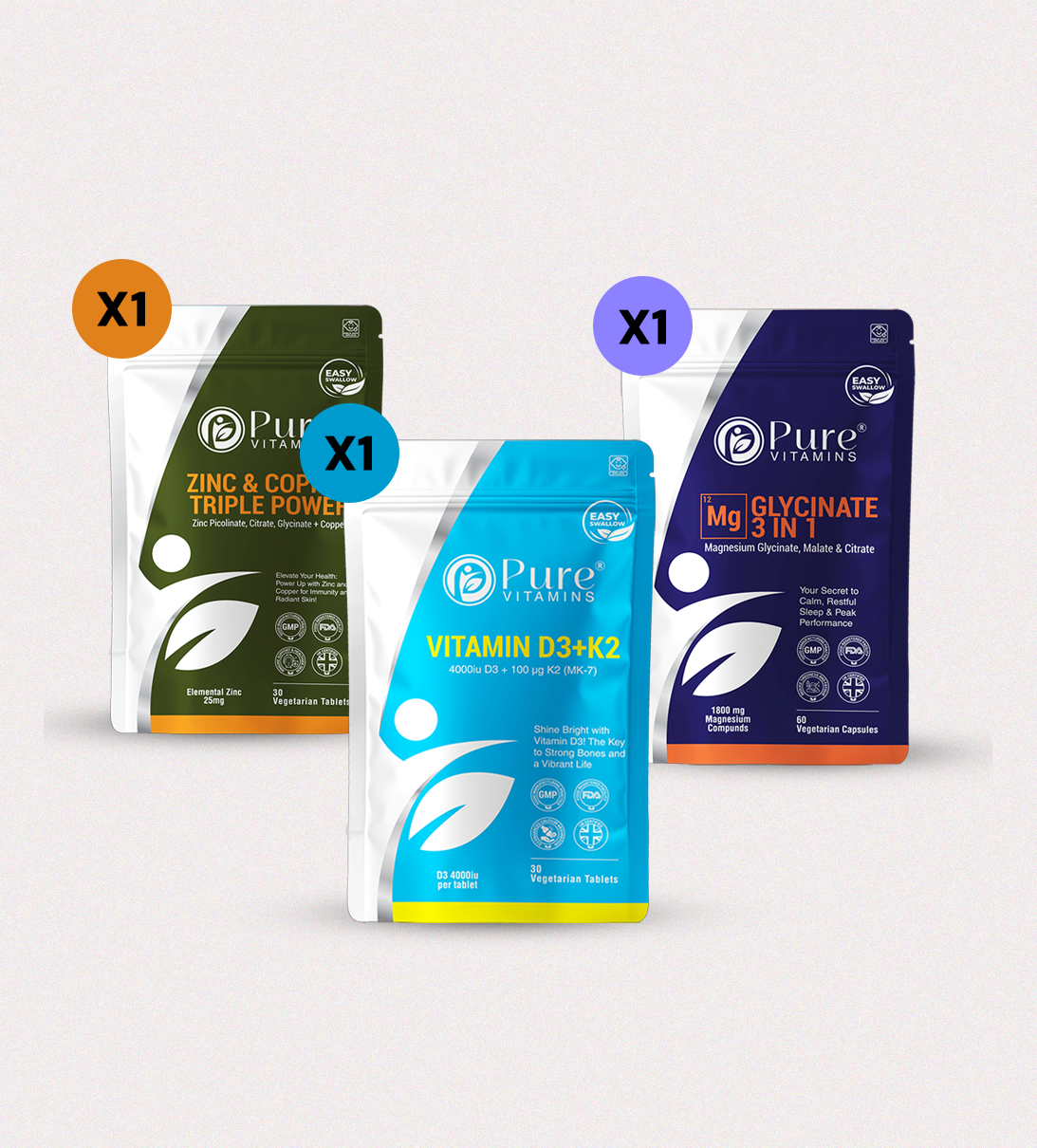
If you would rather take everything in one go, that works too. The most important habit is that both actually get taken, every day, for long enough to matter. If you like the idea of the two together with zinc, our Immunity & Energy Support Trio was built around exactly this daily pairing.
Why vitamin D3 likes a meal
Vitamin D3 is fat-soluble, which means it is absorbed alongside the fats in your food rather than dissolving in water like vitamin C. That is why the classic advice is to take it with a meal. In a randomised study in older adults, researchers found that a single large dose of vitamin D3 was absorbed better when taken with a meal than after an overnight fast, so having something in your stomach genuinely helps the initial uptake (Dawson-Hughes et al., 2013, https://doi.org/10.1002/jbmr.1896).
Here is the honest and slightly reassuring part. In that same study, the meal changed how much D3 appeared in the blood in the short term, but after 30 and 90 days the blood vitamin D levels were much the same across the groups. In plain terms, taking D3 with food gives absorption a helpful nudge, but over the weeks and months your levels are driven mostly by taking it regularly. So take it with a meal if you can, do not lose sleep if one day you forget the food, and make the daily habit the real goal.

Does it need to be a fatty meal?
A little fat helps, but you do not need a fry-up. Interestingly, in the research above the low-fat meal actually edged out the high-fat one for short-term absorption, so a normal balanced meal with some healthy fat, think eggs, oily fish, olive oil, nuts, avocado or full-fat dairy, is more than enough. The takeaway is simple: take D3 with whatever meal you are already eating, rather than on a completely empty stomach.
Why many people take magnesium glycinate in the evening
Magnesium glycinate has a bit of a reputation as an evening supplement, and there are two reasons for that. The first is practical: it slots neatly into a wind-down routine, so it is easy to remember with dinner or before bed. The second is that magnesium is bound here to glycine, an amino acid many people associate with calm, and the glycinate form is gentle on the stomach, so it is comfortable to take later in the day.
What does the science actually say about magnesium and sleep? Honestly, it is modest and mixed rather than a slam dunk. A systematic review and meta-analysis of older adults with insomnia found that magnesium supplements shortened the time it took to fall asleep by around 17 minutes on average compared with placebo, but the authors were clear that the studies were small and the overall quality of evidence was low (Mah and Pitre, 2021, https://doi.org/10.1186/s12906-021-03297-z). An earlier trial in adults over 51 with poor sleep found sleep scores improved during the study, but they improved in the placebo group too, so the researchers could not pin the benefit on magnesium alone (Nielsen et al., 2011, https://doi.org/10.1684/mrh.2010.0220).
So if you find an evening magnesium helps you settle, that is a perfectly good reason to keep taking it then. Just go in with realistic expectations rather than treating it as a sleeping tablet. What we can say plainly is that magnesium contributes to normal muscle function, to the normal functioning of the nervous system, to normal psychological function and to the reduction of tiredness and fatigue, which is a big part of why so many people like having it as part of their evening routine.

Vitamin D3 in the morning or at night?
This is the question I get asked most, and the reassuring answer is that it genuinely does not matter much. Your body does not have a strict clock for absorbing vitamin D, so the best time is simply the time you will actually remember, taken with food.
There is one caveat worth mentioning. A handful of people report that taking vitamin D late in the evening seems to disturb their sleep. The evidence for this is thin and largely anecdotal rather than something confirmed in trials, but it costs nothing to act on. If you take D3 at night and notice your sleep feels lighter, simply move it to breakfast or lunch and keep the magnesium for the evening. For most people, morning D3 and evening magnesium is a tidy, easy split that sidesteps the whole debate.
Magnesium and vitamin D actually work as a team
Here is the small science story that makes this pairing more than a coincidence. Vitamin D does not work in isolation. The enzymes that convert vitamin D into its active form in the liver and kidneys rely on magnesium to do their job. A review in the Journal of the American Osteopathic Association describes magnesium as a cofactor for the enzymes that metabolise and activate vitamin D, which means that having enough magnesium helps your body make proper use of the vitamin D you take (Uwitonze and Razzaque, 2018, https://doi.org/10.7556/jaoa.2018.037).
That is a lovely, practical reason to think of these two as partners rather than as separate items on a shopping list. It is also a genuine point of science about how the nutrients behave in the body, not a promise about any single product. If you want the fuller picture on choosing between D3 options, our UK buyer's guide to vitamin D3 and K2 supplements goes deeper, and you can compare forms in how magnesium glycinate compares with citrate.
How much of each should you take?
Let us talk numbers, because dose is really part of the timing question. For vitamin D, the NHS advises that adults consider a daily supplement providing 10 micrograms (that is 400 IU) of vitamin D, particularly from October to March in the UK when we make very little from sunlight. Many people choose a higher-strength option such as a 4000 IU (100 microgram) D3, which sits at the upper end of what is considered safe for adults to take long term. Taking more than 100 micrograms (4000 IU) a day over long periods is not advised for adults without medical guidance, because vitamin D is fat-soluble and builds up in the body. If in doubt, 10 micrograms a day is plenty for most people.
For magnesium, UK guidance suggests that supplemental magnesium of around 250 mg a day is unlikely to cause problems for most adults, with the main issue at higher doses being a laxative effect rather than anything sinister. Well-absorbed, gentle forms such as glycinate tend to be more comfortable than cheap magnesium oxide, and remember that food adds magnesium on top of any supplement. Always follow the dose on the label and do not exceed it. If you are weighing up which magnesium to buy in the first place, we cover exactly that in what to look for in a magnesium supplement.
A quick word on D3 and K2
You will often see vitamin D3 paired with vitamin K2, and it is worth knowing why. Vitamin D contributes to the normal absorption and utilisation of calcium and to the maintenance of normal bones, while vitamin K contributes to the maintenance of normal bones too. The two are commonly combined so they work alongside each other, which is why our D3 comes paired with K2 as MK-7. If bone support is your main reason for taking them, you might also like why D3 and K2 are paired for bone health, and for pure timing detail there is the best time of day to take vitamin K2 and D3.

Timing around medicines, and a few cautions worth knowing
Most people can take D3 and magnesium glycinate without any fuss, but a few situations call for a little care.
- Levothyroxine (thyroid medication): minerals such as magnesium can reduce how well thyroid medication is absorbed. If you take levothyroxine, take it on an empty stomach and leave a gap of around four hours before your magnesium.
- Warfarin and other blood thinners: vitamin K plays a role in normal blood clotting, so if you take warfarin, keep your vitamin K intake steady and speak to your GP or pharmacist before starting a D3 with K2.
- Kidney problems: if you have reduced kidney function, check with your doctor before taking magnesium supplements, as your body may clear it less easily.
- Pregnancy and breastfeeding: vitamin D is recommended in pregnancy, but it is sensible to confirm doses of any supplement with your midwife or GP.
- Other minerals and medicines: if you take iron, calcium or certain antibiotics, spacing magnesium a couple of hours apart avoids any absorption clash.
None of this should put you off. It is simply the sort of practical care that makes a daily routine safe as well as easy.
Who should take vitamin D year-round in the UK?
The UK sits far enough north that from about October to March our skin makes very little vitamin D, whatever the weather does. That is why the NHS suggests everyone consider a daily vitamin D supplement through the darker months. Some groups are advised to take it all year, including people who spend little time outdoors, those who cover most of their skin when outside, and people with darker skin tones, who make vitamin D less efficiently at our latitude. If that sounds like you, a small daily D3 is one of the simplest habits worth keeping. You can read more on the seasonal side in vitamin D in the UK winter, and on everyday dosing in whether 1000 IU of vitamin D3 a day is a sensible amount.
What to realistically expect
Let me set honest expectations, because I would rather you stayed with a routine than gave up after a fortnight. Vitamin D works quietly in the background, topping up a level you cannot feel changing day to day, so its value is in steady, long-term use through the seasons rather than a noticeable buzz. Magnesium is much the same. If an evening dose helps you feel a little more settled, wonderful, but count that as a bonus on top of its everyday role in muscle and nervous-system function. The people who get the most from this pairing are simply the ones who take it consistently.
Frequently asked questions
Can I take vitamin D3 and magnesium glycinate at the same time?
Yes. They do not interfere with each other, so taking both with the same meal is fine. Many people still prefer to take D3 during the day with food and magnesium glycinate in the evening, simply because it is easy to remember.
Should I take vitamin D3 in the morning or at night?
Either works. The best time is whenever you will reliably remember, taken with a meal. If you take it at night and feel it affects your sleep, move it to breakfast or lunch and keep magnesium for the evening.
Why should vitamin D3 be taken with food?
Vitamin D3 is fat-soluble, so a meal helps it absorb. Research shows a meal improves short-term absorption compared with fasting, although over weeks and months your blood levels are driven mostly by taking it consistently.
Does magnesium glycinate actually help sleep?
The evidence is modest and mixed. Some studies suggest magnesium can slightly shorten the time it takes to fall asleep, but the trials are small and low quality. Many people find an evening dose helps them wind down, and magnesium contributes to normal nervous-system and psychological function.
How much vitamin D3 and magnesium should I take?
The NHS suggests adults consider 10 micrograms (400 IU) of vitamin D a day, especially from October to March, and adults should not exceed 100 micrograms (4000 IU) a day long term without advice. For magnesium, supplemental doses around 250 mg a day suit most people. Always follow your product label.
The simple routine I would suggest
If you want a plan you can start tomorrow, here it is: take your vitamin D3, ideally with K2, alongside breakfast or lunch, and take your magnesium glycinate with your evening meal. Do that every day and you have covered both the timing that matters and the timing that is just personal preference. For the wider picture, browse all our supplement guides, or explore what we make at Pure Vitamins UK. You can also see the individual Vitamin D3 + K2 tablets and Magnesium Glycinate 3-in-1, or take both together in one pack.
Shop the Immunity & Energy Support Trio
Warmly,
Dr. Miron, Founder of Pure Vitamins UK
Food supplements should not be used as a substitute for a varied, balanced diet and a healthy lifestyle. This article is for general information and is not medical advice. Always consult a healthcare professional before use if you are pregnant, breastfeeding, have a medical condition or are taking medication.

