


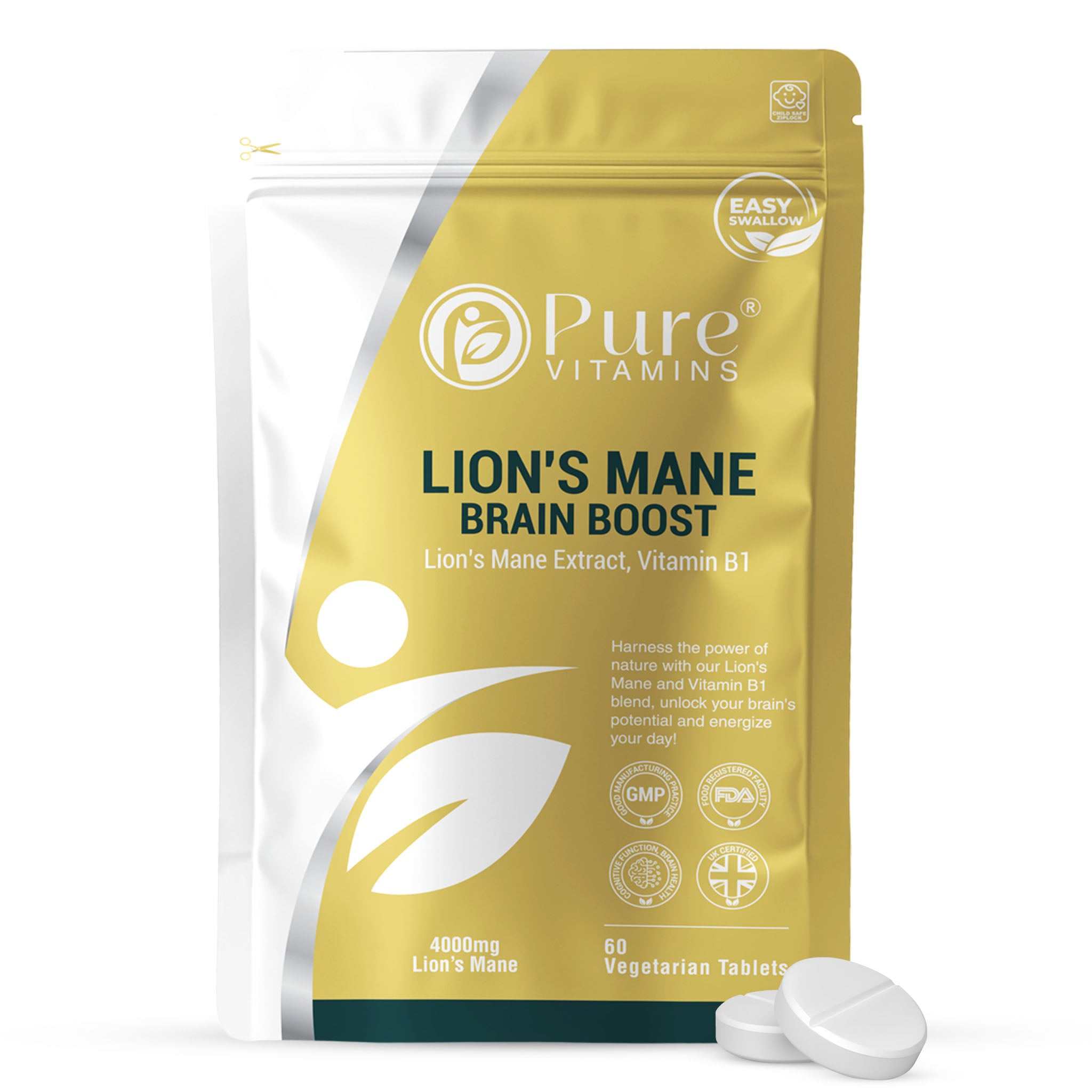
Is 4000 mg of lion's mane safe?
For most healthy adults, 4000 mg of lion's mane on a UK supplement label is safe to take daily, because that figure almost always describes the raw mushroom equivalent rather than 4000 mg of concentrated extract. Once you decode the label, a "4000 mg" tablet usually delivers a few hundred milligrams of actual extract, which sits comfortably inside the amounts used in published human studies. The number looks big. What it represents is more modest, and that distinction is the whole answer.
Reviewed and updated: 19 August 2026

Lion's mane (Hericium erinaceus) is not some newly invented lab compound. It is a shaggy white mushroom that grows on hardwood trees across Europe, North America and East Asia, and people have been eating it for a very long time. In Chinese and Japanese traditional practice it has been prized for centuries both as a delicacy and as a tonic, traditionally reached for to support a clear head and a settled stomach. Buddhist monks are said to have brewed it as a tea before meditation. That heritage matters here, because when a food has been eaten for centuries, we are not starting a safety conversation from zero.
What has changed is the packaging. A mushroom you would once have sliced into a broth now arrives as a tablet with a number on the front, and that number is where nearly all the confusion about safety comes from. So let us go through it properly.
TL;DR
- The short answer: yes, for most healthy adults, a 4000 mg lion's mane supplement is a sensible daily amount, because 4000 mg is the mushroom equivalent, not the weight of extract in the tablet.
- What it really means: a 10:1 extract at 400 mg represents 4000 mg of raw mushroom. Same tablet, two different-looking numbers.
- What studies have used: human trials have run at roughly 1.8 g to 3 g of lion's mane preparation a day for four to sixteen weeks, with no adverse effects reported in the published results.
- The honest caveat: there is no official Tolerable Upper Intake Level for lion's mane, because upper limits are set for nutrients, not for mushrooms. Absence of a limit is not the same as a licence to take unlimited amounts.
- The one real hard stop: if you have a mushroom allergy, do not take it. Everyone else, follow the label and start low.
What 4000 mg on a lion's mane label actually means
This is the single most useful thing to understand, and almost nobody explains it clearly, so here it is in plain terms.
Extract weight versus mushroom equivalent
Concentrated mushroom extracts are described with a ratio. A 10:1 extract means ten parts of dried mushroom were processed down into one part of extract. So 400 mg of a 10:1 extract represents, and is derived from, 4000 mg of the starting mushroom. Both figures describe the same tablet. One is the weight of powder that goes in; the other is how much raw mushroom it took to make it.
Manufacturers can legitimately print either number, and most print the bigger one because it looks more impressive on a shelf. That is why you will see 4000 mg, 5000 mg, even 10,000 mg on the front of packs that contain a fraction of that weight in actual material. Our own Lion's Mane 4000mg uses exactly this convention: 4000 mg equivalent, delivered as a concentrated extract standardised to 50% polysaccharides.
Once you know this, the safety question changes shape entirely. Nobody is asking you to swallow four grams of mushroom powder. You are taking a small, concentrated tablet that stands in for four grams of mushroom, which is roughly a modest portion of a cooked mushroom side dish.
How to work out what you are really taking
Three quick checks tell you almost everything:
- Is there a ratio on the label? If it says 10:1, 8:1 or similar, the big number is very likely the equivalent, not the extract weight. Divide by the first figure to get the approximate extract weight.
- Does it say "equivalent" or "equiv."? That word is doing a lot of work. It is the manufacturer telling you the figure is a conversion.
- Is there a standardisation percentage? A stated polysaccharide or beta-glucan percentage tells you the extract has actually been measured for its active fraction rather than just ground and bagged.
If a pack shouts a huge milligram figure with no ratio, no equivalence wording and no standardisation, you genuinely cannot tell what is inside it. That is a labelling problem, not a safety problem in itself, but it makes any sensible dose conversation impossible. I go into the arithmetic in more detail in our lion's mane dosage guide.
What is actually in lion's mane
To think about safety sensibly, it helps to know what the mushroom contains. Lion's mane is not one active compound; it is a food with a mixed chemistry, and the compounds are distributed differently between the parts of the organism.
- Hericenones. Aromatic compounds found in the fruiting body, the visible white mushroom itself. These are the compounds most often discussed in the research literature.
- Erinacines. Diterpenoid compounds concentrated in the mycelium, the root-like network the mushroom grows from. Erinacines and hericenones are chemically distinct and come from different parts, which is one reason fruiting body and mycelium products are not interchangeable.
- Beta-glucans and other polysaccharides. The structural carbohydrates that make up much of the mushroom's cell walls. These are what a "standardised to 50% polysaccharides" figure is measuring, and they are the most common quality marker on a mushroom extract label.
- Ergothioneine. A naturally occurring sulphur-containing amino acid found in many mushrooms, including lion's mane, and a subject of ongoing research interest.
None of these are exotic or novel to the human diet. They are the ordinary constituents of an edible mushroom that has been on menus for centuries, which is a meaningful part of why the safety record looks the way it does. If you want the fuller chemistry, our piece on what the research says about lion's mane and focus goes further into it.
The typical amounts people take
Across the UK and European market, lion's mane supplements broadly cluster into a few bands:
- 250 mg to 500 mg of concentrated extract per day. This is the most common real-world extract dose, often labelled as 2500 mg to 5000 mg equivalent.
- 500 mg to 1000 mg of concentrated extract per day. A higher band, usually split across two servings.
- 1 g to 3 g of plain dried powder per day. Powders are not concentrated, so the numbers are necessarily larger to represent a comparable amount of mushroom.
A commonly quoted practical ceiling in the supplement world is around 3000 mg of extract a day, but I want to be straight with you: that figure is a convention rather than a regulated limit. It reflects what manufacturers and practitioners have settled on, not a threshold that a UK or European authority has set. When someone tells you 3000 mg is "the maximum", they are describing custom, not law.
The practical point is that a 4000 mg equivalent tablet is not in a different league from any of these bands. It sits squarely in the ordinary middle of the market.

What the human studies used, and what they reported
Human research on lion's mane is still modest in scale, and I would rather tell you that plainly than dress it up. The trials that exist are small, short and varied in design. But they are useful for one specific purpose, which is showing us what amounts have actually been given to people under observation and what the researchers recorded.
Based on trials retrieved from PubMed:
- A double-blind, placebo-controlled trial in Japanese adults aged 50 to 80 gave four 250 mg tablets of dried lion's mane powder three times a day, so roughly 3 g daily, for 16 weeks. The authors reported that laboratory tests showed no adverse effect of the mushroom over that period (Mori et al., 2009, DOI).
- A randomised, double-blind, placebo-controlled pilot study in 41 healthy adults aged 18 to 45 used 1.8 g a day for 28 days, alongside an acute single-dose arm. It was a small study and the authors were careful to say so, but it gives us a second observed amount in a healthy, younger population (Docherty et al., 2023, DOI).
- A randomised, double-blind, placebo-controlled parallel-group study ran fruiting-body supplementation over 12 weeks, again with no safety concerns reported by the investigators (Saitsu et al., 2019, DOI).
- An earlier four-week study delivered lion's mane baked into cookies at a daily amount in the region of 2 g (Nagano et al., 2010, DOI).
Read those together and a picture emerges. Human intakes in the published literature have run at roughly 1.8 g to 3 g of lion's mane preparation per day, for periods of four to sixteen weeks, in adults from their late teens to their eighties, and the published reports do not describe adverse effects attributable to the mushroom.
Two honest limitations. First, these were mostly powder or fruiting-body preparations rather than high-ratio concentrated extracts, so the gram figures are not directly comparable with an extract tablet. Second, none of these studies was designed primarily as a safety trial, and none ran for years. What they give us is reassurance within their own boundaries, not a guarantee about long-term high-dose use. I would treat them as encouraging rather than conclusive.
What the safety and toxicology work shows
Alongside the human trials there is a body of dedicated toxicology work, which is where the sharper safety signal actually lives. These studies are done in animals, so they do not translate directly into a human dose, but they are designed specifically to look for harm and they are conducted at amounts far above anything a person would take.
- A 90-day subchronic toxicity study of a lion's mane beta-glucan extract preparation, conducted to Good Laboratory Practice and OECD test guidelines, found no toxicologically significant changes attributable to the test material in clinical observations, body weight, organ weights, haematology, serum chemistry or histopathology. The no-observed-adverse-effect level was set at 2000 mg per kg of body weight per day, the highest amount tested. Accompanying genotoxicity tests, including bacterial gene mutation, chromosome aberration and an in vivo micronucleus test, did not show genotoxicity (Chen et al., 2022, DOI).
- A separate 90-day study of an aqueous extract of the fruiting body reported no mortality or morbidity and no adverse effect on general behaviour, body weight, haematology, clinical biochemistry or relative organ weights at up to 1000 mg per kg of body weight, concluding that consumption is relatively non-toxic (Lakshmanan et al., 2016, DOI).
- A 28-day oral feeding study of an erinacine-enriched mycelium preparation found all animals survived, with no abnormal clinical signs and no differences attributable to the test material in urinalysis, haematology or serum biochemistry, giving a no-observed-adverse-effect level greater than 3 g per kg of body weight per day (Li et al., 2014, DOI).
To put those numbers in perspective without overstating them: a no-observed-adverse-effect level of 2000 mg per kg per day in a rodent is an enormous amount of material relative to a 400 mg extract tablet taken by an adult. Animal data never map one to one onto people, and I am not going to pretend otherwise. But when the dedicated toxicology, the genotoxicity screens and the human trial reports all point the same way, that consistency is worth something.
Is there an official upper limit for lion's mane?
No, and this is worth explaining because the absence trips people up.
Tolerable Upper Intake Levels are set for specific nutrients where excessive intake causes recognised problems. Vitamin D, vitamin A, iron, zinc, selenium and a handful of others have them. Lion's mane is not a nutrient in that sense; it is a food, and food ingredients are not assigned upper limits in the same framework. So when you search for "the maximum safe dose of lion's mane" and find nothing official, that is not a red flag and it is not a gap in the science. It is simply the wrong question for the category.
What you get instead is the combination of things above: centuries of dietary use, the amounts used in human trials, and dedicated toxicology at multiples of any realistic intake. That is the honest basis for saying a 4000 mg equivalent tablet is a reasonable daily amount for a healthy adult, and it is a more useful answer than an invented number would be.
My own rule of thumb is straightforward. Follow the serving on the pack, do not stack several mushroom products on top of one another without thinking about the total, and if you find yourself wanting to take four times the label amount, ask yourself what you are actually expecting to happen.
Possible side effects at higher amounts
Lion's mane is generally well tolerated, and the clinical reports reflect that. Where people do notice something, it is usually mild and usually digestive:
- Stomach discomfort, bloating or loose stools. Easily the most commonly reported niggle, and more likely with plain powders, on an empty stomach, or when someone jumps straight to a high amount. Mushroom cell walls are fibrous, and some digestive systems need a week or two to get used to that.
- Mild nausea. Again, most often reported when taken without food.
- Skin itching or rash. Occasionally reported. This can be an early signal of sensitivity rather than a simple tolerance issue, so it deserves attention rather than pushing through.
- Headache. Reported anecdotally, though it is hard to separate from everything else going on in a normal week.
Almost all of these respond to two very boring adjustments: take it with food, and take less of it for a fortnight before building back up. If a symptom persists after you stop, or if it is anything more than mild, stop taking it and speak to your GP or pharmacist.
People often ask what to do if they accidentally take an extra tablet, or double up because they forgot whether they had taken it. Given the amounts involved and everything described in the toxicology section below, one extra tablet is not a cause for concern. Skip the next scheduled serving, go back to your normal routine the following day, and if you feel unwell at any point, stop and speak to a pharmacist. Do not try to compensate for a missed day by taking two the day after; there is no benefit in it.
What is worth noting is the absence of certain things. Lion's mane is not a stimulant, so it does not cause the jitteriness or sleep disruption you get from caffeine, and timing it late in the day is not the problem people assume it is. There is no recognised withdrawal effect. And there is no evidence base suggesting tolerance builds in a way that requires escalating amounts.

Lion's mane and the liver
Liver safety comes up a lot with mushroom supplements, partly because the words "mushroom" and "liver" together make people nervous, and partly because a small number of case reports involving mixed mushroom powder blends have circulated online.
Here is what the published work on lion's mane specifically shows. In the 90-day subchronic study, serum chemistry, which includes liver enzyme markers, showed no toxicologically significant changes attributable to the test material at up to 2000 mg per kg of body weight per day (Chen et al., 2022, DOI). The second 90-day study similarly reported no adverse effect on clinical biochemistry, with the authors describing only a few incidental histopathological observations unrelated to the test material (Lakshmanan et al., 2016, DOI). And in the 16-week human trial, laboratory tests showed no adverse effect (Mori et al., 2009, DOI).
Two sensible caveats. Case reports involving multi-mushroom blends are not evidence about lion's mane on its own, because a blend containing several species cannot tell you which ingredient did what. And if you are already taking medication that is processed by the liver, or you are under medical care for a liver condition, the right move is to tell your doctor or pharmacist what supplements you take. That is good practice with any supplement, not a lion's mane-specific warning.
Mushroom allergy: the one genuine hard stop
If you are allergic to mushrooms, do not take lion's mane. It is a mushroom. This sounds obvious written down, but it is easy to forget when a food arrives in tablet form with a brand name on it.
Mushroom allergy is uncommon but real, and it is distinct from the mild digestive grumbling described earlier. Signs of a genuine allergic reaction include hives, swelling of the lips, face or throat, wheezing or difficulty breathing. Those need urgent medical attention, not a smaller dose.
People who work with mushroom spores, or who react to other fungi, may also want to be cautious and speak to a pharmacist first. And if you have never eaten lion's mane in any form before, starting with one tablet rather than two for the first few days is a sensible, no-cost precaution.
Fruiting body, mycelium, extract or powder: how form changes the number
Form matters as much as milligrams, and it directly affects how you should read a 4000 mg figure.
- Fruiting body. The actual mushroom. This is the part with centuries of dietary history behind it and the part that contains hericenones. On the whole, this is what I would look for on a label.
- Mycelium. The underground network. It contains erinacines, which the fruiting body does not, but it is frequently grown on a grain substrate that stays in the finished powder. That means part of what you are buying can be grain rather than mushroom, which is not unsafe, but it does mean the milligram figure is describing something different.
- Concentrated extract. Mushroom material processed with hot water or alcohol to concentrate the active fraction. This is where ratios like 10:1 come from and where a standardisation percentage becomes meaningful.
- Plain dried powder. The whole mushroom, dried and ground. Not concentrated, so gram-scale servings are normal and expected.
The safety implication is simple. A 4000 mg figure attached to a concentrated extract is an equivalence and represents a modest tablet. A 4000 mg figure attached to plain powder is four actual grams of powder, which is a much bulkier serving and rather more likely to cause the digestive grumbling described above. Same number, quite different experience.
Starting low and building up
This is my standard advice with any new supplement and it applies neatly here.
For the first week, take the lower end of the label serving, with food, at the same time each day. If everything feels normal, move to the full serving. If you notice mild digestive discomfort, hold at the lower amount for another week or two rather than abandoning it altogether, because most people settle within that window.
Taking it with food is the single most effective adjustment. It slows everything down, buffers the stomach and, as a bonus, makes it far easier to remember. Whether you take it in the morning or the evening is genuinely up to you; lion's mane is not a stimulant, so there is no sleep argument either way. If you like your routine anchored to a morning coffee, our piece on lion's mane coffee covers that habit.
Who should take care
Most healthy adults can take a lion's mane supplement without a second thought. These are the situations where I would pause and ask a professional first:
- Mushroom allergy or known fungal sensitivity. As above, this is a no.
- Pregnancy and breastfeeding. There is not enough research in these groups to say anything useful, and where the data are absent the honest answer is to leave it. This is the standard position for most botanical supplements.
- Taking prescribed medication. Particularly anticoagulants or antiplatelet medicines, diabetes medication, or anything with a narrow therapeutic window. Tell your GP or pharmacist what you are taking so they can advise on your actual situation.
- Booked in for surgery. Many clinicians ask patients to stop non-essential supplements a couple of weeks beforehand. Follow whatever your surgical team tells you.
- Children. Supplements of this type are formulated for adults.
- Managing an ongoing health condition. Check with the clinician who knows your history.
None of that is meant to be alarming. It is the same short list you would run through before adding anything new, and for the large majority of people it takes ten seconds.
What to realistically expect, and how long to give it
Let me set expectations honestly, because unrealistic ones are the main reason people escalate to amounts they do not need.
Lion's mane is not a stimulant and it does not do anything dramatic in the first hour. The human studies that have looked at it ran for four, twelve and sixteen weeks, which tells you something about the timescale researchers thought was appropriate. In the 16-week trial, scores tracked with the duration of intake and then fell back after people stopped taking it (Mori et al., 2009, DOI). Read that as a hint that consistency over weeks is the relevant unit of time, not days.
So give it a proper trial at the label amount for six to eight weeks before drawing any conclusions, and resist the temptation to double up because nothing happened by Friday. Taking more of something sooner is almost never the fix, and with a food-derived extract it is particularly unlikely to be.
How to choose a lion's mane you can actually trust
If the safety question is really a quality question in disguise, and quite often it is, here is what I would check on any pack:
- A stated extract ratio. 10:1 or similar, so you can convert the headline number yourself.
- The part of the organism named. Fruiting body, mycelium or both, stated plainly rather than hidden behind "mushroom powder".
- A standardisation figure. A polysaccharide or beta-glucan percentage means the active fraction has been measured, not assumed.
- Clear serving information. How many tablets a day, and how many days a pack lasts.
- Purity testing. Mushrooms are efficient accumulators from their growing substrate, so heavy-metal testing genuinely matters for this ingredient more than for many others.
- A short ingredients list. If you cannot work out why something is in there, that is a fair question to ask.
Our own Lion's Mane 4000mg states its equivalence, is standardised to 50% polysaccharides, includes black pepper extract, is Formulated in the UK and is tested for purity and heavy metals at our GMP-certified facility, with a Certificate of Analysis available on request. You do not have to buy ours, but do apply that checklist to whatever you do buy.

Where the vitamin B1 fits in
Our formula pairs the mushroom extract with vitamin B1, also called thiamine, and there is a good reason for that beyond it sounding nice on a label. Thiamine contributes to normal energy-yielding metabolism, to the normal functioning of the nervous system, and to normal psychological function. Those are established functions of the vitamin, and they sit naturally alongside the reasons people reach for lion's mane in the first place.
Thiamine is water soluble, which means the body does not store large amounts of it and excess is passed out rather than accumulated. It is one of the more forgiving vitamins in that respect, and at the amounts used in a supplement like this it is not a factor in the safety question you came here with.
Black pepper extract is in there for absorption support, which is a common and well-established formulation choice rather than an active ingredient in its own right.
Taking lion's mane alongside other supplements
A practical question that follows almost immediately from the safety one. Lion's mane is not known to conflict with the everyday supplements most people take, and it is commonly combined with B vitamins, magnesium, omega-3 or a general multivitamin without issue, a pairing we look at in detail in can I take lion's mane with vitamin B.
The sensible watch-outs are about totals rather than interactions. If you take a mushroom blend, a separate lion's mane tablet and a mushroom coffee, you are taking three servings, and it is worth adding them up rather than counting each as though the others do not exist. The same applies if your multivitamin already contains B vitamins and you are adding more.
If you are weighing lion's mane against another popular option, our comparison of lion's mane and ashwagandha may help, and if the whole category is new to you, our explainer on what a nootropic actually is is a good place to start.
A few cautions worth knowing
Keeping this brief and in one place, as it should be:
- Do not take lion's mane if you have a mushroom allergy.
- If you are pregnant or breastfeeding, leave it, as there is not enough research in these groups.
- If you take prescribed medication, especially blood-thinning or diabetes medication, speak to your GP or pharmacist first.
- Stop before planned surgery if your clinical team advises it.
- Stick to the label serving and count your total across all mushroom products you take.
- If you get anything more than mild, short-lived digestive discomfort, stop and get advice.
The takeaway
Is 4000 mg of lion's mane safe? For a healthy adult, yes, and the reason is less exciting than the number suggests: 4000 mg on a UK label is almost always the raw mushroom equivalent, delivered as a few hundred milligrams of concentrated extract. That sits inside the range used in published human trials, well below the amounts tested in dedicated toxicology work, and comfortably within what people have eaten as food for centuries. Read the ratio, take it with food, start low, and skip it entirely if mushrooms do not agree with you.
You can see the full formula and label detail on our Lion's Mane 4000mg page, browse every guide we have written in one place on our supplement guides hub, or have a look at the wider range on the Pure Vitamins UK home page.
Frequently asked questions
Is 4000 mg of lion's mane too much? Not for most healthy adults, because 4000 mg on a supplement label almost always describes the raw mushroom equivalent rather than the weight of extract in the tablet. A 10:1 extract delivering 4000 mg equivalent contains roughly 400 mg of concentrated extract.
Is there an official maximum daily dose of lion's mane? No. Tolerable Upper Intake Levels are set for specific nutrients rather than for mushrooms, so there is no official upper limit for lion's mane. Follow the serving stated on the pack.
Can I take lion's mane every day? Yes, it is normally taken daily, and the human studies ran continuously for four to sixteen weeks. Consistency over several weeks matters more than any single day.
What are the side effects of lion's mane? The most commonly reported effects are mild and digestive, such as stomach discomfort, bloating or loose stools, and are more likely on an empty stomach or when starting at a high amount. Taking it with food usually settles it.
Who should not take lion's mane? Anyone with a mushroom allergy should avoid it. Those who are pregnant or breastfeeding, taking prescribed medication, or managing a health condition should speak to a GP or pharmacist first.
Is lion's mane bad for your liver? The published toxicology and human trial reports on lion's mane have not shown adverse effects on liver-related laboratory markers at the amounts studied. If you take medication processed by the liver, tell your doctor or pharmacist what supplements you are taking.
Should I take lion's mane in the morning or at night? Either. It is not a stimulant, so timing is a matter of routine rather than a sleep consideration. Take it whenever you will remember it, ideally with food.
Food supplements should not be used as a substitute for a varied, balanced diet and a healthy lifestyle. If you are pregnant, breastfeeding, taking medication or managing a medical condition, speak to your GP or pharmacist before starting a new supplement. This article is for information and is not medical advice.
Dr. Miron, Founder of Pure Vitamins UK.

