

Lion's mane and focus is one of the most talked-about pairings in wellness, so let me give you the honest picture rather than the hype. Lion's mane is a striking, shaggy white mushroom that people across China, Japan and Korea have prized for centuries, both as a food and in traditional wellness practice, and today it is a favourite of the focus-and-study crowd. What does the research actually say? It is an area of genuine but early study, not settled fact, and I would rather walk you through what we do and do not know. For timing, see when to take lion's mane.
Reviewed and updated: 24 July 2026

Lion's mane and focus: what the research actually says
The honest short answer is that lion's mane (Hericium erinaceus) is an area of active but early research, not a proven focus aid. A few small human studies in healthy adults have found narrow, task-specific effects, while others found no overall change, and much of the wider evidence still comes from laboratory and animal work. So the fair way to describe it is "being studied," not "proven." Our own formula pairs the mushroom with vitamin B1 (thiamine), which is a genuinely useful companion for the nervous system.
TL;DR
- What it is: an edible mushroom with a long history in East Asian tradition, reached for today by people who want to feel switched on.
- Compounds of interest: hericenones, erinacines, beta-glucans and ergothioneine.
- Human evidence on focus: early, small and mixed; some narrow effects, some null results.
- Why we add B1: vitamin B1 (thiamine) supports the normal function of the nervous system and normal psychological function, a sensible companion to the mushroom.
- Honest note: lion's mane is a food supplement, not a remedy for any condition; speak to a GP about focus, memory or mood concerns.
What lion's mane is and what is in it
Lion's mane is an edible mushroom named for its cascading white spines, valued for centuries in traditional East Asian practice and popular today as a so-called nootropic. According to a 2026 review retrieved from the literature, its compounds of interest include hericenones (found mainly in the fruiting body), erinacines (mainly in the mycelium), immune-active beta-glucans, antioxidant phenolics and ergothioneine; hericenones and erinacines can stimulate nerve growth factor synthesis in laboratory models, though the review stresses these functional properties are predominantly supported by in vitro and animal studies (Raja-Razali et al., 2026, DOI). We break the compounds down in what's in lion's mane, and explain the category in what a nootropic is.

What the human research on focus actually shows
Two recent studies in healthy adults give a balanced picture. In a double-blind, placebo-controlled pilot, healthy adults aged 18 to 45 taking 1.8 g of lion's mane performed faster on the Stroop task 60 minutes after a single dose, with a trend toward lower subjective stress after 28 days, though the authors note null and some negative findings and a small sample, urging caution (Docherty, Doughty and Smith, 2023, DOI). A separate acute, placebo-controlled crossover in healthy younger adults using a 3 g fruiting-body extract found no significant overall effect on global cognition or mood, with only a single motor task (pegboard) improving (Surendran et al., 2025, DOI). Taken together, this is exactly what early-stage evidence looks like: occasional narrow effects, some null results, and a clear need for larger trials. It is honest to say it does not yet amount to a settled focus benefit.
Why we pair it with vitamin B1
Here is where our formula makes a simple, sensible choice. We pair our lion's mane with vitamin B1 (thiamine) because thiamine genuinely contributes to the normal function of the nervous system, to normal psychological function, and to normal energy-yielding metabolism. That makes it a natural companion to a mushroom people reach for during focused, demanding days, and it gives the product a real, well-understood nutritional footing alongside the mushroom's heritage and composition. If you want the fuller picture on combining the two, we cover it in can I take lion's mane with vitamin B.

What lion's mane is not
Being clear about this protects you. Lion's mane is a food supplement, not a treatment for any condition, and it is not a remedy for ADHD, anxiety, low mood, cognitive decline or any neurological illness. If any of those are a real concern for you, the right first step is a conversation with your GP rather than a mushroom supplement. Anyone promising a supplement will fix such things is going well beyond what is actually known.
How people take it: forms, ratios and timing
Lion's mane is usually taken daily as a capsule or extract, or stirred into coffee as a popular morning ritual, which we cover in lion's mane coffee. Whether you choose a concentrated extract or a powder, and what an extract ratio such as 8:1 actually means, are points of composition and convenience; we explain them in the dosage and usage guide, with the fruiting body vs mycelium quality question in fruiting body vs mycelium and the extract question in full-spectrum vs extract. And if you are weighing this mushroom up against the other herb people ask us about most, we set the two side by side in is lion mane better than ashwagandha.
A few cautions worth knowing
Lion's mane is a culinary mushroom and is generally well tolerated in studies, with mild digestive upset the most commonly reported effect. As with any mushroom, allergy is possible, and isolated case reports of unusual reactions exist, so stop and seek advice if you react badly. If you are pregnant, breastfeeding, taking medication or managing a health condition, speak to your GP or pharmacist before starting a new supplement, as the safety data in these specific groups is limited. If it is the size of the number on the pack you are wondering about, we look at what a big label figure actually represents in is 4000 mg of lion's mane safe.

How our lion's mane is formulated
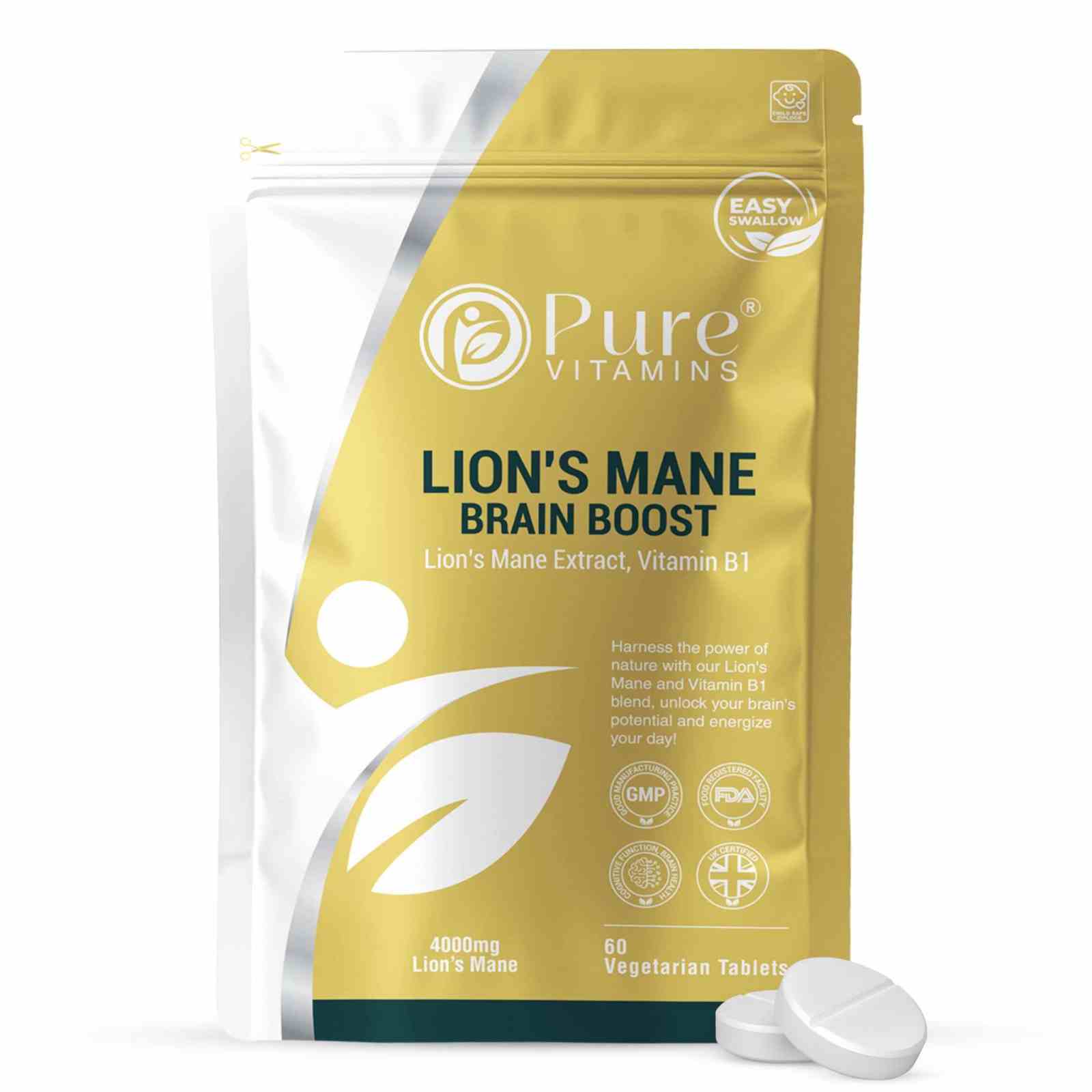
Our Lion's Mane 4000mg is a concentrated extract paired with vitamin B1, so the thiamine supports normal nervous-system and psychological function while the mushroom is presented honestly on its heritage and composition. It is formulated in the UK and tested for purity and heavy metals at our GMP-certified facility. Browse the wider range on the Pure Vitamins UK home page.
Frequently asked questions
Does lion's mane actually help focus?
The human evidence is early and mixed. Some small studies in healthy adults have found narrow, task-specific effects, while others found no overall change. It is best thought of as being studied, not proven.
Why does your lion's mane contain vitamin B1?
We pair it with vitamin B1 (thiamine) because thiamine genuinely supports the normal function of the nervous system and normal psychological function, making it a sensible companion to the mushroom.
How long does lion's mane take to work?
There is no established timeline. Some studies tested a single dose, others 28 days, with inconsistent results, so any effect is uncertain. Consistency is more sensible than expecting a quick change.
Is lion's mane safe?
It is a culinary mushroom and is generally well tolerated, with mild digestive upset most commonly reported. Allergy is possible, and those who are pregnant, breastfeeding or on medication should check with a GP or pharmacist first.
Sources retrieved from PubMed and the published literature; see linked DOIs above. Study findings are paraphrased as science. Food supplements should not be used as a substitute for a varied, balanced diet and a healthy lifestyle. If you are pregnant, breastfeeding, taking medication or managing a medical condition, speak to your GP or pharmacist before starting a new supplement. Concerns about focus, memory or mood should be discussed with your GP. Signed, Dr. Miron, Founder of Pure Vitamins UK.
