


News

Iron Supplement Without Constipation: What Actually Helps (UK Guide)
Looking for an iron supplement without constipation? Why iron upsets the gut, and the practical steps — sensible dose, well-tolerated form, taking it with food and vitamin C — that genuinely help.
Learn more
How to Increase Ferritin: A Practical UK Guide
How to increase ferritin: what it is, the practical steps that help raise iron stores, how iron supplements fit in, and why low ferritin should always be checked with your GP first.
Learn more
What Vitamins Help With Tiredness? A UK Guide
Which vitamins help with tiredness? Iron, B12, folic acid, vitamin C and magnesium all carry authorised roles in energy and reducing fatigue — here's what each does and how to choose.
Learn more
NMN for Women: What to Know Before You Buy (UK Guide)
Why women — particularly around perimenopause — are researching NMN, what the science honestly does and doesn't show, and what to check before buying in the UK.
Learn more
Best NMN Supplement UK: How to Choose (2026 Buyer's Guide)
Searching for the best NMN supplement in the UK? This guide explains what NMN is, how it works as an NAD+ precursor, and the specific things to check — dose, purity, COA, testing and manufacturing standards — before you buy.
Learn more
Best Multivitamin Supplements UK: How to Compare Formulas
Reviewed and updated: 22 September 2026 Best multivitamin supplements UK: how to compare formulas without the marketing noise The best multivitamin supplements in the UK are not the ones with the longest ingredient list or the boldest label, they are the ones whose formula actually matches the gaps in your own diet, uses well-absorbed forms at sensible doses, and stays inside safe upper limits. And if you came here asking a simpler question, the top 3 vitamins to take daily, here is my committed answer before anything else: vitamin D for everyone in the UK through autumn and winter, vitamin B12 if you eat little or no meat, dairy or fish, and iron only if you have a reason to think you are low. That is a reasoned three rather than a list of the three most marketed, and I will explain below exactly who each one is really for and when the honest answer changes. This guide then gives you a clear, practical framework for comparing formulas so you can decide what is genuinely worth your money. TL;DR: what to look for in a multivitamin What it is: a single product combining several vitamins and minerals, usually somewhere around the Nutrient Reference Value (NRV) for each. Who it is for: people who want a convenient nutritional baseline, and specific groups (vegans, older adults, people on restricted diets) who are more likely to fall short on certain nutrients. Key checks: meaningful doses (a nutrient at roughly 15% NRV or more is doing a real job), well-absorbed forms, vitamin D present at a useful level, zinc balanced with copper, and amounts that respect safe upper limits. Honest caveat: in adults who already eat well, large studies have not shown that a daily multivitamin lowers the risk of death. Think of it as insurance against shortfalls, not a health upgrade on top of a good diet. The top 3 vitamins to take daily, and why there is no universal answer Every page that ranks for this question dodges it. One turns it into a quiz, one is an alphabetical index with no ranking at all, and one answers seasonally around a product carousel. So let me commit, and then tell you honestly what the commitment depends on. 1. Vitamin D, the only one that genuinely applies to everyone here This is the one nutrient where UK public health advice is unambiguous. NHS guidance is that everyone should consider taking a daily supplement containing 10 micrograms of vitamin D during autumn and winter, because between roughly October and March the sunlight in the UK is not strong enough for our skin to make it. Some groups are advised to consider it all year round, including people who are rarely outdoors, people who usually wear clothing that covers most of their skin, and people with darker skin. Vitamin D contributes to the maintenance of normal bones and teeth, to normal muscle function and to the normal function of the immune system. If you take only one thing from this whole page, take that one. 2. Vitamin B12, if your diet points that way B12 occurs naturally almost entirely in animal foods, so the people who genuinely need it as a daily habit are vegans and strict vegetarians, people eating very little meat, fish, eggs or dairy, adults over about 50 whose absorption tends to decline, and anyone on long-term medication that affects stomach acid. Vitamin B12 contributes to normal energy-yielding metabolism, to the normal functioning of the nervous system and to the reduction of tiredness and fatigue. If you eat a mixed omnivorous diet and absorb normally, a daily B12 is usually solving a problem you do not have. 3. Iron, but only on evidence rather than on a hunch Iron is the one I would most like people to slow down on. It genuinely matters for menstruating women, for anyone with heavy periods, for people eating very little meat, and for anyone eating much less food overall. Iron contributes to normal formation of red blood cells and haemoglobin, to normal oxygen transport in the body and to the reduction of tiredness and fatigue. But iron is also the nutrient where taking it without needing it buys you constipation and, over time, unnecessary accumulation. A ferritin blood test costs very little and answers the question properly. I have written the practical version in how to increase ferritin. When the honest three change If you are eating much less than usual, the picture shifts fast, because a smaller total intake drops everything at once rather than one nutrient at a time. Protein, magnesium and the B group tend to fall short first. I have set that out in what to take when you are eating less. If you are over 60, B12 absorption and vitamin D status both deserve more attention than they did at 30. If immunity is your actual concern, the nutrients with genuinely recognised immune roles are vitamin D, zinc and vitamin C. Vitamin C contributes to the normal function of the immune system, and zinc does the same, which is why that trio keeps reappearing. See the immunity guide for how they fit together. If you are pregnant or trying to conceive, the UK advice centres on folic acid and vitamin D, and that conversation belongs with your midwife or GP rather than with a blog. Food first, for every nutrient named above A supplement is the backup, not the plan. Worth knowing where these actually come from: Vitamin D: oily fish such as salmon, mackerel and sardines, egg yolks, and fortified spreads and cereals. Summer sunlight on bare skin is the main source, which is precisely why the UK has a winter problem. Vitamin B12: meat, fish, eggs and dairy, plus fortified plant milks, fortified cereals and nutritional yeast. Spirulina, seaweed and mushrooms are not reliable sources, despite what the packaging sometimes implies. Iron: red meat, liver, beans, lentils, tofu, fortified cereals and dark green leafy vegetables. Pairing plant iron with a vitamin C source at the same meal helps absorption; tea and coffee alongside the meal hinder it. Zinc: meat, shellfish, dairy, seeds and wholegrains. Magnesium: nuts, seeds, wholegrains, beans and leafy greens. Vitamin C: peppers, citrus, berries, broccoli and potatoes. When a blood test beats guessing This is the part the supplement industry has no incentive to tell you. If you have persistent unexplained tiredness, if you are thinking about taking iron, if you have been eating very little for a while, or if you have simply been supplementing for months without any idea whether it was needed, a conversation with your GP and a blood test will tell you more than another purchase will. Ferritin, full blood count, B12 and vitamin D are the usual suspects. Guessing is how people end up taking the three nutrients they are already getting plenty of while missing the one they are short on. 1. Start with the NRV and the 15% rule Every vitamin and mineral on a UK label is shown as a percentage of its Nutrient Reference Value (NRV), the reference amount for an average adult. This single number is the quickest way to sort a real formula from a decorative one. As a working rule, a nutrient needs to be present at roughly 15% of its NRV per daily dose before it is contributing anything meaningful. If you see a nutrient listed at a token 2 to 3% NRV, read it as label decoration rather than a real contributor, it is there to lengthen the ingredient list, not to help you. 2. Nutrient coverage: breadth that matches your diet A good multivitamin covers the nutrients people commonly fall short on, rather than padding the label with forty obscure extras. For most UK adults the useful core is the B vitamins, vitamin D, magnesium, zinc, selenium and, for some people, iron. At meaningful doses the reasons to include them are well established: vitamin D contributes to the normal function of the immune system, magnesium contributes to the reduction of tiredness and fatigue, and zinc contributes to the protection of cells from oxidative stress. In other words, these are the workhorses, and a sensible formula gets them right before reaching for anything exotic. If you are currently eating meaningfully less than usual, our guide to what supplements to take on a calorie deficit sets out which of these nutrients run short first, and if the reason is a small appetite rather than a deliberate cut, see what vitamin to take if you don't eat enough. 3. B vitamins: the forms matter A complete formula usually includes all eight B vitamins (B1, B2, B3, B5, B6, B7/biotin, B9/folate and B12). Better formulas use the forms the body can use directly, such as methylcobalamin for B12 and methylfolate (5-MTHF) for folate. These can matter for people with common genetic variations in folate processing. An honest note: for most people with normal folate metabolism, ordinary folic acid is also converted efficiently, so methylated forms are a sensible default rather than a demonstrated advantage for everyone. B12 contributes to normal energy-yielding metabolism and to the reduction of tiredness and fatigue, though it only relieves tiredness that is actually caused by a shortfall. 4. Vitamin D: get the dose right The NHS recommends 10 micrograms (400 IU) of vitamin D a day, and advises that everyone in the UK consider a daily supplement in autumn and winter, when sunlight is too weak for the skin to make enough. Many multivitamins quietly under-dose vitamin D, so check the figure. Choose D3 (cholecalciferol), which raises blood levels more effectively than D2. Vitamin D contributes to the normal function of the immune system and to the maintenance of normal bones. On the safety side, the NHS advises adults not to take more than 100 micrograms (4000 IU) a day from supplements. See our UK guide to vitamin D3 and K2 dosing for more. 5. Zinc, and why copper belongs with it Zinc contributes to the normal function of the immune system and to the maintenance of normal hair, skin and nails. A multivitamin only needs a modest amount. The important detail is that sustained higher-dose zinc can interfere with copper absorption, which is why a small amount of copper is often added alongside it. The UK and EU safe upper limit for zinc from supplements is 25 mg a day, so watch out for stacking a high-zinc multivitamin with a separate zinc product. Our guide to zinc forms, copper and dosage covers this in detail. 6. Selenium: an antioxidant mineral with a narrow window Selenium contributes to the protection of cells from oxidative stress and to the normal function of the immune system. A daily amount near the NRV (around 55 to 70 micrograms) is plenty. Selenium has a relatively narrow margin between enough and too much: the EFSA tolerable upper intake level is 300 micrograms a day, so avoid stacking several selenium sources at once. 7. Iron: include it only if you need it Iron contributes to the reduction of tiredness and fatigue and to normal oxygen transport in the body, but it only helps if you are genuinely low. Many adults, particularly men and post-menopausal women, do not need extra iron, and too much can cause constipation and, rarely, a build-up over time. Iron-free or low-iron multivitamins exist for exactly this reason. If you suspect low iron, ask for a ferritin blood test rather than guessing, and read our practical UK guide to raising ferritin. 8. Respect the safe upper limits The risk with a high-strength everything multivitamin is not the multivitamin alone, it is stacking it with other supplements until you cross a safe limit. Useful reference points for adults are: vitamin D 100 micrograms (4000 IU) a day, zinc 25 mg a day, and selenium 300 micrograms a day. Preformed vitamin A (retinol) should be kept low, especially in pregnancy. The more single-nutrient products you take, the more carefully you need to add up the totals. Interactions and who should be cautious Pregnancy: avoid high preformed vitamin A (retinol) and choose a pregnancy-specific formula that provides folic acid; speak to your midwife or GP. Warfarin and other blood thinners: vitamin K affects how these medicines work, so any K-containing product should be discussed with your GP or pharmacist. Kidney disease: be cautious with mineral loads (including magnesium and potassium) and take medical advice first. Biotin: high doses can interfere with some laboratory blood tests (including thyroid and certain heart tests), so tell the person taking your blood that you use it. Medication timing: iron, zinc and calcium can reduce absorption of some antibiotics and thyroid medicine, so separate them by a few hours. Suitability: vegan, vegetarian and allergen-free If you follow a plant-based diet, check that the vitamin D is D3 from a vegan source such as lichen, and that the capsule shell is not gelatin. Look for clear gluten-free, dairy-free and nut-free declarations if you have allergies. A trustworthy label states all of this plainly rather than leaving you to guess. Clean label, quality and value Prefer formulas with minimal fillers and no unnecessary colours or sweeteners, and a transparent ingredient list that names the exact forms used. At Pure Vitamins our products are formulated in the UK and tested for purity and heavy metals at our GMP-certified facility. On value, look at the cost per day rather than the headline price, and check the capsule count so you know how long a pack lasts. Does a multivitamin actually work? Here is the honest picture, and it is genuinely mixed. According to PubMed, a 2024 analysis of nearly 400,000 generally healthy US adults across three large cohorts found that regular multivitamin use was not associated with a lower risk of death over up to 27 years of follow-up (Loftfield and colleagues, 2024, JAMA Network Open, DOI 10.1001/jamanetworkopen.2024.18729, read it on PMC). On the other side of the ledger, the COSMOS randomised trials found something more encouraging for older adults: in COSMOS-Web, a daily multivitamin improved memory compared with placebo (Yeung and colleagues, 2023, American Journal of Clinical Nutrition, DOI 10.1016/j.ajcnut.2023.05.011, read it on PMC), and a pooled analysis across three COSMOS cognitive substudies reported a modest benefit for global cognition and memory, roughly equivalent to reducing cognitive ageing by around two years (Vyas and colleagues, 2024, American Journal of Clinical Nutrition, DOI 10.1016/j.ajcnut.2023.12.011, read it on PMC). The effects were modest, and the participants were older adults, so this is not a promise for everyone. The sensible reading is that a multivitamin earns its place by correcting a real shortfall, from diet, life stage or restricted eating, rather than by adding benefit on top of an already good diet. Match the formula to your gaps and it can be a tidy nutritional baseline. Building a daily routine you will actually keep The best formula in the world does nothing sitting in a cupboard, so here is the whole system in four lines. Anchor it to a meal you eat every single day, because a habit attached to breakfast survives and a habit attached to a good intention does not. Take fat-soluble vitamins, D among them, with a meal that contains some fat. Keep iron away from tea and coffee, and give it a vitamin C source instead. And review it twice a year rather than never, once as the clocks go back and vitamin D starts to matter, and once in spring when it matters less. Every guide we publish is collected on the supplement guides hub if you want to work through a nutrient properly rather than take my word for it. How Pure Vitamins approaches this Rather than crowd forty nutrients into one tablet at token doses, we focus on well-dosed formulas you can combine to suit your needs. The Immunity & Energy Support Trio pairs Zinc, Vitamin D3+K2 and Magnesium Glycinate, three of the most commonly useful additions for UK adults, at meaningful doses and in well-absorbed forms. If your priority is everyday energy, our guide to vitamins for tiredness and our immunity guide are good next reads. You can also browse the full range on our home page. Shop the Immunity & Energy Support Trio Frequently asked questions What are the top 3 vitamins to take daily? If you want a committed answer: vitamin D for everyone in the UK through autumn and winter, vitamin B12 if you eat little or no meat, fish, eggs or dairy or are over about 50, and iron only if you have reason to think you are low, ideally confirmed by a ferritin test. Vitamin D is the only one of the three that applies to essentially everyone here. How much vitamin D should UK adults take? NHS guidance is that everyone should consider a daily supplement containing 10 micrograms of vitamin D during autumn and winter, with some groups advised to consider it all year round, including people who are rarely outdoors, people who usually cover most of their skin, and people with darker skin. What is the best multivitamin in the UK? There is no single best multivitamin for everyone. The best one for you provides the nutrients your diet is short on, at meaningful doses (at least 15% NRV), in well-absorbed forms, and within safe upper limits. Match the formula to your own gaps rather than chasing the longest ingredient list. Do I really need a multivitamin? Not necessarily. People who eat a varied, balanced diet may get little from one, while vegans, older adults and people on restricted diets are more likely to benefit from targeted nutrients such as vitamin D, B12 and, sometimes, iron. Is it safe to take a multivitamin every day? For most adults a sensibly dosed multivitamin is fine daily. The main risk is stacking it with other supplements and exceeding safe limits, for example more than 100 micrograms (4000 IU) of vitamin D, 25 mg of zinc or 300 micrograms of selenium per day. Should a multivitamin contain iron? Only if you need it. Iron is useful for people who are genuinely low, but unnecessary iron can cause constipation and build-up. If in doubt, ask for a ferritin test before choosing an iron-containing formula. Does a multivitamin help memory or brain function? The evidence is early but interesting. The COSMOS randomised trials found a modest memory and cognition benefit from a daily multivitamin in adults aged 60 and over, while large mortality studies show no benefit in generally well-nourished adults. It is best seen as a possible small edge for older adults, not an established brain benefit for everyone. Signed, Dr. Miron, Founder of Pure Vitamins UK. This article is for general information and education only and is not medical advice. Food supplements are not a substitute for a varied, balanced diet and a healthy lifestyle. If you are pregnant, breastfeeding, taking medication or living with a health condition, speak to your GP or pharmacist before starting a supplement. If that is useful, see also why medical research references matter.
Learn more
Best Vitamin D3 and K2 Supplements UK: Buyer's Guide 2026
Reviewed and updated: 23 July 2026 Best vitamin D3 and K2 supplements UK: buyer's guide 2026 The best vitamin D3 and K2 supplements UK buyers should look for use D3 (cholecalciferol) rather than D2, pair it with K2 as MK-7 (the longest-lasting menaquinone), state both doses clearly, and are made to a recognised quality standard. That is the short answer. Let me explain why D3 and MK-7 are the preferred forms, what each vitamin supports, the dose and safe upper limit, and the important blood-thinner interaction to know before you buy. Quick answer (TL;DR) What to look for: D3 (not D2), K2 as MK-7, both amounts clearly labelled, clean GMP-made formula. Who it's for: adults topping up vitamin D, especially over the darker UK months; vitamin D contributes to normal immune function, muscle function and the maintenance of normal bones, and vitamin K contributes to normal blood clotting and the maintenance of normal bones. Key caution: vitamin K can interact with warfarin and similar anticoagulants, so talk to your doctor first. The adult upper limit for vitamin D is 100 micrograms (4,000 IU) per day. Why D3 rather than D2? Vitamin D comes as D2 (ergocalciferol) or D3 (cholecalciferol), and the research favours D3 for raising and maintaining vitamin D status. According to research retrieved by Scholar Gateway, a randomised, double-blind trial in 95 healthy adults aged 18 to 50 given 1,000 IU daily for six months over winter found the D3 group reached a significantly higher serum 25-hydroxyvitamin D level than the D2 group (81 vs 52 nmol/L, p<0.001), with D2 and placebo similar by the end (Houghton et al., 2011, DOI). For a UK audience with limited winter sun, that difference is the main reason I would choose D3. More in vitamin D3 vs D2. Why K2 as MK-7? Vitamin K2 (menaquinone) comes in several forms, and MK-7 is the standout for supplements because it is well absorbed and stays in circulation far longer than other forms. According to research retrieved by Scholar Gateway, MK-7 has a serum half-life of around 72 hours versus roughly 3 hours for vitamin K1, giving a steadier daily level (Cirilli et al., 2022, DOI). That long half-life is why a once-daily MK-7 tablet makes sense. See what is vitamin K2 MK-7. What D3 and K2 support Both are vitamins with authorised function claims at meaningful amounts, and it is worth knowing exactly what they cover. Vitamin D contributes to the normal function of the immune system, to normal muscle function, to the maintenance of normal bones and teeth, to the normal absorption and utilisation of calcium and phosphorus, and to normal blood calcium levels. Vitamin K contributes to normal blood clotting and to the maintenance of normal bones. People often pair them because vitamin D supports calcium absorption while vitamin K supports the normal bone roles above. Dose and the safe upper limit Public-health advice in the UK suggests considering a daily 10 microgram (400 IU) vitamin D supplement in autumn and winter. Higher-strength products like ours provide 4,000 IU (100 micrograms) of D3 for a stronger top-up. Be aware that 100 micrograms per day is the adult tolerable upper intake level for vitamin D set by EFSA and UK guidance, so this is a higher-strength option to take as directed and not to stack on top of other high-dose vitamin D. The K2 amount here is 100 micrograms MK-7. If you are unsure what level suits you, a GP can check your vitamin D status. If you are weighing a lower daily strength instead, our guide to whether 1000 IU of vitamin D3 a day is a good dose compares it with the UK baseline. A few cautions worth knowing This is the most important safety point for a D3 and K2 product: vitamin K plays a role in normal blood clotting, so it can interact with warfarin and other vitamin-K-antagonist anticoagulants. If you take a blood thinner, do not start a K2 supplement without speaking to your doctor. Both D3 and K2 are fat-soluble, so take with a meal containing some fat for absorption. If you also take magnesium, our guide to the best time to take vitamin D3 and magnesium glycinate covers how to fit them into your day. People with high blood calcium, kidney problems, sarcoidosis, or who are pregnant or breastfeeding should seek advice before taking high-strength vitamin D. Do not exceed the 100 microgram per day vitamin D upper limit from all sources combined. Food sources and signs you may be low Vitamin D is found in oily fish, egg yolks and fortified foods, but diet alone rarely covers UK winter needs, which is why supplementation is commonly advised. Vitamin K1 comes from leafy greens, and K2 from fermented foods like natto and some cheeses. Low vitamin D is non-specifically associated with tiredness and aches, but these overlap with many causes; a blood test is the only way to confirm status. The buyer's checklist D3 (cholecalciferol), not D2. K2 as MK-7 for a long, steady half-life. Both doses clearly labelled (e.g. 4,000 IU D3 + 100 mcg MK-7). Suitable for your diet; check vegetarian/vegan and allergens. Made in a GMP-certified facility and tested for purity and heavy metals. Sensible dosing within the 100 mcg per day vitamin D upper limit. Where Pure Vitamins fits Our Vitamin D3 + K2 tablets deliver 4,000 IU (100 mcg) of D3 with 100 mcg of K2 as MK-7 in one easy-to-swallow vegetarian tablet, formulated in the UK, made in a GMP-certified facility and tested for purity and heavy metals at our GMP-certified facility. Explore related guides or the full range on our Pure Vitamins UK home page. View Vitamin D3 + K2 Tablets Frequently asked questions Is D3 better than D2? For raising and maintaining vitamin D status, the evidence favours D3, which is why most quality supplements use it. Why combine D3 with K2? Vitamin D supports calcium absorption while vitamin K2 (MK-7) supports the maintenance of normal bones and normal blood clotting; many people prefer them together. How much vitamin D per day? UK advice suggests 10 mcg in autumn and winter; higher-strength options like 4,000 IU exist, but 100 mcg per day is the adult upper limit, not to be exceeded. Can I take K2 with warfarin? Not without medical advice, as vitamin K can interact with warfarin and similar anticoagulants. Sources: Houghton et al. 2011 and Cirilli et al. 2022, retrieved by Scholar Gateway (DOIs linked). Food supplements should not replace a varied, balanced diet and a healthy lifestyle. This is information, not medical advice. If you take anticoagulants, are pregnant or breastfeeding, have kidney problems or high blood calcium, or manage a medical condition, speak to your GP or pharmacist before starting. Dr. Miron, Founder of Pure Vitamins UK. Related articles Vitamin D3 vs D2: which form to choose What is vitamin K2 MK-7? How much vitamin D3 and K2 should you take? Best vitamins for immunity UK Vitamin D3 + K2 tablets (4,000 IU D3 + MK-7) Can vitamin D3 without K2 actually hurt you? What time of day is best to take vitamin D3 and K2? Is it good to take 1000 IU of vitamin D3 daily?
Learn more
Best Magnesium Supplements UK: What to Look For Before Buying
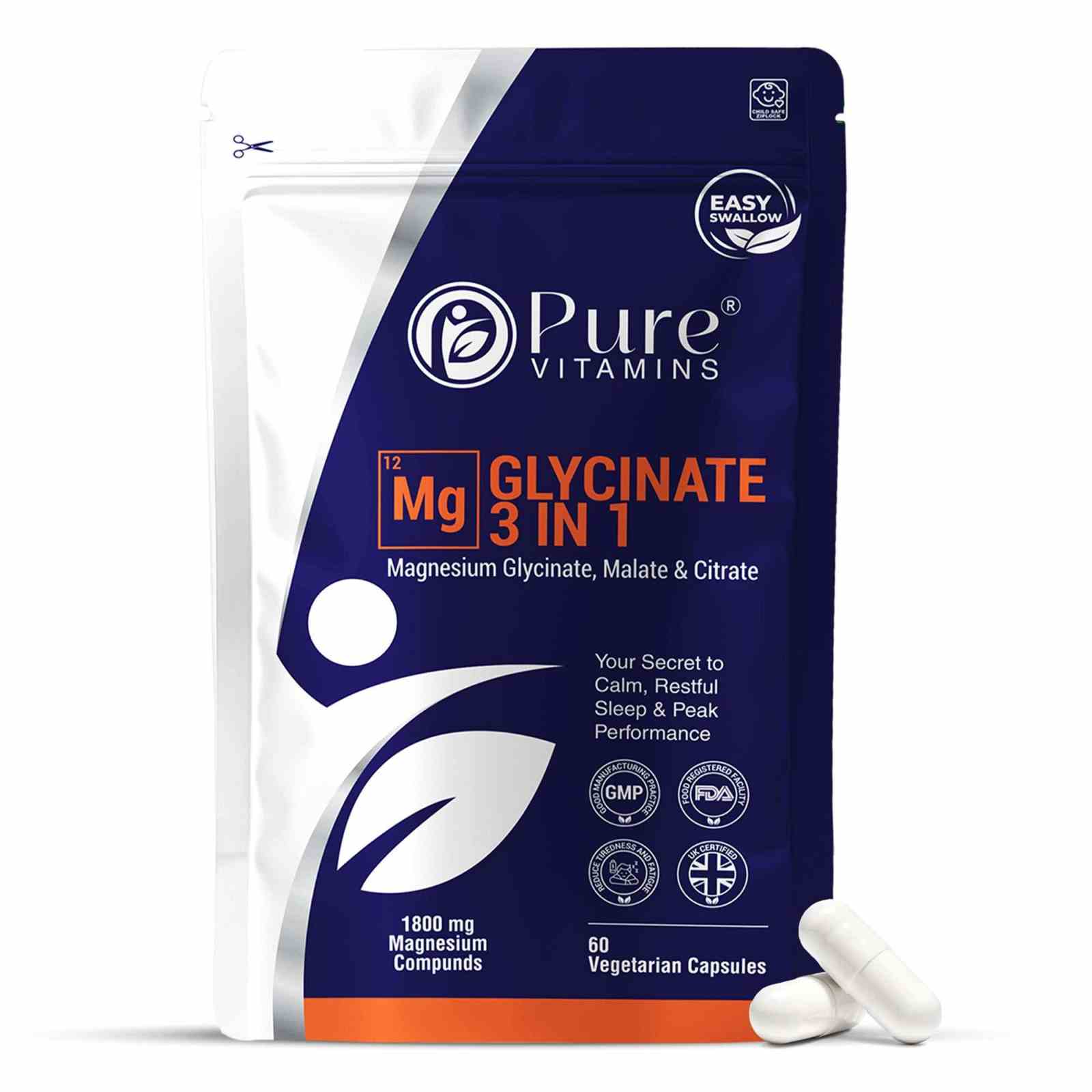
Reviewed and updated: 23 July 2026 Best magnesium supplements UK: what to look for before buying The best magnesium supplements UK shoppers can buy come down to three things: a well-absorbed form (glycinate, malate or citrate rather than cheap oxide), a meaningful elemental magnesium dose stated clearly on the label, and a clean, transparent formula made to a recognised standard. Magnesium is an essential mineral your body draws on for muscle and nerve signalling, energy and much more, and because many of us do not get quite enough from food, it is one of the most popular everyday top-ups. Let me walk you through exactly what to check before you buy, what the research shows, the sensible dose and upper limit, and who should take care. The quick answer What to look for: a well-absorbed form (glycinate/bisglycinate, malate, citrate), the elemental magnesium amount per serving (not just the compound weight), and a clean, GMP-made formula. Who it is for: adults who want to top up magnesium intake; magnesium contributes to normal muscle function, the nervous system, and the reduction of tiredness and fatigue. Key caution: high doses of supplemental magnesium can cause loose stools; UK guidance puts the supplemental upper level around 400 mg a day. More is not better. Elemental magnesium: the number that actually matters The single most useful check when comparing magnesium supplements is the elemental magnesium per serving. A label might say "1,800 mg magnesium bisglycinate," but only a fraction of that compound weight is magnesium itself. Reputable products state the elemental figure. The UK reference intake (NRV) for magnesium is 375 mg, and our Magnesium Glycinate 3-in-1 provides 384 mg of elemental magnesium across three forms, so you can compare like with like. For the trials behind the glycinate form specifically, see what the peer-reviewed research on magnesium glycinate shows. Which magnesium form is best absorbed? Form affects both absorption and tolerability. Organic forms such as magnesium glycinate (bisglycinate), magnesium malate and magnesium citrate are generally well absorbed and gentler on the stomach than magnesium oxide, which is cheap but poorly absorbed and more likely to loosen stools. Glycinate (magnesium bound to the amino acid glycine) is a popular premium choice for everyday use; citrate is well studied; malate is favoured by some for daytime use. A triple-form blend aims to combine these strengths. For a deeper comparison see magnesium glycinate vs citrate and which magnesium is gentlest on the stomach, and if you are unsure whether glycinate and bisglycinate are two different forms at all, our guide to magnesium glycinate compared with bisglycinate settles the naming. What magnesium does in the body Magnesium is a mineral your body genuinely relies on, and at a meaningful amount it earns its place for well-understood reasons. Magnesium contributes to normal muscle function, to the normal functioning of the nervous system, to a reduction of tiredness and fatigue, to normal psychological function, to electrolyte balance, to normal energy-yielding metabolism, and to the maintenance of normal bones and teeth. Those are the honest, everyday reasons to consider topping up. What the research shows on magnesium and sleep Magnesium and sleep is one of the most searched topics, so here is the honest picture, framed as science. Based on research retrieved from PubMed, a 2025 randomised, double-blind, placebo-controlled trial in 155 healthy adults reporting poor sleep found that magnesium bisglycinate (250 mg elemental daily) produced a modestly greater reduction in Insomnia Severity Index scores than placebo over four weeks, though the effect size was small (Schuster et al., 2025, DOI). Based on further research retrieved from PubMed, a 2021 systematic review and meta-analysis of three RCTs in 151 older adults found magnesium shortened time to fall asleep by about 17 minutes versus placebo, while total sleep time did not reach significance and the authors rated the overall evidence as low quality (Mah & Pitre, 2021, DOI). In short, the evidence is modest and mixed rather than conclusive, so I would treat magnesium as a supportive part of a wind-down routine. See best magnesium for sleep for the fuller picture. How much magnesium should you take, and the upper limit For most adults a supplement providing around the 375 mg NRV is sensible, ideally alongside magnesium-rich foods. There is a recognised caution on supplemental magnesium: UK expert guidance (EVM) sets a safe upper level of around 400 mg per day for supplemental magnesium in adults, above which loose stools become more likely (this refers to magnesium added to food and supplements, not magnesium naturally present in food and water). Well-absorbed forms like glycinate tend to be gentler at a given dose. Take with food if you have a sensitive stomach, and split the dose if needed. If your appetite is small and you are eating much less than usual, the form and the timing both matter more than they normally would, and I go through that in which magnesium is best when you are eating less. Natural food sources and signs you may be low Magnesium is found in wholegrains, nuts and seeds (pumpkin seeds and almonds are rich), legumes, leafy greens and dark chocolate. Many UK adults sit below the recommended intake, and being low is non-specifically associated with muscle cramps, fatigue and disturbed sleep, though these overlap with many causes and cannot diagnose a shortfall on their own. A supplement is best seen as topping up intake, not as a treatment. A few cautions worth knowing Magnesium can interact with certain medicines, including some antibiotics (tetracyclines and quinolones) and bisphosphonates, where it may reduce absorption if taken at the same time, so separate them by a few hours. People with reduced kidney function should not take magnesium supplements without medical advice, as the kidneys regulate magnesium levels. If you are pregnant or breastfeeding, take regular medication, or manage a health condition, check with your GP or pharmacist first. The buyer's checklist Elemental magnesium clearly stated per serving (aim around the 375 mg NRV). Well-absorbed forms (glycinate/bisglycinate, malate, citrate) rather than mostly oxide. Clean formula, suitable for your diet (check vegetarian/vegan, allergens). Made in a GMP-certified facility and tested for purity and heavy metals at our GMP-certified facility. Honest labelling, with no exaggerated health promises. Where Pure Vitamins fits Our Magnesium Glycinate 3-in-1 combines three well-absorbed forms (glycinate, malate and citrate) for 384 mg of elemental magnesium per serving, formulated in the UK, made in a GMP-certified facility and tested for purity and heavy metals at our GMP-certified facility. For a related read, see what magnesium is good for muscle function, or browse the full range on our Pure Vitamins UK home page. View Magnesium Glycinate 3-in-1 Frequently asked questions Which magnesium is best? For everyday use, a well-absorbed form such as glycinate, malate or citrate; a triple-form blend combines their strengths. Avoid relying on oxide. How much magnesium per day? Around the 375 mg NRV for most adults; keep supplemental magnesium near or below about 400 mg a day to avoid loose stools. When should I take it? With food if your stomach is sensitive; timing is otherwise personal preference. Does magnesium help with sleep? Studies show modest, mixed effects on sleep, most relevant when dietary magnesium is low. Its clearest roles are supporting normal muscle and nervous-system function and the reduction of tiredness and fatigue, so it is best seen as part of a routine. Sources: clinical studies retrieved from PubMed (see linked DOIs). Food supplements should not be used as a substitute for a varied, balanced diet and a healthy lifestyle. This article is information, not medical advice. If you are pregnant, breastfeeding, have kidney problems, take medication or manage a medical condition, speak to your GP or pharmacist before starting a new supplement. Dr. Miron, Founder of Pure Vitamins UK. Related articles Magnesium glycinate vs citrate: which to choose Which magnesium is gentlest on the stomach? Best magnesium for sleep What magnesium is good for muscle function? What kind of magnesium to take with vitamin D3 and K2 Magnesium Glycinate 3-in-1 (triple-form complex)
Learn more
Medical Research References: The Backbone of Supplement Credibility
Reviewed and updated: 25 July 2026 Medical research references: the backbone of supplement credibility Medical research references are the difference between a supplement brand that simply makes claims and one you can actually check. Anyone can print a benefit on a label; a credible brand shows you the published science behind each ingredient and is honest about what that science does, and does not, prove. This guide explains how to read that evidence for yourself, so you can judge any supplement on its merits rather than its marketing. TL;DR What it is: the published studies and official guidance that sit behind an ingredient, cited with working links so you can verify them. Who it is for: anyone comparing supplements who wants evidence rather than slogans. Key idea: peer review is a credibility signal, not a guarantee, and a single study rarely settles anything. Strong claims need multiple, consistent, high-quality sources. The line that matters in the UK: paraphrasing what a study found is science and education; only authorised wording for qualifying vitamins and minerals may be used as a product claim. Why scientific references matter When you choose a supplement you deserve more than marketing language. References let you see the foundation under a statement: the type of study, who it was done in, how many people took part, and whether the finding has been repeated. They also keep a brand honest, because a cited claim can be checked and a vague one cannot. The goal is to remove guesswork, not add jargon. The hierarchy of evidence Not all studies carry the same weight. From weakest to strongest, the usual ladder runs: a single case report or anecdote, then laboratory and animal studies, then small observational studies, then randomised controlled trials (RCTs), and finally systematic reviews and meta-analyses that pool many trials. A test-tube or mouse result is a starting hint, not proof of what happens in people. Formal frameworks exist to grade how much confidence a body of evidence deserves; according to PubMed, the widely used GRADE approach rates evidence by factors such as study design, consistency and precision (Guyatt and colleagues, Journal of Clinical Epidemiology, https://doi.org/10.1016/j.jclinepi.2011.01.012). When you read a reference, the first question is simply: where on this ladder does it sit? Peer review is a signal, not a guarantee Peer review means other experts checked a paper before publication. That filters out a lot of weak work, but it does not make a finding true or final. Studies still get overturned, fail to replicate, or turn out to be too small to mean much. This is not a fringe worry: according to PubMed, a landmark analysis argued that, for many study designs and settings, it is actually more likely for a research claim to be false than true, especially when studies are small, effect sizes are modest and financial interests are involved (Ioannidis, PLoS Medicine, https://doi.org/10.1371/journal.pmed.0020124). So peer review is best treated as a credibility signal that raises confidence, alongside sample size, study design and whether independent groups have found the same thing. Why one study is never enough The strongest, most concentrated picture comes from synthesising several credible sources, not from leaning on one headline-grabbing trial. A good worked example is the multivitamin question. According to PubMed, a 2024 analysis of nearly 400,000 generally healthy US adults across three large cohorts found no association between regular multivitamin use and a lower risk of death over up to 27 years (Loftfield and colleagues, JAMA Network Open, https://doi.org/10.1001/jamanetworkopen.2024.18729). A single small positive study could easily have suggested the opposite. Large, long, repeated data tells a more honest story, which is why we read across the literature rather than cherry-picking. The UK rules: authorised claims versus marketing In Great Britain, what a supplement may claim is tightly controlled. Authorised function statements from the GB Nutrition and Health Claims Register may be used only for vitamins and minerals, in exact wording, and only when the nutrient is present at a meaningful level (at least 15% of the Nutrient Reference Value per daily dose). For example, vitamin D "contributes to the normal function of the immune system" and magnesium "contributes to the reduction of tiredness and fatigue". Botanicals and other popular ingredients such as collagen, probiotics, creatine, turmeric and NAD+ precursors hold no authorised health claims at all, so a credible brand describes them by their composition, mechanism and traditional use, and presents their science purely as science. Science versus a product benefit This is the line we hold throughout our writing. Describing what a study observed is education. Turning that into "so our product will do this for you" would be a product claim, and for ingredients without authorised claims that is not permitted in the UK. So you will see us say things like "research in healthy adults explored magnesium and sleep-quality scores", and you will not see us promise that a product changes your sleep. If a brand blurs that line, treat it as a red flag. How to read a reference in under a minute Find the source: a real reference has a DOI or a link to a journal, .gov or .edu page, not just a brand blog. Check the population: was it humans, and were they reasonably similar to you, or was it cells and animals? Check the size and design: a randomised trial of hundreds beats an observational snapshot of a dozen. Watch for overreach: be wary of "clinically proven", proprietary blends that hide doses, and a single study used to justify a sweeping claim. Look for balance: trustworthy summaries mention null or mixed findings, not only the flattering ones. Trusted places to check for yourself You do not have to take any brand's word for it. PubMed indexes biomedical studies, Cochrane publishes systematic reviews, and the NIH Office of Dietary Supplements (ODS) and the British Nutrition Foundation publish balanced, plain-language summaries. For what may legally be claimed, the GB Nutrition and Health Claims Register and EFSA opinions are the reference points. Cross-checking a brand's references against these is the fastest way to separate evidence from marketing. How Pure Vitamins approaches references We aim to cite real, working sources, lead with the strongest available evidence, and disclose when findings are modest, mixed or preclinical. Our products are formulated in the UK and tested for purity and heavy metals at our GMP-certified facility, and our articles keep ingredient science framed as science. You can see this approach in pieces such as what the peer-reviewed research on magnesium glycinate actually shows, our honest look at lion's mane and focus, and our NMN versus NR comparison. Our multivitamin buyer's guide applies the same standard. You can also see that standard reflected in the products themselves, such as our Magnesium Glycinate 3-in-1, whose evidence we set out in full. Explore the Pure Vitamins range Frequently asked questions What are medical research references in supplements? They are the published studies and official guidance behind an ingredient, ideally cited with a DOI or a link to a journal, .gov or .edu page so you can verify the claim yourself rather than relying on marketing. Does peer review mean a supplement claim is true? No. Peer review raises confidence because independent experts checked the work, but it is not a guarantee. Studies can still be small, fail to replicate, or be overturned, so look at study design, sample size and whether other research agrees. Why is one study not enough? A single study can be a fluke or too small to be reliable. Stronger conclusions come from synthesising several consistent, high-quality sources, which is why systematic reviews and large long-term studies carry more weight than one headline. Can supplements legally claim to treat conditions? No. In the UK, only authorised function statements for qualifying vitamins and minerals may be used, in exact wording. Botanicals and many popular ingredients carry no authorised claims, and no food supplement may claim to treat, cure or prevent disease. Dr. Miron, Founder of Pure Vitamins UK. This article is for general information and education only and is not medical advice. Food supplements are not a substitute for a varied, balanced diet and a healthy lifestyle. If you are pregnant, breastfeeding, taking medication or living with a health condition, speak to your GP or pharmacist before starting a supplement.
Learn more