


Reviewed and updated: 21 September 2026
EPA vs DHA: what is the difference and how much do you need?
EPA vs DHA comes down to what each one does and how much of it you actually get. EPA and DHA together contribute to the normal function of the heart at 250 mg a day, while DHA additionally contributes to the maintenance of normal brain function and normal vision at 250 mg of DHA a day. In the UK, official dietary advice goes further than those label thresholds: two portions of fish a week, one of them oily, which works out at roughly 450 mg of EPA and DHA combined per day. I am Dr. Miron, and I founded Pure Vitamins UK. This guide will get you to the point where you can pick up any fish oil bottle in a British shop and work out, in about twenty seconds, whether it is worth buying.

TL;DR
- What they are: EPA and DHA, the two active long-chain omega-3s in oily fish and fish oil. ALA from flaxseed and walnuts is a different, shorter-chain omega-3 that converts into them poorly.
- How much: 250 mg combined is the GB label threshold for the heart wording, and 250 mg of DHA for brain and vision. UK dietary advice points at roughly 450 mg a day combined, from two portions of fish a week.
- Who they are for: anyone whose diet is light on oily fish, which in Britain is most of us.
- The one thing to know: read the EPA and DHA figures on the back, not the total oil weight on the front. A 1,000 mg fish oil capsule is usually nowhere near 1,000 mg of EPA and DHA.
- The honest caution: tinned tuna barely counts as oily fish, and freshness matters more than most people realise.
What are EPA and DHA?
EPA (eicosapentaenoic acid) and DHA (docosahexaenoic acid) are the two long-chain omega-3 fatty acids found in oily fish and fish oil. They are the forms the body uses most readily, and they are different from ALA, the shorter-chain omega-3 in plant foods like flaxseed, chia and walnuts.
Your body can convert ALA into EPA and DHA, but only inefficiently, and that is the single most misunderstood point in this whole subject. Based on a review retrieved from PubMed, conversion of ALA to EPA is limited in men and further conversion to DHA is very low, although women of reproductive age convert somewhat more, which is thought to relate to oestrogen (Burdge and Calder, 2005, Reproduction Nutrition Development; DOI 10.1051/rnd:2005047, PubMed record). The practical upshot is that a tablespoon of ground flaxseed on your porridge is a good thing for other reasons, but it is not a dependable way to get DHA. Preformed EPA and DHA, from fish or from algae, are the reliable route.
What is the difference between EPA and DHA?
They are related but they do different jobs, and the authorised UK wording follows that split precisely.
- EPA and DHA together contribute to the normal function of the heart, at a combined daily intake of 250 mg.
- DHA on its own contributes to the maintenance of normal brain function and to the maintenance of normal vision, at a daily intake of 250 mg of DHA.
- DHA also has a structural role. It is heavily concentrated in the grey matter of the brain and in the retina of the eye, where it makes up a large share of the fatty acids present. That is part of why it carries those two extra roles and EPA does not.
- DHA during pregnancy and infancy carries its own separate authorised wording relating to normal brain and eye development, with its own conditions of use.
So in short: EPA works alongside DHA for the heart, DHA does the brain and vision work, and a decent fish oil gives you a meaningful amount of both. We cover the heart side in best fish oil for heart health, and the wider picture sits in our pillar guide to omega-3 for heart and brain health.
How much EPA and DHA is needed per day?
There are two different numbers in circulation and people conflate them constantly, so let me separate them cleanly.
The 250 mg figures are label thresholds. They are the conditions of use attached to the authorised GB claims. A product has to deliver at least that much per day before the wording may be used. They are a regulatory floor, not a recommendation for how much you should aim to eat.
The UK dietary recommendation is higher. UK advice, set out by the Scientific Advisory Committee on Nutrition and carried through into NHS guidance, is to eat at least two portions of fish a week, one of which should be oily. A portion is around 140 g cooked. Averaged across a week, that works out at roughly 450 mg of long-chain omega-3 a day, which is where the commonly quoted 450 mg figure comes from.
So a fair way to read it: 250 mg is the minimum that lets a label say something, and about 450 mg a day is what UK dietary advice is actually steering you towards. If you eat oily fish twice a week you are comfortably there without a capsule. If you rarely eat fish, which national diet survey data suggests is true of most British adults, that is the gap a supplement is closing.
What a real UK portion actually delivers
This is the part that makes the numbers concrete, and it is where one very common assumption falls apart. Approximate EPA and DHA content, per typical cooked portion:
- Mackerel, 100 g fillet: roughly 2,500 to 3,000 mg. The highest-yielding common British oily fish, and usually the cheapest.
- Salmon, 140 g portion: roughly 2,500 to 3,500 mg, depending on whether it is farmed or wild.
- Herring or kipper, 100 g: roughly 1,800 to 2,200 mg.
- Sardines, one 90 g tin drained: roughly 1,300 to 1,600 mg, plus around 400 mg of calcium if you eat the bones.
- Trout, 140 g portion: roughly 1,000 to 1,500 mg.
- Tinned tuna, one 100 g tin: roughly 100 to 300 mg. This is the one that surprises people.
That last line deserves its own paragraph, because it quietly undoes a lot of good intentions. Fresh tuna is an oily fish. Tinned tuna is not classed as one in UK dietary advice, because the canning process removes most of the long-chain omega-3. If your two portions of fish a week are a tuna sandwich and a tuna pasta bake, you are eating a perfectly good source of protein and getting a small fraction of the omega-3 you think you are. Swapping one of them for tinned sardines or mackerel costs about the same and multiplies the omega-3 roughly tenfold.

Label arithmetic: why the front of the pack misleads
Here is the honest catch with fish oil, and it is the single most useful thing in this article. A 1,000 mg fish oil capsule is not 1,000 mg of EPA and DHA. That figure is the weight of the whole oil in the capsule. EPA and DHA are only a fraction of it, and in standard, unconcentrated fish oil that fraction is typically around 30 per cent.
Work it through. A standard 1,000 mg fish oil capsule commonly contains about 180 mg of EPA and 120 mg of DHA, so 300 mg combined. That clears the 250 mg heart threshold on one capsule, but it delivers only 120 mg of DHA, which is under half the 250 mg DHA threshold for the brain and vision wording. To reach 450 mg combined you would need two capsules; to reach 250 mg of DHA you would need two as well. A bottle of 60 that looked like two months' supply is actually one month.
So the rule is simple. Turn the bottle over. Find the EPA figure and the DHA figure per serving, and check what the serving size is. Those two numbers, and the serving size, are the whole product. Everything on the front is packaging.
Cost per 1,000 mg of EPA and DHA
Once you have those numbers you can do the only price comparison that means anything, and it routinely reverses which bottle looks cheap. The sum is: milligrams of EPA and DHA per capsule, multiplied by the number of capsules, divided by 1,000, then divide the price by that.
Two worked examples using round numbers:
- Bottle A, 90 capsules at £10, standard strength, 300 mg EPA and DHA per capsule. That is 27,000 mg in the bottle, so 27 units of 1,000 mg. £10 divided by 27 is about 37p per 1,000 mg.
- Bottle B, 60 capsules at £18, concentrated, 900 mg EPA and DHA per capsule. That is 54,000 mg in the bottle, so 54 units. £18 divided by 54 is about 33p per 1,000 mg.
Bottle B costs nearly twice as much on the shelf and is cheaper per unit of the thing you are actually buying, and you swallow one capsule instead of three. Run that sum on whatever is in your cupboard. It takes a minute and it is usually eye-opening.
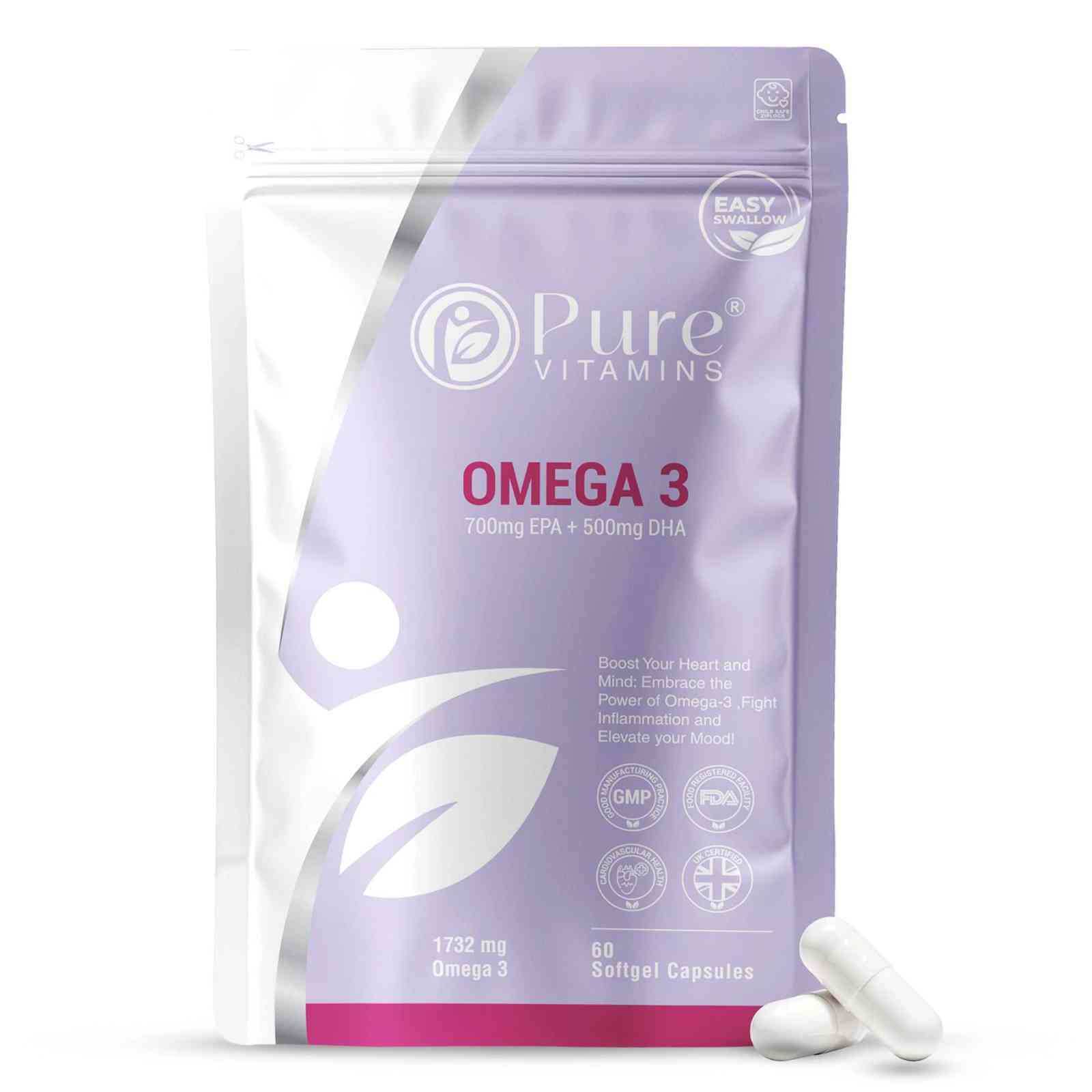
Our high-strength Omega-3 provides 1,732 mg of omega-3 per serving, with EPA and DHA comfortably above both 250 mg reference points, which is the reason it is a one-capsule product rather than a three-capsule one.
The EPA to DHA ratio, and when each matters
Most fish oils land somewhere around 3:2 in favour of EPA, because that roughly reflects the natural ratio in fish body oil. Some products deliberately skew one way or the other, and the marketing around that is often louder than the evidence supports. Here is the honest position.
- For the general aim of covering a dietary shortfall, the ratio matters far less than the total. Getting to a decent combined intake with a reasonable amount of each is the whole game.
- If DHA is your priority, whether for the brain and vision wording, or in pregnancy, check the DHA figure specifically rather than the combined one, because a high-EPA product can clear 250 mg combined while delivering well under 250 mg of DHA.
- Algal oils are often DHA-dominant, which is worth knowing if you are switching from fish oil and were relying on the EPA.
- Cod liver oil is a different product again. It is generally lower in EPA and DHA per capsule than a dedicated fish oil, and it carries vitamin A, which has its own upper limit and matters particularly in pregnancy. Do not treat the two as interchangeable.
Does the form of omega-3 affect absorption?
It can, modestly. Based on a randomised trial retrieved from PubMed in 150 healthy volunteers, identical doses of EPA and DHA raised the omega-3 index, which is the proportion of EPA and DHA in red blood cell membranes, faster and to a greater extent when taken as re-esterified triacylglycerides than as ethyl esters over six months (Neubronner et al., 2011, European Journal of Clinical Nutrition; DOI 10.1038/ejcn.2010.239, PubMed record).
Two caveats worth stating. The difference was real but not dramatic, and it was measured over six months in a single trial. And taking your oil with a meal that contains some fat probably does more for absorption than the form does, because bile flow is what gets the fat emulsified in the first place. So: choose a well-formulated oil, take it with food, and do not agonise over the chemistry.

Freshness and oxidation, the quality variable nobody mentions
This is the part of the category I would most like people to understand, because it is invisible on the label and it is the main thing separating a good fish oil from a poor one.
Long-chain omega-3s are highly unsaturated, which is exactly what makes them biologically useful and also what makes them chemically fragile. Exposed to heat, light and oxygen, they oxidise, and oxidised oil is both unpleasant and pointless. The industry measures this with a peroxide value for the early stage of oxidation and an anisidine value for the later stage, with a total oxidation figure combining the two. Good manufacturers hold these well inside the voluntary limits the sector works to. You will rarely see any of it printed on a consumer label.
Independent testing has repeatedly found variation between products on exactly these measures. According to an analysis of top-selling fish oil supplements retrieved from PubMed, capsule products generally held their labelled EPA and DHA content and sat at low peroxide values of roughly 2 to 3 milliequivalents per kilogram, whereas about a third of the syrup and liquid products contained less than their stated content, with peroxide values ranging far more widely, up to around 18. The same analysis found most heavy metal results within limits, with a small number of products exceeding the recommended lead limit (Ozyurt and colleagues, 2021, Environmental Science and Pollution Research; DOI 10.1007/s11356-021-17581-5, PubMed record). It is a single market survey rather than a UK-wide audit, so read it as an indication of how much variation exists rather than as a verdict on any particular brand.
What you can actually do about it, without a laboratory:
- Trust your nose and your mouth. Fresh fish oil tastes of very little. A sharp, bitter, paint-like or strongly fishy taste, or a burp that is genuinely unpleasant rather than just fishy, points at oxidation. That reputation fish oil has for repeating on people is largely a freshness problem, not an inherent one.
- Check for an antioxidant in the ingredients, usually natural tocopherols, which is vitamin E. Its job is to protect the oil in the capsule.
- Buy a size you will finish. A 365-capsule tub is poor value if the last hundred have been oxidising in a warm kitchen for months.
- Store it cool, dark and closed. A cupboard, not a windowsill. Liquid oils belong in the fridge once opened and should be used within the stated window.
- Mind the expiry date properly. It is not a formality with this product in the way it is with a mineral tablet.
Our omega-3 is Formulated in the UK and tested for purity and heavy metals at our GMP-certified facility, and it is supplied in a size intended to be used, not stockpiled.
Natural sources, and the vegan route
The richest food sources are the oily fish listed above: mackerel, salmon, sardines, herring, trout and anchovies. Plant foods such as flaxseed, chia and walnuts provide ALA, which converts poorly, so they are not a dependable source of EPA and DHA on their own.
For vegans and vegetarians, algal oil is the direct answer, and it is worth knowing it is not a compromise. The reason oily fish contain EPA and DHA in the first place is that they eat microalgae, so algal oil simply goes to the original source and skips the fish. A few practical points on choosing one:
- Typical algal oil capsules deliver somewhere between 100 and 300 mg of DHA each, with EPA content varying much more, from almost none in older DHA-only products to a meaningful amount in newer combined ones.
- If you want the heart wording, which needs EPA and DHA combined, check that the product actually contains EPA rather than DHA alone.
- Algal oil is generally more expensive per 1,000 mg than fish oil, so run the cost sum above before assuming a bigger bottle is better value.
- It has no fish allergen and no fishy aftertaste, which for some people is the deciding factor regardless of diet.
We go through the comparison in full in fish oil vs algae omega-3, and when to take it.
How much is too much: upper intakes and UK fish advice
Omega-3 is well tolerated, but there are two separate ceilings worth knowing, and they apply to different things.
- From supplements. European assessments have concluded that supplemental EPA and DHA combined at intakes up to around 5 g a day do not raise safety concerns for adults, while UK advice has generally suggested keeping supplemental intake to around 3 g a day for the general population. Nobody covering a dietary shortfall needs to go near either figure; the useful range for most people is well under 1 g a day.
- From oily fish. This one catches people out because it runs in the opposite direction. UK advice sets a maximum as well as a minimum for oily fish, because of pollutants such as dioxins that accumulate in it. The guidance is up to four portions of oily fish a week for most adults, and up to two portions a week for girls, women who are pregnant or breastfeeding, and women who may wish to become pregnant. That is a ceiling on the fish, not on a purified supplement.
- Common side effects at higher intakes are a fishy aftertaste, burping, loose stools and mild stomach upset. Taking it with food and splitting the dose usually settles all of them.
A few cautions worth knowing
Fish oil contains fish, so it is not suitable if you have a fish allergy; algal oil is the alternative. Take omega-3 with a meal containing some fat to help absorption. If you take blood-thinning medication such as warfarin, or antiplatelet medicines, speak to your GP or pharmacist before starting, because higher intakes can affect clotting. The same applies if you are due surgery, if you are pregnant or breastfeeding, particularly where cod liver oil and its vitamin A content are concerned, or if you are managing a medical condition. If you are eating much less than usual overall, omega-3 is one of several nutrients that quietly slides, and our guide to supplements while on a calorie deficit puts it in context with the rest.
What to realistically expect
Omega-3 is a steady, background nutrient, not a quick fix. Levels in your cell membranes build gradually over weeks to months of consistent intake, which is exactly what that six-month trial reflects, and they fall away again just as gradually if you stop. Take it daily, give it a few months, and think of it as topping up a nutrient most of us are genuinely short on rather than something you will feel on Thursday.
The takeaway
EPA and DHA are the two active long-chain omega-3s. EPA and DHA together support normal heart function at 250 mg a day, DHA additionally supports normal brain function and vision at 250 mg of DHA, and UK dietary advice points at roughly 450 mg a day from two portions of fish a week. The number that matters on a label is the EPA and DHA content per serving, not the total oil weight, and once you have that number you can work out cost per 1,000 mg and stop guessing. Our High-Strength Omega-3 is Formulated in the UK and tested for purity and heavy metals at our GMP-certified facility. Everything we have written by nutrient sits together on the supplement guides hub, and you can browse the range on our Pure Vitamins UK home page.

Frequently asked questions
What is the difference between EPA and DHA?
Both together support normal heart function at 250 mg a day. DHA additionally supports normal brain function and normal vision at 250 mg of DHA a day, and it is the one concentrated structurally in the brain and the retina. EPA does not carry those two extra roles on its own.
How much EPA and DHA is needed per day?
There are two numbers. 250 mg combined is the GB label threshold for the heart wording, and 250 mg of DHA for brain and vision. UK dietary advice is higher and points at roughly 450 mg a day combined, which is what two portions of fish a week, one of them oily, works out at.
Is 1,000 mg of fish oil enough?
Usually not as much as it sounds. That figure is the oil weight, not the EPA and DHA content. A standard 1,000 mg capsule typically contains about 180 mg of EPA and 120 mg of DHA, so 300 mg combined, which clears the heart threshold but falls well short of the 250 mg of DHA needed for the brain and vision wording. Read the EPA and DHA figures on the back.
Does tinned tuna count as oily fish?
No. Fresh tuna is oily fish, but the canning process removes most of the long-chain omega-3, so tinned tuna is not counted as an oily fish portion in UK advice. A 100 g tin delivers roughly 100 to 300 mg of EPA and DHA against roughly 1,300 to 1,600 mg in a 90 g tin of sardines. Swapping one tuna meal a week for sardines or mackerel costs about the same and delivers many times the omega-3.
How do I work out which fish oil is better value?
Multiply the EPA and DHA per capsule by the number of capsules, divide by 1,000, then divide the price by that number. It gives you a cost per 1,000 mg of the thing you are actually buying. A concentrated bottle that looks expensive on the shelf is often cheaper per 1,000 mg than a standard-strength one, and needs fewer capsules a day.
Can I get EPA and DHA without fish?
Yes. Algal oil is the direct vegan and vegetarian source of preformed EPA and DHA, and it is where fish get theirs from in the first place. Check the EPA figure as well as the DHA one, because some algal products are DHA-only, and run the cost-per-1,000 mg sum, because algal oil is usually dearer.
How do I know if my fish oil has gone off?
Taste and smell are your best guide. Fresh fish oil tastes of very little, while oxidised oil tastes sharp, bitter or paint-like and produces genuinely unpleasant burps. Look for natural tocopherols in the ingredients as an antioxidant, store it cool, dark and closed, keep liquid oils refrigerated once opened, and buy a pack size you will actually finish.
Can you take too much omega-3?
There is a lot of headroom, but there are limits. European assessments have concluded supplemental EPA and DHA up to around 5 g a day does not raise safety concerns for adults, and UK advice has generally suggested keeping supplements to around 3 g a day. Separately, UK guidance caps oily fish itself at four portions a week for most adults and two for girls and women who are pregnant, breastfeeding or may become pregnant, because of pollutants that accumulate in the fish.
Food supplements should not be used as a substitute for a varied, balanced diet and a healthy lifestyle. Contains fish. If you are pregnant, breastfeeding, taking medication (including blood thinners) or managing a medical condition, speak to your GP or pharmacist before starting a new supplement.
Dr. Miron, Founder of Pure Vitamins UK.
